Thank you for visiting SNEWPapers!
Sign up free
Story
May 22, 1852
Anti Slavery Bugle
New Lisbon, Salem, Columbiana County, Ohio
What is this article about?
Abolitionist correspondent critiques Boston's warm reception of Hungarian revolutionary Louis Kossuth in 1852, contrasting it with mistreatment of anti-slavery figures like George Thompson and Anthony Burns (Sims). Satirizes Whig politician Daniel Webster's narrow escape from a carriage accident and his party's misfortunes.
Clipping
OCR Quality
95%
Excellent
Full Text
Kossuth in Boston—Daniel Webster.
Extracts from the Boston Correspondence of the Anti-Slavery Standard.
Boston, May 10th, 1852.
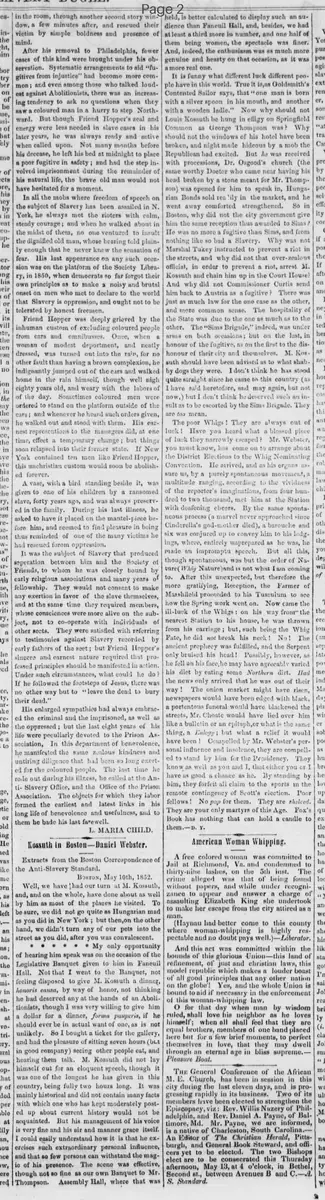
Well, we have had our turn at M. Kossuth, and, on the whole, have done about as well by him as most of the places he visited. To be sure, we did not go quite as Hungarian mad as you did in New York; but then, on the other hand, we didn't turn any of our pets into the street as you did, after you was convalescent. * * My only opportunity of hearing him speak was on the occasion of the Legislative Banquet given to him in Faneuil Hall. Not that I went to the Banquet, not feeling disposed to give M. Kossuth a dinner, honoris causa, by way of honor, not thinking he had deserved any at the hands of an Abolitionist, though I was very willing to give him a dollar for a dinner, forma pauperis, if he should ever be in actual want of one, as is not unlikely. So I bought a ticket for the gallery, and had the pleasure of sitting seven hours (but in good company) seeing other people eat, and hearing them talk. M. Kossuth did not lay himself out for an eloquent speech, though it was one of the longest he has given in this country, being fully two hours long. It was mainly historical and did not contain many facts with which one who has kept moderately posted up about current history would not be acquainted. But his management of his voice is very fine and his air and manner grace itself. I could easily understand how it is that he exercises such extraordinary personal influence, and that so few persons can withstand the magic of his presence. The scene was effective, though not so fine as our own Banquet to Mr. Thompson. Assembly Hall, where that was held, is better calculated to display such an audience than Faneuil Hall, and, besides, we had at least a third more in number, and one half of them being women, the spectacle was finer. And, indeed, the enthusiasm was as much more genuine and hearty on that occasion, as it was a more real one. It is funny what different luck different people have in this world. True it is, as Goldsmith's Contented Sailor says, that "one man is born with a silver spoon in his mouth, and another with a wooden ladle." Now why should not Louis Kossuth be hung in effigy on Springfield Common as George Thompson was? Why should not the windows of his hotel have been broken, and night made hideous by a mob the Republican had excited. But he was received with processions, Dr. Osgood's church (the same worthy Doctor who came near having his head broken by a stone meant for Mr. Thompson) was opened for him to speak in, Hungarian Bonds sold readily in the market, and he went away comforted strengthened. So in Boston, why did not the city government give him the same reception thus awarded to Sims? He was no more a fugitive than Sims, and from nothing like so bad a Slavery. Why was not Marshal Tukey instructed to prevent a riot in the streets, and why did not that over-zealous official, in order to prevent a riot, arrest M. Kossuth and chain him up in the Court House? And why did not Commissioner Curtis send him back to Austria as a fugitive? There was just as much law for the one case as the other, and more common sense. The hospitality of the State was due to the one as much as to the other. The "Sims Brigade," indeed, was under arms on both occasions: but on the last, in honour of the fugitive, as on the first to the dishonour of their city and themselves. M. Kossuth should have been advised as to what shabby dogs they were. I don't think he has stood quite straight since he came to this country (as I have said heretofore, and may again, but not now.) but I don't think he deserved such an insult as to be escorted by the Sims Brigade. They are too mean. The poor Whigs! They are always out of luck! Have you heard what a blessed piece of luck they narrowly escaped? Mr. Webster, you must know, has come on to arrange about the District Elections to the Whig Nominating Convention. He arrived, and as his organs assure us, by a purely spontaneous movement, a multitude ranging, according to the vividness of the reporter's imaginations, from four hundred to two thousand, met him at the Station with deafening cheers. By the same spontaneous process (a marvel never approached since Cinderella's god-mother died), a barouche and six was conjured up to convey him to his lodgings, where, entirely unprepared as he was, he made an impromptu speech. But all this, though spontaneous, was but the order of Nature (Whig Nature) and is not what I am coming to. After this unexpected, but therefore the more gratifying, Reception, the Farmer of Marshfield proceeded to his Tusculum to see how the Spring work went on. Now came the ill-luck of the Whigs: on his way from the nearest Station to his house, he was thrown from his carriage; but, such being the Whig Fate, he did not break his neck! No! The ancient prophecy was fulfilled, and the Serpent only bruised his head! Possibly, however, as he fell on his face, he may have agreeably varied his diet by eating some Northern dirt. Had the news only arrived that he was out of their way! The onion market might have risen, newspapers would have been edged with black, a portentous funeral would have blackened the streets, Mr. Choate would have lied over him like a bulletin or an epitaph, or what is the same thing, a Eulogy; but what a relief it would have been! Compelled by Mr. Webster's personal influence and insolence, they are compelled to stand by him for the Presidency. They know as well as you and I, that either you or I have as good a chance as he. By standing by him, they forfeit all claim to the spoils in the remote contingency of Scott's election. Poor fellows! No pap for them. They are shelved. They are your only martyrs of this Age. Fox's Book has nothing that can hold a candle to them.—D. Y.
Extracts from the Boston Correspondence of the Anti-Slavery Standard.
Boston, May 10th, 1852.
Well, we have had our turn at M. Kossuth, and, on the whole, have done about as well by him as most of the places he visited. To be sure, we did not go quite as Hungarian mad as you did in New York; but then, on the other hand, we didn't turn any of our pets into the street as you did, after you was convalescent. * * My only opportunity of hearing him speak was on the occasion of the Legislative Banquet given to him in Faneuil Hall. Not that I went to the Banquet, not feeling disposed to give M. Kossuth a dinner, honoris causa, by way of honor, not thinking he had deserved any at the hands of an Abolitionist, though I was very willing to give him a dollar for a dinner, forma pauperis, if he should ever be in actual want of one, as is not unlikely. So I bought a ticket for the gallery, and had the pleasure of sitting seven hours (but in good company) seeing other people eat, and hearing them talk. M. Kossuth did not lay himself out for an eloquent speech, though it was one of the longest he has given in this country, being fully two hours long. It was mainly historical and did not contain many facts with which one who has kept moderately posted up about current history would not be acquainted. But his management of his voice is very fine and his air and manner grace itself. I could easily understand how it is that he exercises such extraordinary personal influence, and that so few persons can withstand the magic of his presence. The scene was effective, though not so fine as our own Banquet to Mr. Thompson. Assembly Hall, where that was held, is better calculated to display such an audience than Faneuil Hall, and, besides, we had at least a third more in number, and one half of them being women, the spectacle was finer. And, indeed, the enthusiasm was as much more genuine and hearty on that occasion, as it was a more real one. It is funny what different luck different people have in this world. True it is, as Goldsmith's Contented Sailor says, that "one man is born with a silver spoon in his mouth, and another with a wooden ladle." Now why should not Louis Kossuth be hung in effigy on Springfield Common as George Thompson was? Why should not the windows of his hotel have been broken, and night made hideous by a mob the Republican had excited. But he was received with processions, Dr. Osgood's church (the same worthy Doctor who came near having his head broken by a stone meant for Mr. Thompson) was opened for him to speak in, Hungarian Bonds sold readily in the market, and he went away comforted strengthened. So in Boston, why did not the city government give him the same reception thus awarded to Sims? He was no more a fugitive than Sims, and from nothing like so bad a Slavery. Why was not Marshal Tukey instructed to prevent a riot in the streets, and why did not that over-zealous official, in order to prevent a riot, arrest M. Kossuth and chain him up in the Court House? And why did not Commissioner Curtis send him back to Austria as a fugitive? There was just as much law for the one case as the other, and more common sense. The hospitality of the State was due to the one as much as to the other. The "Sims Brigade," indeed, was under arms on both occasions: but on the last, in honour of the fugitive, as on the first to the dishonour of their city and themselves. M. Kossuth should have been advised as to what shabby dogs they were. I don't think he has stood quite straight since he came to this country (as I have said heretofore, and may again, but not now.) but I don't think he deserved such an insult as to be escorted by the Sims Brigade. They are too mean. The poor Whigs! They are always out of luck! Have you heard what a blessed piece of luck they narrowly escaped? Mr. Webster, you must know, has come on to arrange about the District Elections to the Whig Nominating Convention. He arrived, and as his organs assure us, by a purely spontaneous movement, a multitude ranging, according to the vividness of the reporter's imaginations, from four hundred to two thousand, met him at the Station with deafening cheers. By the same spontaneous process (a marvel never approached since Cinderella's god-mother died), a barouche and six was conjured up to convey him to his lodgings, where, entirely unprepared as he was, he made an impromptu speech. But all this, though spontaneous, was but the order of Nature (Whig Nature) and is not what I am coming to. After this unexpected, but therefore the more gratifying, Reception, the Farmer of Marshfield proceeded to his Tusculum to see how the Spring work went on. Now came the ill-luck of the Whigs: on his way from the nearest Station to his house, he was thrown from his carriage; but, such being the Whig Fate, he did not break his neck! No! The ancient prophecy was fulfilled, and the Serpent only bruised his head! Possibly, however, as he fell on his face, he may have agreeably varied his diet by eating some Northern dirt. Had the news only arrived that he was out of their way! The onion market might have risen, newspapers would have been edged with black, a portentous funeral would have blackened the streets, Mr. Choate would have lied over him like a bulletin or an epitaph, or what is the same thing, a Eulogy; but what a relief it would have been! Compelled by Mr. Webster's personal influence and insolence, they are compelled to stand by him for the Presidency. They know as well as you and I, that either you or I have as good a chance as he. By standing by him, they forfeit all claim to the spoils in the remote contingency of Scott's election. Poor fellows! No pap for them. They are shelved. They are your only martyrs of this Age. Fox's Book has nothing that can hold a candle to them.—D. Y.
What sub-type of article is it?
Historical Event
Biography
What themes does it cover?
Misfortune
Justice
Social Manners
What keywords are associated?
Kossuth Reception
Boston Banquet
Webster Accident
Abolitionist Critique
Whig Misfortune
Sims Case
What entities or persons were involved?
Louis Kossuth
Daniel Webster
George Thompson
Sims
Dr. Osgood
Marshal Tukey
Commissioner Curtis
Mr. Choate
Where did it happen?
Boston
Story Details
Key Persons
Louis Kossuth
Daniel Webster
George Thompson
Sims
Dr. Osgood
Marshal Tukey
Commissioner Curtis
Mr. Choate
Location
Boston
Event Date
May 10th, 1852
Story Details
Abolitionist observer describes Kossuth's favorable reception in Boston, contrasting it with the hostility faced by anti-slavery activists like Thompson and Sims; satirizes Webster's carriage mishap and Whig Party's political woes.