Thank you for visiting SNEWPapers!
Sign up free
The Columbian
Bloomsburg, Columbia County, Pennsylvania
What is this article about?
Commissioner Newton's July 1865 agricultural report indicates average to above-average crop prospects nationwide, including wheat at 8.5/10 quantity but superior quality, excellent oats, increased corn acreage, and generally good conditions for barley, potatoes, and beans, with smaller fruit yields.
Clipping
OCR Quality
Full Text
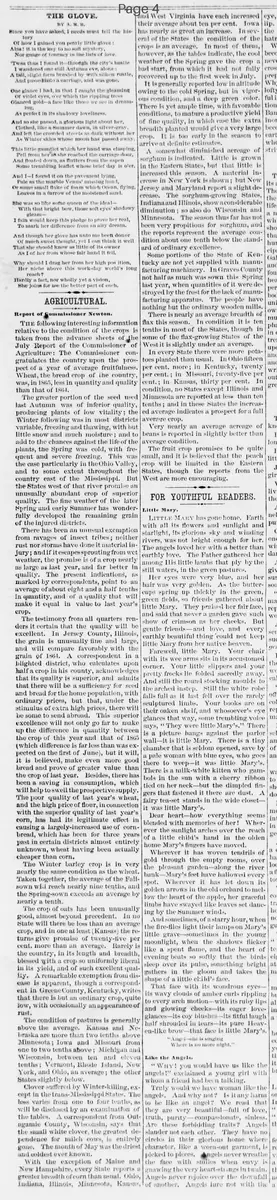
Report of Commissioner Newton.
The following interesting information relative to the condition of the crops is taken from the advance sheets of the July Report of the Commissioner of Agriculture: The Commissioner congratulates the country upon the prospect of a year of average fruitfulness. Wheat, the bread crop of the country was, in 1865, less in quantity and quality than that of 1864. The greater portion of the seed used last Autumn was of inferior quality, producing plants of low vitality; the Winter following was in most districts variable, freezing and thawing, with but little snow and much moisture; and to add to the chances against the life of the plants, the Spring was cold, with frequent and severe freezing. This was the case particularly in the Ohio Valley, and to some extent throughout the country east of the Mississippi. But the States west of that river promise an unusually abundant crop of superior quality. The fine weather of the later Spring and early Summer has wonderfully developed the remaining grain of the injured districts. There has been an unusual exemption from ravages of insect tribes; neither rust nor storms have done it material injury; and if it escapes sprouting from wet weather, the promise is of a crop nearly as large as last year, and far better in quality. The present indications, as marked by correspondents, point to an average of about eight and a half tenths in quantity, and of a quality that will make it equal in value to last year's crop. The testimony from all quarters renders it certain that the quality will be excellent. In Jersey County, Illinois, the grain is unusually fine and large. and will compare favorably with the grain of 1864. A correspondent in a blighted district, who calculates upon half a crop in his county, acknowledges that its quality is superior, and admits that there will be a sufficiency for seed and bread for the home population, with ordinary prices, but that, under the stimulus of extra high prices, there will be some to send abroad. This superior excellence will not only go far to make up the difference in quantity between the crop of this year and that of 1865 (which difference is far less than was expected on the first of June), but it will, it is believed, make even more good bread and prove of greater value than the crop of last year. Besides, there has been a saving in consumption, which will help to swell the prospective supply. The poor quality of last year's wheat, and the high price of flour, in connection with the superior quality of last year's corn, has had its legitimate effect in causing a largely-increased use of corn-bread, which has been for three years past in certain districts almost entirely unknown, wheat having been actually cheaper than corn The Winter barley crop is in very nearly the same condition as the wheat. Taken together, the average of the Fall sown will reach nearly nine tenths, and the Spring-sown exceeds an average by nearly a tenth. The crop of oats has been unusually good, almost beyond precedent. In no State will there be less than an average crop, and in one at least (Kansas) the returns give promise of twenty-five per cent. more than an average. Rarely is the country, in its length and breadth. blessed with a crop so uniformly liberal in its yield, and of such excellent quality. A remarkable exemption from disease is apparent, though a correspondent in Greene County, Kentucky, writes that there is but an ordinary crop, quite low, with occasionally an appearance of rust. The condition of pastures is generally above the average. Kansas and Nebraska are more than two tenths above Minnesota; Iowa and Missouri from one to two tenths above; Michigan and Wisconsin, between ten and eleven tenths; Vermont, Rhode Island, New York, and Ohio, an average; the other States slightly below. Clover suffered by Winter-killing, except in the trans-Mississippi States. The loss varies from one to four tenths, as will be disclosed by an examination of the tables. A correspondent from Outagamie County, Wisconsin. says that the small white clover, the greatest dependence for milch cows, is entirely gone. The month of May was the driest and coldest ever known. With the exception of Maine and New Hampshire, every State reports a greater breadth of corn than usual. Ohio, Indiana, Illinois, Minnesota, Kansas, and West Virginia have each increased their average about ten per cent. Iowa has nearly as great an increase. In several of the States the condition of the crops is an average. In most of them, however, as the tables indicate, the cool weather of the Spring gave the crop a bad start, from which it had not fully recovered up to the first week in July. It is generally reported low in altitude owing to the cold Spring, but in vigorous condition, and a deep green color. There is yet ample time, with favorable conditions, to mature a productive yield of fine quality, in which case the extra breadth planted would give a very large crop. It is too early in the season to arrive at definite estimates. A somewhat diminished acreage of sorghum is indicated. Little is grown in the Eastern States, but that little is increased this season. A material increase in New York is shown; but New Jersey and Maryland report a slight decrease. The sorghum-growing States. Indiana and Illinois, show a considerable diminution : so also do Wisconsin and Minnesota. The season thus far has not been very propitious for sorghum, and the reports represent the average condition about one tenth below the standard of ordinary excellence. Some portions of the State of Kentucky are not yet supplied with manufacturing machinery. In Graves County not half as much was sown this Spring last year, when quantities of it were destroyed by the frost for the lack of manufacturing apparatus. The people have nothing but the ordinary wooden mills. There is nearly an average breadth of flax this season. In condition it is ten tenths in most of the States, though in some of the flax-growing States of the West it is slightly under an average. In every State there were more potatoes planted than usual. In Ohio fifteen per cent. more; in Kentucky, twenty per cent.; in Missouri, twenty-five per cent. in Kansas, thirty per cent. In condition, no States except Illinois and Minnesota are reported at less than ten tenths: and in these States the increased average indicates a prospect for a full average crop. Very nearly an average acreage of beans is reported in slightly better than average condition. The fruit crop promises to be quite small, and it is believed that the peach crop will be limited in the Eastern States, though the reports from the West are more encouraging.
What sub-type of article is it?
What keywords are associated?
What entities or persons were involved?
Where did it happen?
Domestic News Details
Primary Location
United States
Event Date
July 1865
Key Persons
Outcome
average to above-average crop yields expected, with wheat at 8.5/10 quantity but superior quality; oats exceeding average; increased corn acreage; diminished sorghum and fruit crops.
Event Details
The July Report of the Commissioner of Agriculture details crop conditions: wheat faced challenges but promises average yield of good quality; barley near average; oats unusually good; pastures generally above average; clover winter-killed in some areas; corn planted more widely but slow start; sorghum slightly below average; flax and beans average to above; potatoes increased; fruit small.