Thank you for visiting SNEWPapers!
Sign up free
The Liberator
Boston, Suffolk County, Massachusetts
What is this article about?
Editorial from Nantucket Islander defends the Chardon Street Convention in Boston as the inception of a profound social and religious reform movement, criticizing media ridicule and predicting its transformative impact on corrupt systems, drawing historical parallels to past reforms.
Clipping
OCR Quality
Full Text
Reform
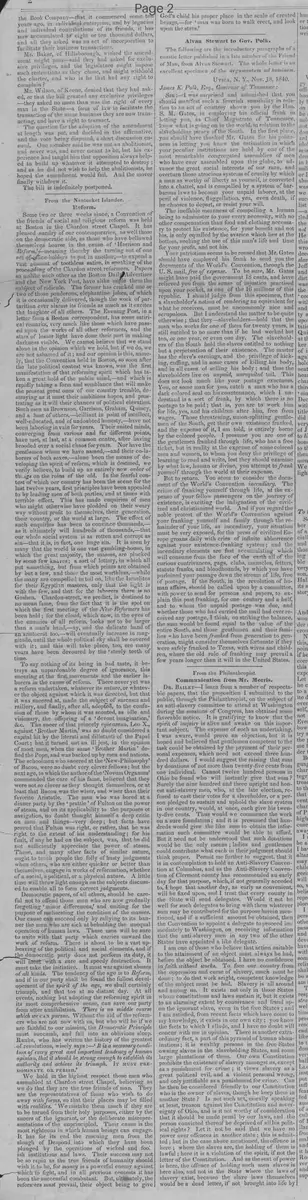
Some two or three weeks since, a Convention of the friends of social and religious reform was held at Boston in the Chardon Street Chapel. It has pleased sundry of our contemporaries, as well those on the democratic side, as those who have bellowed themselves hoarse in the cause of 'Harrison and Reform,'—meaning thereby the turning out of one set of office-holders to put in another,—to expend a vast amount of toothless satire, in speaking of the proceeding of the Chardon Street reformers. Papers so unlike each other as the Boston Daily Advertiser and the New York Post, have alike made them the subject of ridicule. The former has cracked one or two of those ponderous, elephantine jokes, of which it is occasionally delivered, though the work of parturition ever alarms its friends as much as it excites the laughter of all others. The Evening Post, in a letter from a Boston correspondent, has some satirical remarks, very much like those which have passed upon the works of all other reformers, and the stars of lesser light have done their part in making darkness visible. We cannot believe that we stand alone in the opinion which we hold, but if we do, we are not ashamed of it; and our opinion is this, namely, that the Convention held in Boston, so soon after the late political contest was known, was the first manifestation of that reforming spirit which has taken a great hold of the public mind,—and which is rapidly taking a form and semblance that will make the present great ones of our country tremble, destroying as it must their ambitious hopes, and prostrating as it will their chances of political elevation.
Such men as Brownson, Garrison, Graham, Quincy, and a host of others,—brilliant in point of intellect, well-educated, and of undoubted honesty,—have not been laboring in vain for years. Their united minds, converging from various and far different points, have met, at last, at a common centre, after having brooded over a social chaos for years. Nor have the gentlemen whom we have named,—and their co-laborers of both sexes,—alone been the means of developing the spirit of reform, which is destined, we verily believe, to build up an entirely new order of things on the ruins of the old. In the fearful contest of which our country has been the scene for the last twelve years, first principles have been appealed to by leading men of both parties, and at times with terrible effect. This has made enquiries of men who might otherwise have plodded on their weary way without profit to themselves, their generation, their country, or the world at large. The effect of such enquiries has been to convince thousands,—as it ultimately will hundreds of thousands, that our whole social system is as rotten and corrupt as sin—that it is, in fact, one huge sin. It is seen by many that the world is one vast gambling-house, in which the great majority, the masses, are plucked by some few knaves; a sort of lottery, in which all put something, but from which prizes are obtained by but a few, and those the most worthless,—while the many are compelled to toil on, like the Israelites for their Egyptian masters, only that the light is with the few, and that for the laborers there is no Goshen. Chardon-street, we predict, is destined to no mean fame, from the fact that it is the spot on which the first meeting of the New Reformers has been held; for the cloud, which now, in the eyes of the enemies of all reform, looks not to be larger than a man's hand,—ay, and the delicate hand of an aristocrat too,—will eventually increase in magnitude, until the whole political sky shall be covered with it; and this will take place, too, ere many years have been devoured by the 'steely teeth of time.'
To say nothing of its being in bad taste, it betrays an unpardonable degree of ignorance, this sneering at the first movements and the earlier laborers in the cause of reform. There never yet was a reform undertaken, whatever its nature, or whatever the object against which it was directed, but that it was sneered at, made the subject of sarcasm and raillery, and finally, after all, adopted, to the confusion of those by whom it was scouted, as idle and visionary, the offspring of a devout imagination, &c. The sneer of that princely epicurean, Leo X., against Brother Martin, was no doubt considered a capital hit by the literati and dilettanti of the Papal Court; but it turned out an ill jest, in the opinion of most men, when the same 'Brother Martin' defied the Pope, and was backed up by men and nations. The schoolmen who sneered at the 'New Philosophy' of Bacon, were no doubt very clever fellows; but the next age, to which the author of the 'Novum Organum' commended the care of his fame, believed that they were not so clever as they thought themselves, or at least that Bacon was the wiser, and wiser than their favorite Aristotle. The man who was bored at a dinner party by the 'prattle' of Fulton on the power of steam, and on its applicability to the purposes of navigation, no doubt thought himself a deep critic on men and things—very deep; but facts have proved that Fulton was right, or rather, that he was right to the extent of his understanding; for his fault, if any he had on the subject, was, that he did not sufficiently appreciate the power of steam.
These, and many other facts of similar nature, ought to teach people the folly of hasty judgments when others, who are either quicker or better than themselves, engage in works of reformation, whether of a social, a political, or a physical nature. A little time will throw light enough on the subjects discussed to enable all to form correct judgments.
Democratic papers, of all others, should be careful not to offend those men who are now gradually forgetting 'minor differences,' and uniting for the purpose of meliorating the condition of the masses. Our cause can succeed only by rallying to its banner the men who are sick at beholding the unequal operation of human laws. These men will be sure to unite with that party which carries onward the work of reform. There is about to be a vast upheaving of the political and social elements, and if the democratic party does not perform its duty, it will meet with a sure and speedy destruction. It must take the initiative. It must war against abuses of all kinds. The tendency of the age is to Reform, and if in our party shall be found the fullest development of the spirit of the age, we shall certainly triumph, and that too at no distant day. At all events, nothing but adopting the reforming spirit in its most comprehensive sense, can save our party from utter annihilation. There is no middle course which we can pursue. Without the aid of the reformers who are not now with us, but who will be if we are faithful to our mission, the Democratic Principle must succumb, and fall into an oblivious sleep.
Ranke, who has written the history of the greatest of revolutions, wisely says:—'It is a necessary condition of every great and important tendency of human opinion, that it should be strong enough to establish its authority and achieve its triumph. IT MUST PREDOMINATE OR PERISH.'
We hold in the highest respect those men who assembled at Chardon Street Chapel, believing as we do that they are the true friends of man. They are the representatives of those who wish to do away with forms, so that their places may be filled with realities. We mistake them much if they are to be turned from their holy purposes, either by the sneers of the ignorant, or the deliberate misrepresentations of the unprincipled. Their cause is the most righteous in which human beings can engage. It has for its end the rescuing men from the slough of Despond into which they have been plunged by the operations of wicked and foolish institutions and laws. Their success may not be so rapid as the true friends of humanity should wish it to be, for money is a powerful enemy against which to fight, and in all previous contests it has been the successful combatant. But, ultimately, the reformers must prevail, their object being to give
What sub-type of article is it?
What themes does it cover?
What keywords are associated?
What entities or persons were involved?
Where did it happen?
Story Details
Key Persons
Location
Boston, Chardon Street Chapel
Event Date
Two Or Three Weeks Since
Story Details
The article praises the recent Chardon Street Convention as the start of a major reform movement against social corruption, highlights key reformers' efforts, criticizes media satire, draws parallels to historical reforms like Luther's, Bacon's philosophy, and Fulton's steam, and urges the Democratic party to embrace reform for survival.