Thank you for visiting SNEWPapers!
Sign up free
The Massachusetts Spy
Worcester, Worcester County, Massachusetts
What is this article about?
An eyewitness describes a visit to President Adams, where educator Mr. Weld and deaf pupil George H. Loring from Hartford's Asylum demonstrate sign language and writing. Adams shares a Benjamin Franklin fable about an eagle and cat, symbolizing the British-colonial dispute, which Loring transcribes.
Clipping
OCR Quality
Full Text
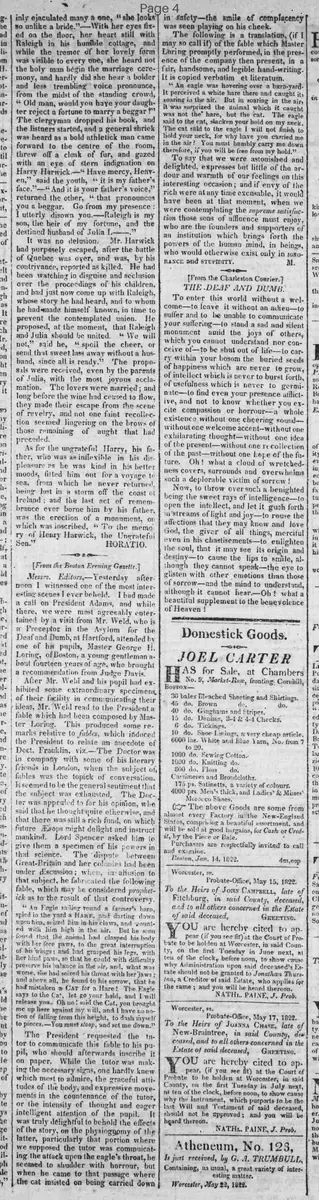
Messrs. Editors,
Yesterday afternoon I witnessed one of the most interesting scenes I ever beheld. I had made a call on President Adams, and while there, we were most agreeably entertained by a visit from Mr. Weld, who is a Preceptor in the Asylum for the Deaf and Dumb, at Hartford, attended by one of his pupils, Master George H. Loring, of Boston, a young gentleman about fourteen years of age, who brought a recommendation from Judge Davis.
After Mr. Weld and his pupil had exhibited some extraordinary specimens of their facility in communicating their ideas, Mr. Weld read to the President a fable which had been composed by Master Loring. This produced some remarks relative to fables, which induced the President to relate an anecdote of Doct. Franklin, viz.—The Doctor was in company with some of his literary friends in London, when the subject of fables was the topic of conversation. It seemed to be the general sentiment that the subject was exhausted. The Doctor was appealed to for his opinion, when he said that he thought quite otherwise, and that there was still a rich fund, on which future Esops might delight and instruct mankind. Lord Spencer asked him to give them a specimen of his powers in that science. The dispute between Great-Britain and her colonies had been under discussion; when, in allusion to that subject, he fabricated the following fable, which may be considered prophetic as to the result of that controversy.
"An Eagle sailing round a farmer's barn, spied in the yard a Mare, and darting down upon him, seized him in his claws, and mounted with him high in the air. But he soon found that the animal had clasped his body with her fore paws, to the great interruption of his wings: and had grasped his legs, with her hind paws, so that he could with difficulty preserve his balance in the air, and, what was worse, she had seized his throat with her jaws; and above all, he found to his sorrow, that he had mistaken a Cat for a Hare! The Eagle says to the Cat, let go your hold, and I will release you. Oh no! said the Cat, you brought me up here against my will, and I have no notion of falling from this height, to dash myself to pieces.—You must stoop, and set me down."
The President requested the tutor to communicate this fable to his pupil, who should afterwards inscribe it on paper. While the tutor was making the necessary signs, one hardly knew which most to admire, the graceful attitudes of the body, and expressive movements in the countenance of the tutor, or the intensity of thought and eager intelligent attention of the pupil. It was truly delightful to behold the effects of the story, on the physiognomy of the latter, particularly that portion where we supposed the tutor was communicating the attack upon the eagle's throat, he seemed to shudder with horror, but when he came to that passage where the cat insisted on being carried down in safety—the smile of complacency was seen playing on his cheek.
The following is a translation, (if I may so call it) of the fable which Master Loring promptly performed, in the presence of the company then present, in a fair, handsome, and legible hand-writing. It is copied verbatim et literatim.
"An eagle was hovering over a barn-yard. It perceived a white hare there and caught it, soaring in the air. But in soaring in the air, it was surprised the animal which it caught was not the hare, but the cat. The eagle said to the cat, slacken your hold on my neck. The cat said to the eagle I will not finish to hold your neck, for why have you carried me in the air? You must humbly carry me down therefore, if you will be free from my hold."
To say that we were astonished and delighted, expresses but little of the ardour and warmth of our feelings on this interesting occasion; and if envy of the rich were at any time excusable, it would have been at that moment, when we were contemplating the supreme satisfaction those sons of affluence must enjoy, who are the founders and supporters of an institution which brings forth the powers of the human mind, in beings, who would otherwise exist only in IGNORANCE and STUPIDITY.
M.
What sub-type of article is it?
What themes does it cover?
What keywords are associated?
What entities or persons were involved?
Letter to Editor Details
Author
M.
Recipient
Messrs. Editors
Main Argument
the letter recounts an inspiring visit to president adams featuring a demonstration of sign language by educator mr. weld and deaf pupil george h. loring, followed by adams sharing a prophetic benjamin franklin fable about an eagle and cat alluding to the british-colonial conflict, highlighting the value of the hartford asylum for the deaf and dumb.
Notable Details