Thank you for visiting SNEWPapers!
Sign up free
The New Hampshire Gazette And General Advertiser
Portsmouth, Exeter, Rockingham County, New Hampshire
What is this article about?
In the House of Commons on Feb. 17, R. Thomas Pitt defended the peace treaties ending the American war, highlighting financial exhaustion and necessity, distinguishing deserving from treacherous loyalists, and moved an address thanking the King; passed by majority of 16. Editorial critiques loyalists.
Merged-components note: These components form a single coherent article reporting on Mr. Pitt's speech in the House of Commons about the peace treaty, including discussion of Loyalists, followed by the newspaper's integrated commentary on the same topic. The content flows continuously from the debate report to the analysis, all under foreign news from London.
Clippings
1 of 2
OCR Quality
Full Text
House of Commons, Monday, Feb. 17.
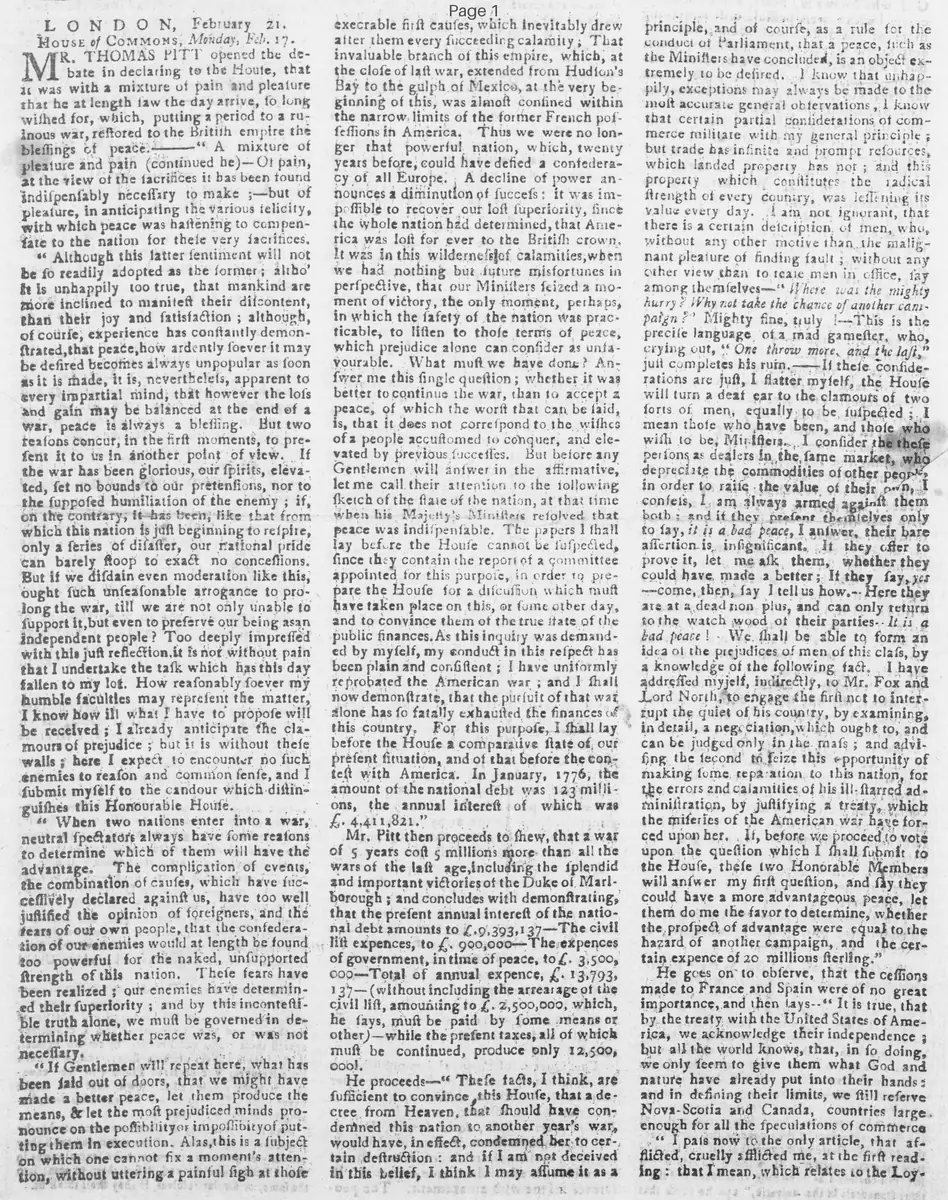
R. THOMAS PITT opened the debate in declaring to the House, that it was with a mixture of pain and pleasure that he at length saw the day arrive, so long wished for, which, putting a period to a ruinous war, restored to the British empire the blessings of peace.
A mixture of pleasure and pain (continued he)—Of pain, at the view of the sacrifices it has been found indispensably necessary to make;—but of pleasure, in anticipating the various felicity with which peace was hastening to compensate to the nation for these very sacrifices.
Although this latter sentiment will not be so readily adopted as the former: altho' it is unhappily too true, that mankind are more inclined to manifest their discontent, than their joy and satisfaction; although, of course, experience has constantly demonstrated, that peace, how ardently soever it may be desired becomes always unpopular as soon as it is made, it is, nevertheless, apparent to every impartial mind, that however the loss and gain may be balanced at the end of a war, peace is always a blessing. But two reasons concur, in the first moments, to present it to us in another point of view. If the war has been glorious, our spirits, elevated, set no bounds to our pretensions, nor to the supposed humiliation of the enemy: if, on the contrary, it has been, like that from which this nation is just beginning to respire, only a series of disaster, our national pride can barely stoop to exact no concessions.
But if we disdain even moderation like this, ought such unreasonable arrogance to prolong the war, till we are not only unable to support it, but even to preserve our being as an independent people? Too deeply impressed with this just reflection, it is not without pain that I undertake the task which has this day fallen to my lot. How reasonably soever my humble faculties may represent the matter, I know how ill what I have to propose will be received; I already anticipate the clamour of prejudice; but it is without these walls: here I expect to encounter no such enemies to reason and common sense, and I submit myself to the candour which distinguishes this Honourable House.
When two nations enter into a war, neutral spectators always have some reasons to determine which of them will have the advantage. The complication of events, the combination of causes, which have successively declared against us, have too well justified the opinion of foreigners, and the fears of our own people, that the confederation of our enemies would at length be found too powerful for the naked, unsupported strength of this nation. These fears have been realized; our enemies have determined their superiority; and by this incontestable truth alone, we must be governed in determining whether peace was, or was not necessary.
If Gentlemen will repeat here, what has been laid out of doors, that we might have made a better peace, let them produce the means, & let the most prejudiced minds pronounce on the possibility or impossibility of putting them in execution. Alas, this is a subject on which one cannot fix a moment's attention, without uttering a painful sigh at those execrable first causes, which inevitably drew after them every succeeding calamity; That invaluable branch of this empire, which, at the close of last war, extended from Hudson's Bay to the gulph of Mexico, at the very beginning of this, was almost confined within the narrow limits of the former French possessions in America. Thus we were no longer that powerful nation, which, twenty years before, could have defied a confederacy of all Europe. A decline of power announces a diminution of success: it was impossible to recover our lost superiority, since the whole nation had determined, that America was lost for ever to the British crown.
It was in this wilderness of calamities, when we had nothing but future misfortunes in perspective, that our Ministers seized a moment of victory, the only moment, perhaps, in which the safety of the nation was practicable, to listen to those terms of peace, which prejudice alone can consider as unfavourable. What must we have done? Answer me this single question; whether it was better to continue the war, than to accept a peace, of which the worst that can be said, is, that it does not correspond to the wishes of a people accustomed to conquer, and elevated by previous successes. But before any Gentlemen will answer in the affirmative, let me call their attention to the following sketch of the state of the nation, at that time when his Majesty's Ministers resolved that peace was indispensable. The papers I shall lay before the House cannot be suspected, since they contain the report of a committee appointed for this purpose, in order to prepare the House for a discussion which must have taken place on this, or some other day, and to convince them of the true state of the public finances. As this inquiry was demanded by myself, my conduct in this respect has been plain and consistent: I have uniformly reprobated the American war: and I shall now demonstrate, that the pursuit of that war alone has so fatally exhausted the finances of this country. For this purpose, I shall lay before the House a comparative state of our present situation, and of that before the contest with America. In January, 1776, the amount of the national debt was 128 millions, the annual interest of which was £. 4,411,821.
Mr. Pitt then proceeds to shew, that a war of 5 years cost 5 millions more than all the wars of the last age, including the splendid and important victories of the Duke of Marlborough: and concludes with demonstrating, that the present annual interest of the national debt amounts to £.9,393,137—The civil list expences, to £.600,000—The expences of government, in time of peace, to £.3,500,000—Total of annual expence, £.13,793,137—(without including the arrearage of the civil list, amounting to £.2,500,000, which, he says, must be paid by some means or other)—while the present taxes, all of which must be continued, produce only 12,500,000l.
He proceeds "These facts, I think, are sufficient to convince this House, that a decree from Heaven, that should have condemned this nation to another year's war, would have, in effect, condemned her to certain destruction: and if I am not deceived in this belief, I think I may assume it as a principle, and of course, as a rule for the conduct of Parliament, that a peace, such as the Ministers have concluded, is an object extremely to be desired. I know that unhappily, exceptions may always be made to the most accurate general observations, I know that certain partial considerations of commerce militate with my general principle; but trade has infinite and prompt resources, which landed property has not; and this property which constitutes the radical strength of every country, was lessening its value every day. I am not ignorant, that there is a certain description of men, who, without any other motive than the malignant pleasure of finding fault; without any other view than to tease men in office, say among themselves—'there was the mighty hurry? Why not take the chance of another campaign?' Mighty fine, truly!—This is the precise language of a mad gameter, who, crying out, 'One throw more, and the last,' just completes his ruin.—If these considerations are just, I flatter myself, the House will turn a deaf ear to the clamours of two sorts of men, equally to be suspected: I mean those who have been, and those who wish to be, Ministers. I consider these persons as dealers in the same market, who depreciate the commodities of other people, in order to raise the value of their own, confess, I, am always armed against them both; and if they present themselves only to say, it is a bad peace, I answer, their bare assertion is insignificant. If they offer to prove it, let me ask them,: whether they could have made a better; If they say, yes—Come, then, say I tell us how.—Here they are at a dead non plus, and can only return to the watch word of their parties—It is a bad peace! We shall be able to form an idea of the prejudices of men of this class, by a knowledge of the following fact. I have addressed myself, indirectly, to Mr. Fox and Lord North, to engage the first not to interrupt the quiet of his country, by examining, in detail, a negociation, which ought to, and can be judged only in the mass; and advising the second to seize this opportunity of making some reparation to this nation, for the errors and calamities of his ill-starred administration, by justifying a treaty, which the miseries of the American war have forced upon her. If, before we proceed to vote upon the question which I shall submit to the House, these two Honorable Members will answer my first question, and say they could have a more advantageous peace, let them do me the favor to determine, whether the prospect of advantage were equal to the hazard of another campaign, and the certain expence of 20 millions sterling."
He goes on to observe, that the cessions made to France and Spain were of no great importance, and then lays—."It is true, that by the treaty with the United States of America, we acknowledge their independence; but all the world knows, that, in so doing, we only seem to give them what God and nature have already put into their hands; and in defining their limits, we still reserve Nova-Scotia and Canada, countries large enough for all the speculations of commerce.
"I pass now to the only article, that affected, cruelly affected me, at the first reading: that I mean, which relates to the Loyalists.
There are, however, some observations to be made on this matter. All the individuals, comprehended under the general term of Loyalists, are not equally interesting to us. I distinguish them into two classes; one of which is composed of men whom I honor and revere, with whom I would divide my only crown, and my last mouthful of bread: but I detest and abhor the other: I consider them as an impure, corrupted nest of vipers and traitors, as the most abandoned and flagitious scoundrels in the universe: who, by treachery to America, and constant deceit to this nation, have well nigh brought down destruction on both countries. God, who knows my heart, knows how sincerely I wish it were possible to do something more for the first class of them: and God only knows whether such a possibility exists. But I ask, whether to save a handful of deserving subjects, Great-Britain ought to run the hazard of her own ruin?--Whether, on their account alone, it can be thought expedient to continue the war? If any Gentleman says yes, I would then make two other inquiries--1st, Whether the efforts, necessary to be made could be proportioned to the subject in view--and 2dly, Whether, after the utmost exertion, success would be certain, or even probable? I do verily think, that even for these unhappy men, matters have taken the most favourable turn they could. Congress is solemnly bound to recommend them to the several states: and we cannot doubt they will do it with equal zeal and integrity. In short, if Parliament testifies any aversion to the treaty with America, it may be remembered, it is the work of Parliament itself.--And with respect to the preliminaries with France and Spain, it is not long since Mr. Fox said, in a full house, and many Gentlemen repeated the cry, "That we must have peace, whatever should be the price of it."
Mr. Pitt concluded by moving, "That an humble address be presented to his Majesty, containing the thanks of this House, for his gracious condescension in communicating the different treaties which his Majesty has concluded: and that we have considered them with that attention which their Importance demands.--For to express to his Majesty, in the most grateful terms, how much we are satisfied, that, in consequence of the powers with which he has been vested, his Majesty has, by the provisional articles concluded with North America, laid the foundations of a treaty of peace, which, as we have reason to hope, will establish and secure, between the two countries, a reconciliation and perfect friendship.--That, in confidence of this, we dare express to his Majesty our just expectations, that the several states of North-America will execute in the most effectual and satisfactory manner, the measures which the Congress is so solemnly engaged, by treaty, to recommend in favor of the persons who have suffered for the part which they have taken in the war; and that we shall consider these circumstances as the surest indication of the return of friendship."--The remainder of the motion expresses great satisfaction with the preliminaries of peace, concluded with France and Spain; and that every attention will be given in the extension of commerce.
The above motion, after undergoing some amendments, was passed by a majority of sixteen.
[We can easily conceive, that by the "impure, corrupted nest of vipers and traitors" Mr. Pitt intends the same sort of men whom we have denominated conspirators against the rights and liberties of mankind; and whom the town of Boston seem particularly to refer to in their late resolution--Among these, are such of the late Colony Governors as Bernard, Hutchinson, Franklin and others--Mandamus Councillors--Commissioners of the Customs, and their numerous retinue--Pensioned judges--Attornies and Solicitor General, and all their abettors and supporters, who, conscious of their horrid treason against the civil constitutions of their country fled for protection to the British troops, though they did not actually take up arms against us. If these are the men whom "flagitious scoundrels in the universe," can he think that Mr. Pitt considers as "the most abandoned and flagitious
We, who have long entertained the same opinion of them, and who have abundantly more reason than he or any British subject can have to "detest and abhor" them, can ever cordially receive them into our bosom or--that we can admit into the number of our citizens those very men, who as he declares himself, had not only by their "constant deceit to Great-Britain," but by their "treachery to America, well nigh brought down destruction on both countries"! Surely he cannot. Congress may indeed hold itself "solemnly bound" to recommend them to the several States; but can it be expected, that the States will, for the sake of such an impure, corrupted nest of vipers and traitors, "run the hazard of their own ruin." A risque which Mr. Pitt thinks Great-Britain ought not to have run, for the sake of saving even that class of loyalists whom he calls, "deserving subjects" whom he "honors and reveres." and with whom he "would divide his only crown and his last mouthful of bread."
We wish Mr. Pitt had been more explicit, and had said who he meant to include under the description of deserving subjects. Is there not reason to think, that there are many in this class, whom America has long ago execrated, to the confederates of those whom he justly calls the most abandoned and flagitious scoundrels in the universe! Men tho' less capable than some others of affecting the ruinous plans of a most unprincipled court, yet not less criminal in their manifest design. They have done, all they could; and enough to recommend them, if ever they should obtain a residence among us, as very fit instruments under the direction of another unprincipled British administration, in attempting to frustrate all our hopes from our virtuous struggle--to break our connections (if it were possible) with our allies--to recover (we say again, if it were possible) our unsuspicious confidence in Britain. and from that moment, to bring us again to the brink of destruction.
Mr. Pitt must pardon us if we are jealous of his countrymen. We can never trust that nation which has been so wantonly and so long employing its whole force to enslave and ruin us. We cannot think it will be safe for us to have veteran British emissaries dispersed thro' our states. and practising the arts of seduction among the citizens. Such we fear will be found among Mr. Pitt's deserving subjects. We candidly believe he is altogether unacquainted with the characters of many of them Others whose principles and practices we presume Mr, Pitt cordially reprobates, have experienced the usefulness of these men, and if we are not now upon our guard, they may at another time make use of them with success.
There are indeed a few among the many refugees who perhaps may be distinguished from the rest as more handful of those Mr. Pitt calls deserving subjects--We call them very harmless folks. and therefore it is of little or no importance where they reside.--We mean those who have never taken a side against us in word or deed. but had not fortitude to join with their countrymen in defending their invaded rights. If their fears impelled them to leave their country at a time when honor, virtue, and every principle which binds human society warmly remonstrated against it. we blame them still for quieting their fears in the bosom of our enemies. Should these men be permitted to return, would it not be just and reasonable, that so much of their estates as may be equal to their proportion of the expense of the war, should be sold and appropriated towards sinking the public debt ]
What sub-type of article is it?
What keywords are associated?
What entities or persons were involved?
Where did it happen?
Foreign News Details
Primary Location
United States Of America
Event Date
Monday, Feb. 17
Key Persons
Outcome
motion passed by a majority of sixteen; peace treaties acknowledged american independence, ceded territories to france and spain of no great importance, congress bound to recommend measures for loyalists.
Event Details
R. Thomas Pitt debated in House of Commons defending peace treaties ending American war due to financial exhaustion (national debt from 128 millions in 1776 to higher with annual interest £9,393,137, total expenses £13,793,137 vs taxes £12,500,000), distinguished deserving from treacherous loyalists, moved address thanking King for treaties establishing reconciliation with North America, satisfaction with France and Spain preliminaries; editorial commentary on loyalists as traitors like governors Bernard, Hutchinson, Franklin.