Thank you for visiting SNEWPapers!
Sign up free
The Ohio Daily Express
Dayton, Montgomery County, Ohio
What is this article about?
The House Committee on Education and Labor voted 13-12 to table a $300 million federal aid to education bill passed by the Senate, due to disputes over funding for private schools and segregation. NAACP opposed it for not prohibiting segregation, while NEA blamed Chairman Lesinski. Support shifts to Burke bill.
Clipping
OCR Quality
Full Text
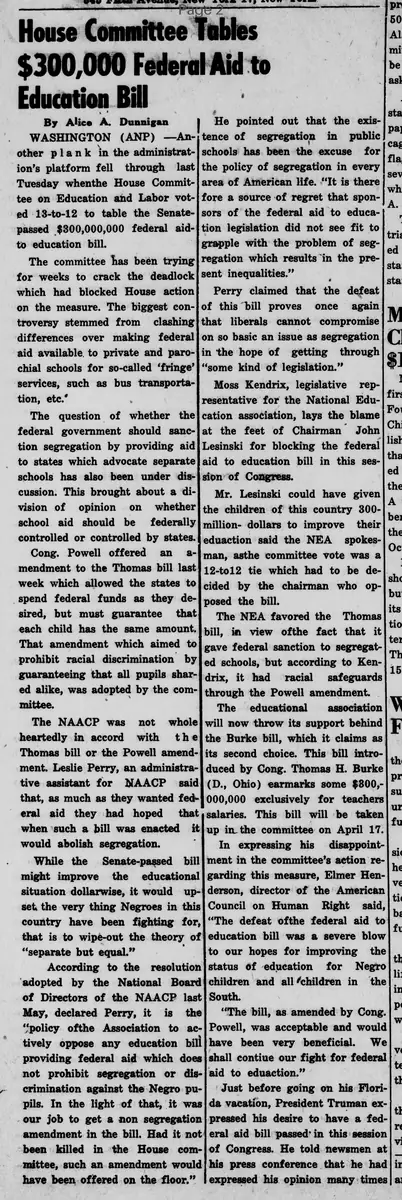
$300,000 Federal Aid to
Education
Bill
By Alice A. Dunnigan
WASHINGTON (ANP) - Another plank in the administration's platform fell through last Tuesday when the House Committee on Education and Labor voted 13-to-12 to table the Senate-passed $300,000,000 federal aid-to education bill.
The committee has been trying for weeks to crack the deadlock which had blocked House action on the measure. The biggest controversy stemmed from clashing differences over making federal aid available to private and parochial schools for so-called 'fringe' services. such as bus transportation, etc.
The question of whether the federal government should sanction segregation by providing aid to states which advocate separate schools has also been under discussion. This brought about a division of opinion on whether school aid should be federally controlled or controlled by states.
Cong. Powell offered an amendment to the Thomas bill last week which allowed the states to spend federal funds as they desired, but must guarantee that each child has the same amount.
That amendment which aimed to prohibit racial discrimination by guaranteeing that all pupils shared alike, was adopted by the committee.
The NAACP was not wholeheartedly in accord with the Thomas bill or the Powell amendment. Leslie Perry, an administrative assistant for NAACP said that, as much as they wanted federal aid they had hoped that when such a bill was enacted it would abolish segregation.
While the Senate-passed bill might improve the educational situation dollarwise, it would upset the very thing Negroes in this country have been fighting for, that is to wipe-out the theory of "separate but equal."
According to the resolution adopted by the National Board of Directors of the NAACP last May, declared Perry, it is the "policy of the Association to actively oppose any education bill providing federal aid which does not prohibit segregation or discrimination against the Negro pupils. In the light of that, it was our job to get a non segregation amendment in the bill. Had it not been killed in the House committee, such an amendment would have been offered on the floor."
He pointed out that the existence of segregation in public schools has been the excuse for the policy of segregation in every area of American life. "It is therefore a source of regret that sponsors of the federal aid to education legislation did not see fit to grapple with the problem of segregation which results in the present inequalities."
Perry claimed that the defeat of this bill proves once again that liberals cannot compromise on so basic an issue as segregation in the hope of getting through "some kind of legislation."
Moss Kendrix, legislative representative for the National Education association, lays the blame at the feet of Chairman John Lesinski for blocking the federal aid to education bill in this session of Congress.
Mr. Lesinski could have given the children of this country 300-million- dollars to improve their education said the NEA spokesman, as the committee vote was a 12-to-12 tie which had to be decided by the chairman who opposed the bill.
The NEA favored the Thomas bill, in view of the fact that it gave federal sanction to segregated schools, but according to Kendrix, it had racial safeguards through the Powell amendment.
The educational association will now throw its support behind the Burke bill, which it claims as its second choice. This bill introduced by Cong. Thomas H. Burke (D., Ohio) earmarks some $300,000,000 exclusively for teachers salaries. This bill will be taken up in the committee on April 17.
In expressing his disappointment in the committee's action regarding this measure, Elmer Henderson, director of the American Council on Human Right said, "The defeat of the federal aid to education bill was a severe blow to our hopes for improving the status of education for Negro children and all children in the South.
"The bill, as amended by Cong. Powell, was acceptable and would have been very beneficial. We shall continue our fight for federal aid to education."
Just before going on his Florida vacation, President Truman expressed his desire to have a federal aid bill passed in this session of Congress. He told newsmen at his press conference that he had expressed his opinion many times in favor of federal aid to schools and that opinion still stands.
What sub-type of article is it?
What themes does it cover?
What keywords are associated?
What entities or persons were involved?
Where did it happen?
Story Details
Key Persons
Location
Washington
Event Date
Last Tuesday
Story Details
House Committee on Education and Labor votes 13-12 to table $300M Senate-passed federal aid to education bill amid controversies over private school funding and segregation. Powell amendment adopted to ensure equal per-child funding, but NAACP opposes for not abolishing segregation. Blame on Chairman Lesinski; support shifts to Burke bill for teachers' salaries.