Thank you for visiting SNEWPapers!
Sign up free
Story
May 21, 1816
The Rhode Island American, And General Advertiser
Providence, Providence County, Rhode Island
What is this article about?
In the U.S. House, Hon. Mr. Huger of South Carolina delivers a speech opposing the Compensation Bill, which proposes raising members' pay from $6 per diem to $1500 annual salary with retroactive effect. He criticizes the change as concealment, unbecoming, and burdensome post-war.
Clipping
OCR Quality
95%
Excellent
Full Text
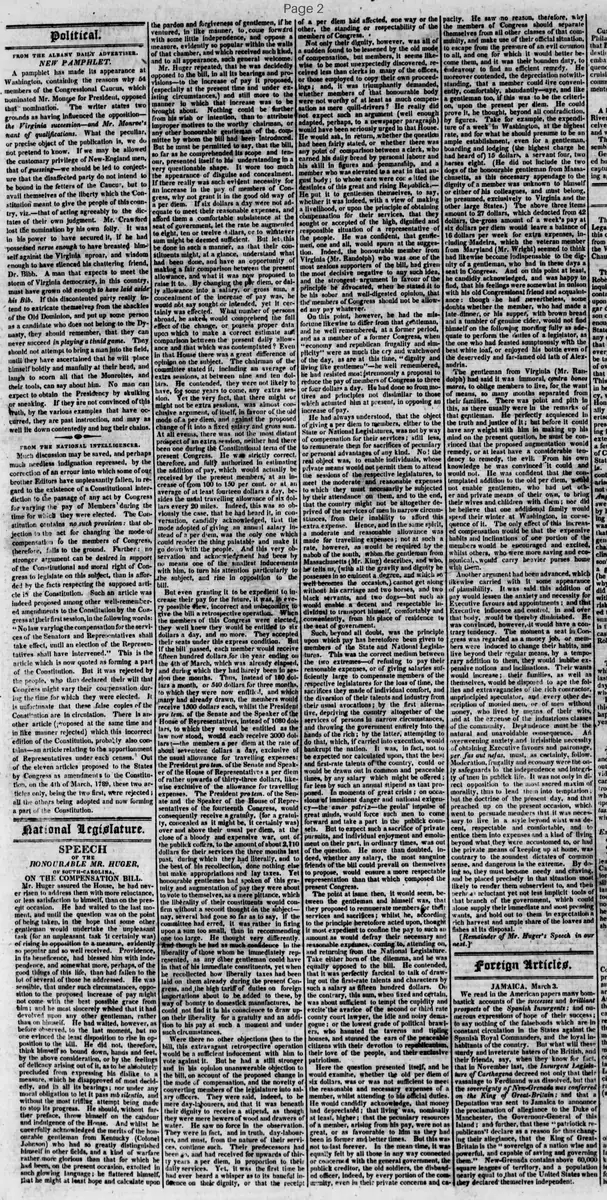
National Legislature.
SPEECH
OF THE
HONOURABLE MR. HUGER,
OF SOUTH-CAROLINA,
ON THE COMPENSATION BILL.
Mr. Huger assured the House, he had never risen to address them with more reluctance, or less satisfaction to himself, than on the present occasion. He had waited to the last moment, and until the question was on the point of being taken, in the hope that some other gentleman would undertake the unpleasant task (for an unpleasant task it certainly was) of rising in opposition to a measure, evidently so popular and so well received. Providence, in its beneficence, had blessed him with independence, and somewhat more, perhaps, of the good things of this life, than had fallen to the lot of several of those he addressed. He was sensible, that under such circumstances, opposition to the proposed increase of pay might not come with the best possible grace from him; and he most sincerely wished that it had devolved upon any other gentleman, rather than on himself. He had waited, however, as before observed, to the last moment, but no one evinced the least disposition to rise in opposition to the bill. He did not, therefore, think himself so bound down, hands and feet, by the above consideration, or by the feelings of delicacy arising out of it, as to be absolutely precluded from expressing his dislike to a measure, which he disapproved of most decidedly, and in all its bearings; nor under any moral obligation to let it pass sub silentio, and without the most trifling attempt being made to stop its progress. He should, without further preface, throw himself on the candour and indulgence of the House. And whilst he cheerfully acknowledged the merits of the honourable gentleman from Kentucky (Colonel Johnson) who had so greatly distinguished himself in other fields, and a kind of warfare rather more glorious than that for which he had been, on the present occasion, extolled in such glowing language; he flattered himself, that he might at least hope and calculate upon the pardon and forgiveness of gentlemen, if he ventured, in like manner, to come forward with some little independence, and oppose a measure, evidently so popular within the walls of that chamber, and which received such kind, and to all appearance, such general welcome.
Mr. Huger repeated, that he was decidedly opposed to the bill, in all its bearings and provisions—to the increase of pay it proposed, (especially at the present time and under existing circumstances,) and still more to the manner in which that increase was to be brought about. Nothing could be further from his wish or intention, than to attribute improper motives to the worthy chairman, or any other honourable gentleman of the Committee by whom the bill had been introduced. But he must be permitted to say, that the bill, so far as he comprehended its scope and tenor, presented itself to his understanding in a very questionable shape. It wore too much the appearance of disguise and concealment. If there really was such evident necessity for an increase in the pay of members of Congress, why not grant it in the good old way of a per diem. If six dollars a day were not adequate to meet their reasonable expenses, and afford them a comfortable subsistence at the seat of government, let the rate be augmented to eight, ten or twelve dollars, or to whatever sum might be deemed sufficient. But let this be done in such a manner, as that their constituents might, at a glance, understand what had been done, and have an opportunity of making a fair comparison between the present allowance, and what it was now proposed to raise it to. By changing the per diem, or daily allowance into a salary, or gross sum, a concealment of the increase of pay was, he would not say sought or intended, yet it certainly was effected. What number of persons abroad, he asked, would comprehend the full effect of the change, or possess proper data upon which to make a correct estimate and comparison between the present daily allowance and that which was contemplated? Even in that House there was a great difference of opinion on the subject. The chairman of the committee stated it, including an average of extra sessions, at between nine and ten dollars. He contended, they were not likely to have, for some years to come, any extra session. Yet the very fact, that there might or might not be extra sessions, was almost conclusive argument, of itself, in favour of the old mode of a per diem, and against the proposed change of it into a fixed salary and gross sum. At all events, there was not the most distant prospect of an extra session, neither had there been one during the Constitutional term of the present Congress. He was strictly correct, therefore, and fully authorized in estimating the addition of pay, which would actually be received by the present members, at an increase of from 100 to 150 per cent. or at an average of at least fourteen dollars a day, besides the usual travelling allowance of six dollars every 20 miles. Indeed, this was so obviously the case, that he had heard it, in conversation, candidly acknowledged, that the mode adopted of giving an annual salary instead of a per diem, was the only one which could render the thing palatable and make it go down with the people. And this very observation and acknowledgment had been by no means one of the smallest inducements with him, to turn his attention particularly to the subject, and rise in opposition to the bill.
But even granting it to be expedient to increase their pay for the future, it was, in every possible view, incorrect and unbecoming to give the bill a retrospective operation. When the members of this Congress were elected, they well knew they would be entitled to six dollars a day, and no more. They accepted their seats under this express condition. But if the bill passed, each member would receive fifteen hundred dollars for the year ending on the 4th of March, which was already elapsed, and during which they had barely been in session three months. Thus, instead of 180 dollars a month, or 540 dollars for three months, to which they were now entitled, and which many had already drawn, the members would receive 1500 dollars each, whilst the President pro tem. of the Senate and the Speaker of the House of Representatives, instead of 1080 dollars, to which they would be entitled as the law now stood, would each receive 3000 dollars;—the members a per diem at the rate of about seventeen dollars a day, exclusive of the usual allowance for travelling expenses: the President pro tem. of the Senate and Speaker of the House of Representatives a per diem of rather upwards of thirty-three dollars, likewise exclusive of the allowance for travelling expenses. The President pro tem. of the Senate and Speaker of the House of Representatives of the fourteenth Congress, would consequently receive a gratuity, (for a gratuity, concealed as it might be, it certainly was) over and above their usual per diem, at the close of a bloody and expensive war, out of the public coffers, to the amount of about 2,110 dollars for their services the three months last past, during which they had literally, and to the best of his recollection, done nothing else but make appropriations and lay taxes. Yet honourable gentlemen had spoken of this gratuity and augmentation of pay they were about to vote to themselves, as a mere pittance, which the liberality of their constituents would confirm without a second thought on the subject—nay, several had gone so far as to say, if the committee had erred, it was rather in fixing upon a sum too small, than in recommending one too large. He thought very differently. And though he had as much confidence in the liberality of those whom he immediately represented, as any other gentleman could have in that of his immediate constituents, yet when he recollected how liberally taxes had been laid on them already during the present Congress, and the high tariff of duties on foreign importations about to be added to these, by way of bounty to domestic manufactures, he could not find it in his conscience to draw upon their liberality for a gratuity and an addition to his pay at such a moment and under such circumstances.
Were there no other objections then to the bill, this extravagant retrospective operation would be a sufficient inducement with him to vote against it. But he had a still stronger and in his opinion unanswerable objection to the bill, on account of the proposed change in the mode of compensation, and the novelty of converting members of the legislature into salary officers. They were said, indeed, to be mere day-labourers, and that it was beneath their dignity to receive a stipend, as though they were mere hewers of wood and drawers of water. He saw no force in the observation. They were in fact, and in truth, day-labourers, and must, from the nature of their services, continue such. Their predecessors had been so, and had received for upwards of thirty years a per diem, in proportion to their daily services. Yet, it was the first time he had ever heard a whisper as to its baneful influence on their dignity, or that the receipt of a per diem had affected, one way or the other, the standing or respectability of the members of Congress.
Not only their dignity, however, was all of a sudden found to be lessened by the old mode of compensation, but members, it seems likewise to be most unexpectedly discovered, received less than clerks in many of the offices, or those employed to copy their own proceedings; and, it was triumphantly demanded, whether members of that honourable body were not worthy of at least as much compensation as mere quill-drivers? He really did not expect such an argument (well enough adapted, perhaps, to a newspaper paragraph) would have been seriously urged in that House. He would ask, in return, whether the question had been fairly stated, or whether there was any point of comparison between a clerk, who earned his daily bread by personal labour and his skill in figures and penmanship, and a member who was elevated to a seat in that august body; to whose care were committed the destinies of this great and rising Republic. He put it to gentlemen themselves, to say, whether it was indeed, with a view of making a livelihood, or upon the principle of obtaining compensation for their services, that they sought or accepted of the high, dignified and responsible situation of a representative of the people. He was confident, that gentlemen, one and all, would spurn at the suggestion. Indeed, the honourable member from Virginia (Mr. Randolph) who was one of the most zealous supporters of the bill, had given the most decisive negative to any such idea, and the strongest argument in favour of the principle he advocated, when he stated it to be his sober and well-digested opinion, that the members of Congress should not be allowed any pay whatever.
On this point, however, he had the misfortune likewise to differ from that gentleman, and he well remembered, at a former period, and as a member of a former Congress, when "economy and republican frugality and simplicity" were as much the cry and watchword of the day, as are at this time, "dignity and living like gentlemen"—he well remembered, he had resisted most strenuously a proposal to reduce the pay of members of Congress to three or four dollars a day. He had done so from motives and principles not dissimilar to those which actuated him at present, in opposing an increase of pay.
He had always understood, that the object of giving a per diem to members, either to the State or National Legislatures, was not by way of compensation for their services; still less, to remunerate them for sacrifices of pecuniary or personal advantages of any kind. No! the real object was, to enable individuals, whose private means would not permit them to attend the sessions of the respective legislatures, to meet the moderate and reasonable expenses to which they must necessarily be subjected by their attendance on them, and to the end, that the country might not be altogether deprived of the services of men in narrow circumstances, from their inability to afford this extra expense. Hence, and in the same spirit, a moderate and reasonable allowance was made for travelling expenses; not at such a rate, however, as would be required by the nabob of the south, whom the gentleman from Massachusetts (Mr. King) describes, and who, he tells us, (with all the gravity and dignity he possesses in so eminent a degree, and which so well becomes the occasion,) cannot get along without his carriage and two horses, and two black servants, and two dogs—but such as would enable a decent and respectable individual to transport himself, comfortably and conveniently, from his place of residence to the seat of government.
Such, beyond all doubt, was the principle upon which pay has heretofore been given to members of the State and National Legislatures. This was the correct medium between the two extremes—of refusing to pay their reasonable expenses, or of giving salaries sufficiently large to compensate members of the respective legislatures for the loss of time, the sacrifices they made of individual comfort, and the diversion of their talents and industry from their usual avocations; by the first alternative, depriving the country altogether of the services of persons in narrow circumstances, and throwing the government entirely into the hands of the rich; by the latter, attempting to do that, which, if carried into execution, would bankrupt the nation. It was, in fact, not to be expected nor calculated upon, that the best and first-rate talents of the country, could or would be drawn out in common and peaceable times, by any salary which might be offered; far less by such an annual stipend as that proposed. In moments of great crisis; on occasions of imminent danger and national exigency—the amor patriae—the generous impulse of great minds, would force such men to come forward and take a part in the public councils. But to expect such a sacrifice of private pursuits, and individual enjoyment and emolument on their part, in ordinary times, was out of the question. He more than doubted, indeed, whether any salary, the most sanguine friends of the bill could prevail on themselves to propose, would ensure a more respectable representation than that which composed the present Congress.
The point at issue then, it would seem, between the gentleman and himself was, that they proposed to remunerate members for their services and sacrifices; whilst he, according to the principle heretofore acted upon, thought it most expedient to confine the pay to such an amount as would defray their necessary and reasonable expenses, coming to, attending on, and returning from the National Legislature. Take either horn of the dilemma, and he was equally opposed to the bill. He contended, that it was perfectly farcical to talk of drawing out the first-rate talents and characters by such a salary as fifteen hundred dollars. On the contrary, this sum, when fixed and certain, was about sufficient to tempt the cupidity and excite the avarice of the second or third rate county court lawyer, the idle and noisy demagogue; or the lowest grade of political brawlers, who haunted the taverns and tipling houses, and stunned the ears of the peaceable citizens with their devotion to republicanism, their love of the people, and their exclusive patriotism.
Here the question presented itself, and he would examine, whether the old per diem of six dollars, was or was not sufficient to meet the reasonable and necessary expenses of a member, whilst attending to his official duties. He would candidly acknowledge, that money had depreciated; that living was, nominally at least, higher; that the pecuniary resources of a member, arising from his pay, were not as great, or as favourable to him as they had been in former and better times. But this was not to last forever. In the mean time, it was equally felt by all those in any way connected or concerned with the general government, the public creditor, the old soldiers, the disbanded officer, indeed, by every portion of the community, even in their private concerns and capacity. He saw no reason, therefore, why the members of Congress should separate themselves from all other classes of that community, and make use of their official situation, to escape from the pressure of an evil common to all, and one for which it would better become them, and it was their bounden duty, to endeavour to find an efficient remedy. He moreover contended, the depreciation notwithstanding, that a member could live conveniently, comfortably, abundantly—aye, and like a gentleman too, if this was to be the criterion, upon the present per diem. He could prove it, he thought, beyond all contradiction, by figures. Take for example, the expenditure of a week in Washington, at the highest rate, and for what he should presume to be an ample establishment, even for a gentleman, boarding and lodging (the highest charge he had heard of) 15 dollars, a servant four, two horses eight. (He did not include the two dogs of the honourable gentleman from Massachusetts, as this necessary appendage to the dignity of a member was unknown to himself or either of his colleagues, and must belong, he presumed, exclusively to Virginia and the other large States.) The above three items amount to 27 dollars, which deducted from 42 dollars, the gross amount of a week's pay at six dollars per diem would leave a balance of 16 dollars per week for extra expenses, including Madeira, which the veteran member from Maryland (Mr. Wright) seemed to think had likewise become indispensable to the dignity of a gentleman, who had in these days a seat in Congress. And on this point at least, he candidly acknowledged, and was happy to find, that his feelings were somewhat in unison with his old Congressional friend and acquaintance: though he had nevertheless, some doubts whether the member, who had made a late-dinner, or his supper, with brown bread and a tumbler of genuine cider, would not find himself on the following morning fully as adequate to perform the duties of a legislator, as the one who had feasted sumptuously with the best white loaf, or enjoyed his bottle, even of the deservedly and far-famed old latch of Alexandria.
The gentleman from Virginia (Mr. Randolph) had said it was immoral, contra bonos mores, to oblige members to live, for the want of means, so many months separated from their families. There was point and pith in this, as there usually were in the remarks of that gentleman. He perfectly acquiesced in the truth and justice of it; but before it could have any weight with him in making up his mind on the present question, he must be convinced that the proposed augmentation would remedy, or at least have a considerable tendency to remedy, the evil. From his own knowledge he was convinced it could and would not. He was confident that the contemplated addition to the old per diem, would not enable gentlemen, who had not other and private means of their own, to bring their wives and children with them; nor did he believe that one additional family would spend their winter at Washington, in consequence of it. The only effect of this increased compensation would be that the expensive habits and inclinations of one portion of the members would be encouraged and excited, whilst others, who were more saving and economical, would carry heavier purses home with them.
Another argument had been advanced, which likewise carried with it some appearance of plausibility. It was said this addition of pay would lessen the anxiety and necessity for Executive favours and appointments; and that Executive influence and control, in and over that body, would be thereby diminished. He was convinced, however, it would have a contrary tendency. The moment a seat in Congress was regarded as a money job, or members were induced to change their habits, and live beyond their regular means, by a temporary addition to them, they would imbibe expensive notions and inclinations. Their wants would increase; their families, as well as themselves, would be disposed to ape the follies and extravagancies of the rich contractor, unprincipled speculator, and every other description of monied men, or of men without money, who lived by means of their wits, and at the expense of the industrious classes of the community. Dependence must be the natural and unavoidable consequence. An overweening anxiety and irresistible necessity of obtaining Executive favours and patronage, per fas aut nefas, must, as certainly, follow. Moderation, frugality and economy were the only safeguards to the independence and integrity of men in public life. It was not only in direct opposition to the most sacred maxim of morality, thus to lead them into temptation; but the doctrine of the present day, and that preached up on the present occasion, which went to persuade members that it was necessary to live in a style beyond what was decent, respectable and comfortable, and to entice them into expenses and a kind of living beyond what they were accustomed to, or had the private means of keeping up at home, was contrary to the soundest dictates of common sense, and dangerous in the extreme. By doing so, they must become needy and craving, and be placed precisely in that situation most likely to render them subservient to, and then perhaps reluctant yet not less implicit tools of that branch of the government, which could alone supply their immediate and most pressing wants, and hold out to them in expectation a rich harvest and ample share of the loaves and fishes at its disposal.
[Remainder of Mr. Huger's Speech in our next.]
SPEECH
OF THE
HONOURABLE MR. HUGER,
OF SOUTH-CAROLINA,
ON THE COMPENSATION BILL.
Mr. Huger assured the House, he had never risen to address them with more reluctance, or less satisfaction to himself, than on the present occasion. He had waited to the last moment, and until the question was on the point of being taken, in the hope that some other gentleman would undertake the unpleasant task (for an unpleasant task it certainly was) of rising in opposition to a measure, evidently so popular and so well received. Providence, in its beneficence, had blessed him with independence, and somewhat more, perhaps, of the good things of this life, than had fallen to the lot of several of those he addressed. He was sensible, that under such circumstances, opposition to the proposed increase of pay might not come with the best possible grace from him; and he most sincerely wished that it had devolved upon any other gentleman, rather than on himself. He had waited, however, as before observed, to the last moment, but no one evinced the least disposition to rise in opposition to the bill. He did not, therefore, think himself so bound down, hands and feet, by the above consideration, or by the feelings of delicacy arising out of it, as to be absolutely precluded from expressing his dislike to a measure, which he disapproved of most decidedly, and in all its bearings; nor under any moral obligation to let it pass sub silentio, and without the most trifling attempt being made to stop its progress. He should, without further preface, throw himself on the candour and indulgence of the House. And whilst he cheerfully acknowledged the merits of the honourable gentleman from Kentucky (Colonel Johnson) who had so greatly distinguished himself in other fields, and a kind of warfare rather more glorious than that for which he had been, on the present occasion, extolled in such glowing language; he flattered himself, that he might at least hope and calculate upon the pardon and forgiveness of gentlemen, if he ventured, in like manner, to come forward with some little independence, and oppose a measure, evidently so popular within the walls of that chamber, and which received such kind, and to all appearance, such general welcome.
Mr. Huger repeated, that he was decidedly opposed to the bill, in all its bearings and provisions—to the increase of pay it proposed, (especially at the present time and under existing circumstances,) and still more to the manner in which that increase was to be brought about. Nothing could be further from his wish or intention, than to attribute improper motives to the worthy chairman, or any other honourable gentleman of the Committee by whom the bill had been introduced. But he must be permitted to say, that the bill, so far as he comprehended its scope and tenor, presented itself to his understanding in a very questionable shape. It wore too much the appearance of disguise and concealment. If there really was such evident necessity for an increase in the pay of members of Congress, why not grant it in the good old way of a per diem. If six dollars a day were not adequate to meet their reasonable expenses, and afford them a comfortable subsistence at the seat of government, let the rate be augmented to eight, ten or twelve dollars, or to whatever sum might be deemed sufficient. But let this be done in such a manner, as that their constituents might, at a glance, understand what had been done, and have an opportunity of making a fair comparison between the present allowance, and what it was now proposed to raise it to. By changing the per diem, or daily allowance into a salary, or gross sum, a concealment of the increase of pay was, he would not say sought or intended, yet it certainly was effected. What number of persons abroad, he asked, would comprehend the full effect of the change, or possess proper data upon which to make a correct estimate and comparison between the present daily allowance and that which was contemplated? Even in that House there was a great difference of opinion on the subject. The chairman of the committee stated it, including an average of extra sessions, at between nine and ten dollars. He contended, they were not likely to have, for some years to come, any extra session. Yet the very fact, that there might or might not be extra sessions, was almost conclusive argument, of itself, in favour of the old mode of a per diem, and against the proposed change of it into a fixed salary and gross sum. At all events, there was not the most distant prospect of an extra session, neither had there been one during the Constitutional term of the present Congress. He was strictly correct, therefore, and fully authorized in estimating the addition of pay, which would actually be received by the present members, at an increase of from 100 to 150 per cent. or at an average of at least fourteen dollars a day, besides the usual travelling allowance of six dollars every 20 miles. Indeed, this was so obviously the case, that he had heard it, in conversation, candidly acknowledged, that the mode adopted of giving an annual salary instead of a per diem, was the only one which could render the thing palatable and make it go down with the people. And this very observation and acknowledgment had been by no means one of the smallest inducements with him, to turn his attention particularly to the subject, and rise in opposition to the bill.
But even granting it to be expedient to increase their pay for the future, it was, in every possible view, incorrect and unbecoming to give the bill a retrospective operation. When the members of this Congress were elected, they well knew they would be entitled to six dollars a day, and no more. They accepted their seats under this express condition. But if the bill passed, each member would receive fifteen hundred dollars for the year ending on the 4th of March, which was already elapsed, and during which they had barely been in session three months. Thus, instead of 180 dollars a month, or 540 dollars for three months, to which they were now entitled, and which many had already drawn, the members would receive 1500 dollars each, whilst the President pro tem. of the Senate and the Speaker of the House of Representatives, instead of 1080 dollars, to which they would be entitled as the law now stood, would each receive 3000 dollars;—the members a per diem at the rate of about seventeen dollars a day, exclusive of the usual allowance for travelling expenses: the President pro tem. of the Senate and Speaker of the House of Representatives a per diem of rather upwards of thirty-three dollars, likewise exclusive of the allowance for travelling expenses. The President pro tem. of the Senate and Speaker of the House of Representatives of the fourteenth Congress, would consequently receive a gratuity, (for a gratuity, concealed as it might be, it certainly was) over and above their usual per diem, at the close of a bloody and expensive war, out of the public coffers, to the amount of about 2,110 dollars for their services the three months last past, during which they had literally, and to the best of his recollection, done nothing else but make appropriations and lay taxes. Yet honourable gentlemen had spoken of this gratuity and augmentation of pay they were about to vote to themselves, as a mere pittance, which the liberality of their constituents would confirm without a second thought on the subject—nay, several had gone so far as to say, if the committee had erred, it was rather in fixing upon a sum too small, than in recommending one too large. He thought very differently. And though he had as much confidence in the liberality of those whom he immediately represented, as any other gentleman could have in that of his immediate constituents, yet when he recollected how liberally taxes had been laid on them already during the present Congress, and the high tariff of duties on foreign importations about to be added to these, by way of bounty to domestic manufactures, he could not find it in his conscience to draw upon their liberality for a gratuity and an addition to his pay at such a moment and under such circumstances.
Were there no other objections then to the bill, this extravagant retrospective operation would be a sufficient inducement with him to vote against it. But he had a still stronger and in his opinion unanswerable objection to the bill, on account of the proposed change in the mode of compensation, and the novelty of converting members of the legislature into salary officers. They were said, indeed, to be mere day-labourers, and that it was beneath their dignity to receive a stipend, as though they were mere hewers of wood and drawers of water. He saw no force in the observation. They were in fact, and in truth, day-labourers, and must, from the nature of their services, continue such. Their predecessors had been so, and had received for upwards of thirty years a per diem, in proportion to their daily services. Yet, it was the first time he had ever heard a whisper as to its baneful influence on their dignity, or that the receipt of a per diem had affected, one way or the other, the standing or respectability of the members of Congress.
Not only their dignity, however, was all of a sudden found to be lessened by the old mode of compensation, but members, it seems likewise to be most unexpectedly discovered, received less than clerks in many of the offices, or those employed to copy their own proceedings; and, it was triumphantly demanded, whether members of that honourable body were not worthy of at least as much compensation as mere quill-drivers? He really did not expect such an argument (well enough adapted, perhaps, to a newspaper paragraph) would have been seriously urged in that House. He would ask, in return, whether the question had been fairly stated, or whether there was any point of comparison between a clerk, who earned his daily bread by personal labour and his skill in figures and penmanship, and a member who was elevated to a seat in that august body; to whose care were committed the destinies of this great and rising Republic. He put it to gentlemen themselves, to say, whether it was indeed, with a view of making a livelihood, or upon the principle of obtaining compensation for their services, that they sought or accepted of the high, dignified and responsible situation of a representative of the people. He was confident, that gentlemen, one and all, would spurn at the suggestion. Indeed, the honourable member from Virginia (Mr. Randolph) who was one of the most zealous supporters of the bill, had given the most decisive negative to any such idea, and the strongest argument in favour of the principle he advocated, when he stated it to be his sober and well-digested opinion, that the members of Congress should not be allowed any pay whatever.
On this point, however, he had the misfortune likewise to differ from that gentleman, and he well remembered, at a former period, and as a member of a former Congress, when "economy and republican frugality and simplicity" were as much the cry and watchword of the day, as are at this time, "dignity and living like gentlemen"—he well remembered, he had resisted most strenuously a proposal to reduce the pay of members of Congress to three or four dollars a day. He had done so from motives and principles not dissimilar to those which actuated him at present, in opposing an increase of pay.
He had always understood, that the object of giving a per diem to members, either to the State or National Legislatures, was not by way of compensation for their services; still less, to remunerate them for sacrifices of pecuniary or personal advantages of any kind. No! the real object was, to enable individuals, whose private means would not permit them to attend the sessions of the respective legislatures, to meet the moderate and reasonable expenses to which they must necessarily be subjected by their attendance on them, and to the end, that the country might not be altogether deprived of the services of men in narrow circumstances, from their inability to afford this extra expense. Hence, and in the same spirit, a moderate and reasonable allowance was made for travelling expenses; not at such a rate, however, as would be required by the nabob of the south, whom the gentleman from Massachusetts (Mr. King) describes, and who, he tells us, (with all the gravity and dignity he possesses in so eminent a degree, and which so well becomes the occasion,) cannot get along without his carriage and two horses, and two black servants, and two dogs—but such as would enable a decent and respectable individual to transport himself, comfortably and conveniently, from his place of residence to the seat of government.
Such, beyond all doubt, was the principle upon which pay has heretofore been given to members of the State and National Legislatures. This was the correct medium between the two extremes—of refusing to pay their reasonable expenses, or of giving salaries sufficiently large to compensate members of the respective legislatures for the loss of time, the sacrifices they made of individual comfort, and the diversion of their talents and industry from their usual avocations; by the first alternative, depriving the country altogether of the services of persons in narrow circumstances, and throwing the government entirely into the hands of the rich; by the latter, attempting to do that, which, if carried into execution, would bankrupt the nation. It was, in fact, not to be expected nor calculated upon, that the best and first-rate talents of the country, could or would be drawn out in common and peaceable times, by any salary which might be offered; far less by such an annual stipend as that proposed. In moments of great crisis; on occasions of imminent danger and national exigency—the amor patriae—the generous impulse of great minds, would force such men to come forward and take a part in the public councils. But to expect such a sacrifice of private pursuits, and individual enjoyment and emolument on their part, in ordinary times, was out of the question. He more than doubted, indeed, whether any salary, the most sanguine friends of the bill could prevail on themselves to propose, would ensure a more respectable representation than that which composed the present Congress.
The point at issue then, it would seem, between the gentleman and himself was, that they proposed to remunerate members for their services and sacrifices; whilst he, according to the principle heretofore acted upon, thought it most expedient to confine the pay to such an amount as would defray their necessary and reasonable expenses, coming to, attending on, and returning from the National Legislature. Take either horn of the dilemma, and he was equally opposed to the bill. He contended, that it was perfectly farcical to talk of drawing out the first-rate talents and characters by such a salary as fifteen hundred dollars. On the contrary, this sum, when fixed and certain, was about sufficient to tempt the cupidity and excite the avarice of the second or third rate county court lawyer, the idle and noisy demagogue; or the lowest grade of political brawlers, who haunted the taverns and tipling houses, and stunned the ears of the peaceable citizens with their devotion to republicanism, their love of the people, and their exclusive patriotism.
Here the question presented itself, and he would examine, whether the old per diem of six dollars, was or was not sufficient to meet the reasonable and necessary expenses of a member, whilst attending to his official duties. He would candidly acknowledge, that money had depreciated; that living was, nominally at least, higher; that the pecuniary resources of a member, arising from his pay, were not as great, or as favourable to him as they had been in former and better times. But this was not to last forever. In the mean time, it was equally felt by all those in any way connected or concerned with the general government, the public creditor, the old soldiers, the disbanded officer, indeed, by every portion of the community, even in their private concerns and capacity. He saw no reason, therefore, why the members of Congress should separate themselves from all other classes of that community, and make use of their official situation, to escape from the pressure of an evil common to all, and one for which it would better become them, and it was their bounden duty, to endeavour to find an efficient remedy. He moreover contended, the depreciation notwithstanding, that a member could live conveniently, comfortably, abundantly—aye, and like a gentleman too, if this was to be the criterion, upon the present per diem. He could prove it, he thought, beyond all contradiction, by figures. Take for example, the expenditure of a week in Washington, at the highest rate, and for what he should presume to be an ample establishment, even for a gentleman, boarding and lodging (the highest charge he had heard of) 15 dollars, a servant four, two horses eight. (He did not include the two dogs of the honourable gentleman from Massachusetts, as this necessary appendage to the dignity of a member was unknown to himself or either of his colleagues, and must belong, he presumed, exclusively to Virginia and the other large States.) The above three items amount to 27 dollars, which deducted from 42 dollars, the gross amount of a week's pay at six dollars per diem would leave a balance of 16 dollars per week for extra expenses, including Madeira, which the veteran member from Maryland (Mr. Wright) seemed to think had likewise become indispensable to the dignity of a gentleman, who had in these days a seat in Congress. And on this point at least, he candidly acknowledged, and was happy to find, that his feelings were somewhat in unison with his old Congressional friend and acquaintance: though he had nevertheless, some doubts whether the member, who had made a late-dinner, or his supper, with brown bread and a tumbler of genuine cider, would not find himself on the following morning fully as adequate to perform the duties of a legislator, as the one who had feasted sumptuously with the best white loaf, or enjoyed his bottle, even of the deservedly and far-famed old latch of Alexandria.
The gentleman from Virginia (Mr. Randolph) had said it was immoral, contra bonos mores, to oblige members to live, for the want of means, so many months separated from their families. There was point and pith in this, as there usually were in the remarks of that gentleman. He perfectly acquiesced in the truth and justice of it; but before it could have any weight with him in making up his mind on the present question, he must be convinced that the proposed augmentation would remedy, or at least have a considerable tendency to remedy, the evil. From his own knowledge he was convinced it could and would not. He was confident that the contemplated addition to the old per diem, would not enable gentlemen, who had not other and private means of their own, to bring their wives and children with them; nor did he believe that one additional family would spend their winter at Washington, in consequence of it. The only effect of this increased compensation would be that the expensive habits and inclinations of one portion of the members would be encouraged and excited, whilst others, who were more saving and economical, would carry heavier purses home with them.
Another argument had been advanced, which likewise carried with it some appearance of plausibility. It was said this addition of pay would lessen the anxiety and necessity for Executive favours and appointments; and that Executive influence and control, in and over that body, would be thereby diminished. He was convinced, however, it would have a contrary tendency. The moment a seat in Congress was regarded as a money job, or members were induced to change their habits, and live beyond their regular means, by a temporary addition to them, they would imbibe expensive notions and inclinations. Their wants would increase; their families, as well as themselves, would be disposed to ape the follies and extravagancies of the rich contractor, unprincipled speculator, and every other description of monied men, or of men without money, who lived by means of their wits, and at the expense of the industrious classes of the community. Dependence must be the natural and unavoidable consequence. An overweening anxiety and irresistible necessity of obtaining Executive favours and patronage, per fas aut nefas, must, as certainly, follow. Moderation, frugality and economy were the only safeguards to the independence and integrity of men in public life. It was not only in direct opposition to the most sacred maxim of morality, thus to lead them into temptation; but the doctrine of the present day, and that preached up on the present occasion, which went to persuade members that it was necessary to live in a style beyond what was decent, respectable and comfortable, and to entice them into expenses and a kind of living beyond what they were accustomed to, or had the private means of keeping up at home, was contrary to the soundest dictates of common sense, and dangerous in the extreme. By doing so, they must become needy and craving, and be placed precisely in that situation most likely to render them subservient to, and then perhaps reluctant yet not less implicit tools of that branch of the government, which could alone supply their immediate and most pressing wants, and hold out to them in expectation a rich harvest and ample share of the loaves and fishes at its disposal.
[Remainder of Mr. Huger's Speech in our next.]
What sub-type of article is it?
Historical Event
What themes does it cover?
Moral Virtue
Justice
Social Manners
What keywords are associated?
Compensation Bill
Congressional Pay
Per Diem
Salary Increase
Retrospective Operation
National Legislature
What entities or persons were involved?
Mr. Huger
Colonel Johnson
Mr. Randolph
Mr. King
Mr. Wright
Where did it happen?
Washington
Story Details
Key Persons
Mr. Huger
Colonel Johnson
Mr. Randolph
Mr. King
Mr. Wright
Location
Washington
Event Date
Fourteenth Congress, Year Ending 4th Of March
Story Details
Mr. Huger opposes the Compensation Bill increasing congressional pay to a salary with retrospective effect, arguing it conceals the raise, undermines dignity via per diem, and burdens constituents amid taxes; advocates maintaining per diem for expenses only.