Thank you for visiting SNEWPapers!
Sign up free
Public Ledger
Memphis, Shelby County, Tennessee
What is this article about?
A destitute woman with two young children, partially demented from hardship, receives a permit to the County Poor-house but cannot reach it due to lack of transport amid muddy roads. She and her children shelter at the Adams Street station-house, highlighting flaws in the poor relief system and calling for reform.
Clipping
OCR Quality
Full Text
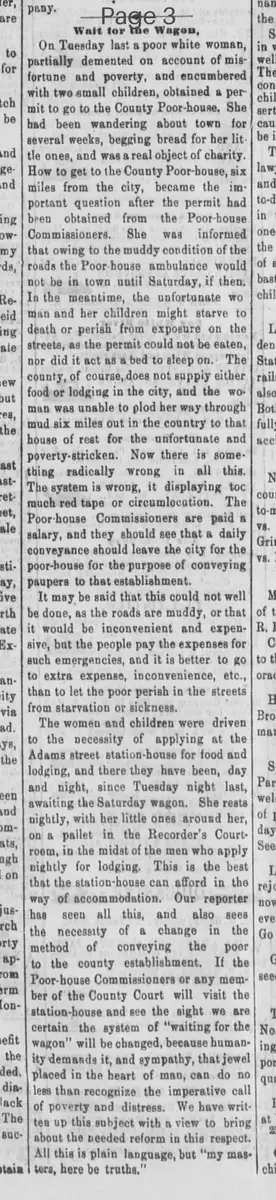
On Tuesday last a poor white woman, partially demented on account of misfortune and poverty, and encumbered with two small children, obtained a permit to go to the County Poor-house. She had been wandering about town for several weeks, begging bread for her little ones, and was a real object of charity. How to get to the County Poor-house, six miles from the city, became the important question after the permit had been obtained from the Poor-house Commissioners. She was informed that owing to the muddy condition of the roads the Poor-house ambulance would not be in town until Saturday, if then. In the meantime, the unfortunate woman and her children might starve to death or perish from exposure on the streets, as the permit could not be eaten, nor did it act as a bed to sleep on. The county, of course, does not supply either food or lodging in the city, and the woman was unable to plod her way through mud six miles out in the country to that house of rest for the unfortunate and poverty-stricken. Now there is something radically wrong in all this. The system is wrong, it displaying too much red tape or circumlocution. The Poor-house Commissioners are paid a salary, and they should see that a daily conveyance should leave the city for the poor-house for the purpose of conveying paupers to that establishment. It may be said that this could not well be done, as the roads are muddy, or that it would be inconvenient and expensive, but the people pay the expenses for such emergencies, and it is better to go to extra expense, inconvenience, etc., than to let the poor perish in the streets from starvation or sickness. The women and children were driven to the necessity of applying at the Adams street station-house for food and lodging, and there they have been, day and night, since Tuesday night last, awaiting the Saturday wagon. She rests nightly, with her little ones around her, on a pallet in the Recorder's Court room, in the midst of the men who apply nightly for lodging. This is the best that the station-house can afford in the way of accommodation. Our reporter has seen all this, and also sees the necessity of a change in the method of conveying the poor to the county establishment. If the Poor-house Commissioners or any member of the County Court will visit the station-house and see the sight we are certain the system of "waiting for the wagon" will be changed, because humanity demands it, and sympathy, that jewel placed in the heart of man, can do no less than recognize the imperative call of poverty and distress. We have written up this subject with a view to bring about the needed reform in this respect. All this is plain language, but "my masters, here be truths."
What sub-type of article is it?
What themes does it cover?
What keywords are associated?
Where did it happen?
Story Details
Location
The City, Adams Street Station House, County Poor House Six Miles Away
Event Date
Tuesday Last
Story Details
A poor white woman with two small children obtains a permit to the County Poor-house but faces delays in transport due to muddy roads, forcing her to seek shelter at the station-house while awaiting the wagon, exposing systemic failures in poor relief.