Thank you for visiting SNEWPapers!
Sign up free
Story
July 17, 1841
The Northern Star, And Farmers' And Mechanics' Advocate
Warren, Bristol County, Rhode Island
What is this article about?
Report on Rhode Island Senator Simmons' debut speech in Congress, opposing Rives' amendment as a surrender of government power, praised for his plain, effective style across parties.
Clipping
OCR Quality
98%
Excellent
Full Text
The Washington correspondent of the New World thus notices the speech of Mr. Simmons on Mr. Rives' amendment:
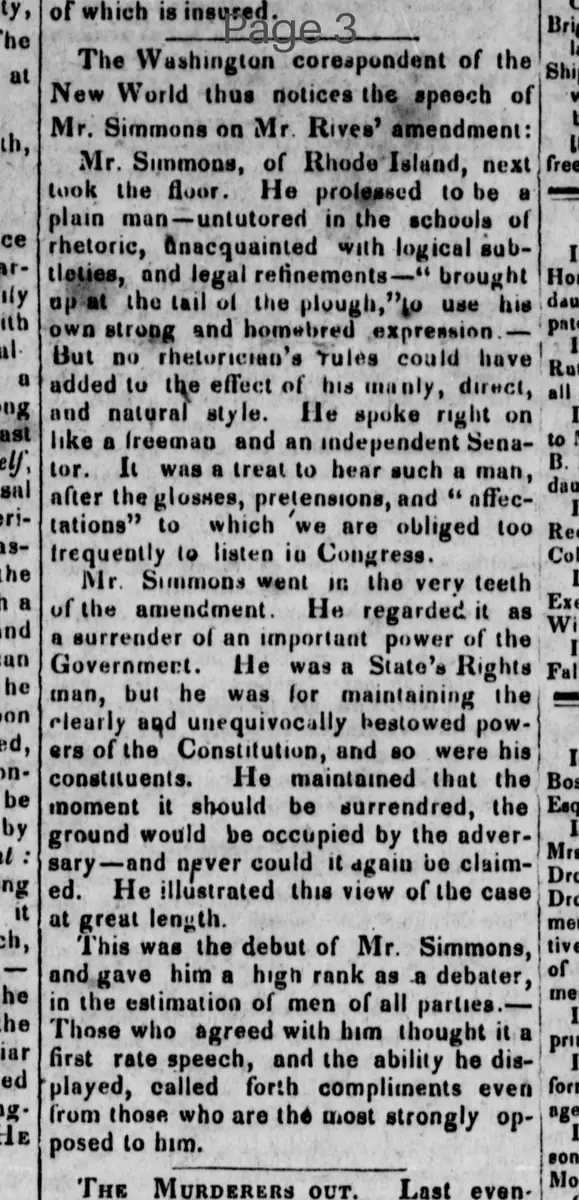
Mr. Simmons, of Rhode Island, next took the floor. He professed to be a plain man—untutored in the schools of rhetoric, unacquainted with logical subtleties, and legal refinements—“brought up at the tail of the plough," to use his own strong and homebred expression. But no rhetorician's rules could have added to the effect of his manly, direct, and natural style. He spoke right on like a freeman and an independent Senator. It was a treat to hear such a man, after the glosses, pretensions, and "affectations" to which we are obliged too frequently to listen in Congress.
Mr. Simmons went in the very teeth of the amendment. He regarded it as a surrender of an important power of the Government. He was a State's Rights man, but he was for maintaining the clearly and unequivocally bestowed powers of the Constitution, and so were his constituents. He maintained that the moment it should be surrendered, the ground would be occupied by the adversary—and never could it again be claimed. He illustrated this view of the case at great length.
This was the debut of Mr. Simmons, and gave him a high rank as a debater, in the estimation of men of all parties. Those who agreed with him thought it a first rate speech, and the ability he displayed, called forth compliments even from those who are the most strongly opposed to him.
Mr. Simmons, of Rhode Island, next took the floor. He professed to be a plain man—untutored in the schools of rhetoric, unacquainted with logical subtleties, and legal refinements—“brought up at the tail of the plough," to use his own strong and homebred expression. But no rhetorician's rules could have added to the effect of his manly, direct, and natural style. He spoke right on like a freeman and an independent Senator. It was a treat to hear such a man, after the glosses, pretensions, and "affectations" to which we are obliged too frequently to listen in Congress.
Mr. Simmons went in the very teeth of the amendment. He regarded it as a surrender of an important power of the Government. He was a State's Rights man, but he was for maintaining the clearly and unequivocally bestowed powers of the Constitution, and so were his constituents. He maintained that the moment it should be surrendered, the ground would be occupied by the adversary—and never could it again be claimed. He illustrated this view of the case at great length.
This was the debut of Mr. Simmons, and gave him a high rank as a debater, in the estimation of men of all parties. Those who agreed with him thought it a first rate speech, and the ability he displayed, called forth compliments even from those who are the most strongly opposed to him.
What sub-type of article is it?
Biography
Historical Event
What themes does it cover?
Justice
Moral Virtue
What keywords are associated?
Congressional Speech
Simmons Debut
Constitutional Powers
States Rights
Senate Debate
What entities or persons were involved?
Mr. Simmons
Mr. Rives
Where did it happen?
Congress
Story Details
Key Persons
Mr. Simmons
Mr. Rives
Location
Congress
Story Details
Mr. Simmons delivers his debut speech opposing Mr. Rives' amendment, arguing it surrenders important government powers under the Constitution, praised for his plain and effective style.