Thank you for visiting SNEWPapers!
Sign up free
Daily National Intelligencer
Washington, District Of Columbia
What is this article about?
A historical analysis of British political parties, tracing the origins and evolution of Whigs and Tories from aristocratic and democratic roots, influenced by events like the American and French Revolutions, leading to the decline of Whigs and rise of Reformers amid current political and economic crisis.
Clipping
OCR Quality
Full Text
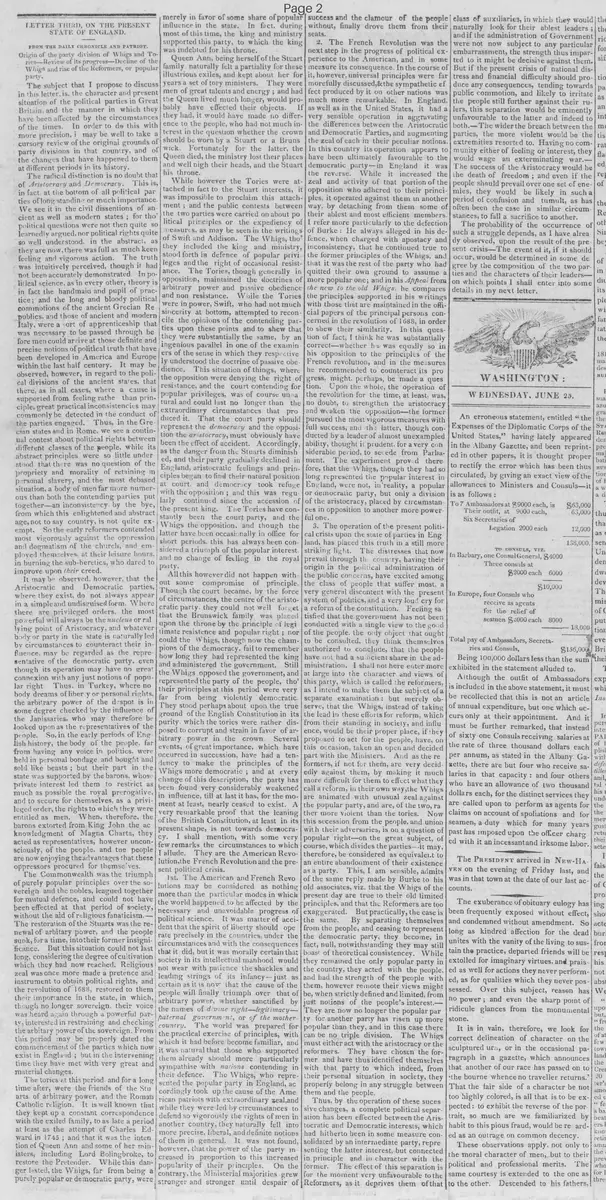
ON THE PRESENT STATE OF ENGLAND.
FROM THE DAILY CHRONICLE AND PATRIOT.
Origin of the party division of Whigs and Tories—Review of its progress—Decline of the Whigs and rise of the Reformers, or popular party.
The subject that I propose to discuss in this letter, is, the character and present situation of the political parties in Great Britain, and the manner in which they have been affected by the circumstances of the times. In order to do this with more precision, it may be well to take a cursory review of the original grounds of party divisions in that country, and of the changes that have happened to them at different periods in its history.
The radical distinction is no doubt that of Aristocracy and Democracy. This is, in fact, at the bottom of all political parties of long standing or much importance. We see it in the civil dissensions of ancient as well as modern states; for though political questions were not then quite so learnedly argued, nor political rights quite so well understood, in the abstract, as they are now, there was full as much keen feeling and vigorous action. The truth was intuitively perceived, though it had not been accurately demonstrated. In political science, as in every other, theory is in fact the handmaid and pupil of practice; and the long and bloody political commotions of the ancient Grecian Republics, and those of ancient and modern Italy, were a sort of apprenticeship that was necessary to be passed through before men could arrive at those definite and precise notions of political truth that have been developed in America and Europe within the last half century. It may be observed, however, in regard to the political divisions of the ancient states, that there, as in all cases, where a cause is supported from feeling rather than principle, great practical inconsistencies may commonly be detected in the conduct of the parties engaged. Thus, in the Grecian states and in Rome, we see a continual contest about political rights between different classes of the people, while its abstract principles were so little understood that there was no question of the propriety and morality of retaining in personal slavery, and the most debased situation, a body of men far more numerous than both the contending parties put together—an inconsistency, by the bye, from which this enlightened and abstract age, not to say country, is not quite exempt. So the early reformers contended most vigorously against the oppression and dogmatism of the church, and employed themselves, at their leisure hours, in burning the sub-heretics, who dared to improve upon their creed.
It may be observed, however, that the Aristocratic and Democratic parties, where they exist, do not always appear in a simple and undisguised form. Where there are privileged orders, the most powerful will always be the nucleus or rallying point of Aristocracy, and whatever body or party in the state is naturally led by circumstances to counteract their influence, may be regarded as the representative of the democratic party, even though its operation may have no great connexion with any just notions of popular right. Thus, in Turkey, where no body dreams of liberty or personal rights, the arbitrary power of the despot is in some degree checked by the influence of the Janissaries, who may therefore be looked upon as the representatives of the people. So, in the early periods of English history, the body of the people, far from having any voice in politics, were held in personal bondage and bought and sold like beasts; but their part in the state was supported by the barons, whose private interest led them to restrict as much as possible the royal prerogative, and to secure for themselves, as a privileged order, the rights to which they were entitled as men. When, therefore, the barons extorted from King John the acknowledgment of Magna Charta, they acted as representatives, however unconsciously, of the people, and the people are now enjoying the advantages that these oppressors procured for themselves.
The Commonwealth was the triumph of purely popular principles over the sovereign and the nobles, leagued together for mutual defence, and could not have been effected at that period of society, without the aid of religious fanaticism.—The restoration of the Stuarts was the renewal of arbitrary power, and the people sunk, for a time, into their former insignificance. But this situation could not last long, considering the degree of cultivation which they had now reached. Religious zeal was once more made a pretence and instrument to obtain political rights, and the revolution of 1688, restored to them their importance in the state, in which, though no longer sovereign, their voice was heard again through a powerful party, interested in restraining and checking the arbitrary power of the sovereign. From this period may be properly dated the commencement of the parties which now exist in England; but in the intervening time they have met with very great and material changes.
The tories at this period and for a long time after, were the friends of the Stuarts of arbitrary power, and the Roman Catholic religion. It is well known that they kept up a constant correspondence with the exiled family, to as late a period at least as the attempt of Charles Edward in 1745: and that it was the intention of Queen Ann and some of her ministers, including Lord Bolingbroke, to restore the Pretender. While this danger lasted, the Whigs, far from being a purely popular or democratic party, were merely in favor of some share of popular influence in the state. In fact, during most of this time, the king and ministry supported this party, to which the king was indebted for his throne. Queen Ann, being herself of the Stuart family naturally felt a partiality for these illustrious exiles, and kept about her for years a set of tory ministers. They were men of great talents and energy; and had the Queen lived much longer, would probably have effected their objects. "If they had, it would have made no difference to the people, who had not much interest in the question whether the crown should be worn by a Stuart or a Brunswick. Fortunately for the latter, the Queen died, the ministry lost their places and well nigh their heads, and the Stuart his throne.
While however the Tories were attached in fact to the Stuart interests, it was impossible to proclaim this attachment; and the public contests between the two parties were carried on about political principles or the expediency of measures, as may be seen in the writings of Swift and Addison. The Whigs, though they included the king and ministry, stood forth in defence of popular privileges and the right of occasional resistance. The Tories, though generally in opposition, maintained the doctrines of arbitrary power and passive obedience and non resistance. While the Tories were in power, Swift, who had not much sincerity at bottom, attempted to reconcile the opinions of the contending parties upon these points and to shew that they were substantially the same, by an ingenious parallel in one of the examiners of the sense in which they respectively understood the doctrine of passive obedience. This situation of things, where the opposition were denying the right of resistance, and the court contending for popular privileges, was of course unnatural and could last no longer than the extraordinary circumstances that produced it. That the court party should represent the democracy and the opposition the aristocracy, must obviously have been the effect of accident. Accordingly, as the danger from the Stuarts diminished, and their party gradually declined in England, aristocratic feelings and principles began to find their natural position at court, and democracy took refuge with the opposition; and this was regularly continued since the accession of the present king. The Tories have constantly been the court party, and the Whigs the opposition, and though the latter have been occasionally in office for short periods, this has always been considered a triumph of the popular interest, and no change of feeling in the royal party.
All this however did not happen without some compromise of principle. Though the court became, by the force of circumstances, the centre of the aristocratic party, they could not well forget that the Brunswick family was placed upon the throne by the principle of legitimate resistance and popular right; nor could the Whigs, though now the champions of the democracy, fail to remember how long they had represented the king and administered the government. Still the Whigs opposed the government, and represented the party of the people, tho' their principles at this period were very far from being violently democratic. They stood perhaps about upon the true ground of the English Constitution in its purity, which the tories were rather disposed to corrupt and strain in favor of arbitrary power in the crown. Several events, of great importance, which have occurred in succession, have had a tendency to make the principles of the Whigs more democratic; and at every change of this description, the party has been found very considerably weakened in influence, till at last it has, for the moment at least, nearly ceased to exist. A very remarkable proof that the leaning of the British Constitution, at least in its present shape, is not towards democracy. I shall mention, with some very few remarks the circumstances to which I allude. They are the American Revolution, the French Revolution and the present political crisis.
1st. The American and French Revolutions may be considered as nothing more than the particular modes in which the world happened to be affected by the necessary and unavoidable progress of political science. It was matter of accident that the spirit of liberty should operate precisely in the countries, under the circumstances and with the consequences that it did, but it was morally certain that society in its intellectual manhood would not wear with patience the shackles and leading strings of its infancy—just as certain as it is now that the cause of the people will finally triumph over that of arbitrary power, whether sanctified by the names of divine right—legitimacy—paternal government, or of the mother-country. The world was prepared for the practical exercise of principles, with which it had before become familiar, and it was natural that those who supported them already should more particularly sympathise with nations contending in their defence. The Whigs, who represented the popular party in England, accordingly took up the cause of the American patriots with extraordinary zeal, and while they were led by circumstances to defend so vigorously the rights of men in another country, they naturally fell into more precise, liberal, and definite notions of them in general. It was not found, however, that the power of the party increased in proportion to this increased popularity of their principles. On the contrary, the Ministerial majorities grew stronger and stronger until despair of success and the clamour of the people without, finally drove them from their seats.
2. The French Revolution was the next step in the progress of political experience to the American, and in some measure its consequence. In the course of it, however, universal principles were far more fully discussed, & the sympathetic effect produced by it on other nations was much more remarkable. In England, as well as in the United States, it had a very sensible operation in aggravating the differences between the Aristocratic and Democratic Parties, and augmenting the zeal of each in their peculiar notions. In this country its operation appears to have been ultimately favourable to the democratic party—in England it was the reverse. While it increased the zeal and activity of that portion of the opposition who adhered to their principles, it operated against them in another way, by detaching from them some of their ablest and most efficient members. I refer more particularly to the defection of Burke: He always alleged in his defence, when charged with apostacy and inconsistency, that he continued true to the former principles of the Whigs, and that it was the rest of the party who had quitted their own ground to assume a more popular one; and in his Appeal from the new to the old Whigs, he compares the principles supported in his writings with those that are maintained in the official papers of the principal persons concerned in the revolution of 1688, in order to shew their similarity. In this question of fact, I think he was substantially correct—whether he was equally so in his opposition to the principles of the French revolution, and in the measures he recommended to counteract its progress, might, perhaps, be made a question. Upon the whole, the operation of the revolution for the time, at least, was, no doubt, to strengthen the aristocracy and weaken the opposition—the former pursued the most vigorous measures with full success, and the latter, though conducted by a leader of almost unexampled ability, thought it prudent, for a very considerable period, to secede from Parliament. The experiment proved therefore, that the Whigs, though they had so long represented the popular interest in England, were not, in reality, a popular or democratic party, but only a division of the aristocracy, placed by circumstances in opposition to another more powerful one.
3. The operation of the present political crisis upon the state of parties in England, has placed this truth in a still more striking light. The distresses that now prevail through the country, having their origin in the political administration of the public concerns, have excited among the class of people that suffer most, a very general discontent with the present system of politics, and a very loud cry for a reform of the constitution. Feeling satisfied that the government has not been conducted with a single view to the good of the people, the only object that ought to be consulted, they think themselves authorized to conclude, that the people have not had a sufficient share in the administration. I shall not here enter more at large into the character and views of this party, which is called the reformers, as I intend to make them the subject of a separate examination: but merely observe, that the Whigs, instead of taking the lead in these efforts for reform, which from their standing in society, and influence, would be their proper place, if they proposed to act for the people, have, on this occasion, taken an open and decided part with the Ministers. "And as the reformers, if not for them, are very decidedly against them, by making it much more difficult for them to effect what they call a reform, in their own way, the Whigs are animated with unusual zeal against the popular party, and are, of the two, rather more violent than the tories. Now this secession from the people, and union with their adversaries, is on a question of popular right—on the great subject, of course, which divides the parties—it may, therefore, be considered as equivalent to an entire abandonment of their existence as a party. This, I am sensible, admits of the same reply made by Burke to his old associates, viz. that the Whigs of the present day are true to their old limited principles, and that the Reformers are too exaggerated. But practically, the case is the same. By separating themselves from the people, and ceasing to represent the democratic party, they become, in fact, null, notwithstanding they may still boast of theoretical consistency. While they remained the only popular party in the country, they acted with the people, and had the strength of the people with them, however remote their views might be, when strictly defined and limited, from just notions of the people's interest.—They are now no longer the popular party for another party has risen up more popular than they, and in this case there can be no triple division. The Whigs must either act with the aristocracy or the reformers. They have chosen the former and have thus identified themselves with that party to which indeed, from their personal situation in society, they properly belong in any struggle between them and the people.
Thus, by the operation of these successive changes, a complete political separation has been effected between the Aristocratic and Democratic interests, which had hitherto been in some measure consolidated by an intermediate party, representing the latter interest, but connected in principle and in character with the former. The effect of this separation is for the moment very unfavourable to the Reformers, as it deprives them of that class of auxiliaries, in which they would naturally look for their ablest leaders; and if the administration of Government were not now subject to any particular embarrassment, the strength thus imparted to it might be decisive against them. But if the present crisis of national distress and financial difficulty should produce any consequences, tending towards public commotion, and likely to irritate the people still further against their rulers, this separation would be eminently unfavourable to the latter and indeed to both. The wider the breach between the parties, the more violent would be the extremities resorted to. Having no community either of feeling or interest, they would wage an exterminating war.—The success of the Aristocracy would be the death of freedom; and even if the people should prevail over one set of enemies, they would be likely in such a period of confusion and tumult, as has often been the case in similar circumstances, to fall a sacrifice to another. The probability of the occurrence of such a struggle depends, as I have already observed, upon the result of the present crisis—The event of it, if it should occur, would be determined in some degree by the composition of the two parties and the characters of their leaders—on which points I shall enter into some details in my next letter.
What sub-type of article is it?
What keywords are associated?
What entities or persons were involved?
Where did it happen?
Foreign News Details
Primary Location
England
Key Persons
Outcome
decline of the whigs, rise of the reformers, strengthened aristocracy amid political crisis
Event Details
Historical review of British political parties from aristocratic and democratic origins, evolution of Whigs and Tories through events like the Revolution of 1688, American and French Revolutions, leading to Whigs aligning with aristocracy against Reformers in current crisis of distress and calls for constitutional reform.