Thank you for visiting SNEWPapers!
Sign up free
Literary
March 14, 1789
The Kentucky Gazette
Lexington, Fayette County, Kentucky
What is this article about?
Extract from William Shenstone's 'Essays on Politics' featuring aphoristic reflections on politics, society, ambition, rebellion, national identity, and distinctions of rank, including a dialogue on honors and titles.
Clipping
OCR Quality
95%
Excellent
Full Text
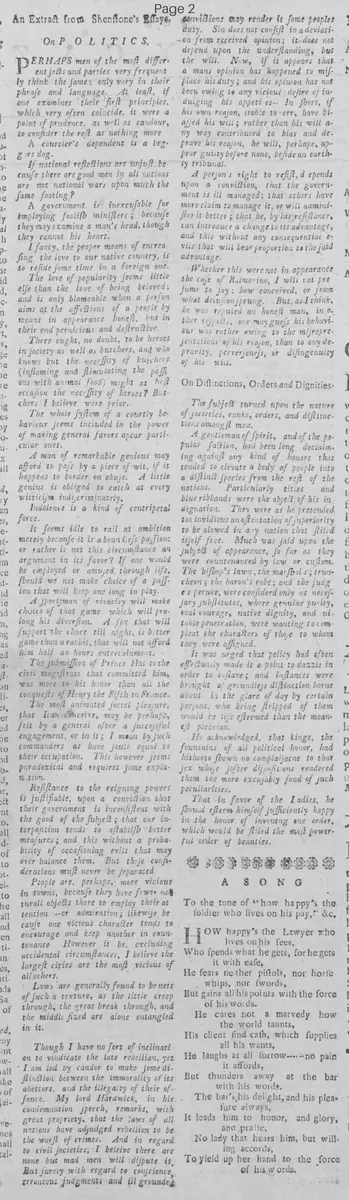
An Extract from Shenstone's Essays On POLITICS,
PERHAPS men of the most different sects and parties very frequently think the same; only vary in their phrase and language. At least, if one examines their first principles, which very often coincide, it were a point of prudence, as well as candour, to consider the rest as nothing more than the different modes of conveying the same idea.
A courtier's dependent is a beggar's dog.
If national reflections are unjust, because there are good men in all nations, are not national wars upon much the same footing?
A government is inexcusable for employing foolish ministers; because they may examine a man's head, though they cannot his heart.
I fancy, the proper means of encreasing the love to our native country, is to reside some time in a foreign one.
The love of popularity seems little else than the love of being beloved; and is only blameable when a person aims at the affections of a people by means in appearance honest, but in their end pernicious and destructive.
There ought, no doubt, to be heroes in society as well as butchers, and who knows but the necessity of butchers (inflaming and stimulating the passions with animal food) might at first occasion the necessity of heroes? Butchers I believe were prior.
The whole system of a courtly behaviour seems included in the power of making general favors appear particular ones.
A man of remarkable genius may afford to pass by a piece of wit, if it happens to border on abuse. A little genius is obliged to catch at every witticism indiscriminately.
Indolence is a kind of centripetal force.
It seems idle to rail at ambition merely because it is a boundless passion: or rather is not this circumstance an argument in its favor? If one would be employed or amused through life, should we not make choice of a passion that will keep one long in play.
A sportsman of vivacity will make choice of that game which will prolong his diversion. A fox that will support the chase till night, is better game than a rabbit, that will not afford him half an hour's entertainment.
The submission of Prince Hal to the civil magistrate that committed him, was more to his honor than all the conquests of Henry the Fifth in France.
The most animated social pleasure, that I can conceive, may be perhaps, felt by a general after a successful engagement, or in it; I mean by such commanders as have souls equal to their occupation. This however seems paradoxical and requires some explanation.
Resistance to the reigning powers is justifiable, upon a conviction that their government is inconsistent with the good of the subject; that our interposition tends to establish better measures; and this without a probability of occasioning evils that may over balance them. But these considerations must never be separated.
People are, perhaps, more vicious in towns, because they have fewer natural objects there to employ their attention --or admiration; likewise because one vicious character tends to encourage and keep another in countenance. However it be, excluding accidental circumstances, I believe the largest cities are the most vicious of all others.
Laws are generally found to be nets of such a texture, as the little creep through, the great break through, and the middle sized are alone entangled in it.
Though I have no sort of inclination to vindicate the late rebellion, yet I am led by candor to make some distinction between the immorality of its abettors, and the illegality of their offence. My lord Hardwick, in his condemnation speech, remarks, with great propriety, that the laws of all nations have adjudged rebellion to be the worst of crimes. And in regard to civil societies, I believe there are none but mad men will dispute it. But surely with regard to conscience erroneous judgments and ill grounded convictions may render it some peoples duty. Sin does not consist in a deviation from received opinion; it does not depend upon the understanding, but the will. Now, if it appears that a man's opinion has happened to misplace his duty; and his opinion has not been owing to any vicious desire of indulging his appetites-- In short, if his own reason, liable to err, have biased his will; rather than his will any way contributed to bias and deprave his reason, he will, perhaps, appear guilty before none, beside an earthly tribunal.
A person's right to resist, depends upon a conviction, that the government is ill managed; that others have more claim to manage it, or will administer it better; that he, by his resistance, can introduce a change to its advantage, and this without any consequential evils that will bear proportion to the said advantage.
Whether this were not in appearance the case of Balmerino, I will not presume to say; how conceived, or from what delusion sprung. But, as I think, he was reputed an honest man, in other respects, one may guess his behaviour was rather owing to the misrepresentations of his reason, than to any depravity, perverseness, or disingenuity of his will.
On Distinctions, Orders and Dignities
The subject turned upon the nature of societies, ranks, orders, and distinctions amongst men.
A gentleman of spirit, and of the popular faction, had been long declaiming against any kind of honors that tended to elevate a body of people into a distinct species from the rest of the nation. Particularly titles and blue ribbands were the object of his indignation. They were, as he pretended, too invidious an ostentation of superiority to be allowed in any nation that styled itself free. Much was said upon the subject of appearance, so far as they were countenanced by law or custom.
The bishop's lawn; the marshal's truncheon; the baron's robe; and the judge's ermine, were considered only as necessary substitutes, where genuine purity, real courage, native dignity, and visible penetration, were wanting to complete the characters of those to whom they were assigned.
It was urged that policy had often effectually made it a point to dazzle in order to enslave; and instances were brought of groundless distinction borne about in the glare of day by certain persons, who being stripped of them would be less esteemed than the meanest plebeian.
He acknowledged, that kings, the fountains of all political honor, had hitherto shewn no complaisance to that sex whose softer dispositions rendered them the more excusably fond of such peculiarities.
That -in favor of the Ladies. he should esteem himself sufficiently happy in the honor of inventing one order, which would be styled the most powerful order of beauties.
PERHAPS men of the most different sects and parties very frequently think the same; only vary in their phrase and language. At least, if one examines their first principles, which very often coincide, it were a point of prudence, as well as candour, to consider the rest as nothing more than the different modes of conveying the same idea.
A courtier's dependent is a beggar's dog.
If national reflections are unjust, because there are good men in all nations, are not national wars upon much the same footing?
A government is inexcusable for employing foolish ministers; because they may examine a man's head, though they cannot his heart.
I fancy, the proper means of encreasing the love to our native country, is to reside some time in a foreign one.
The love of popularity seems little else than the love of being beloved; and is only blameable when a person aims at the affections of a people by means in appearance honest, but in their end pernicious and destructive.
There ought, no doubt, to be heroes in society as well as butchers, and who knows but the necessity of butchers (inflaming and stimulating the passions with animal food) might at first occasion the necessity of heroes? Butchers I believe were prior.
The whole system of a courtly behaviour seems included in the power of making general favors appear particular ones.
A man of remarkable genius may afford to pass by a piece of wit, if it happens to border on abuse. A little genius is obliged to catch at every witticism indiscriminately.
Indolence is a kind of centripetal force.
It seems idle to rail at ambition merely because it is a boundless passion: or rather is not this circumstance an argument in its favor? If one would be employed or amused through life, should we not make choice of a passion that will keep one long in play.
A sportsman of vivacity will make choice of that game which will prolong his diversion. A fox that will support the chase till night, is better game than a rabbit, that will not afford him half an hour's entertainment.
The submission of Prince Hal to the civil magistrate that committed him, was more to his honor than all the conquests of Henry the Fifth in France.
The most animated social pleasure, that I can conceive, may be perhaps, felt by a general after a successful engagement, or in it; I mean by such commanders as have souls equal to their occupation. This however seems paradoxical and requires some explanation.
Resistance to the reigning powers is justifiable, upon a conviction that their government is inconsistent with the good of the subject; that our interposition tends to establish better measures; and this without a probability of occasioning evils that may over balance them. But these considerations must never be separated.
People are, perhaps, more vicious in towns, because they have fewer natural objects there to employ their attention --or admiration; likewise because one vicious character tends to encourage and keep another in countenance. However it be, excluding accidental circumstances, I believe the largest cities are the most vicious of all others.
Laws are generally found to be nets of such a texture, as the little creep through, the great break through, and the middle sized are alone entangled in it.
Though I have no sort of inclination to vindicate the late rebellion, yet I am led by candor to make some distinction between the immorality of its abettors, and the illegality of their offence. My lord Hardwick, in his condemnation speech, remarks, with great propriety, that the laws of all nations have adjudged rebellion to be the worst of crimes. And in regard to civil societies, I believe there are none but mad men will dispute it. But surely with regard to conscience erroneous judgments and ill grounded convictions may render it some peoples duty. Sin does not consist in a deviation from received opinion; it does not depend upon the understanding, but the will. Now, if it appears that a man's opinion has happened to misplace his duty; and his opinion has not been owing to any vicious desire of indulging his appetites-- In short, if his own reason, liable to err, have biased his will; rather than his will any way contributed to bias and deprave his reason, he will, perhaps, appear guilty before none, beside an earthly tribunal.
A person's right to resist, depends upon a conviction, that the government is ill managed; that others have more claim to manage it, or will administer it better; that he, by his resistance, can introduce a change to its advantage, and this without any consequential evils that will bear proportion to the said advantage.
Whether this were not in appearance the case of Balmerino, I will not presume to say; how conceived, or from what delusion sprung. But, as I think, he was reputed an honest man, in other respects, one may guess his behaviour was rather owing to the misrepresentations of his reason, than to any depravity, perverseness, or disingenuity of his will.
On Distinctions, Orders and Dignities
The subject turned upon the nature of societies, ranks, orders, and distinctions amongst men.
A gentleman of spirit, and of the popular faction, had been long declaiming against any kind of honors that tended to elevate a body of people into a distinct species from the rest of the nation. Particularly titles and blue ribbands were the object of his indignation. They were, as he pretended, too invidious an ostentation of superiority to be allowed in any nation that styled itself free. Much was said upon the subject of appearance, so far as they were countenanced by law or custom.
The bishop's lawn; the marshal's truncheon; the baron's robe; and the judge's ermine, were considered only as necessary substitutes, where genuine purity, real courage, native dignity, and visible penetration, were wanting to complete the characters of those to whom they were assigned.
It was urged that policy had often effectually made it a point to dazzle in order to enslave; and instances were brought of groundless distinction borne about in the glare of day by certain persons, who being stripped of them would be less esteemed than the meanest plebeian.
He acknowledged, that kings, the fountains of all political honor, had hitherto shewn no complaisance to that sex whose softer dispositions rendered them the more excusably fond of such peculiarities.
That -in favor of the Ladies. he should esteem himself sufficiently happy in the honor of inventing one order, which would be styled the most powerful order of beauties.
What sub-type of article is it?
Essay
Satire
What themes does it cover?
Political
Moral Virtue
Social Manners
What keywords are associated?
Politics
Society
Ambition
Rebellion
Distinctions
Honors
Titles
Morality
What entities or persons were involved?
Shenstone
Literary Details
Title
An Extract From Shenstone's Essays On Politics
Author
Shenstone
Subject
On Politics
Form / Style
Aphoristic Reflections And Dialogue
Key Lines
A Courtier's Dependent Is A Beggar's Dog.
Laws Are Generally Found To Be Nets Of Such A Texture, As The Little Creep Through, The Great Break Through, And The Middle Sized Are Alone Entangled In It.
Resistance To The Reigning Powers Is Justifiable, Upon A Conviction That Their Government Is Inconsistent With The Good Of The Subject...
They Were, As He Pretended, Too Invidious An Ostentation Of Superiority To Be Allowed In Any Nation That Styled Itself Free.