Thank you for visiting SNEWPapers!
Sign up free
The Indiana State Sentinel
Indianapolis, Marion County, Indiana
What is this article about?
Report on busy Washington officials handling government appointments: Appointment Clerk Higgins manages Treasury visitors; Commissioner McCalmont oversees Customs Bureau changes; First Assistant Postmaster General A. E. Stevenson deals with 45,000 post offices amid political contests.
Merged-components note: Sequential reading orders (24-27) and bbox overlaps indicate these images (portraits of Higgins, Stevenson, McCalmont) are part of the illustrated 'Weekly Budget From the National Capital' article.
Clipping
OCR Quality
Full Text
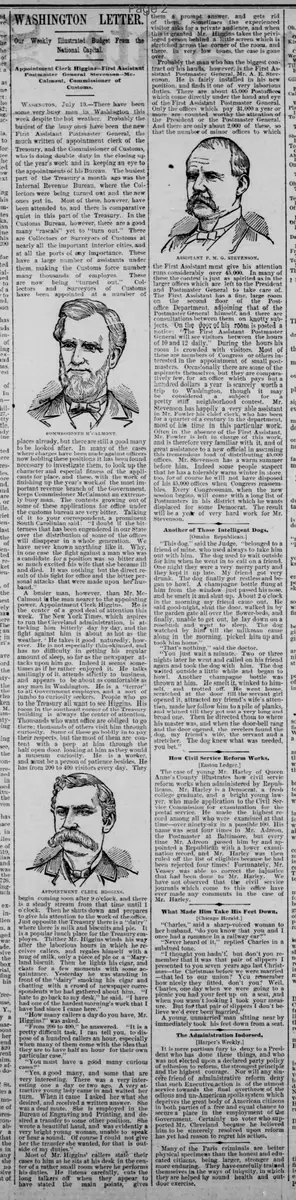
Appointment Clerk Higgins—First Assistant Postmaster General Stevenson—McCalmont, Commissioner of Customs.
Washington, July 10.—There have been some very busy men in Washington this week despite the hot weather. Probably the busiest of the busy ones have been the new First Assistant Postmaster General, the much written of appointment clerk of the Treasury, and the Commissioner of Customs, who is doing double duty in the closing up of the year's work and in keeping an eye to the appointments of his Bureau. The busiest part of the Treasury a month ago was the Internal Revenue Bureau, where the Collectors were being turned out and the new ones put in. Most of these, however, have been attended to, and there is comparative quiet in this part of the Treasury. In the Customs Bureau, however, there are a good many 'rascals' yet to 'turn out.' There are Collectors or Surveyors of Customs at nearly all the important interior cities, and at all the ports of any importance. These have a large number of assistants under them, making the Customs force number many thousands of employees. These are now being 'turned out.' Collectors and Surveyors of Customs have been appointed at a number of places already, but there are still a good many to be looked after. In many of the cases where charges have been made against officers now holding these positions it has been found necessary to investigate them, to look up the character and especial fitness of the applicants for place, and these, with the work of finishing up the year's work of the most important revenue branch of the Government, keeps Commissioner McCalmont an extremely busy man. The contests growing out of some of these applications for office under the customs bureau are very bitter. Talking of it to your correspondent, a prominent South Carolinian said: 'I doubt if the bitterness that has been engendered in our State over the distribution of some of the offices will disappear in a whole generation. We have never known anything like it. Why, in one case the fight against a man who was a candidate for a position was so bitter and so much excited his wife that she became ill and died. It was nothing but the direct result of this fight for office and the bitter personal attacks that were made upon her husband.'
A busier man, however, than Mr. McCalmont is the man nearer to the appointing power, Appointment Clerk Higgins. He is the center of a good deal of attention this week. The New York Times, which aspires to run the Cleveland administration, is attacking him bitterly day by day, and the fight against him is about as hot as the weather. He takes it good-naturedly, however. He is not especially thin-skinned, and has no difficulty in getting his regular amount of sleep, so far as the newspaper attacks upon him go. Indeed it seems sometimes as if he rather enjoyed it. He talks smilingly of it, attends strictly to business, and appears to be about as comfortable as any man in Washington. He is a 'terror' to all Government employees, and a sort of jumbo to curiosity seekers. People who go to the Treasury all want to see Higgins. His room in the southeast corner of the Treasury building is always the center of attention. Thousands who want office are obliged to go there; thousands of others visit him through curiosity. Some of these go boldly in to pay their respects, but the most of them are content with a peep at him through the half open door, looking at him as they would a museum curiosity. He is a worker, and must be a person of patience besides. He has from 200 to 400 visitors every day. They begin coming soon after 9 o'clock, and there is a steady stream from that time until 1 o'clock. Then he shuts down and prepares to give his attention to the work of the office. Just opposite the Treasury there is a 'dairy' where there is milk and biscuits and pie. It is a popular lunch place for the Treasury employees. Thither Mr. Higgins winds his way after the laborious hours in which he receives callers, and regales himself with a mug of milk, only a piece of pie or a 'Maryland biscuit. Then he lights his cigar, and chats for a few moments with some acquaintance. Yesterday he was standing in front of the 'dairy' smoking his cigar and chatting with a crowd of newspaper correspondents who had gathered about him. 'I hate to go back to my desk,' he said. 'I have had one of the hardest morning's work that I have had since I came here.'
'How many callers a day do you have, Mr. Higgins?' was asked.
'From 200 to 400,' he answered.
'It is a pretty difficult task, I can tell you, to dispose of a hundred callers an hour, especially when many of them come with the idea that they are to have half an hour for their own particular case.'
'You must have a good many curious cases?'
'Yes, a good many, and some that are very interesting. There was a very interesting one a day or two ago. A very attractive young lady came in and waited her turn. When it came I asked her what she desired, and received a written answer. She was a deaf mute. She is employed in the Bureau of Engraving and Printing, and desired a transfer to some other position. She wrote a beautiful hand, and was evidently a very bright young woman, unable to speak or hear a sound. Of course I could not give her the transfer she wanted, for that is outside of my duties.'
Most of Mr. Higgins' callers state their cases to him as he sits at his desk in the center of a rather small room where he performs his duties. He listens carefully, cuts the long talkers off when they appear to have stated the main points, gives them a prompt answer, and gets rid of them. Sometimes the experienced visitor asks for a private audience, and when this is granted Mr. Higgins takes the privileged person behind a little screen which is stretched across the corner of the room, and there, in very low tones, the case is gone over.
Probably the man who has the biggest contract on his hands, however, is the First Assistant Postmaster General, Mr. A. E. Stevenson. He is fairly installed in his new position, and finds it one of very laborious duties. There are about 45,000 Postoffices which come directly under the hand and eye of the First Assistant Postmaster General. Only the offices which pay $1,000 a year or more are counted worthy the attention of the President or the Postmaster General. And there are only about 2,000 of these, so that the number of minor offices to which the First Assistant must give his attention runs considerably over 45,000. In many of these the contest is just as spirited as in the larger offices which are left to the President and Postmaster General to take care of. The First Assistant has a fine, large room on the second floor of the Postoffice Department, adjoining that of the Postmaster General himself, and there are consultations between them on knotty subjects. On the door of his room is posted a notice: 'The First Assistant Postmaster General will see visitors between the hours of 10 and 12 daily.' During the hours his room is crowded with visitors. Most of these are members of Congress or others interested in the appointment of small postmasters. Occasionally there are some of the aspirants themselves, but they are comparatively few, for an office which pays but a hundred dollars a year is scarcely worth a trip to Washington, though it may be considered subject for a pretty stiff neighborhood contest. Mr. Stevenson has happily a very able assistant in Mr. Fowler his chief clerk, who has been for a quarter of a century in the department, most of his time in this particular work. Often in the absence of the First Assistant, Mr. Fowler is left in charge of this work, and is therefore very familiar with it, and of great assistance to a new official in assuming this tremendous load of distributing 45,000 offices. Mr. Stevenson has a warm summer before him. Indeed some people suspect that he has a tolerably warm winter in store, too, for of course he will not have disposed of his 45,000 offices when Congress reassembles. Every Congressman, when the new session begins, will come with a long list of Postmasters in his district which he wants displaced for some Democrat. The result will be a year of very hard work for Mr. Stevenson.
What sub-type of article is it?
What keywords are associated?
What entities or persons were involved?
Where did it happen?
Domestic News Details
Primary Location
Washington
Event Date
July 10
Key Persons
Outcome
bitter contests over offices, including one case where a candidate's wife died from stress; ongoing appointments in customs and post office bureaus.
Event Details
Busy officials in Washington handle government appointments: Commissioner McCalmont oversees Customs Bureau changes and investigations; Appointment Clerk Higgins manages 200-400 daily visitors seeking offices; First Assistant Postmaster General Stevenson deals with 45,000 post offices amid political rivalries.