Thank you for visiting SNEWPapers!
Sign up free
Story
April 19, 1828
Literary Cadet And Rhode Island Statesman
Providence, Providence County, Rhode Island
What is this article about?
In early American frontier times, a family is captured by Indians. Parents escape but leave their infant son behind to survive. Raised by the tribe, he reunites with his family years later but rejects civilized life and returns to the Indians. Decades on, his mother kills an attacking Indian, realizing it's her son by a scar on his hand.
Clipping
OCR Quality
98%
Excellent
Full Text
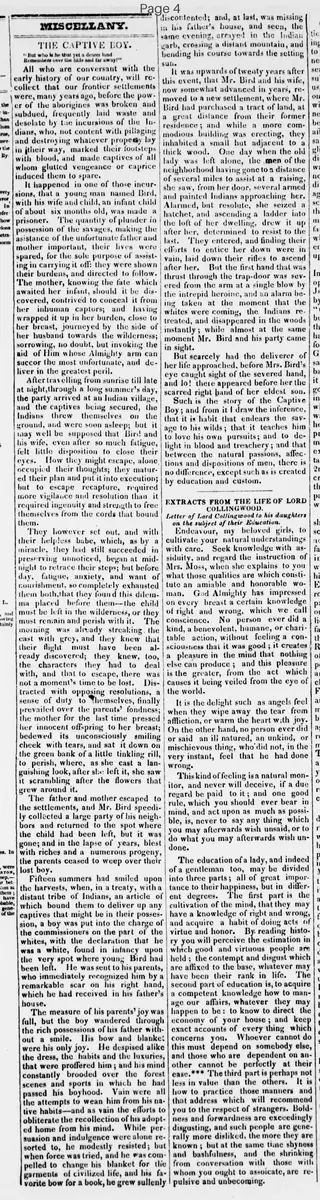
MISCELLANY.
THE CAPTIVE BOY.
"But who is he that yet a dearer land
Remembers over the hills and far away?"
All who are conversant with the early history of our country, will recollect that our frontier settlements were, many years ago, before the power of the aborigines was broken and subdued, frequently laid waste and desolate by the incursions of the Indians, who, not content with pillaging and destroying whatever property lay in their way, marked their footsteps with blood, and made captives of all whom glutted vengeance or caprice induced them to spare.
It happened in one of those incursions, that a young man named Bird, with his wife and child, an infant child of about six months old, was made a prisoner. The quantity of plunder in possession of the savages, making the assistance of the unfortunate father and mother important, their lives were spared, for the sole purpose of assisting in carrying it off: they were shown their burdens, and directed to follow. The mother, knowing the fate which awaited her infant, should it be discovered, contrived to conceal it from her inhuman captors; and having wrapped it up in her burden, close to her breast, journeyed by the side of her husband towards the wilderness; sorrowing, no doubt, but invoking the aid of Him whose Almighty arm can succor the most unfortunate, and deliver in the greatest peril.
After travelling from sunrise till late at night, through a long summer's day, the party arrived at an Indian village, and the captives being secured, the Indians threw themselves on the ground, and were soon asleep; but it may well be supposed that Bird and his wife, even after so much fatigue, felt little disposition to close their eyes. How they might escape, alone occupied their thoughts; they matured their plan and put it into execution; but to escape recapture, required more vigilance and resolution than it required ingenuity and strength to free themselves from the cords that bound them. They however set out, and with their helpless babe, which, as by a miracle, they had still succeeded in preserving unnoticed, began at midnight to retrace their steps; but before day, fatigue, anxiety, and want of nourishment, so completely exhausted them both, that they found themselves in this dilemma—the child must be left in the wilderness, or they must remain and perish with it. The morning was already streaking the east with gray, and they knew that their flight must have been already discovered; they knew, too, the characters they had to deal with, and that to escape, there was not a moment's time to be lost. Distracted with opposing resolutions, a sense of duty to themselves, finally prevailed over the parents' fondness; the mother for the last time pressed her innocent offspring to her breast; bedewed its unconsciously smiling cheek with tears, and sat it down on the green bank of a little tinkling rill, to perish, where, as she cast a languishing look, after she left it, she saw it scrambling after the flowers that grew around it.
The father and mother escaped to the settlements, and Mr. Bird speedily collected a large party of his neighbors and returned to the spot where the child had been left, but it was gone; and in the lapse of years, blest with riches and a numerous progeny, the parents ceased to weep over their lost boy.
Fifteen summers had smiled upon the harvests, when, in a treaty, with a distant tribe of Indians, an article of which bound them to deliver up any captives that might be in their possession, a boy was put into the charge of the commissioners on the part of the whites, with the declaration that he was a white, found in infancy upon the very spot where young Bird had been left. He was sent to his parents, who immediately recognized him by a remarkable scar on his right hand, which he had received in his father's house.
The measure of his parents' joy was full, but the boy wandered through the rich possessions of his father without a smile. His bow and blanket were his only joy. He despised alike the dress, the habits and the luxuries, that were proffered him; and his mind constantly brooded over the forest scenes and sports in which he had passed his boyhood. Vain were all the attempts to wean him from his native habits—and as vain the efforts to obliterate the recollection of his adopted home from his mind. While persuasion and indulgence were alone resorted to, he modestly resisted; but when force was tried, and he was compelled to change his blanket for the garments of civilized life, and his favorite bow for a book, he grew sullenly discontented; and, at last, was missing in his father's house, and seen, the same evening, arrayed in the Indian garb, crossing a distant mountain, and bending his course towards the setting sun.
It was upwards of twenty years after this event, that Mr. Bird and his wife, now somewhat advanced in years, removed to a new settlement, where Mr. Bird had purchased a tract of land, at a great distance from their former residence; and while a more commodious building was erecting, they inhabited a small hut adjacent to a thick wood. One day when the old lady was left alone, the men of the neighborhood having gone to a distance of several miles to assist at a raising, she saw, from her door, several armed and painted Indians approaching her. Alarmed, but resolute, she seized a hatchet, and ascending a ladder into the loft of her dwelling, drew it up after her, determined to resist to the last. They entered, and finding their efforts to entice her down were in vain, laid down their rifles to ascend after her. But the first hand that was thrust through the trap-door was severed from the arm at a single blow by the intrepid heroine, and an alarm being taken at the moment that the whites were coming, the Indians retreated, and disappeared in the woods instantly; while almost at the same moment Mr. Bird and his party came in sight.
But scarcely had the deliverer of her life approached, before Mrs. Bird's eye caught sight of the severed hand, and lo! there appeared before her the scarred right hand of her eldest son.
Such is the story of the Captive Boy; and from it I draw the inference, that it is habit that endears the savage to his wilds; that it teaches him to love his own pursuits; and to delight in blood and treachery; and that between the natural passions, affections and dispositions of men, there is no difference, except such as is created by education and custom.
THE CAPTIVE BOY.
"But who is he that yet a dearer land
Remembers over the hills and far away?"
All who are conversant with the early history of our country, will recollect that our frontier settlements were, many years ago, before the power of the aborigines was broken and subdued, frequently laid waste and desolate by the incursions of the Indians, who, not content with pillaging and destroying whatever property lay in their way, marked their footsteps with blood, and made captives of all whom glutted vengeance or caprice induced them to spare.
It happened in one of those incursions, that a young man named Bird, with his wife and child, an infant child of about six months old, was made a prisoner. The quantity of plunder in possession of the savages, making the assistance of the unfortunate father and mother important, their lives were spared, for the sole purpose of assisting in carrying it off: they were shown their burdens, and directed to follow. The mother, knowing the fate which awaited her infant, should it be discovered, contrived to conceal it from her inhuman captors; and having wrapped it up in her burden, close to her breast, journeyed by the side of her husband towards the wilderness; sorrowing, no doubt, but invoking the aid of Him whose Almighty arm can succor the most unfortunate, and deliver in the greatest peril.
After travelling from sunrise till late at night, through a long summer's day, the party arrived at an Indian village, and the captives being secured, the Indians threw themselves on the ground, and were soon asleep; but it may well be supposed that Bird and his wife, even after so much fatigue, felt little disposition to close their eyes. How they might escape, alone occupied their thoughts; they matured their plan and put it into execution; but to escape recapture, required more vigilance and resolution than it required ingenuity and strength to free themselves from the cords that bound them. They however set out, and with their helpless babe, which, as by a miracle, they had still succeeded in preserving unnoticed, began at midnight to retrace their steps; but before day, fatigue, anxiety, and want of nourishment, so completely exhausted them both, that they found themselves in this dilemma—the child must be left in the wilderness, or they must remain and perish with it. The morning was already streaking the east with gray, and they knew that their flight must have been already discovered; they knew, too, the characters they had to deal with, and that to escape, there was not a moment's time to be lost. Distracted with opposing resolutions, a sense of duty to themselves, finally prevailed over the parents' fondness; the mother for the last time pressed her innocent offspring to her breast; bedewed its unconsciously smiling cheek with tears, and sat it down on the green bank of a little tinkling rill, to perish, where, as she cast a languishing look, after she left it, she saw it scrambling after the flowers that grew around it.
The father and mother escaped to the settlements, and Mr. Bird speedily collected a large party of his neighbors and returned to the spot where the child had been left, but it was gone; and in the lapse of years, blest with riches and a numerous progeny, the parents ceased to weep over their lost boy.
Fifteen summers had smiled upon the harvests, when, in a treaty, with a distant tribe of Indians, an article of which bound them to deliver up any captives that might be in their possession, a boy was put into the charge of the commissioners on the part of the whites, with the declaration that he was a white, found in infancy upon the very spot where young Bird had been left. He was sent to his parents, who immediately recognized him by a remarkable scar on his right hand, which he had received in his father's house.
The measure of his parents' joy was full, but the boy wandered through the rich possessions of his father without a smile. His bow and blanket were his only joy. He despised alike the dress, the habits and the luxuries, that were proffered him; and his mind constantly brooded over the forest scenes and sports in which he had passed his boyhood. Vain were all the attempts to wean him from his native habits—and as vain the efforts to obliterate the recollection of his adopted home from his mind. While persuasion and indulgence were alone resorted to, he modestly resisted; but when force was tried, and he was compelled to change his blanket for the garments of civilized life, and his favorite bow for a book, he grew sullenly discontented; and, at last, was missing in his father's house, and seen, the same evening, arrayed in the Indian garb, crossing a distant mountain, and bending his course towards the setting sun.
It was upwards of twenty years after this event, that Mr. Bird and his wife, now somewhat advanced in years, removed to a new settlement, where Mr. Bird had purchased a tract of land, at a great distance from their former residence; and while a more commodious building was erecting, they inhabited a small hut adjacent to a thick wood. One day when the old lady was left alone, the men of the neighborhood having gone to a distance of several miles to assist at a raising, she saw, from her door, several armed and painted Indians approaching her. Alarmed, but resolute, she seized a hatchet, and ascending a ladder into the loft of her dwelling, drew it up after her, determined to resist to the last. They entered, and finding their efforts to entice her down were in vain, laid down their rifles to ascend after her. But the first hand that was thrust through the trap-door was severed from the arm at a single blow by the intrepid heroine, and an alarm being taken at the moment that the whites were coming, the Indians retreated, and disappeared in the woods instantly; while almost at the same moment Mr. Bird and his party came in sight.
But scarcely had the deliverer of her life approached, before Mrs. Bird's eye caught sight of the severed hand, and lo! there appeared before her the scarred right hand of her eldest son.
Such is the story of the Captive Boy; and from it I draw the inference, that it is habit that endears the savage to his wilds; that it teaches him to love his own pursuits; and to delight in blood and treachery; and that between the natural passions, affections and dispositions of men, there is no difference, except such as is created by education and custom.
What sub-type of article is it?
Historical Event
Family Drama
Survival
What themes does it cover?
Family
Survival
Fate Providence
What keywords are associated?
Indian Captivity
Family Separation
Reunion
Cultural Conflict
Frontier Attack
What entities or persons were involved?
Bird
Mrs. Bird
The Boy
Where did it happen?
American Frontier Settlements
Story Details
Key Persons
Bird
Mrs. Bird
The Boy
Location
American Frontier Settlements
Story Details
A family captured by Indians escapes but leaves infant son behind; he survives, raised by tribe, reunites via treaty but rejects family and returns to Indians; years later, mother kills attacking Indian, discovering it's her son by scar.