Thank you for visiting SNEWPapers!
Sign up free
Literary
October 9, 1846
The Ottawa Free Trader
Ottawa, La Salle County County, Illinois
What is this article about?
Conclusion of 'A Legend of the Wahtahpee' by P. W. Leland. Chapter III depicts family discussions, a boating excursion on Wahtahpee pond turning into a perilous accident, and rescue by an octogenarian (General Walpole). Chapter IV skips a year to peaceful life, reflections, and the marriage of Mary Wilson and Luke Hathaway.
Clipping
OCR Quality
95%
Excellent
Full Text
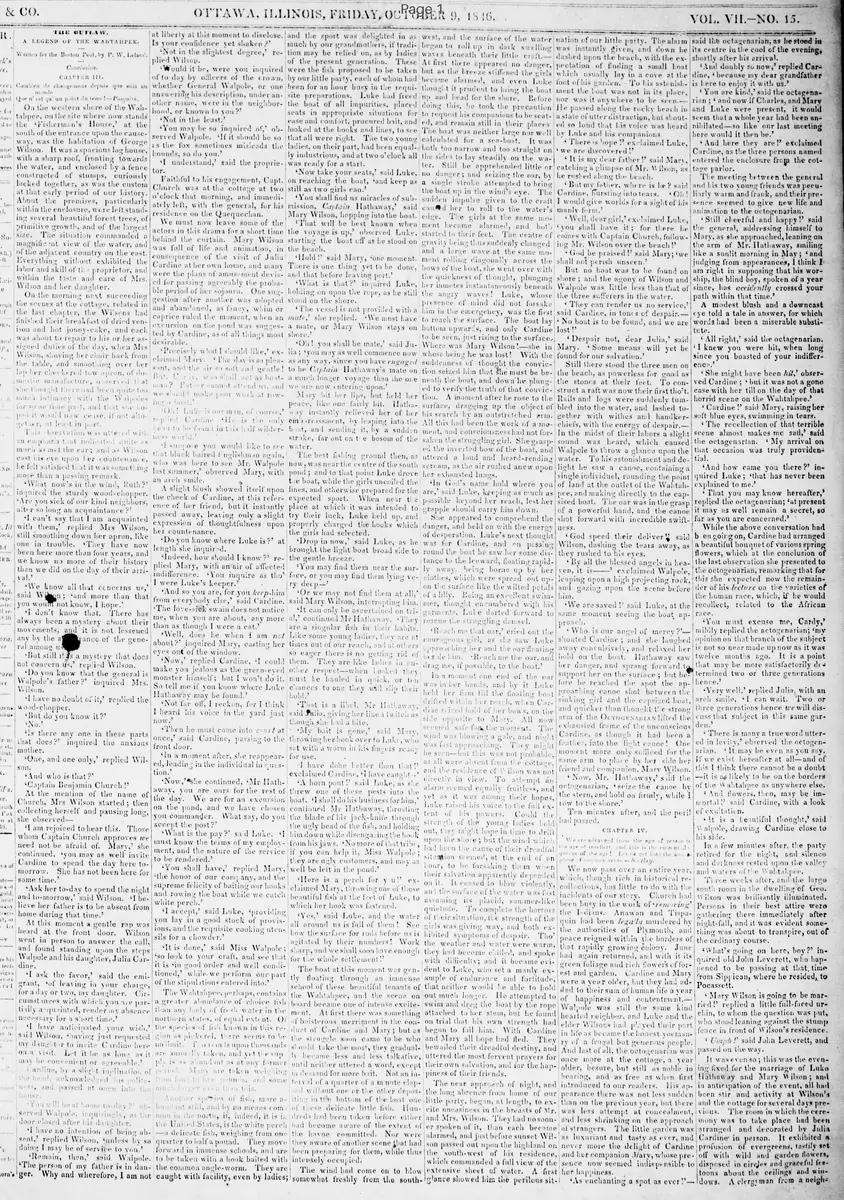
A LEGEND OF THE WAHTAYPEE.
Written for the Boston Post, by P. W. Leland.
Conclusion.
CHAPTER III.
Combien de changements depuis que suis au monde!
Que n'est qu'un point du temps!—Pusguier.
On the western shore of the Wahtahpee, on the site where now stands the 'Fisherman's House,' at the south of the entrance upon the causeway, was the habitation of George Wilson. It was a spacious log house, with a sharp roof, fronting towards the water, and enclosed by a fence constructed of stumps, curiously locked together, as was the custom at that early period of our history. About the premises, particularly within the enclosure, were left standing several beautiful forest trees, of primitive growth, and of the largest size. The situation commanded a magnificent view of the water, and of the adjacent country on the east. Everything without exhibited the labor and skill of the proprietor, and within the taste and care of Mrs. Wilson and her daughter.
On the morning next succeeding the scenes at the cottage, related in the last chapter, the Wilsons had finished their breakfast of dried venison and hot johnny-cake, and each was about to repair to his or her assigned duties of the day, when Mrs. Wilson, shoving her chair back from the table, and smoothing over her lap her checkered tow apron, of domestic manufacture, observed that she thought there had been quite too much intimacy with the Walpoles for some time past, and that she hoped it would now cease, if not altogether, at least in part.
This observation was uttered with an emphasis that indicated quite as much as met the ear: and as Wilson cast his eye upon her countenance, he felt satisfied that it was something more than a passing remark.
'What now's in the wind, Ruth?' inquired the sturdy wood-chopper.
'Are you sick of our kind neighbors, after so long an acquaintance?'
'I can't say that I am acquainted with them,' replied Mrs. Wilson, still smoothing down her apron, like one in trouble. 'They have now been here more than four years, and we know no more of their history than we did on the day of their arrival.'
'We know all that concerns us,' said Wilson; 'and more than that you would not know, I hope.'
'I don't know that. There has always been a mystery about their movements, and it is not lessened any by the general rumor among us of the appearance of the general.'
'But still it's a mystery that does not concern us,' replied Wilson.
'Do you know that the general is Walpole's father?' inquired Mrs. Wilson.
'I have no doubt of it,' replied the wood-chopper.
'But do you know it?'
'No.'
'Is there any one in these parts that does?' inquired the anxious mother.
'One, and one only,' replied Wilson.
'And who is that?'
'Captain Benjamin Church!'
At the mention of the name of Church, Mrs. Wilson started: then collecting herself and pausing long, she observed—
'I am rejoiced to hear this. Those whom Captain Church approves we need not be afraid of. Mary,' she continued, 'you may as well invite Cardine to spend the day here tomorrow. She has not been here for some time.'
'Ask her to-day to spend the night and to-morrow,' said Wilson. 'I believe her father is to be absent from home during that time.'
At this moment a gentle rap was heard at the front door. Wilson went in person to answer the call, and found standing upon the steps Walpole and his daughter, Julia Cardine.
'I ask the favor,' said the emigrant, 'of leaving in your charge for a day or two, my daughter. Circumstances with which you are partially acquainted, render my absence necessary for a short time.'
'I have anticipated your wish,' said Wilson, 'having just requested my daughter to invite Cardine here on a visit. Let it be as long as it may be convenient or agreeable.'
Cardine, by a slight inclination of the head, acknowledged his politeness, and passed at once into the house.
'You will be at home to-day?' observed Walpole, inquiringly, as the door closed after his daughter.
'I have no intention of being absent,' replied Wilson, 'unless by so doing I may be of service to you.'
'Remain, then,' said Walpole. 'The person of my father is in danger. Why and wherefore, I am not at liberty at this moment to disclose. Is your confidence yet shaken?'
'Not in the slightest degree,' replied Wilson.
'Would it be, were you inquired of to-day by officers of the crown, whether General Walpole, or one answering his description, under another name, were in the neighborhood, or known to you?'
'Not in the least.'
'You may be so inquired of,' observed Walpole. 'If it should be so, as the fox sometimes misleads the hounds, so do you.'
'I understand,' said the proprietor.
Faithful to his engagement, Capt. Church was at the cottage at two o'clock that morning, and immediately left, with the general, for his residence on the Quequechan.
We must now leave some of the actors in this drama for a short time behind the curtain. Mary Wilson was full of life and animation, in consequence of the visit of Julia Cardine at her own home, and many were the plans of amusement devised for passing agreeably the probable period of her sojourn. One suggestion after another was adopted and abandoned, as fancy, whim or caprice ruled the moment, when an excursion on the pond was suggested by Cardine, as of all things most desirable.
'Precisely what I should like!' exclaimed Mary. 'The day is so pleasant, and the air so soft and gentle! But, Cardine, who shall act as boatman? Luke cannot attend us, and we shan't make poor work at rowing ourselves.'
'O! Luke is our man, of course,' replied Cardine; 'he is the only one to be found in this half wilderness worth—'
'I suppose you would like to see that black haired Englishman again, who was here to see Mr. Walpole last summer,' observed Mary, with an arch smile.
A slight blush showed itself upon the cheek of Cardine, at this reference of her friend, but it instantly passed away, leaving only a slight expression of thoughtfulness upon her countenance.
'Do you know where Luke is?' at length she inquired.
'Indeed, how should I know?' replied Mary, with an air of affected indifference. 'You inquire as tho' I were Luke's keeper.'
'And so you are, for you keep him from everybody else,' said Cardine. 'The love-sick swain does not notice me, when you are about, any more than as though I were a cat.'
'Well, does he when I am not about?' inquired Mary, casting her eyes out of the window.
'Now,' replied Cardine, 'I could make you jealous as the green-eyed monster himself; but I won't do it. So tell me if you know where Luke Hathaway may be found.'
'Not far off, I reckon, for I think I heard his voice in the yard just now.'
Then he must come into court at once,' said Cardine, passing to the front door.
In a moment after, she reappeared, leading in the individual in question.
'Now,' she continued, 'Mr. Hathaway, you are ours for the rest of the day. We are for an excursion on the pond, and we have chosen you commander. What say, do you accept the post?'
'What is the pay?' said Luke. 'I must know the terms of my employment, and the nature of the service to be rendered.'
'You shall have,' replied Mary, 'the honor of our company, and the supreme felicity of baiting our hooks and rowing the boat while we catch white perch.'
'I accept,' said Luke, 'providing you lay in a good stock of provisions, and the requisite cooking utensils for a chowder.'
'It is done,' said Miss Walpole; 'so look to your craft, and see that it is in good order and well conditioned,' while we perform our part of the stipulations entered into.'
The Wahtahpee, perhaps, contains a greater abundance of choice fish than any body of fresh water in the northern states, of equal extent. Of the species of fish known in this region as pickerel, there seems to be no limit. Thousands upon thousands are annually taken, and yet the supply is as abundant as at any former period. Many are taken weighing from two to three pounds, and some much heavier even than this. Another species of fish, more abundant still, and by no means common in the north, if, indeed, it is in the United States, is the white perch—a delicate fish, weighing from one quarter to half a pound. They move forward in immense schools, and are to be taken with a hook baited with the common angle-worm. They are caught with facility, even by ladies; and the sport was delighted in as much by our grandmothers, if tradition may be relied on, as by ladies of the present generation. These were the fish proposed to be taken by our little party, each of whom had been for an hour busy in the requisite preparations. Luke had freed the boat of all impurities, placed seats in appropriate situations for ease and comfort, procured bait, and looked at the hooks and lines, to see that all were right. The two young ladies, on their part, had been equally industrious, and at two o'clock all was ready for a start.
Now take your seats, said Luke, on reaching the boat, 'and keep as still as two girls can.'
'You shall find us miracles of submission, Captain Hathaway,' said Mary Wilson, hopping into the boat.
'That will be best known when the voyage is up,' observed Luke, starting the boat off as he stood on the beach.
'Hold!' said Mary, 'one moment. There is one thing yet to be done, and that before leaving port.'
'What is that?' inquired Luke, holding on upon the rope, as he still stood on the shore.
'The vessel is not provided with a mate,' she replied. 'We must have a mate, or Mary Wilson stays on shore.'
'Oh! you shall be mate,' said Julia; 'you may as well commence now as any way, since you have engaged to be Captain Hathaway's mate on a much longer voyage than the one we are now entering upon.'
Mary bit her lips, but held her peace, like one fairly hit. Hathaway instantly relieved her of her embarrassment, by leaping into the boat, and sending it, by a sudden stroke, far out on the bosom of the water.
The best fishing ground then, as now, was near the centre of the south pond; and to that point Luke drove the boat, while the girls uncoiled the lines, and otherwise prepared for the expected sport. When near the place at which it was intended to try their luck, Luke held up, and properly charged the hooks which the girls had selected.
'Drop in now,' said Luke, as he brought the light boat broad side to the gentle breeze.
'You may find them near the surface, or you may find them lying very deep—'
'Or we may not find them at all,' said Mary Wilson, interrupting him.
'It can only be ascertained on trial,' continued Mr. Hathaway. 'They are a singular fish in their habits. Like some young ladies, they are at times out of our reach, and at others so eager there is no getting rid of them. They are like ladies in another respect—when hooked they must be hauled in quick, or ten chances to one they will slip their hold.'
'That is a libel, Mr. Hathaway,' said Julia, giving her line a twitch as though she had a bite.
'My bait is gone,' said Mary, throwing her hook over to Luke, who sat with a worm in his fingers ready for use.
'I have done better than that!' exclaimed Cardine. 'I have caught—'
'A horn pout!' said Luke, as she threw one of these pests into the boat. 'I shall do his business for him,' continued Mr. Hathaway, thrusting the blade of his jack-knife through the ugly head of the fish, and holding him down while disengaging the hook from his jaws. 'No more of that tribe if you can help it, Miss Walpole; they are ugly customers, and may as well be left in the pond.'
'Here is a perch for you!' exclaimed Mary, throwing one of those beautiful fish at the feet of Luke, to which her hook was fastened.
'Yes,' said Luke, 'and the water all around us is full of them! See how the surface for rods before us is agitated by their numbers! Work sharp, and we shall soon have enough for the whole settlement!'
The boat at this moment was gently floating through an immense school of these beautiful tenants of the Wahtahpee, and the scene on board became one of intense excitement. At first there was something of boisterous merriment in the conduct of Cardine and Mary; but as the struggle soon came to be who should take the most, they gradually became less and less talkative, until neither uttered a word, except in demand for more bait. Not an interval of a quarter of a minute elapsed without one or the other depositing in the bottom of the boat one of these delicate little fish. Hundreds had been taken before either had become aware of the extent of the havoc committed. Nor were they aware of another scene that had been preparing for them, while thus intensely occupied.
The wind had come on to blow somewhat freshly from the southwest, and the surface of the water began to roll up in dark swelling waves beneath their little craft. At first there appeared no danger, but as the breeze stiffened the girls became alarmed, and even Luke thought it prudent to bring the boat up and head for the shore. Before doing this, he took the precaution to request his companions to be seated, and remain still in their places. The boat was neither large nor well calculated for a sea-boat. It was both too narrow and too straight on the sides to lay steadily on the water. Still he apprehended little or no danger; and seizing the oar, by a single stroke attempted to bring the boat up in the wind's eye. The sudden impulse given to the craft caused her to roll to the water's edge. The girls at the same moment became alarmed, and both started to their feet. The centre of gravity being thus suddenly changed and a large wave at the same moment rolling diagonally across the bows of the boat, she went over with the quickness of thought, plunging her inmates instantaneously beneath the angry waves! Luke, whose presence of mind did not forsake him in the emergency, was the first to reach the surface. The boat lay bottom upwards, and only Cardine to be seen, just rising to the surface. Where was Mary Wilson! she in whose being he was lost! With the suddenness of thought the conviction seized him that she must be beneath the boat, and down he plunged to verify the truth of that conviction. A moment after he rose to the surface, dragging up the object of his search by an outstretched arm.
All this had been the work of a moment, and consciousness had not forsaken the struggling girl. She grasped the inverted bow of the boat, and uttered a loud and heart-rending scream, as the air rushed anew upon her exhausted lungs.
'In God's name hold where you are,' said Luke, keeping as much as possible beyond her reach, lest her grapple should carry him down.
She appeared to comprehend the danger, and held on with the energy of desperation. Luke's next thought was for Cardine, and on passing round the boat he saw her some distance to the leeward, floating rapidly away, being borne up by her clothes, which were spread out upon the surface like the wilted petals of a lily. Being an excellent swimmer, though encumbered with his garments, Luke darted forward to rescue the struggling damsel.
'Reach me that oar,' cried out the courageous girl, as she saw Luke approaching her and the oar floating by his side. 'Reach me the oar, and drag me, if possible, to the boat.'
In a moment one end of the oar was in her hands, and by it Luke held her firm till the floating boat drifted within her reach, when Cardine seized hold of her bows, on the side opposite to Mary. All now seemed safe for the moment. The wind was blowing a gale, and night was fast approaching. They might be seen—but this was not probable, as all were absent from the cottage, and the residence of Wilson was not directly in view. To attempt an alarm seemed equally fruitless, and yet as it was among their hopes, Luke raised his voice to the full extent of his powers. Could the strength of the young ladies hold out, they might hope in time to drift upon the shore; but the wind which had been the cause of their dreadful situation seemed, at the end of an hour, to be forsaking them when their salvation apparently depended on it. It ceased to blow violently, and the surface of the water was fast assuming its placid, summer-like quietude. To complete the horrors of their situation, the strength of the girls was giving way, and both exhibited symptoms of despair. Though the weather and water were warm, they had become chilled, and spoke with difficulty; and it became evident to Luke, who set a manly example of endurance and fortitude, that neither would be able to hold out much longer. He attempted to swim and drag the boat by the rope attached to her stern, but he found on trial that his own strength had begun to fail him. With Cardine and Mary all hope had fled. They bewailed their dreadful destiny, and uttered the most fervent prayers for their own salvation, and for the happiness of their friends.
The near approach of night, and the long absence from home of our little party, began, at length, to excite uneasiness in the breasts of Mr. and Mrs. Wilson. They had no sooner spoken of it, than each became alarmed, and just before sunset Wilson passed out upon the highland on the south-west of his residence, which commanded a full view of the extensive sheet of water. A first glance showed him the perilous situation of our little party. The alarm was instantly given, and down he dashed upon the beach, with the expectation of finding a small boat which usually lay in a cove at the foot of his garden. To his astonishment the boat was not in its place, nor was it anywhere to be seen. He passed along the rocky beach in a state of utter distraction, but shouted so loud that his voice was heard by Luke and his companions.
'There is hope!' exclaimed Luke, 'we are discovered!'
'It is my dear father!' said Mary, catching a glimpse of Mr. Wilson, as he rushed along the beach.
'But my father, where is he?' said Cardine. Bursting into tears. 'Oh! I would give worlds for a sight of his manly form.'
'Well, dear girl,' exclaimed Luke, 'you shall have it: for there he comes with Captain Church, following Mr. Wilson over the beach!'
'God be praised!' said Mary; 'we shall not perish unseen.'
But no boat was to be found on shore: and the agony of Wilson and Walpole was little less than that of the three sufferers in the water.
'They can render us no service,' said Cardine, in tones of despair. 'No boat is to be found, and we are lost!'
'Despair not, dear Julia,' said Mary. 'Some means will yet be found for our salvation.'
Still there stood the three men on the beach, as powerless for good as the stones at their feet. To construct a raft was now their first thought. Rails and logs were suddenly tumbled into the water, and lashed together with withes and handkerchiefs, with the energy of despair. In the midst of their labors a slight sound was heard, which caused Walpole to throw a glance upon the water. To his astonishment and delight he saw a canoe, containing a single individual, rounding the point of land at the outlet of the Wahtahpee, and making directly to the capsized boat. The oar was in the grasp of a powerful hand, and the canoe shot forward with incredible swiftness.
'God speed their deliverer!' said Wilson, dashing the tears away, as they rushed to his eyes.
'By all the blessed angels in heaven, it is—' exclaimed Walpole, leaping upon a high projecting rock, and gazing upon the scene before him.
We are saved!' said Luke, at the same moment seeing the boat approach.
'Who is our angel of mercy?'— shouted Cardine; and she laughed away convulsively, and relaxed her hold on the boat. Hathaway saw her danger, and sprang forward to support her on the surface; but before he reached the spot the approaching canoe shot between the sinking girl and the capsized boat, and quicker than thought the strong arm of the octogenarian lifted the exhausted frame of the unconscious Cardine, as though it had been a feather, into the light canoe! One moment more only sufficed for the same arm to place by her side her friend and companion, Mary Wilson.
'Now, Mr. Hathaway,' said the octogenarian, 'seize the canoe by the stern, and hold on firmly, while I row to the shore.'
Ten minutes after, and the peril had passed.
CHAPTER IV.
We are descended from the age of reason to the age of intellect; still this is the current of change! Its getting the air—Phoebe fromt eors—S they.
We now pass over an entire year, which, though rich in historical recollections, has little to do with the incidents of our story. Church had been busy in the work of 'removing the Indians. Anawan and Tispquin had been legally murdered by the authorities of Plymouth, and peace reigned within the borders of that rapidly growing colony. June had again returned, and with it its green foliage and rich flowers of forest and garden. Cardine and Mary were a year older, but they had added to their sum of human life a year of happiness and contentment. Walpole was still the same kind hearted neighbor, and Luke and the elder Wilsons had played their part in life as became the honest yeomanry of a frugal but generous people. And last of all, the octogenarian was once more at the cottage, a year older, be sure, but still as noble in bearing, and as free as when first introduced to our readers. His appearance there was not less sudden than on the previous year, but there was less attempt at concealment, and less shrinking on the approach of strangers. The little garden was as luxuriant and tasty as ever, and never more the delight of Cardine and her companion Mary, whose presence now seemed indispensable to her happiness.
'As enchanting a spot as ever!'— said the octogenarian, as he stood in its centre in the cool of the evening shortly after his arrival.
'And doubly so now,' replied Cardine, 'because my dear grandfather is here to enjoy it with us.'
'You are kind,' said the octogenarian; 'and now if Charles, and Mary and Luke were present, it would seem that a whole year had been annihilated so like our last meeting here would it then be.'
'And here they are!' exclaimed Cardine, as the three persons named entered the enclosure from the cottage parlor.
The meeting between the general and his two young friends was peculiarly warm and frank, and their presence seemed to give new life and animation to the octogenarian.
'Still cheerful and happy!' said the general, addressing himself to Mary, as she approached, leaning on the arm of Mr. Hathaway, smiling like a sunlit morning in May; 'and judging from appearances, I think I am right in supposing that his worship, the blind boy, spoken of a year since, has accidentally crossed your path within that time.'
A modest blush and a downcast eye told a tale in answer, for which words had been a miserable substitute.
'All right,' said the octogenarian. 'I knew you were hit, when long since you boasted of your indifference.'
'She might have been hit,' observed Cardine; 'but it was not a gone case with her till on the day of that horrid scene on the Wahtahpee.'
'Cardine!' said Mary, raising her soft blue eyes, swimming in tears.
'The recollection of that terrible scene almost makes me sad,' said the octogenarian. 'My arrival on that occasion was truly providential.'
'And how came you there?' inquired Luke; 'that has never been explained to me.'
'That you may know hereafter,' replied the octogenarian; 'at present it may as well remain a secret, so far as you are concerned.'
While the above conversation had been going on, Cardine had arranged a beautiful bouquet of various spring flowers, which at the conclusion of the last observation she presented to the octogenarian, remarking that for this she expected now the remainder of his lecture on the varieties of the human race, which, if he would recollect, related to the African race.
'You must excuse me, Cardy,' mildly replied the octogenarian; 'my opinion on that branch of the subject is not so near made up now as it was twelve months ago. It is a point that may be more satisfactorily determined two or three generations hence.'
'Very well,' replied Julia, with an arch smile. 'I can wait. Two or three generations hence we will discuss that subject in this same garden.'
'There is many a true word uttered in levity,' observed the octogenarian. 'It may be even as you say. If we exist hereafter at all—and of this I think there cannot be a doubt—it is as likely to be on the borders of the Wahtahpee as anywhere else.'
'And flowers, then, may be immortal!' said Cardine, with a look of exultation.
'It is a beautiful thought,' said Walpole, drawing Cardine close to his side.
In a few minutes after, the party retired for the night, and silence and darkness rested upon the valley and waters of the Wahtahpee.
Three weeks after, and the large south room in the dwelling of Geo. Wilson was brilliantly illuminated. Persons in their best attire were gathering there immediately after night-fall, and it was evident something was about to transpire, out of the ordinary course.
'What's going on here, boy?' inquired old John Leverett, who happened to be passing at that time from Sippican, where he resided, to Pocasset.
'Mary Wilson is going to be married!' replied a little full-faced urchin, to whom the question was put, who stood leaning against the stump fence in front of Wilson's residence.
'Ummh!' said John Leverett, and passed on his way.
It was even so; this was the evening fixed for the marriage of Luke Hathaway and Mary Wilson; and in anticipation of the event, all had been stir and activity at Wilson's and the cottage for several days previous. The room in which the ceremony was to take place had been arranged and decorated by Julia Cardine in person. It exhibited a profusion of evergreens, tastily set off with wild and garden flowers, disposed in circles and graceful festoons about the ceilings and windows. A clergyman from a neighb—
Written for the Boston Post, by P. W. Leland.
Conclusion.
CHAPTER III.
Combien de changements depuis que suis au monde!
Que n'est qu'un point du temps!—Pusguier.
On the western shore of the Wahtahpee, on the site where now stands the 'Fisherman's House,' at the south of the entrance upon the causeway, was the habitation of George Wilson. It was a spacious log house, with a sharp roof, fronting towards the water, and enclosed by a fence constructed of stumps, curiously locked together, as was the custom at that early period of our history. About the premises, particularly within the enclosure, were left standing several beautiful forest trees, of primitive growth, and of the largest size. The situation commanded a magnificent view of the water, and of the adjacent country on the east. Everything without exhibited the labor and skill of the proprietor, and within the taste and care of Mrs. Wilson and her daughter.
On the morning next succeeding the scenes at the cottage, related in the last chapter, the Wilsons had finished their breakfast of dried venison and hot johnny-cake, and each was about to repair to his or her assigned duties of the day, when Mrs. Wilson, shoving her chair back from the table, and smoothing over her lap her checkered tow apron, of domestic manufacture, observed that she thought there had been quite too much intimacy with the Walpoles for some time past, and that she hoped it would now cease, if not altogether, at least in part.
This observation was uttered with an emphasis that indicated quite as much as met the ear: and as Wilson cast his eye upon her countenance, he felt satisfied that it was something more than a passing remark.
'What now's in the wind, Ruth?' inquired the sturdy wood-chopper.
'Are you sick of our kind neighbors, after so long an acquaintance?'
'I can't say that I am acquainted with them,' replied Mrs. Wilson, still smoothing down her apron, like one in trouble. 'They have now been here more than four years, and we know no more of their history than we did on the day of their arrival.'
'We know all that concerns us,' said Wilson; 'and more than that you would not know, I hope.'
'I don't know that. There has always been a mystery about their movements, and it is not lessened any by the general rumor among us of the appearance of the general.'
'But still it's a mystery that does not concern us,' replied Wilson.
'Do you know that the general is Walpole's father?' inquired Mrs. Wilson.
'I have no doubt of it,' replied the wood-chopper.
'But do you know it?'
'No.'
'Is there any one in these parts that does?' inquired the anxious mother.
'One, and one only,' replied Wilson.
'And who is that?'
'Captain Benjamin Church!'
At the mention of the name of Church, Mrs. Wilson started: then collecting herself and pausing long, she observed—
'I am rejoiced to hear this. Those whom Captain Church approves we need not be afraid of. Mary,' she continued, 'you may as well invite Cardine to spend the day here tomorrow. She has not been here for some time.'
'Ask her to-day to spend the night and to-morrow,' said Wilson. 'I believe her father is to be absent from home during that time.'
At this moment a gentle rap was heard at the front door. Wilson went in person to answer the call, and found standing upon the steps Walpole and his daughter, Julia Cardine.
'I ask the favor,' said the emigrant, 'of leaving in your charge for a day or two, my daughter. Circumstances with which you are partially acquainted, render my absence necessary for a short time.'
'I have anticipated your wish,' said Wilson, 'having just requested my daughter to invite Cardine here on a visit. Let it be as long as it may be convenient or agreeable.'
Cardine, by a slight inclination of the head, acknowledged his politeness, and passed at once into the house.
'You will be at home to-day?' observed Walpole, inquiringly, as the door closed after his daughter.
'I have no intention of being absent,' replied Wilson, 'unless by so doing I may be of service to you.'
'Remain, then,' said Walpole. 'The person of my father is in danger. Why and wherefore, I am not at liberty at this moment to disclose. Is your confidence yet shaken?'
'Not in the slightest degree,' replied Wilson.
'Would it be, were you inquired of to-day by officers of the crown, whether General Walpole, or one answering his description, under another name, were in the neighborhood, or known to you?'
'Not in the least.'
'You may be so inquired of,' observed Walpole. 'If it should be so, as the fox sometimes misleads the hounds, so do you.'
'I understand,' said the proprietor.
Faithful to his engagement, Capt. Church was at the cottage at two o'clock that morning, and immediately left, with the general, for his residence on the Quequechan.
We must now leave some of the actors in this drama for a short time behind the curtain. Mary Wilson was full of life and animation, in consequence of the visit of Julia Cardine at her own home, and many were the plans of amusement devised for passing agreeably the probable period of her sojourn. One suggestion after another was adopted and abandoned, as fancy, whim or caprice ruled the moment, when an excursion on the pond was suggested by Cardine, as of all things most desirable.
'Precisely what I should like!' exclaimed Mary. 'The day is so pleasant, and the air so soft and gentle! But, Cardine, who shall act as boatman? Luke cannot attend us, and we shan't make poor work at rowing ourselves.'
'O! Luke is our man, of course,' replied Cardine; 'he is the only one to be found in this half wilderness worth—'
'I suppose you would like to see that black haired Englishman again, who was here to see Mr. Walpole last summer,' observed Mary, with an arch smile.
A slight blush showed itself upon the cheek of Cardine, at this reference of her friend, but it instantly passed away, leaving only a slight expression of thoughtfulness upon her countenance.
'Do you know where Luke is?' at length she inquired.
'Indeed, how should I know?' replied Mary, with an air of affected indifference. 'You inquire as tho' I were Luke's keeper.'
'And so you are, for you keep him from everybody else,' said Cardine. 'The love-sick swain does not notice me, when you are about, any more than as though I were a cat.'
'Well, does he when I am not about?' inquired Mary, casting her eyes out of the window.
'Now,' replied Cardine, 'I could make you jealous as the green-eyed monster himself; but I won't do it. So tell me if you know where Luke Hathaway may be found.'
'Not far off, I reckon, for I think I heard his voice in the yard just now.'
Then he must come into court at once,' said Cardine, passing to the front door.
In a moment after, she reappeared, leading in the individual in question.
'Now,' she continued, 'Mr. Hathaway, you are ours for the rest of the day. We are for an excursion on the pond, and we have chosen you commander. What say, do you accept the post?'
'What is the pay?' said Luke. 'I must know the terms of my employment, and the nature of the service to be rendered.'
'You shall have,' replied Mary, 'the honor of our company, and the supreme felicity of baiting our hooks and rowing the boat while we catch white perch.'
'I accept,' said Luke, 'providing you lay in a good stock of provisions, and the requisite cooking utensils for a chowder.'
'It is done,' said Miss Walpole; 'so look to your craft, and see that it is in good order and well conditioned,' while we perform our part of the stipulations entered into.'
The Wahtahpee, perhaps, contains a greater abundance of choice fish than any body of fresh water in the northern states, of equal extent. Of the species of fish known in this region as pickerel, there seems to be no limit. Thousands upon thousands are annually taken, and yet the supply is as abundant as at any former period. Many are taken weighing from two to three pounds, and some much heavier even than this. Another species of fish, more abundant still, and by no means common in the north, if, indeed, it is in the United States, is the white perch—a delicate fish, weighing from one quarter to half a pound. They move forward in immense schools, and are to be taken with a hook baited with the common angle-worm. They are caught with facility, even by ladies; and the sport was delighted in as much by our grandmothers, if tradition may be relied on, as by ladies of the present generation. These were the fish proposed to be taken by our little party, each of whom had been for an hour busy in the requisite preparations. Luke had freed the boat of all impurities, placed seats in appropriate situations for ease and comfort, procured bait, and looked at the hooks and lines, to see that all were right. The two young ladies, on their part, had been equally industrious, and at two o'clock all was ready for a start.
Now take your seats, said Luke, on reaching the boat, 'and keep as still as two girls can.'
'You shall find us miracles of submission, Captain Hathaway,' said Mary Wilson, hopping into the boat.
'That will be best known when the voyage is up,' observed Luke, starting the boat off as he stood on the beach.
'Hold!' said Mary, 'one moment. There is one thing yet to be done, and that before leaving port.'
'What is that?' inquired Luke, holding on upon the rope, as he still stood on the shore.
'The vessel is not provided with a mate,' she replied. 'We must have a mate, or Mary Wilson stays on shore.'
'Oh! you shall be mate,' said Julia; 'you may as well commence now as any way, since you have engaged to be Captain Hathaway's mate on a much longer voyage than the one we are now entering upon.'
Mary bit her lips, but held her peace, like one fairly hit. Hathaway instantly relieved her of her embarrassment, by leaping into the boat, and sending it, by a sudden stroke, far out on the bosom of the water.
The best fishing ground then, as now, was near the centre of the south pond; and to that point Luke drove the boat, while the girls uncoiled the lines, and otherwise prepared for the expected sport. When near the place at which it was intended to try their luck, Luke held up, and properly charged the hooks which the girls had selected.
'Drop in now,' said Luke, as he brought the light boat broad side to the gentle breeze.
'You may find them near the surface, or you may find them lying very deep—'
'Or we may not find them at all,' said Mary Wilson, interrupting him.
'It can only be ascertained on trial,' continued Mr. Hathaway. 'They are a singular fish in their habits. Like some young ladies, they are at times out of our reach, and at others so eager there is no getting rid of them. They are like ladies in another respect—when hooked they must be hauled in quick, or ten chances to one they will slip their hold.'
'That is a libel, Mr. Hathaway,' said Julia, giving her line a twitch as though she had a bite.
'My bait is gone,' said Mary, throwing her hook over to Luke, who sat with a worm in his fingers ready for use.
'I have done better than that!' exclaimed Cardine. 'I have caught—'
'A horn pout!' said Luke, as she threw one of these pests into the boat. 'I shall do his business for him,' continued Mr. Hathaway, thrusting the blade of his jack-knife through the ugly head of the fish, and holding him down while disengaging the hook from his jaws. 'No more of that tribe if you can help it, Miss Walpole; they are ugly customers, and may as well be left in the pond.'
'Here is a perch for you!' exclaimed Mary, throwing one of those beautiful fish at the feet of Luke, to which her hook was fastened.
'Yes,' said Luke, 'and the water all around us is full of them! See how the surface for rods before us is agitated by their numbers! Work sharp, and we shall soon have enough for the whole settlement!'
The boat at this moment was gently floating through an immense school of these beautiful tenants of the Wahtahpee, and the scene on board became one of intense excitement. At first there was something of boisterous merriment in the conduct of Cardine and Mary; but as the struggle soon came to be who should take the most, they gradually became less and less talkative, until neither uttered a word, except in demand for more bait. Not an interval of a quarter of a minute elapsed without one or the other depositing in the bottom of the boat one of these delicate little fish. Hundreds had been taken before either had become aware of the extent of the havoc committed. Nor were they aware of another scene that had been preparing for them, while thus intensely occupied.
The wind had come on to blow somewhat freshly from the southwest, and the surface of the water began to roll up in dark swelling waves beneath their little craft. At first there appeared no danger, but as the breeze stiffened the girls became alarmed, and even Luke thought it prudent to bring the boat up and head for the shore. Before doing this, he took the precaution to request his companions to be seated, and remain still in their places. The boat was neither large nor well calculated for a sea-boat. It was both too narrow and too straight on the sides to lay steadily on the water. Still he apprehended little or no danger; and seizing the oar, by a single stroke attempted to bring the boat up in the wind's eye. The sudden impulse given to the craft caused her to roll to the water's edge. The girls at the same moment became alarmed, and both started to their feet. The centre of gravity being thus suddenly changed and a large wave at the same moment rolling diagonally across the bows of the boat, she went over with the quickness of thought, plunging her inmates instantaneously beneath the angry waves! Luke, whose presence of mind did not forsake him in the emergency, was the first to reach the surface. The boat lay bottom upwards, and only Cardine to be seen, just rising to the surface. Where was Mary Wilson! she in whose being he was lost! With the suddenness of thought the conviction seized him that she must be beneath the boat, and down he plunged to verify the truth of that conviction. A moment after he rose to the surface, dragging up the object of his search by an outstretched arm.
All this had been the work of a moment, and consciousness had not forsaken the struggling girl. She grasped the inverted bow of the boat, and uttered a loud and heart-rending scream, as the air rushed anew upon her exhausted lungs.
'In God's name hold where you are,' said Luke, keeping as much as possible beyond her reach, lest her grapple should carry him down.
She appeared to comprehend the danger, and held on with the energy of desperation. Luke's next thought was for Cardine, and on passing round the boat he saw her some distance to the leeward, floating rapidly away, being borne up by her clothes, which were spread out upon the surface like the wilted petals of a lily. Being an excellent swimmer, though encumbered with his garments, Luke darted forward to rescue the struggling damsel.
'Reach me that oar,' cried out the courageous girl, as she saw Luke approaching her and the oar floating by his side. 'Reach me the oar, and drag me, if possible, to the boat.'
In a moment one end of the oar was in her hands, and by it Luke held her firm till the floating boat drifted within her reach, when Cardine seized hold of her bows, on the side opposite to Mary. All now seemed safe for the moment. The wind was blowing a gale, and night was fast approaching. They might be seen—but this was not probable, as all were absent from the cottage, and the residence of Wilson was not directly in view. To attempt an alarm seemed equally fruitless, and yet as it was among their hopes, Luke raised his voice to the full extent of his powers. Could the strength of the young ladies hold out, they might hope in time to drift upon the shore; but the wind which had been the cause of their dreadful situation seemed, at the end of an hour, to be forsaking them when their salvation apparently depended on it. It ceased to blow violently, and the surface of the water was fast assuming its placid, summer-like quietude. To complete the horrors of their situation, the strength of the girls was giving way, and both exhibited symptoms of despair. Though the weather and water were warm, they had become chilled, and spoke with difficulty; and it became evident to Luke, who set a manly example of endurance and fortitude, that neither would be able to hold out much longer. He attempted to swim and drag the boat by the rope attached to her stern, but he found on trial that his own strength had begun to fail him. With Cardine and Mary all hope had fled. They bewailed their dreadful destiny, and uttered the most fervent prayers for their own salvation, and for the happiness of their friends.
The near approach of night, and the long absence from home of our little party, began, at length, to excite uneasiness in the breasts of Mr. and Mrs. Wilson. They had no sooner spoken of it, than each became alarmed, and just before sunset Wilson passed out upon the highland on the south-west of his residence, which commanded a full view of the extensive sheet of water. A first glance showed him the perilous situation of our little party. The alarm was instantly given, and down he dashed upon the beach, with the expectation of finding a small boat which usually lay in a cove at the foot of his garden. To his astonishment the boat was not in its place, nor was it anywhere to be seen. He passed along the rocky beach in a state of utter distraction, but shouted so loud that his voice was heard by Luke and his companions.
'There is hope!' exclaimed Luke, 'we are discovered!'
'It is my dear father!' said Mary, catching a glimpse of Mr. Wilson, as he rushed along the beach.
'But my father, where is he?' said Cardine. Bursting into tears. 'Oh! I would give worlds for a sight of his manly form.'
'Well, dear girl,' exclaimed Luke, 'you shall have it: for there he comes with Captain Church, following Mr. Wilson over the beach!'
'God be praised!' said Mary; 'we shall not perish unseen.'
But no boat was to be found on shore: and the agony of Wilson and Walpole was little less than that of the three sufferers in the water.
'They can render us no service,' said Cardine, in tones of despair. 'No boat is to be found, and we are lost!'
'Despair not, dear Julia,' said Mary. 'Some means will yet be found for our salvation.'
Still there stood the three men on the beach, as powerless for good as the stones at their feet. To construct a raft was now their first thought. Rails and logs were suddenly tumbled into the water, and lashed together with withes and handkerchiefs, with the energy of despair. In the midst of their labors a slight sound was heard, which caused Walpole to throw a glance upon the water. To his astonishment and delight he saw a canoe, containing a single individual, rounding the point of land at the outlet of the Wahtahpee, and making directly to the capsized boat. The oar was in the grasp of a powerful hand, and the canoe shot forward with incredible swiftness.
'God speed their deliverer!' said Wilson, dashing the tears away, as they rushed to his eyes.
'By all the blessed angels in heaven, it is—' exclaimed Walpole, leaping upon a high projecting rock, and gazing upon the scene before him.
We are saved!' said Luke, at the same moment seeing the boat approach.
'Who is our angel of mercy?'— shouted Cardine; and she laughed away convulsively, and relaxed her hold on the boat. Hathaway saw her danger, and sprang forward to support her on the surface; but before he reached the spot the approaching canoe shot between the sinking girl and the capsized boat, and quicker than thought the strong arm of the octogenarian lifted the exhausted frame of the unconscious Cardine, as though it had been a feather, into the light canoe! One moment more only sufficed for the same arm to place by her side her friend and companion, Mary Wilson.
'Now, Mr. Hathaway,' said the octogenarian, 'seize the canoe by the stern, and hold on firmly, while I row to the shore.'
Ten minutes after, and the peril had passed.
CHAPTER IV.
We are descended from the age of reason to the age of intellect; still this is the current of change! Its getting the air—Phoebe fromt eors—S they.
We now pass over an entire year, which, though rich in historical recollections, has little to do with the incidents of our story. Church had been busy in the work of 'removing the Indians. Anawan and Tispquin had been legally murdered by the authorities of Plymouth, and peace reigned within the borders of that rapidly growing colony. June had again returned, and with it its green foliage and rich flowers of forest and garden. Cardine and Mary were a year older, but they had added to their sum of human life a year of happiness and contentment. Walpole was still the same kind hearted neighbor, and Luke and the elder Wilsons had played their part in life as became the honest yeomanry of a frugal but generous people. And last of all, the octogenarian was once more at the cottage, a year older, be sure, but still as noble in bearing, and as free as when first introduced to our readers. His appearance there was not less sudden than on the previous year, but there was less attempt at concealment, and less shrinking on the approach of strangers. The little garden was as luxuriant and tasty as ever, and never more the delight of Cardine and her companion Mary, whose presence now seemed indispensable to her happiness.
'As enchanting a spot as ever!'— said the octogenarian, as he stood in its centre in the cool of the evening shortly after his arrival.
'And doubly so now,' replied Cardine, 'because my dear grandfather is here to enjoy it with us.'
'You are kind,' said the octogenarian; 'and now if Charles, and Mary and Luke were present, it would seem that a whole year had been annihilated so like our last meeting here would it then be.'
'And here they are!' exclaimed Cardine, as the three persons named entered the enclosure from the cottage parlor.
The meeting between the general and his two young friends was peculiarly warm and frank, and their presence seemed to give new life and animation to the octogenarian.
'Still cheerful and happy!' said the general, addressing himself to Mary, as she approached, leaning on the arm of Mr. Hathaway, smiling like a sunlit morning in May; 'and judging from appearances, I think I am right in supposing that his worship, the blind boy, spoken of a year since, has accidentally crossed your path within that time.'
A modest blush and a downcast eye told a tale in answer, for which words had been a miserable substitute.
'All right,' said the octogenarian. 'I knew you were hit, when long since you boasted of your indifference.'
'She might have been hit,' observed Cardine; 'but it was not a gone case with her till on the day of that horrid scene on the Wahtahpee.'
'Cardine!' said Mary, raising her soft blue eyes, swimming in tears.
'The recollection of that terrible scene almost makes me sad,' said the octogenarian. 'My arrival on that occasion was truly providential.'
'And how came you there?' inquired Luke; 'that has never been explained to me.'
'That you may know hereafter,' replied the octogenarian; 'at present it may as well remain a secret, so far as you are concerned.'
While the above conversation had been going on, Cardine had arranged a beautiful bouquet of various spring flowers, which at the conclusion of the last observation she presented to the octogenarian, remarking that for this she expected now the remainder of his lecture on the varieties of the human race, which, if he would recollect, related to the African race.
'You must excuse me, Cardy,' mildly replied the octogenarian; 'my opinion on that branch of the subject is not so near made up now as it was twelve months ago. It is a point that may be more satisfactorily determined two or three generations hence.'
'Very well,' replied Julia, with an arch smile. 'I can wait. Two or three generations hence we will discuss that subject in this same garden.'
'There is many a true word uttered in levity,' observed the octogenarian. 'It may be even as you say. If we exist hereafter at all—and of this I think there cannot be a doubt—it is as likely to be on the borders of the Wahtahpee as anywhere else.'
'And flowers, then, may be immortal!' said Cardine, with a look of exultation.
'It is a beautiful thought,' said Walpole, drawing Cardine close to his side.
In a few minutes after, the party retired for the night, and silence and darkness rested upon the valley and waters of the Wahtahpee.
Three weeks after, and the large south room in the dwelling of Geo. Wilson was brilliantly illuminated. Persons in their best attire were gathering there immediately after night-fall, and it was evident something was about to transpire, out of the ordinary course.
'What's going on here, boy?' inquired old John Leverett, who happened to be passing at that time from Sippican, where he resided, to Pocasset.
'Mary Wilson is going to be married!' replied a little full-faced urchin, to whom the question was put, who stood leaning against the stump fence in front of Wilson's residence.
'Ummh!' said John Leverett, and passed on his way.
It was even so; this was the evening fixed for the marriage of Luke Hathaway and Mary Wilson; and in anticipation of the event, all had been stir and activity at Wilson's and the cottage for several days previous. The room in which the ceremony was to take place had been arranged and decorated by Julia Cardine in person. It exhibited a profusion of evergreens, tastily set off with wild and garden flowers, disposed in circles and graceful festoons about the ceilings and windows. A clergyman from a neighb—
What sub-type of article is it?
Prose Fiction
What themes does it cover?
Love Romance
Friendship
Nature
What keywords are associated?
Wahtahpee Pond
Boating Accident
Rescue Octogenarian
Fishing Excursion
Marriage Wilson Hathaway
Walpole Family
Captain Church
Historical New England
What entities or persons were involved?
Written For The Boston Post, By P. W. Leland.
Literary Details
Title
A Legend Of The Wahtaypee.
Author
Written For The Boston Post, By P. W. Leland.
Key Lines
Combien De Changements Depuis Que Suis Au Monde! Que N'est Qu'un Point Du Temps!—Pusguier.
'In God's Name Hold Where You Are,' Said Luke, Keeping As Much As Possible Beyond Her Reach, Lest Her Grapple Should Carry Him Down.
'And Flowers, Then, May Be Immortal!' Said Cardine, With A Look Of Exultation.
'Mary Wilson Is Going To Be Married!' Replied A Little Full Faced Urchin...