Thank you for visiting SNEWPapers!
Sign up free
Story
March 12, 1817
Daily National Intelligencer
Washington, District Of Columbia
What is this article about?
In a U.S. Senate debate, Mr. Barbour of Virginia opposes Mr. Mason's resolution to reduce the military peace establishment, arguing its necessity for national defense against potential threats from Spain and Britain, citing historical lessons and recent War of 1812 victories.
Clipping
OCR Quality
98%
Excellent
Full Text
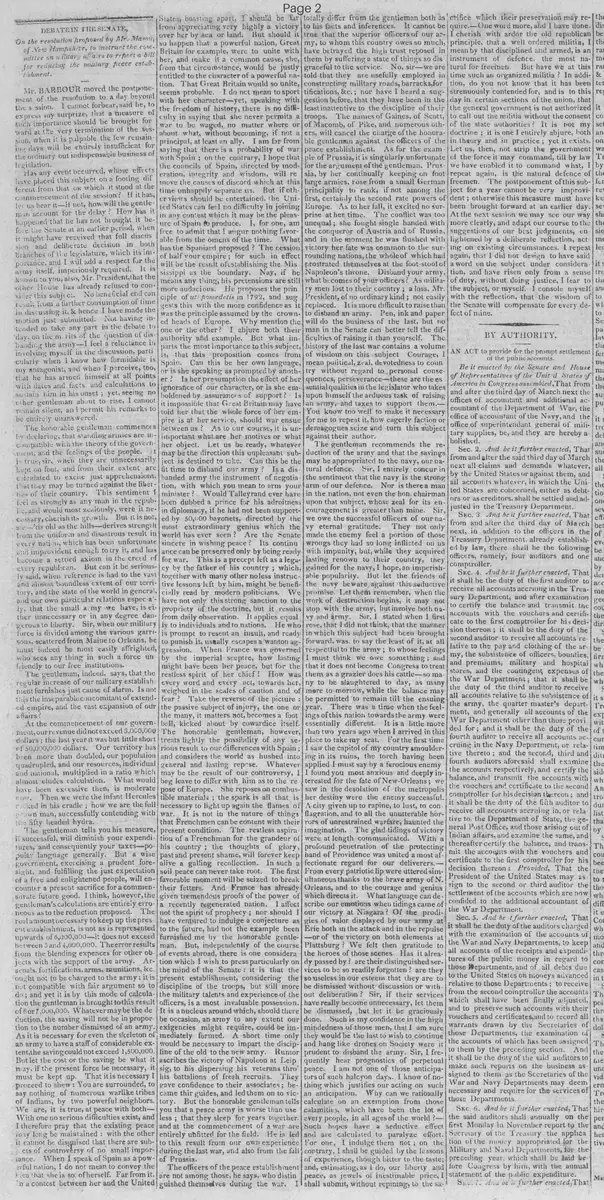
DEBATE IN THE SENATE
On the resolution proposed by Mr. Mason of New Hampshire, to instruct the committee on military affairs to report a bill for reducing the military peace establishment.
Mr. BARBOUR moved the postponement of the resolution to a day beyond the session. "I cannot forbear, said he, to express my surprise, that a measure of such importance should be brought forward at the very termination of the session, when it is palpable the few remaining days will be entirely insufficient for the ordinary but indispensable business of legislation.
Has any event occurred, whose effects have placed this subject on a footing different from that on which it stood at the commencement of the session? If it has, let us hear it—if not, how will the gentleman account for the delay? How has it happened that he has not brought it before the Senate at an earlier period, when it might have received that full discussion and deliberate decision in both branches of the legislature, which its importance, and I will add a respect for the army itself, imperiously required. It is known to you, also, Mr. President, that the other House has already refused to consider this subject. No beneficial end can result from a further consumption of time in discussing it, & hence I have made the motion just submitted. Not having intended to take any part in the debate to-day, on the merits of the question of disbanding the army—I feel a reluctance in involving myself in the discussion, particularly when I know how formidable is my antagonist, and when I perceive, too, that he has armed himself at all points with dates and facts and calculations to sustain him in his onset; yet, seeing no other gentleman about to rise, I cannot remain silent, and I permit his remarks to be entirely unanswered.
The honorable gentleman commences by declaring, that standing armies are incompatible with the theory of the government, and the feelings of the people. It is true, sir, when they are unnecessarily kept on foot, and from their extent are calculated to excite just apprehensions, that they may be turned against the liberties of their country. This sentiment I feel as strongly as any man in the republic, and would most zealously, were it necessary, cherish its growth. But it is not, sir—'tis old as the hills—derives strength from the uniform and disastrous result in every nation, which has been unfortunate and improvident enough to try it, and has become a settled axiom in the creed of every republican. But can it be seriously said, when reference is had to the vast and almost boundless extent of our territory, and the state of the world in general, and our own particular relations especially, that the small army we have, is either unnecessary or in any degree dangerous to liberty. Sir, when our military force is divided among the various garrisons, scattered from Maine to Orleans, he must indeed be most easily afrighted, who sees any thing in such a force unfriendly to our free institutions.
The gentleman, indeed, says, that the regular increase of our military establishment furnishes just cause of alarm. Is not this the inseparable concomitant of extended empire, and the vast expansion of our affairs?
At the commencement of our government, our revenue did not exceed 3,000,000 dollars; the last year it was but little short of 50,000,000 dollars. Our territory has been more than doubled, our population quadrupled, and our resources, individual and national, multiplied in a ratio which almost eludes calculation. What would have been excessive then, is moderate now. Then we were the infant Hercules rocked in his cradle; now we are the full grown man, successfully contending with the fifty headed hydra.
The gentleman tells you his measure, if successful, will diminish your expenditures, and consequently your taxes—popular language generally. But a wise government, exercising a prudent foresight, and fulfilling the just expectation of a free and enlightened people, will encounter a present sacrifice for a commensurate future good. I think, however, the gentleman's calculations are entirely erroneous as to the reduction proposed. The real amount necessary to keep up the present establishment, is not as is represented upwards of 6,000,000—it does not exceed between 3 and 4,000,000. The error results from the blending expenses for other objects with the support of the army. Arsenals, fortifications, arms, munitions, &c. ought not to be charged to the army: it is not compatible with fair argument so to do; and yet it is by this mode of calculation the gentleman is brought to this result of 6 or 7,000,000. Whatever may be the deduction, the saving will not be in proportion to the number dismissed of an army. As it is necessary for even the skeleton of an army to have a staff of considerable extent, the saving could not exceed 1,500,000.
But let the cost or the saving be what it may, if the present force be necessary, it must be kept up. That it is necessary I proceed to show: You are surrounded, to say nothing of numerous warlike tribes of Indians, by two powerful neighbors. We are, it is true, at peace with both—With one no serious difficulties exist, and I therefore pray that the existing peace may long be maintained: with the other it cannot be disguised that there are subjects of controversy of no small importance. When I speak of Spain as a powerful nation, I do not mean to convey the idea that she is so, of herself. Far from it. In a contest between her and the United States, boasting apart, I should be far from appreciating very highly a victory over her by sea or land. But should it so happen that a powerful nation, Great Britain for example, were to unite with her, and make it a common cause, she from that circumstance, would be justly entitled to the character of a powerful nation. That Great Britain would so unite, seems probable. I do not mean to sport with her character—yet, speaking with the freedom of history, there is no difficulty in saying that she never permits a war to be waged, no matter where or about what, without becoming, if not a principal, at least an ally. I am far from saying that there is a probability of war with Spain; on the contrary, I hope that the councils of Spain, directed by moderation, integrity and wisdom, will remove the causes of discord which at this time unhappily separate us. But if other views should be entertained, the United States can feel no difficulty in joining in any contest which it may be the pleasure of Spain to produce. I, for one, am free to admit that I augur nothing favorable from the omens of the time. What has the Spaniard proposed? The cession of half your empire; for such in effect will be the result of establishing the Mississippi as the boundary. Nay, if he means any thing, his pretensions are still more audacious. He proposes the principle of uti possidetis in 1792, and suggests this with the more confidence as it was the principle assumed by the crowned heads of Europe. Why mention the one or the other? I abjure both their authority and example. But what imparts the most importance to this subject, is, that this proposition comes from Spain. Can this be her own language, or is she speaking as prompted by another? Is her presumption the effect of her ignorance of our character, or is she emboldened by assurances of support? Is it impossible that Great Britain may have told her that the whole force of her empire is at her service, should war ensue between us? As to our course, it is unimportant what are her motives or what her object. Let us be ready, whatever may be the direction this unpleasant subject is destined to take. Can this be the fit time to disband our army? Is a disbanded army the instrument of negotiation, with which you mean to arm your minister? Would Talleyrand ever have been dubbed a prince for his adroitness in diplomacy, if he had not been supported by 50,000 bayonets, directed by the most extraordinary genius which the world has ever seen? Are the Senate sincere in wishing peace? Its continuance can be preserved only by being ready for war. This is a precept left as a legacy by the father of his country; which, together with many other no less instructive lessons left by him, might be beneficially read by modern politicians. We have not only this strong sanction to the propriety of the doctrine, but it results from daily observation. It applies equally to individuals and to nations. He who is prompt to resent an insult, and ready to punish it, usually escapes a wanton aggression. When France was governed by the imperial sceptre, how lasting might have been her peace, but for the restless spirit of her chief! How was every word and every act, towards her, weighed in the scales of caution and of fear? Take the reverse of the picture: the passive subject of injury, the one or the many, it matters not, becomes a foot-ball, kicked about by cowardice itself.
The honorable gentleman, however, treats lightly the possibility of any serious result to our differences with Spain; and considers the world as hushed into general and lasting repose. Whatever may be the result of our controversy, I beg leave to differ with him as to the repose of Europe. She reposes on combustible materials: the spark is all that is necessary to light up again the flames of war. It is not in the nature of things that Frenchmen can be content with their present condition. The restless aspiration of a Frenchman for the grandeur of his country; the thoughts of glory, past and present shame, will forever keep alive a galling recollection. In such a soil peace can never take root. The first favorable moment will be seized to break their fetters. And France has already given tremendous proofs of the power of a recently regenerated nation. I affect not the spirit of prophecy; nor should I have ventured to indulge a conjecture as to the future, had not the example been furnished me by the honorable gentleman. But, independently of the course of events abroad, there is one consideration which I wish to press particularly on the mind of the Senate: it is that the present establishment, considering the discipline of the troops, but still more the military talents and experience of the officers, is a most invaluable possession. It is a nucleus around which, should there be occasion, an army to any extent our exigencies might require, could be immediately formed. A short time only would be necessary to impart the discipline of the old to the new army. Rumor ascribes the victory of Napoleon at Leipsig, to his dispersing his veterans through his battalions of fresh recruits. They gave confidence to their associates; became their guides, and led them on to victory. But the honorable gentleman tells you that a peace army is worse than useless; that they sleep for years together and at the commencement of a war are entirely unfit for the field. He is led to this result from our own experience during the last war, and also from the fall of Prussia.
The officers of the peace establishment are not among those, he says, who distinguished themselves during the war. I totally differ from the gentleman both as to his facts and inferences. It cannot be true that the superior officers of our army, to whom this country owes so much, have betrayed the high trust reposed in them by suffering a state of things so disgraceful to the service. No, sir—we are told that they are usefully employed in constructing military roads, barracks, fortifications, &c.; nor have I heard a suggestion before, that they have been in the least inattentive to the discipline of their troops. The names of Gaines, of Scott, of Macomb, of Pike, and numerous others, will cancel the charge of the honorable gentleman against the officers of the peace establishment. As for the example of Prussia, it is singularly unfortunate for the argument of the gentleman. Prussia, by her continually keeping on foot large armies, rose from a small German principality to rank, if not among the first, certainly the second rate powers of Europe. As to her fall, it excited no surprise at her time. The conflict was too unequal; she fought single handed with the conqueror of Austria and of Russia, and in the moment he was flushed with victory her fate was common to the surrounding nations, the whole of which had prostrated themselves at the foot-stool of Napoleon's throne. Disband your army, what becomes of your officers? As military men lost to their country; a loss, Mr. President, of no ordinary kind; not easily replaced. It is more difficult to raise than to disband an army. Pen, ink and paper will do the business of the last, but no man in the Senate can better tell the difficulties of raising it than yourself. The history of the last war contains a volume of wisdom on this subject. Courage, I mean political, zeal, devotedness to country without regard to personal consequences, perseverance—these are the essential qualities in the legislator who takes upon himself the arduous task of raising an army, and taxes to support them. You know too well to make it necessary for me to repeat it, how eagerly faction or demagogues seize and turn this subject against their author.
The gentleman recommends the reduction of the army and that the savings may be appropriated to the navy, our natural defence. Sir, I entirely concur in the sentiment that the navy is the strong arm of our defence. Nor is there a man in the nation, not even the hon. chairman upon that subject, whose zeal for its encouragement is greater than mine. Sir, we owe the successful officers of our navy eternal gratitude. They not only made the enemy feel a portion of those wrongs they had so long inflicted on us with impunity, but, while they acquired lasting renown to their country, they gained for the navy, I hope, an imperishable popularity. But let the friends of the navy beware against this seductive promise. Let them remember, when the work of destruction begins, it may not stop with the army, but involve both navy and army. Sir, I stated when I first rose, that I did not think, that the manner in which this subject had been brought forward, was, to say the least of it, at all respectful to the army; to whose feelings I must think we owe something; and that it does not become Congress to treat them as a grazier does his cattle—so many to be slaughtered to-day, as many more to-morrow, while the balance may be permitted to remain till the ensuing year. There was a time when the feelings of this nation towards the army were essentially different. It is a little more than two years ago when I arrived in this place to take my seat. For the first time I saw the capitol of my country smouldering in its ruins, the torch having been applied I must say by a ferocious enemy. I found you most anxious and deeply interested for the fate of New-Orleans; we saw in the desolation of the metropolis her destiny were the enemy successful. A city given up to rapine, to lust, to conflagration, and to all the unutterable horrors of unrestrained warfare, haunted the imagination. The glad tidings of victory were at length communicated. With a profound penetration of the protecting hand of Providence was united a most affectionate regard for our deliverers. From every patriotic lip were uttered simultaneous thanks to the brave army of N. Orleans, and to the courage and genius which directs it. What language can describe our emotions when tidings came of our victory at Niagara? Of the prodigies of valor displayed by our army at Erie both in the attack and in the repulse—or of the victory on both elements at Plattsburg? We felt then gratitude to the heroes of those scenes. Has it already passed by? are their distinguished services to be so readily forgotten? are they so useless in our esteem that they are to be dismissed without discussion or without deliberation? Sir, if their services have really become unnecessary, let them be dismissed, but let it be graciously done. Such is my confidence in the high mindedness of those men, that I am sure they would be the last to wish to continue and hang like drones on Society were it prudent to disband the army. Sir, I frequently hear prognostics of perpetual peace. I am not one of those anticipators of such halcyon days. I know of nothing which justifies our acting on such an anticipation. Why can we rationally calculate on an exemption from those calamities, which have been the lot of every people, in all ages of the world?—Such hopes have a seductive effect and are calculated to paralyze effort. For one, I indulge them not; on the contrary, I shall be guided by the lessons of experience, though bitter to the taste; and, estimating, as I do, our liberty and peace, as jewels of inestimable price, I shall submit, without repining, to the sacrifice which their preservation may require.
One word more, and I have done. I cherish with ardor the old republican principle, that a well ordered militia, I mean by that disciplined and armed, is an instrument of defence, the most natural for freemen. But have we at this time such an organized militia? In addition, do you not know that it has been strenuously contended for, and is to this day in certain sections of the union, that the general government is not authorized to call out the militia without the consent of the state authorities? It is not my doctrine; it is one I entirely abjure, both in theory and in practice; yet it exists. Let us, then, not strip the government of the force it may command, till by law we have enabled it to command what, I repeat again, is the natural defence of freemen. The postponement of this subject for a year cannot be very improvident; otherwise this measure must have been brought forward at an earlier day. At the next session we may see our way more clearly, and adapt our course to the suggestions of our best judgments, enlightened by a deliberate reflection, acting on existing circumstances. I repeat again, that I did not design to have said a word on the subject under consideration, and have risen only from a sense of duty, without doing justice, I fear to the subject, or myself. I console myself with the reflection, that the wisdom of the Senate will compensate for every defect of mine."
On the resolution proposed by Mr. Mason of New Hampshire, to instruct the committee on military affairs to report a bill for reducing the military peace establishment.
Mr. BARBOUR moved the postponement of the resolution to a day beyond the session. "I cannot forbear, said he, to express my surprise, that a measure of such importance should be brought forward at the very termination of the session, when it is palpable the few remaining days will be entirely insufficient for the ordinary but indispensable business of legislation.
Has any event occurred, whose effects have placed this subject on a footing different from that on which it stood at the commencement of the session? If it has, let us hear it—if not, how will the gentleman account for the delay? How has it happened that he has not brought it before the Senate at an earlier period, when it might have received that full discussion and deliberate decision in both branches of the legislature, which its importance, and I will add a respect for the army itself, imperiously required. It is known to you, also, Mr. President, that the other House has already refused to consider this subject. No beneficial end can result from a further consumption of time in discussing it, & hence I have made the motion just submitted. Not having intended to take any part in the debate to-day, on the merits of the question of disbanding the army—I feel a reluctance in involving myself in the discussion, particularly when I know how formidable is my antagonist, and when I perceive, too, that he has armed himself at all points with dates and facts and calculations to sustain him in his onset; yet, seeing no other gentleman about to rise, I cannot remain silent, and I permit his remarks to be entirely unanswered.
The honorable gentleman commences by declaring, that standing armies are incompatible with the theory of the government, and the feelings of the people. It is true, sir, when they are unnecessarily kept on foot, and from their extent are calculated to excite just apprehensions, that they may be turned against the liberties of their country. This sentiment I feel as strongly as any man in the republic, and would most zealously, were it necessary, cherish its growth. But it is not, sir—'tis old as the hills—derives strength from the uniform and disastrous result in every nation, which has been unfortunate and improvident enough to try it, and has become a settled axiom in the creed of every republican. But can it be seriously said, when reference is had to the vast and almost boundless extent of our territory, and the state of the world in general, and our own particular relations especially, that the small army we have, is either unnecessary or in any degree dangerous to liberty. Sir, when our military force is divided among the various garrisons, scattered from Maine to Orleans, he must indeed be most easily afrighted, who sees any thing in such a force unfriendly to our free institutions.
The gentleman, indeed, says, that the regular increase of our military establishment furnishes just cause of alarm. Is not this the inseparable concomitant of extended empire, and the vast expansion of our affairs?
At the commencement of our government, our revenue did not exceed 3,000,000 dollars; the last year it was but little short of 50,000,000 dollars. Our territory has been more than doubled, our population quadrupled, and our resources, individual and national, multiplied in a ratio which almost eludes calculation. What would have been excessive then, is moderate now. Then we were the infant Hercules rocked in his cradle; now we are the full grown man, successfully contending with the fifty headed hydra.
The gentleman tells you his measure, if successful, will diminish your expenditures, and consequently your taxes—popular language generally. But a wise government, exercising a prudent foresight, and fulfilling the just expectation of a free and enlightened people, will encounter a present sacrifice for a commensurate future good. I think, however, the gentleman's calculations are entirely erroneous as to the reduction proposed. The real amount necessary to keep up the present establishment, is not as is represented upwards of 6,000,000—it does not exceed between 3 and 4,000,000. The error results from the blending expenses for other objects with the support of the army. Arsenals, fortifications, arms, munitions, &c. ought not to be charged to the army: it is not compatible with fair argument so to do; and yet it is by this mode of calculation the gentleman is brought to this result of 6 or 7,000,000. Whatever may be the deduction, the saving will not be in proportion to the number dismissed of an army. As it is necessary for even the skeleton of an army to have a staff of considerable extent, the saving could not exceed 1,500,000.
But let the cost or the saving be what it may, if the present force be necessary, it must be kept up. That it is necessary I proceed to show: You are surrounded, to say nothing of numerous warlike tribes of Indians, by two powerful neighbors. We are, it is true, at peace with both—With one no serious difficulties exist, and I therefore pray that the existing peace may long be maintained: with the other it cannot be disguised that there are subjects of controversy of no small importance. When I speak of Spain as a powerful nation, I do not mean to convey the idea that she is so, of herself. Far from it. In a contest between her and the United States, boasting apart, I should be far from appreciating very highly a victory over her by sea or land. But should it so happen that a powerful nation, Great Britain for example, were to unite with her, and make it a common cause, she from that circumstance, would be justly entitled to the character of a powerful nation. That Great Britain would so unite, seems probable. I do not mean to sport with her character—yet, speaking with the freedom of history, there is no difficulty in saying that she never permits a war to be waged, no matter where or about what, without becoming, if not a principal, at least an ally. I am far from saying that there is a probability of war with Spain; on the contrary, I hope that the councils of Spain, directed by moderation, integrity and wisdom, will remove the causes of discord which at this time unhappily separate us. But if other views should be entertained, the United States can feel no difficulty in joining in any contest which it may be the pleasure of Spain to produce. I, for one, am free to admit that I augur nothing favorable from the omens of the time. What has the Spaniard proposed? The cession of half your empire; for such in effect will be the result of establishing the Mississippi as the boundary. Nay, if he means any thing, his pretensions are still more audacious. He proposes the principle of uti possidetis in 1792, and suggests this with the more confidence as it was the principle assumed by the crowned heads of Europe. Why mention the one or the other? I abjure both their authority and example. But what imparts the most importance to this subject, is, that this proposition comes from Spain. Can this be her own language, or is she speaking as prompted by another? Is her presumption the effect of her ignorance of our character, or is she emboldened by assurances of support? Is it impossible that Great Britain may have told her that the whole force of her empire is at her service, should war ensue between us? As to our course, it is unimportant what are her motives or what her object. Let us be ready, whatever may be the direction this unpleasant subject is destined to take. Can this be the fit time to disband our army? Is a disbanded army the instrument of negotiation, with which you mean to arm your minister? Would Talleyrand ever have been dubbed a prince for his adroitness in diplomacy, if he had not been supported by 50,000 bayonets, directed by the most extraordinary genius which the world has ever seen? Are the Senate sincere in wishing peace? Its continuance can be preserved only by being ready for war. This is a precept left as a legacy by the father of his country; which, together with many other no less instructive lessons left by him, might be beneficially read by modern politicians. We have not only this strong sanction to the propriety of the doctrine, but it results from daily observation. It applies equally to individuals and to nations. He who is prompt to resent an insult, and ready to punish it, usually escapes a wanton aggression. When France was governed by the imperial sceptre, how lasting might have been her peace, but for the restless spirit of her chief! How was every word and every act, towards her, weighed in the scales of caution and of fear? Take the reverse of the picture: the passive subject of injury, the one or the many, it matters not, becomes a foot-ball, kicked about by cowardice itself.
The honorable gentleman, however, treats lightly the possibility of any serious result to our differences with Spain; and considers the world as hushed into general and lasting repose. Whatever may be the result of our controversy, I beg leave to differ with him as to the repose of Europe. She reposes on combustible materials: the spark is all that is necessary to light up again the flames of war. It is not in the nature of things that Frenchmen can be content with their present condition. The restless aspiration of a Frenchman for the grandeur of his country; the thoughts of glory, past and present shame, will forever keep alive a galling recollection. In such a soil peace can never take root. The first favorable moment will be seized to break their fetters. And France has already given tremendous proofs of the power of a recently regenerated nation. I affect not the spirit of prophecy; nor should I have ventured to indulge a conjecture as to the future, had not the example been furnished me by the honorable gentleman. But, independently of the course of events abroad, there is one consideration which I wish to press particularly on the mind of the Senate: it is that the present establishment, considering the discipline of the troops, but still more the military talents and experience of the officers, is a most invaluable possession. It is a nucleus around which, should there be occasion, an army to any extent our exigencies might require, could be immediately formed. A short time only would be necessary to impart the discipline of the old to the new army. Rumor ascribes the victory of Napoleon at Leipsig, to his dispersing his veterans through his battalions of fresh recruits. They gave confidence to their associates; became their guides, and led them on to victory. But the honorable gentleman tells you that a peace army is worse than useless; that they sleep for years together and at the commencement of a war are entirely unfit for the field. He is led to this result from our own experience during the last war, and also from the fall of Prussia.
The officers of the peace establishment are not among those, he says, who distinguished themselves during the war. I totally differ from the gentleman both as to his facts and inferences. It cannot be true that the superior officers of our army, to whom this country owes so much, have betrayed the high trust reposed in them by suffering a state of things so disgraceful to the service. No, sir—we are told that they are usefully employed in constructing military roads, barracks, fortifications, &c.; nor have I heard a suggestion before, that they have been in the least inattentive to the discipline of their troops. The names of Gaines, of Scott, of Macomb, of Pike, and numerous others, will cancel the charge of the honorable gentleman against the officers of the peace establishment. As for the example of Prussia, it is singularly unfortunate for the argument of the gentleman. Prussia, by her continually keeping on foot large armies, rose from a small German principality to rank, if not among the first, certainly the second rate powers of Europe. As to her fall, it excited no surprise at her time. The conflict was too unequal; she fought single handed with the conqueror of Austria and of Russia, and in the moment he was flushed with victory her fate was common to the surrounding nations, the whole of which had prostrated themselves at the foot-stool of Napoleon's throne. Disband your army, what becomes of your officers? As military men lost to their country; a loss, Mr. President, of no ordinary kind; not easily replaced. It is more difficult to raise than to disband an army. Pen, ink and paper will do the business of the last, but no man in the Senate can better tell the difficulties of raising it than yourself. The history of the last war contains a volume of wisdom on this subject. Courage, I mean political, zeal, devotedness to country without regard to personal consequences, perseverance—these are the essential qualities in the legislator who takes upon himself the arduous task of raising an army, and taxes to support them. You know too well to make it necessary for me to repeat it, how eagerly faction or demagogues seize and turn this subject against their author.
The gentleman recommends the reduction of the army and that the savings may be appropriated to the navy, our natural defence. Sir, I entirely concur in the sentiment that the navy is the strong arm of our defence. Nor is there a man in the nation, not even the hon. chairman upon that subject, whose zeal for its encouragement is greater than mine. Sir, we owe the successful officers of our navy eternal gratitude. They not only made the enemy feel a portion of those wrongs they had so long inflicted on us with impunity, but, while they acquired lasting renown to their country, they gained for the navy, I hope, an imperishable popularity. But let the friends of the navy beware against this seductive promise. Let them remember, when the work of destruction begins, it may not stop with the army, but involve both navy and army. Sir, I stated when I first rose, that I did not think, that the manner in which this subject had been brought forward, was, to say the least of it, at all respectful to the army; to whose feelings I must think we owe something; and that it does not become Congress to treat them as a grazier does his cattle—so many to be slaughtered to-day, as many more to-morrow, while the balance may be permitted to remain till the ensuing year. There was a time when the feelings of this nation towards the army were essentially different. It is a little more than two years ago when I arrived in this place to take my seat. For the first time I saw the capitol of my country smouldering in its ruins, the torch having been applied I must say by a ferocious enemy. I found you most anxious and deeply interested for the fate of New-Orleans; we saw in the desolation of the metropolis her destiny were the enemy successful. A city given up to rapine, to lust, to conflagration, and to all the unutterable horrors of unrestrained warfare, haunted the imagination. The glad tidings of victory were at length communicated. With a profound penetration of the protecting hand of Providence was united a most affectionate regard for our deliverers. From every patriotic lip were uttered simultaneous thanks to the brave army of N. Orleans, and to the courage and genius which directs it. What language can describe our emotions when tidings came of our victory at Niagara? Of the prodigies of valor displayed by our army at Erie both in the attack and in the repulse—or of the victory on both elements at Plattsburg? We felt then gratitude to the heroes of those scenes. Has it already passed by? are their distinguished services to be so readily forgotten? are they so useless in our esteem that they are to be dismissed without discussion or without deliberation? Sir, if their services have really become unnecessary, let them be dismissed, but let it be graciously done. Such is my confidence in the high mindedness of those men, that I am sure they would be the last to wish to continue and hang like drones on Society were it prudent to disband the army. Sir, I frequently hear prognostics of perpetual peace. I am not one of those anticipators of such halcyon days. I know of nothing which justifies our acting on such an anticipation. Why can we rationally calculate on an exemption from those calamities, which have been the lot of every people, in all ages of the world?—Such hopes have a seductive effect and are calculated to paralyze effort. For one, I indulge them not; on the contrary, I shall be guided by the lessons of experience, though bitter to the taste; and, estimating, as I do, our liberty and peace, as jewels of inestimable price, I shall submit, without repining, to the sacrifice which their preservation may require.
One word more, and I have done. I cherish with ardor the old republican principle, that a well ordered militia, I mean by that disciplined and armed, is an instrument of defence, the most natural for freemen. But have we at this time such an organized militia? In addition, do you not know that it has been strenuously contended for, and is to this day in certain sections of the union, that the general government is not authorized to call out the militia without the consent of the state authorities? It is not my doctrine; it is one I entirely abjure, both in theory and in practice; yet it exists. Let us, then, not strip the government of the force it may command, till by law we have enabled it to command what, I repeat again, is the natural defence of freemen. The postponement of this subject for a year cannot be very improvident; otherwise this measure must have been brought forward at an earlier day. At the next session we may see our way more clearly, and adapt our course to the suggestions of our best judgments, enlightened by a deliberate reflection, acting on existing circumstances. I repeat again, that I did not design to have said a word on the subject under consideration, and have risen only from a sense of duty, without doing justice, I fear to the subject, or myself. I console myself with the reflection, that the wisdom of the Senate will compensate for every defect of mine."
What sub-type of article is it?
Historical Event
What themes does it cover?
Moral Virtue
Bravery Heroism
Providence Divine
What keywords are associated?
Senate Debate
Military Reduction
National Defense
Standing Army
War Of 1812
Spain Britain Threats
What entities or persons were involved?
Mr. Barbour
Mr. Mason
Gaines
Scott
Macomb
Pike
Where did it happen?
U.S. Senate
Story Details
Key Persons
Mr. Barbour
Mr. Mason
Gaines
Scott
Macomb
Pike
Location
U.S. Senate
Story Details
Mr. Barbour delivers a speech opposing the reduction of the U.S. military peace establishment, emphasizing its necessity for defense against potential threats from Spain and Britain, the value of experienced officers, and lessons from the recent war and history, while criticizing the timing of the proposal.