Thank you for visiting SNEWPapers!
Sign up free
Kentucky Gazette
Lexington, Fayette County, Kentucky
What is this article about?
Report by Baltimore City Council on the 1812 commotions: mob destroyed Federal Republican printing office in June; in July, editors fortified a house, leading to armed confrontation, shootings wounding several and killing Dr. Gale, ending with surrender to authorities and house damage.
Clipping
OCR Quality
Full Text
BALTIMORE COMMOTIONS.
REPORT
Of the Committee appointed to enquire into the causes and extent of the late commotions in Baltimore.
[In the first branch of the City Council, Aug. 6, 1812, the following report was presented, read, concurred in and ordered to be printed in all the newspapers in the city.]
By order,
S. H. MOORE, CLERK.
In the second branch, Aug. 6, 1812, the following report was presented, read, concurred in, and ordered to be printed in all the newspapers of the city.
By order,
THOS. ROGERS, CLERK.
TO EDWARD JOHNSON, Esq.
Mayor of the City of Baltimore.
The joint committee of the two branches of the city council, appointed to enquire into the causes and extent of the late commotions in the city, having, as enjoined upon them, requested the aid of thirteen other of their fellow-citizens; ten of whom attended in the discharge of the duties assigned them, in pursuance thereof
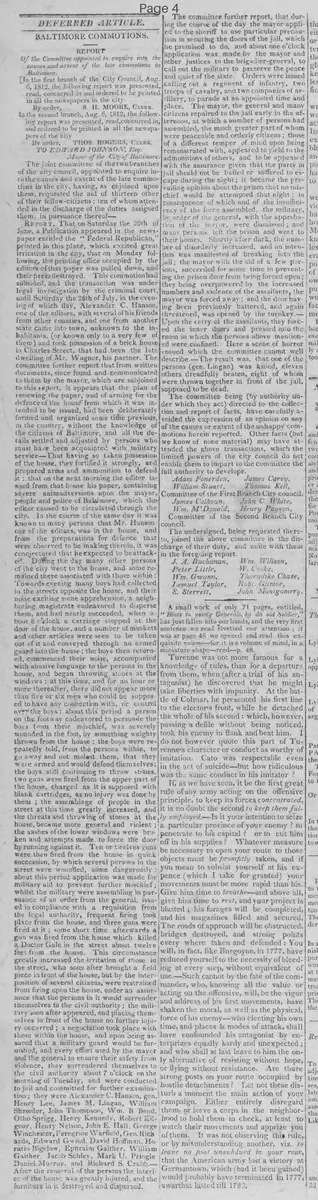
REPORT, That on Saturday the 20th of June, a Publication appeared in the newspaper entitled the "Federal Republican," printed in this place, which excited great irritation in the city, that on Monday following, the printing office occupied by the editors of that paper was pulled down, and their press destroyed. This commotion had subsided, and the transaction was under legal investigation by the criminal court, until Saturday the 25th of July, in the evening of which day, Alexander C. Hanson, one of the editors, with several of his friends from other counties, and one from another state came into town, unknown to the inhabitants, (or known only to a very few of them) and took possession of a brick house in Charles Street, that had been the late dwelling of Mr. Wagner, his partner. The committee further report that from written documents, since found and communicated to them by the mayor, which are subjoined to this report, it appears that the plan of renewing the paper, and of arming for the defence of the house from which it was intended to be issued, had been deliberately formed and organized some time previous, in the country, without the knowledge of the citizens of Baltimore, and all the details settled and adjusted by persons who must have been acquainted with military service—That having so taken possession of the house, they fortified it strongly, and prepared arms and ammunition to defend it: that on the next morning the editor issued from that house his paper, containing severe animadversions upon the mayor, people and police of Baltimore, which the editor caused to be circulated through the city. In the course of the same day it was known to many persons that Mr. Hanson one of the editors, was in the house, and from the preparations for defence that were observed to be making therein, it was conjectured that he expected to be attacked. During the day many other persons of the city went to the house, and some remained there associated with those within: Towards evening many boys had collected in the streets opposite the house, and their noise exciting some apprehension, a neighboring magistrate endeavored to disperse them, and had nearly succeeded, when about 8 o'clock a Carriage stopped at the door of the house, and a number of muskets and other articles were seen to be taken out of it and conveyed through an armed guard into the house: the boys then returned, commenced their noise, accompanied with abusive language to the persons in the house, and began throwing stones at the windows: at this time, and for an hour or more thereafter, there did not appear more than five or six men who could be supposed to have any connection with, or control over the boys: about this period a person on the footway endeavored to persuade the boys from their mischief, was severely wounded in the foot, by something weighty thrown from the house: the boys were repeatedly told, from the persons within, to go away and not molest them, that they were armed and would defend themselves; the boys still continuing to throw stones, two guns were fired from the upper part of the house, charged as it is supposed with blank cartridges, as no injury was done by them; the assemblage of people in the street at this time greatly increased, and the threats and throwing of stones at the house, became more general and violent; the sashes of the lower windows were broken and attempts made to force the door by running against it. Ten or twelve guns were then fired from the house in quick succession, by which several persons in the street were wounded, some dangerously: about this period application was made for military aid to prevent further mischief; whilst the military were assembling in pursuance of an order from the general, issued in compliance with a requisition from the legal authority, frequent firing took place from the house, and three guns were fired at it; some short time afterwards a gun was fired from the house which killed a Doctor Gale in the street about twelve feet from the house. This circumstance greatly increased the irritation of those in the street, who soon after brought a field piece in front of the house, but by the interposition of several citizens, were restrained from firing upon the house, under an assurance that the persons in it would surrender themselves to the civil authority; the military soon after appeared, and placing themselves in front of the house no further injury occurred; a negociation took place with those within the house, and upon being assured that a military guard would be furnished, and every effort used by the mayor and the general to ensure their safety from violence, they surrendered themselves to the civil authority about 7 o'clock on the morning of Tuesday, and were conducted to jail and committed for further examination; they were Alexander C. Hanson, gen. Henry Lee, James M. Lingan, William Shroeder, John Thompson, Wm. B. Bond, Otho Sprigg, Henry Kennedy, Robert Kilgour, Henry Nelson, John E. Hall, George Winchester, Peregrine Warfield, Geo. Richards, Edward Grundy, David Hoffman, Horatio Bigelow, Ephraim Gaither, William Gaither, Jacob Schley, Mark U. Pringle, Daniel Murray, and Richard S. Crabb.—After the removal of the persons the interior of the house was greatly injured, and the furniture in it destroyed and dispersed.
What sub-type of article is it?
What keywords are associated?
What entities or persons were involved?
Where did it happen?
Domestic News Details
Primary Location
Baltimore
Event Date
June 20, 1812 And July 25, 1812
Key Persons
Outcome
several persons wounded, some dangerously; doctor gale killed; house interior greatly injured and furniture destroyed; 24 persons including alexander c. hanson surrendered and committed to jail for examination.
Event Details
A publication in the Federal Republican newspaper on June 20, 1812, irritated the city, leading to the destruction of its printing office on the following Monday. On July 25, 1812, editor Alexander C. Hanson and associates fortified a house in Charles Street, issued a critical paper, and defended against a mob of boys and others throwing stones. Shots fired from the house wounded several and killed Dr. Gale; military intervened, leading to surrender.