Thank you for visiting SNEWPapers!
Sign up free
Daily National Intelligencer
Washington, District Of Columbia
What is this article about?
The American Navigation Act of March 1, 1817, takes effect on October 1, 1817, regulating imports, vessel usage, fisheries bounties, and tonnage duties to promote U.S. shipping. Includes full act text and Treasury circular clarifying provisions, noting impacts on trade with Britain and Sweden.
Merged-components note: These components form a single news article on the new American Navigation Act, including the republished act text and the accompanying explanatory circular from the Treasury Department.
Clipping
OCR Quality
Full Text
WEDNESDAY, OCTOBER 1.
AMERICAN NAVIGATION ACT.
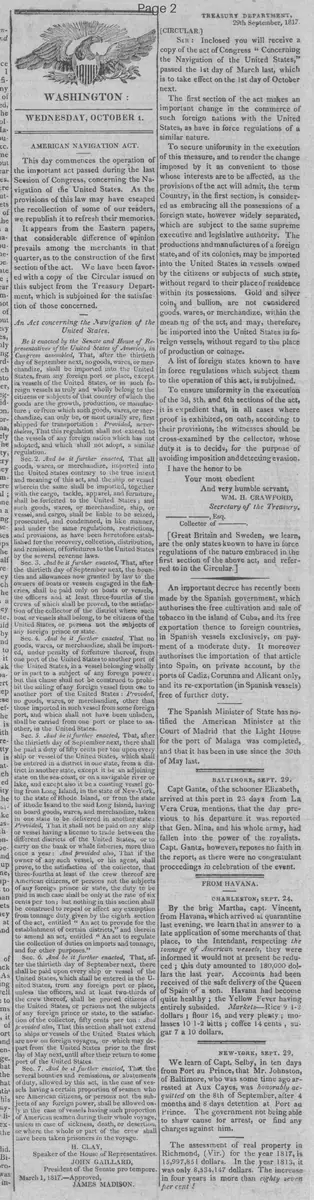
This day commences the operation of the important act passed during the last Session of Congress, concerning the Navigation of the United States. As the provisions of this law may have escaped the recollection of some of our readers, we republish it to refresh their memories. It appears from the Eastern papers, that considerable difference of opinion prevails among the merchants in that quarter, as to the construction of the first section of the act. We have been favored with a copy of the Circular issued on this subject from the Treasury Department, which is subjoined for the satisfaction of those concerned.
An Act concerning the Navigation of the United States.
Be it enacted by the Senate and House of Representatives of the United States of America, in Congress assembled, That, after the thirtieth day of September next, no goods, wares, or merchandise, shall be imported into the United States, from any foreign port or place, except in vessels of the United States, or in such foreign vessels as truly and wholly belong to the citizens or subjects of that country of which the goods are the growth, production, or manufacture; or from which such goods, wares, or merchandise, can only be, or most usually are, first shipped for transportation: Provided, nevertheless, That this regulation shall not extend to the vessels of any foreign nation which has not adopted, and which shall not adopt, a similar regulation.
Sec. 2. And be it further enacted, That all goods, wares, or merchandise, imported into the United States contrary to the true intent and meaning of this act, and the ship or vessel wherein the same shall be imported, together with the cargo, tackle, apparel, and furniture, shall be forfeited to the United States; and such goods, wares, or merchandise, ship, or vessel, and cargo, shall be liable to be seized, prosecuted, and condemned, in like manner, and under the same regulations, restrictions, and provisions, as have been heretofore established for the recovery, collection, distribution, and remission, of forfeitures to the United States by the several revenue laws.
Sec. 3. And be it further enacted, That, after the thirtieth day of September next, the bounties and allowances now granted by law to the owners of boats or vessels engaged in the fisheries, shall be paid only on boats or vessels, the officers and at least three-fourths of the crews of which shall be proved, to the satisfaction of the collector of the district where such boat or vessel shall belong, to be citizens of the United States, or persons not the subjects of any foreign prince or state.
Sec. 4. And be it further enacted, That no goods, wares, or merchandise, shall be imported, under penalty of forfeiture thereof, from one port of the United States to another port of the United States, in a vessel belonging wholly or in part to a subject of any foreign power; but this clause shall not be construed to prohibit the sailing of any foreign vessel from one to another port of the United States: Provided no goods, wares, or merchandise, other than those imported in such vessel from some foreign port, and which shall not have been unladen, shall be carried from one port or place to another, in the United States.
Sec. 5. And be it further enacted, That, after the thirtieth day of September next, there shall be paid a duty of fifty cents per ton upon every ship or vessel of the United States, which shall be entered in a district in one state, from a district in another state, except it be an adjoining state on the sea-coast, or on a navigable river or lake, and except also it be a coasting vessel going from Long Island, in the state of New-York, to the state of Rhode Island, or from the state of Rhode Island to the said Long Island, having on board goods, wares, and merchandise, taken in one state to be delivered in another state: Provided, That it shall not be paid on any ship or vessel having a license to trade between the different districts of the United States, or to carry on the bank or whale fisheries, more than once a year: And provided also, That if the owner of any such vessel, or his agent, shall prove, to the satisfaction of the collector, that three-fourths at least of the crew thereof are American citizens, or persons not the subjects of any foreign prince or state, the duty to be paid in such case shall be only at the rate of six cents per ton; but nothing in this section shall be construed to repeal or affect any exemption from tonnage duty given by the eighth section of the act, entitled "An act to provide for the establishment of certain districts," and therein to amend an act, entitled "An act to regulate the collection of duties on imports and tonnage and for other purposes."
Sec. 6. And be it further enacted. That, after the thirtieth day of September next, there shall be paid upon every ship or vessel of the United States, which shall be entered in the United States, from any foreign port or place, unless the officers, and at least two-thirds of the crew thereof, shall be proved citizens of the United States, or persons not the subjects of any foreign prince or state, to the satisfaction of the collector, fifty cents per ton: And provided also, That this section shall not extend to ships or vessels of the United States which are now on foreign voyages, or which may depart from the United States prior to the first day of May next, until after their return to some port of the United States.
Sec. 7. And be it further enacted, That the several bounties and remissions, or abatements of duty, allowed by this act, in the case of vessels having a certain proportion of seamen who are American citizens, or persons not the subjects of any foreign power, shall be allowed only in the case of vessels having such proportion of American seamen during their whole voyage, unless in case of sickness, death, or desertion, or where the whole or part of the crew shall have been taken prisoners in the voyage.
H. CLAY,
Speaker of the House of Representatives.
JOHN GAILLARD,
President of the Senate pro tempore.
March 1, 1817.—Approved,
JAMES MADISON
TREASURY DEPARTMENT:
29th September, 1817.
[CIRCULAR.]
Sir: Inclosed you will receive a copy of the act of Congress "Concerning the Navigation of the United States," passed the 1st day of March last, which is to take effect on the 1st day of October next.
The first section of the act makes an important change in the commerce of such foreign nations with the United States, as have in force regulations of a similar nature.
To secure uniformity in the execution of this measure, and to render the change imposed by it as convenient to those whose interests are to be affected, as the provisions of the act will admit, the term Country, in the first section, is considered as embracing all the possessions of a foreign state, however widely separated, which are subject to the same supreme executive and legislative authority. The productions and manufactures of a foreign state, and of its colonies, may be imported into the United States in vessels owned by the citizens or subjects of such state, without regard to their place of residence within its possessions. Gold and silver coin, and bullion, are not considered goods, wares, or merchandise, within the meaning of the act, and may, therefore, be imported into the United States in foreign vessels, without regard to the place of production or coinage.
A list of foreign states known to have in force regulations which subject them to the operation of this act, is subjoined.
To ensure uniformity in the execution of the 3d, 5th, and 6th sections of the act, it is expedient that, in all cases where proof is exhibited, on oath, according to their provisions, the witnesses should be cross-examined by the collector, whose duty it is to decide, for the purpose of avoiding imposition and detecting evasion,
I have the honor to be
Your most obedient
And very humble servant,
WM. H. CRAWFORD,
Secretary of the Treasury.
, Esq.
Collector of
[Great Britain and Sweden, we learn, are the only states known to have in force regulations of the nature embraced in the first section of the above act, and referred to in the Circular.]
What sub-type of article is it?
What keywords are associated?
What entities or persons were involved?
Where did it happen?
Domestic News Details
Primary Location
Washington
Event Date
October 1, 1817
Key Persons
Outcome
the act regulates imports to u.s. vessels or those of the originating country, imposes forfeitures for violations, restricts fisheries bounties and coastwise trade to u.s.-crewed vessels, and levies tonnage duties unless crews meet citizenship requirements; affects trade with nations like great britain and sweden having similar regulations.
Event Details
The Navigation Act passed March 1, 1817, commences operation on October 1, 1817, limiting foreign imports to U.S. or originating country vessels, with exceptions for nations without similar rules. It includes provisions for forfeitures, fisheries bounties requiring U.S. crews, prohibitions on foreign vessels in coastwise trade carrying U.S. goods, tonnage duties on inter-state and foreign-entry vessels unless crews are sufficiently American, and clarifications via Treasury circular on uniformity and affected nations.