Thank you for visiting SNEWPapers!
Sign up free
Story
March 2, 1914
The Hattiesburg News
Hattiesburg, Forrest County, Perry County, Mississippi
What is this article about?
The U.S. Department of Agriculture advises farmers on recognizing and preventing hog cholera in pigs, stressing early detection, isolation of sick animals, and prompt serum treatment to reduce losses, as it causes 90% of hog deaths.
Clipping
OCR Quality
95%
Excellent
Full Text
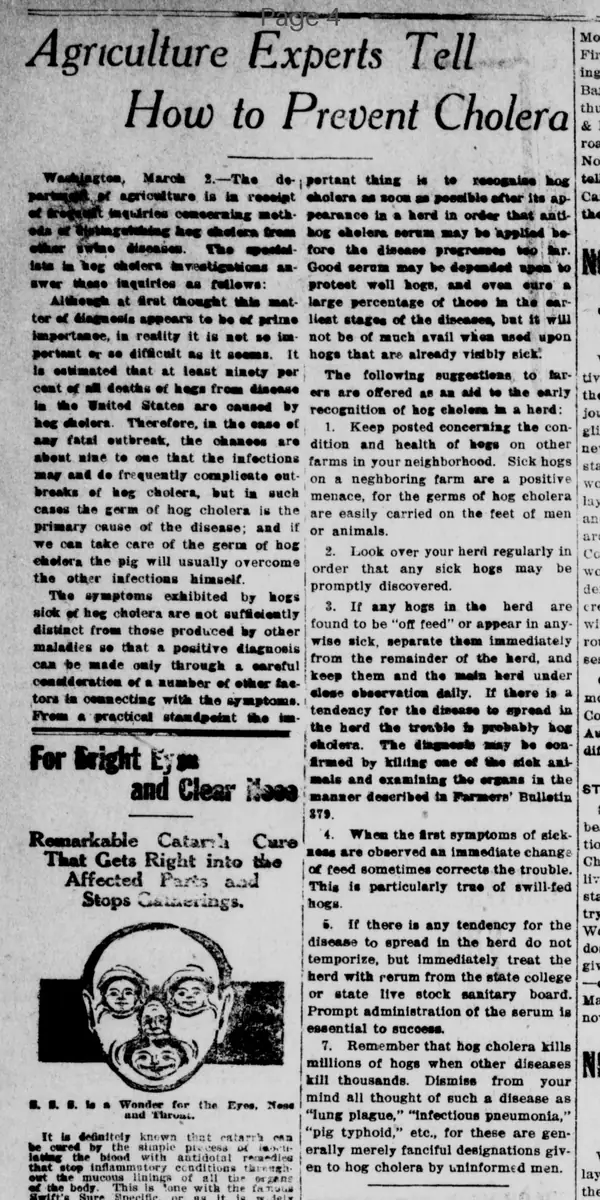
Agriculture Experts Tell How to Prevent Cholera
Washington, March 2.—The Department of Agriculture is receiving many inquiries concerning methods of freeing hogs from disease. The hog cholera investigations answer as follows:
At first thought the matter appears to be of serious importance, in reality it is not so important as it seems. It should be stated that at least ninety per cent of the losses of hogs from disease in the United States are caused by hog cholera.
Therefore, in the case of a fatal outbreak, the chances are about nine to one that the infection may be hog cholera. Other diseases do frequently complicate outbreaks of hog cholera, but in such cases the germ of hog cholera is the primary cause of the disease; and if we can take care of the germ of hog cholera the pig will usually overcome the other infections himself.
The symptoms exhibited by hogs sick with hog cholera are not sufficiently distinct from those produced by other maladies so that a positive diagnosis can be made only through a careful consideration of a number of other factors in connection with the symptoms.
From a practical standpoint the important thing is to recognize hog cholera as soon as possible after its appearance in a herd in order that anti-hog cholera serum may be applied before it is too late.
Good serum properly applied will protect well hogs, cure a large percentage of those in the earliest stages of the disease, but it will not be of much avail when used upon hogs that are already visibly sick.
The following suggestions to farmers are offered as an aid to the early recognition of hog cholera in a herd:
1. Keep posted concerning the condition and health of hogs on other farms in your neighborhood. Sick hogs on a neighboring farm are a positive menace, for the germs of hog cholera are easily carried on the feet of men or animals.
2. Look over your herd regularly in order that any sick hogs may be promptly discovered.
3. If any hogs in the herd are found to be "off feed" or appear in any wise sick, separate them immediately from the remainder of the herd, and keep them and the main herd under close observation daily. If there is a tendency for the disease to spread in the herd the trouble is probably hog cholera. The diagnosis may be confirmed by killing one of the sick animals and examining the organs in the manner described in Farmers' Bulletin 879.
4. When the first symptoms of sickness are observed an immediate change of feed sometimes corrects the trouble. This is particularly true of swill-fed hogs.
5. If there is any tendency for the disease to spread in the herd do not temporize, but immediately treat the herd with serum from the state college or state live stock sanitary board. Prompt administration of the serum is essential to success.
7. Remember that hog cholera kills millions of hogs when other diseases kill thousands. Dismiss from your mind all thought of such a disease as "lung plague," "infectious pneumonia," "pig typhoid," etc., for these are generally merely fanciful designations given to hog cholera by uninformed men.
Washington, March 2.—The Department of Agriculture is receiving many inquiries concerning methods of freeing hogs from disease. The hog cholera investigations answer as follows:
At first thought the matter appears to be of serious importance, in reality it is not so important as it seems. It should be stated that at least ninety per cent of the losses of hogs from disease in the United States are caused by hog cholera.
Therefore, in the case of a fatal outbreak, the chances are about nine to one that the infection may be hog cholera. Other diseases do frequently complicate outbreaks of hog cholera, but in such cases the germ of hog cholera is the primary cause of the disease; and if we can take care of the germ of hog cholera the pig will usually overcome the other infections himself.
The symptoms exhibited by hogs sick with hog cholera are not sufficiently distinct from those produced by other maladies so that a positive diagnosis can be made only through a careful consideration of a number of other factors in connection with the symptoms.
From a practical standpoint the important thing is to recognize hog cholera as soon as possible after its appearance in a herd in order that anti-hog cholera serum may be applied before it is too late.
Good serum properly applied will protect well hogs, cure a large percentage of those in the earliest stages of the disease, but it will not be of much avail when used upon hogs that are already visibly sick.
The following suggestions to farmers are offered as an aid to the early recognition of hog cholera in a herd:
1. Keep posted concerning the condition and health of hogs on other farms in your neighborhood. Sick hogs on a neighboring farm are a positive menace, for the germs of hog cholera are easily carried on the feet of men or animals.
2. Look over your herd regularly in order that any sick hogs may be promptly discovered.
3. If any hogs in the herd are found to be "off feed" or appear in any wise sick, separate them immediately from the remainder of the herd, and keep them and the main herd under close observation daily. If there is a tendency for the disease to spread in the herd the trouble is probably hog cholera. The diagnosis may be confirmed by killing one of the sick animals and examining the organs in the manner described in Farmers' Bulletin 879.
4. When the first symptoms of sickness are observed an immediate change of feed sometimes corrects the trouble. This is particularly true of swill-fed hogs.
5. If there is any tendency for the disease to spread in the herd do not temporize, but immediately treat the herd with serum from the state college or state live stock sanitary board. Prompt administration of the serum is essential to success.
7. Remember that hog cholera kills millions of hogs when other diseases kill thousands. Dismiss from your mind all thought of such a disease as "lung plague," "infectious pneumonia," "pig typhoid," etc., for these are generally merely fanciful designations given to hog cholera by uninformed men.
What sub-type of article is it?
Curiosity
Medical Curiosity
What themes does it cover?
Misfortune
Recovery
What keywords are associated?
Hog Cholera
Prevention
Serum Treatment
Agriculture
Hog Disease
Farm Advice
What entities or persons were involved?
Department Of Agriculture
Where did it happen?
Washington
Story Details
Key Persons
Department Of Agriculture
Location
Washington
Event Date
March 2
Story Details
The Department of Agriculture provides practical suggestions for farmers to recognize and prevent hog cholera outbreaks in herds through monitoring, isolation, feed changes, and timely serum treatment.