Thank you for visiting SNEWPapers!
Sign up free
Story
September 7, 1903
The Vinita Daily Chieftain
Vinita, Craig County, Oklahoma
What is this article about?
Italian botanist G. Albo from Palermo gardens investigates nicotine in tobacco, finding it acts as a nutrient essential for the plant's nutrition rather than a waste product. It transforms from a solanin-like substance in seeds during germination and varies with plant conditions like preventing flowering.
Clipping
OCR Quality
98%
Excellent
Full Text
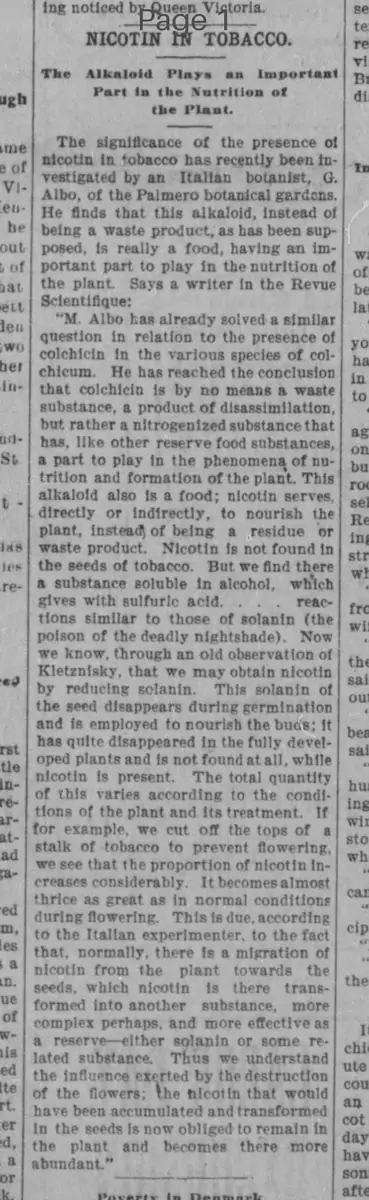
NICOTIN IN TOBACCO.
The Alkaloid Plays an Important Part in the Nutrition of the Plant.
The significance of the presence of nicotin in tobacco has recently been investigated by an Italian botanist, G. Albo, of the Palermo botanical gardens. He finds that this alkaloid, instead of being a waste product, as has been supposed, is really a food, having an important part to play in the nutrition of the plant. Says a writer in the Revue Scientifique:
"M. Albo has already solved a similar question in relation to the presence of colchicin in the various species of colchicum. He has reached the conclusion that colchicin is by no means a waste substance, a product of disassimilation, but rather a nitrogenized substance that has, like other reserve food substances, a part to play in the phenomena of nutrition and formation of the plant. This alkaloid also is a food: nicotin serves, directly or indirectly, to nourish the plant, instead of being a residue or waste product. Nicotin is not found in the seeds of tobacco. But we find there a substance soluble in alcohol, which gives with sulphuric acid reactions similar to those of solanin (the poison of the deadly nightshade). Now we know, through an old observation of Kletznisky, that we may obtain nicotin by reducing solanin. This solanin of the seed disappears during germination and is employed to nourish the buds: it has quite disappeared in the fully developed plants and is not found at all, while nicotin is present. The total quantity of this varies according to the conditions of the plant and its treatment. If, for example, we cut off the tops of a stalk of tobacco to prevent flowering, we see that the proportion of nicotin increases considerably. It becomes almost thrice as great as in normal conditions during flowering. This is due, according to the Italian experimenter, to the fact that, normally, there is a migration of nicotin from the plant towards the seeds, which nicotin is there transformed into another substance, more complex perhaps, and more effective as a reserve—either solanin or some related substance. Thus we understand the influence exerted by the destruction of the flowers: the nicotin that would have been accumulated and transformed in the seeds is now obliged to remain in the plant and becomes there more abundant."
The Alkaloid Plays an Important Part in the Nutrition of the Plant.
The significance of the presence of nicotin in tobacco has recently been investigated by an Italian botanist, G. Albo, of the Palermo botanical gardens. He finds that this alkaloid, instead of being a waste product, as has been supposed, is really a food, having an important part to play in the nutrition of the plant. Says a writer in the Revue Scientifique:
"M. Albo has already solved a similar question in relation to the presence of colchicin in the various species of colchicum. He has reached the conclusion that colchicin is by no means a waste substance, a product of disassimilation, but rather a nitrogenized substance that has, like other reserve food substances, a part to play in the phenomena of nutrition and formation of the plant. This alkaloid also is a food: nicotin serves, directly or indirectly, to nourish the plant, instead of being a residue or waste product. Nicotin is not found in the seeds of tobacco. But we find there a substance soluble in alcohol, which gives with sulphuric acid reactions similar to those of solanin (the poison of the deadly nightshade). Now we know, through an old observation of Kletznisky, that we may obtain nicotin by reducing solanin. This solanin of the seed disappears during germination and is employed to nourish the buds: it has quite disappeared in the fully developed plants and is not found at all, while nicotin is present. The total quantity of this varies according to the conditions of the plant and its treatment. If, for example, we cut off the tops of a stalk of tobacco to prevent flowering, we see that the proportion of nicotin increases considerably. It becomes almost thrice as great as in normal conditions during flowering. This is due, according to the Italian experimenter, to the fact that, normally, there is a migration of nicotin from the plant towards the seeds, which nicotin is there transformed into another substance, more complex perhaps, and more effective as a reserve—either solanin or some related substance. Thus we understand the influence exerted by the destruction of the flowers: the nicotin that would have been accumulated and transformed in the seeds is now obliged to remain in the plant and becomes there more abundant."
What sub-type of article is it?
Curiosity
What themes does it cover?
Nature
What keywords are associated?
Nicotine
Tobacco
Plant Nutrition
Alkaloid
Botanical Research
Solanin
What entities or persons were involved?
G. Albo
Kletznisky
Where did it happen?
Palermo Botanical Gardens
Story Details
Key Persons
G. Albo
Kletznisky
Location
Palermo Botanical Gardens
Event Date
Recently
Story Details
G. Albo discovers that nicotine in tobacco is a nutrient playing a key role in plant nutrition, transforming from a solanin-like substance in seeds during germination, with quantities varying based on plant conditions such as preventing flowering to increase nicotine levels.