Thank you for visiting SNEWPapers!
Sign up free
Literary
September 13, 1850
Southern Christian Advocate
Charleston, Charleston County, South Carolina
What is this article about?
Descriptive essay on scenic rides around Columbia, S.C., particularly to Chalk Hill, featuring beautiful landscapes, historical residences of figures like Pierce M. Butler and Thomas Cooper, community life, and a poignant story of a French widow's conversion and resilience through faith.
Clipping
OCR Quality
95%
Excellent
Full Text
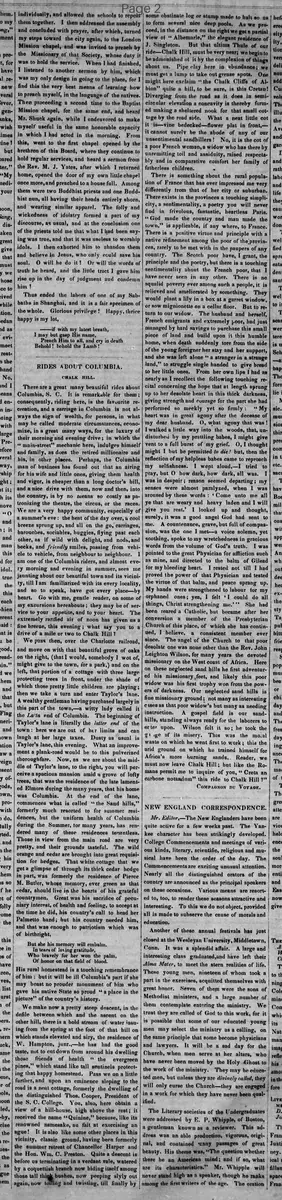
RIDES ABOUT COLUMBIA.
CHALK HILL.
There are a great many beautiful rides about Columbia, S. C. It is remarkable for them; consequently, riding here, is the favourite recreation, and a carriage in Columbia is not always the sign of wealth, or persons, in what may be called moderate circumstances, economize, in a great many ways, for the luxury of their morning and evening drive; in which the "main-street" mechanic here, indulges himself and family, as does the retired millionaire and his, in other places. Perhaps, the Columbia man of business has found out that an airing for his wife and little ones, giving them health and vigor, is cheaper than a long doctor's bill, and a nice drive with them, now and then, into the country, is by no means so costly as patronizing the theatre, the circus, or the races.
We are a very happy community, especially of a summer's eve: the heat of the day over, a cool breeze sprung up, and all on the go, carriages, barouches, sociables, buggies, flying past each other, as if wild with delight, and nods, and becks, and friendly smiles, passing from vehicle to vehicle, from neighbour to neighbour. I am one of the Columbia riders, and almost every morning and evening in summer, sees me jaunting about our beautiful town and its vicinity, till I am familiarized with its every locality, and so to speak, have got every place-by heart. Go with me, gentle reader, on some of my excursions hereabouts; they may be of service to your appetite, and to your heart. The extremely rarified air of noon has given us a fine breeze, this evening; what say you to a drive of a mile or two to Chalk Hill?
We pass then, over the Charlotte railroad, and move on with that beautiful grove of oaks on the right, (that I would, somebody I wot of, might give to the town, for a park,) and on the left, that portion of a cottage with three large protecting trees in front, under the shade of which those pretty little children are playing; then we take a turn and enter Taylor's lane. A wealthy gentleman having purchased largely in this part of the town, a witty lady called it the La'la end of Columbia. The beginning of Taylor's lane is literally the latter end of the town: here we are out of her limits and can laugh at her large taxes. Dusty as usual is Taylor's lane, this evening. What an improvement a plank-road would be to this pulverized thoroughfare. Now, as we are about the middle of Taylor's lane, to the right, you will perceive a spacious mansion amid a grove of lofty trees, that was the residence of the late lamented Elmore during the many years, that his home was Columbia. At the end of the lane, commences what is called "the Sand hills," formerly much resorted to for summer residences, but the uniform health of Columbia during the Summer, for many years, has rendered many of these residences tenantless.
Those in view from the main road are very pretty, and their grounds tasteful. The wild orange and cedar are brought into great requisition for hedges. That white cottage that we get a glimpse of through its thick cedar hedge in part, was formerly the residence of Pierce M. Butler, whose memory, ever green as that cedar, should live in the hearts of his grateful countrymen. Great was his sacrifice of pecuniary interest, of health and feeling, to accept at the time he did, his country's call to head her Palmetto band; but his country needed him, and that was enough to patriotism which was of birthright.
But she his memory will embalm.
In tears of loving gratitude,
Who bravely for her won the palm,
Of honor on that field of blood.
His rural homestead is a touching remembrance of him: but it will be ill Columbia's part if she may boast no prouder monument of him who gave his native State so proud "a place in the picture" of the country's history.
We make now a pretty steep descent, in the defile between which and the ascent on the other hill, there is a bold stream of water issuing from the spring at the foot of that hill on which stands elevated and airy, the residence of W. Hampton, junr., he has had the good taste, not to cut down from around his dwelling those friends of health "the evergreen pines," which stand like tall sentinels protecting that happy homestead. Pass we on a little further, and upon an eminence sloping to the road is a neat cottage, formerly the dwelling of the distinguished Thos. Cooper, President of the S. C. College. You, also, here obtain a view of a hill-house, high above the rest; it received the name "Quinine," because, like its renowned namesake, au fait at exorcising an ague! It is also like some other places in this vicinity, classic ground, having been formerly the summer retreat of Chancellor Harper and the Hon. Wm. C. Preston. Quite a descent is before us terminating in a verdant vale, watered by a coquettish branch now hiding itself among those tall thick bushes, now peeping slyly out again, now toiling and twisting, till finally by some obstinate log or stump made to halt so as to form several nice deep pools. As we proceed, in the distance on the right we get a partial view of "Albemarle," the elegant residence of J. Singleton. But that ultima Thule of our ride-Chalk Hill, must be very near; we begin to be admonished of it by the complexion of things about us. Pipe clay here in abundance; we must get a lump to take out grease spots. One might here exclaim "the Chalk Cliffs of Albion" quite a hill, to be sure, is this Cretan! Diverging from the road as it does in semi-circular elevation a concavity is thereby formed making a sheltered nook for that small cottage by the road side. What a neat little cot it is-vine bedecked-flower plat in front, it cannot surely be the abode of any of our unsentimental sandhillers! No, it is the cot of a poor French woman, a widow who has there by unremitting toil and assiduity, raised respectably and in comparative comfort her family of fatherless children.
There is something about the rural population of France that has ever impressed me very differently from that of her city or suburban. There exists in the provinces a touching simplicity, a sentimentality, a poetry you will never find in frivolous, fantastic, heartless Paris. "God made the country and man made the town," is applicable, if anywhere, to France. There is a positive virtue and principle with a native refinement among the poor of the provinces, rarely to be met with in the paupers of any country. The Scotch poor have, I grant, the principle and the poetry, but there is a touching sentimentality about the French poor, that I have never seen in any other. There is no squalid poverty ever among such a people, it is relieved and ameliorated by something. They would plant a lily in a box at a garret window, or sow mignionette on a cellar floor. But to return to our widow. The husband and herself French emigrants and extremely poor, had just managed by hard savings to purchase this small piece of land and build upon it this humble home, when death suddenly tore from the side of the young foreigner her stay and her support, and she was left alone "a stranger in a strange land," to struggle single handed to give bread to her little ones. From her own lips I had as nearly as I recollect the following touching recital concerning the hope that at length sprung up to her desolate heart in this thick darkness, giving strength and courage for the part she had performed so meekly yet so firmly: "My heart was in great agony after the decease of my dear husband. O, what agony that was! I walked a little way into the woods, that, undisturbed by my prattling babes, I might give vent to a full burst of my grief. O, I thought might I but be permitted to die! but, then the reflection of my helpless babes came to reproach my selfishness. I wept aloud,-I tried to pray, but O how dark, how dark, all was. I was in despair; reason seemed departing; my senses were almost paralyzed, when I was aroused by these words: 'Come unto me all ye that are weary and heavy laden and I will give you rest.' I looked up and thought, surely, it was a good angel God had sent to me. A countenance, grave, but full of compassion, was the one I met--a voice solemn, yet soothing, spoke to my wretchedness in gracious words from the volume of God's truth. I was pointed to the great Physician for affliction such as mine, and directed to the balm of Gilead for my bleeding heart. I rested not till I had proved the power of that Physician and tested the virtue of that balm, and peace sprang up. My hands were strengthened to labour for my orphaned ones; yea, I felt 'I could do all things, Christ strengthening me.'" She had been reared a Catholic, but became after her conversion a member of the Presbyterian Church of this place, of which she has continued, I believe, a consistent member ever since. The angel of the Church to that poor desolate one was none other than the Rev. John Leighton Wilson, for many years the devoted missionary on the West coast of Africa. Here on these neglected sand hills he first adventured his missionary feet, and likely this poor widow was his first trophy won from the powers of darkness. Our neglected sand hills is fine missionary ground; not many cases as interesting as that poor widow's but many as needing instruction. A gospel field is our sand-hills, standing always ready for the laborers to enter upon. Wilson felt it so; he took the gauge of its misery. This was the moral waste on which he went first to work; this the arid ground on which he trained himself for Africa's more burning sands. Reader, we must now leave Chalk Hill; but like the Romans permit me to inquire of you, "Creta an carbone notandum" this ride to Chalk Hill?
COMPAGNON DU VOYAGE.
CHALK HILL.
There are a great many beautiful rides about Columbia, S. C. It is remarkable for them; consequently, riding here, is the favourite recreation, and a carriage in Columbia is not always the sign of wealth, or persons, in what may be called moderate circumstances, economize, in a great many ways, for the luxury of their morning and evening drive; in which the "main-street" mechanic here, indulges himself and family, as does the retired millionaire and his, in other places. Perhaps, the Columbia man of business has found out that an airing for his wife and little ones, giving them health and vigor, is cheaper than a long doctor's bill, and a nice drive with them, now and then, into the country, is by no means so costly as patronizing the theatre, the circus, or the races.
We are a very happy community, especially of a summer's eve: the heat of the day over, a cool breeze sprung up, and all on the go, carriages, barouches, sociables, buggies, flying past each other, as if wild with delight, and nods, and becks, and friendly smiles, passing from vehicle to vehicle, from neighbour to neighbour. I am one of the Columbia riders, and almost every morning and evening in summer, sees me jaunting about our beautiful town and its vicinity, till I am familiarized with its every locality, and so to speak, have got every place-by heart. Go with me, gentle reader, on some of my excursions hereabouts; they may be of service to your appetite, and to your heart. The extremely rarified air of noon has given us a fine breeze, this evening; what say you to a drive of a mile or two to Chalk Hill?
We pass then, over the Charlotte railroad, and move on with that beautiful grove of oaks on the right, (that I would, somebody I wot of, might give to the town, for a park,) and on the left, that portion of a cottage with three large protecting trees in front, under the shade of which those pretty little children are playing; then we take a turn and enter Taylor's lane. A wealthy gentleman having purchased largely in this part of the town, a witty lady called it the La'la end of Columbia. The beginning of Taylor's lane is literally the latter end of the town: here we are out of her limits and can laugh at her large taxes. Dusty as usual is Taylor's lane, this evening. What an improvement a plank-road would be to this pulverized thoroughfare. Now, as we are about the middle of Taylor's lane, to the right, you will perceive a spacious mansion amid a grove of lofty trees, that was the residence of the late lamented Elmore during the many years, that his home was Columbia. At the end of the lane, commences what is called "the Sand hills," formerly much resorted to for summer residences, but the uniform health of Columbia during the Summer, for many years, has rendered many of these residences tenantless.
Those in view from the main road are very pretty, and their grounds tasteful. The wild orange and cedar are brought into great requisition for hedges. That white cottage that we get a glimpse of through its thick cedar hedge in part, was formerly the residence of Pierce M. Butler, whose memory, ever green as that cedar, should live in the hearts of his grateful countrymen. Great was his sacrifice of pecuniary interest, of health and feeling, to accept at the time he did, his country's call to head her Palmetto band; but his country needed him, and that was enough to patriotism which was of birthright.
But she his memory will embalm.
In tears of loving gratitude,
Who bravely for her won the palm,
Of honor on that field of blood.
His rural homestead is a touching remembrance of him: but it will be ill Columbia's part if she may boast no prouder monument of him who gave his native State so proud "a place in the picture" of the country's history.
We make now a pretty steep descent, in the defile between which and the ascent on the other hill, there is a bold stream of water issuing from the spring at the foot of that hill on which stands elevated and airy, the residence of W. Hampton, junr., he has had the good taste, not to cut down from around his dwelling those friends of health "the evergreen pines," which stand like tall sentinels protecting that happy homestead. Pass we on a little further, and upon an eminence sloping to the road is a neat cottage, formerly the dwelling of the distinguished Thos. Cooper, President of the S. C. College. You, also, here obtain a view of a hill-house, high above the rest; it received the name "Quinine," because, like its renowned namesake, au fait at exorcising an ague! It is also like some other places in this vicinity, classic ground, having been formerly the summer retreat of Chancellor Harper and the Hon. Wm. C. Preston. Quite a descent is before us terminating in a verdant vale, watered by a coquettish branch now hiding itself among those tall thick bushes, now peeping slyly out again, now toiling and twisting, till finally by some obstinate log or stump made to halt so as to form several nice deep pools. As we proceed, in the distance on the right we get a partial view of "Albemarle," the elegant residence of J. Singleton. But that ultima Thule of our ride-Chalk Hill, must be very near; we begin to be admonished of it by the complexion of things about us. Pipe clay here in abundance; we must get a lump to take out grease spots. One might here exclaim "the Chalk Cliffs of Albion" quite a hill, to be sure, is this Cretan! Diverging from the road as it does in semi-circular elevation a concavity is thereby formed making a sheltered nook for that small cottage by the road side. What a neat little cot it is-vine bedecked-flower plat in front, it cannot surely be the abode of any of our unsentimental sandhillers! No, it is the cot of a poor French woman, a widow who has there by unremitting toil and assiduity, raised respectably and in comparative comfort her family of fatherless children.
There is something about the rural population of France that has ever impressed me very differently from that of her city or suburban. There exists in the provinces a touching simplicity, a sentimentality, a poetry you will never find in frivolous, fantastic, heartless Paris. "God made the country and man made the town," is applicable, if anywhere, to France. There is a positive virtue and principle with a native refinement among the poor of the provinces, rarely to be met with in the paupers of any country. The Scotch poor have, I grant, the principle and the poetry, but there is a touching sentimentality about the French poor, that I have never seen in any other. There is no squalid poverty ever among such a people, it is relieved and ameliorated by something. They would plant a lily in a box at a garret window, or sow mignionette on a cellar floor. But to return to our widow. The husband and herself French emigrants and extremely poor, had just managed by hard savings to purchase this small piece of land and build upon it this humble home, when death suddenly tore from the side of the young foreigner her stay and her support, and she was left alone "a stranger in a strange land," to struggle single handed to give bread to her little ones. From her own lips I had as nearly as I recollect the following touching recital concerning the hope that at length sprung up to her desolate heart in this thick darkness, giving strength and courage for the part she had performed so meekly yet so firmly: "My heart was in great agony after the decease of my dear husband. O, what agony that was! I walked a little way into the woods, that, undisturbed by my prattling babes, I might give vent to a full burst of my grief. O, I thought might I but be permitted to die! but, then the reflection of my helpless babes came to reproach my selfishness. I wept aloud,-I tried to pray, but O how dark, how dark, all was. I was in despair; reason seemed departing; my senses were almost paralyzed, when I was aroused by these words: 'Come unto me all ye that are weary and heavy laden and I will give you rest.' I looked up and thought, surely, it was a good angel God had sent to me. A countenance, grave, but full of compassion, was the one I met--a voice solemn, yet soothing, spoke to my wretchedness in gracious words from the volume of God's truth. I was pointed to the great Physician for affliction such as mine, and directed to the balm of Gilead for my bleeding heart. I rested not till I had proved the power of that Physician and tested the virtue of that balm, and peace sprang up. My hands were strengthened to labour for my orphaned ones; yea, I felt 'I could do all things, Christ strengthening me.'" She had been reared a Catholic, but became after her conversion a member of the Presbyterian Church of this place, of which she has continued, I believe, a consistent member ever since. The angel of the Church to that poor desolate one was none other than the Rev. John Leighton Wilson, for many years the devoted missionary on the West coast of Africa. Here on these neglected sand hills he first adventured his missionary feet, and likely this poor widow was his first trophy won from the powers of darkness. Our neglected sand hills is fine missionary ground; not many cases as interesting as that poor widow's but many as needing instruction. A gospel field is our sand-hills, standing always ready for the laborers to enter upon. Wilson felt it so; he took the gauge of its misery. This was the moral waste on which he went first to work; this the arid ground on which he trained himself for Africa's more burning sands. Reader, we must now leave Chalk Hill; but like the Romans permit me to inquire of you, "Creta an carbone notandum" this ride to Chalk Hill?
COMPAGNON DU VOYAGE.
What sub-type of article is it?
Essay
Journey Narrative
What themes does it cover?
Nature
Patriotism
Social Manners
What keywords are associated?
Columbia Sc
Chalk Hill
Sand Hills
Historical Residences
French Widow
Missionary Work
Patriotism
Rural Life
What entities or persons were involved?
Compagnon Du Voyage.
Literary Details
Title
Rides About Columbia. Chalk Hill.
Author
Compagnon Du Voyage.
Subject
Rides About Columbia, Focusing On Chalk Hill.
Form / Style
Descriptive Prose Narrative Of Local Excursions.
Key Lines
But She His Memory Will Embalm.
In Tears Of Loving Gratitude,
Who Bravely For Her Won The Palm,
Of Honor On That Field Of Blood.
"Come Unto Me All Ye That Are Weary And Heavy Laden And I Will Give You Rest."
"God Made The Country And Man Made The Town,"