Thank you for visiting SNEWPapers!
Sign up free
Editorial
November 18, 1947
The Wilmington Morning Star
Wilmington, New Hanover County, North Carolina
What is this article about?
Editorial highlights risks of broken glass in streets to pedestrians, recounts a boy's near-death from a fall on glass saved by prompt aid, and calls for immediate cleanup to avoid hazards.
Clipping
OCR Quality
98%
Excellent
Full Text
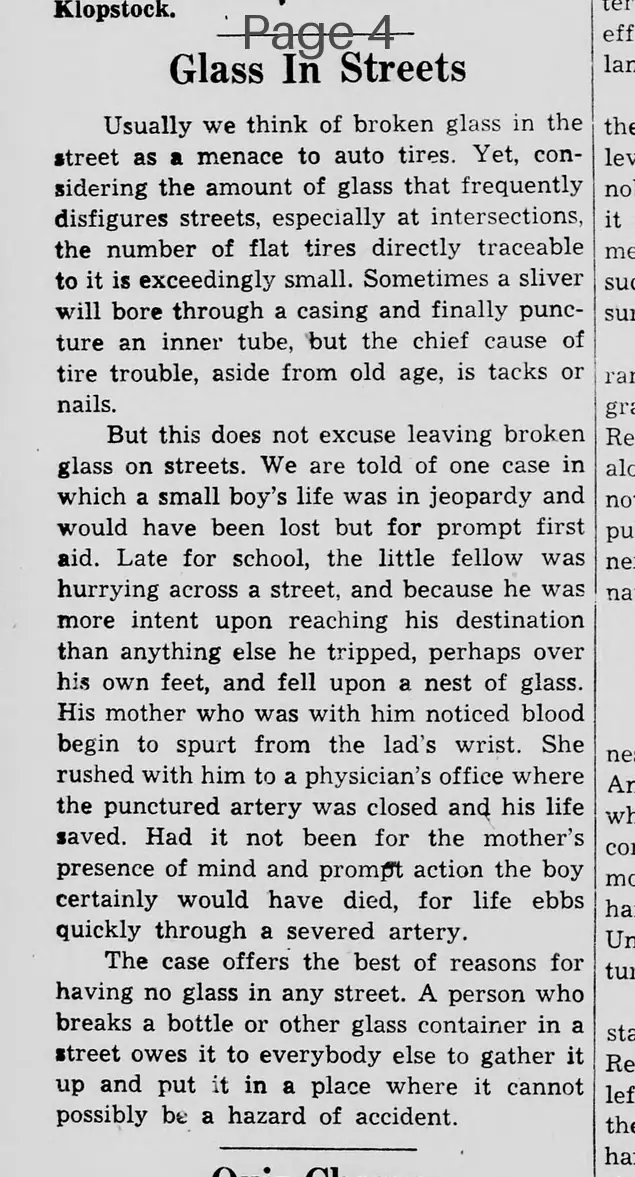
Glass In Streets
Usually we think of broken glass in the
street as a menace to auto tires. Yet, con-
sidering the amount of glass that frequently
disfigures streets, especially at intersections,
the number of flat tires directly traceable
to it is exceedingly small. Sometimes a sliver
will bore through a casing and finally punc-
ture an inner tube, but the chief cause of
tire trouble, aside from old age, is tacks or
nails.
But this does not excuse leaving broken
glass on streets. We are told of one case in
which a small boy's life was in jeopardy and
would have been lost but for prompt first
aid. Late for school. the little fellow was
hurrying across a street, and because he was
more intent upon reaching his destination
than anything else he tripped, perhaps over
his own feet, and fell upon a nest of glass.
His mother who was with him noticed blood
begin to spurt from the lad's wrist. She
rushed with him to a physician's office where
the punctured artery was closed and his life
saved. Had it not been for the mother's
presence of mind and prompt action the boy
certainly would have died, for life ebbs
quickly through a severed artery.
The case offers the best of reasons for
having no glass in any street. A person who
breaks a bottle or other glass container in a
street owes it to everybody else to gather it
up and put it in a place where it cannot
possibly be a hazard of accident.
Usually we think of broken glass in the
street as a menace to auto tires. Yet, con-
sidering the amount of glass that frequently
disfigures streets, especially at intersections,
the number of flat tires directly traceable
to it is exceedingly small. Sometimes a sliver
will bore through a casing and finally punc-
ture an inner tube, but the chief cause of
tire trouble, aside from old age, is tacks or
nails.
But this does not excuse leaving broken
glass on streets. We are told of one case in
which a small boy's life was in jeopardy and
would have been lost but for prompt first
aid. Late for school. the little fellow was
hurrying across a street, and because he was
more intent upon reaching his destination
than anything else he tripped, perhaps over
his own feet, and fell upon a nest of glass.
His mother who was with him noticed blood
begin to spurt from the lad's wrist. She
rushed with him to a physician's office where
the punctured artery was closed and his life
saved. Had it not been for the mother's
presence of mind and prompt action the boy
certainly would have died, for life ebbs
quickly through a severed artery.
The case offers the best of reasons for
having no glass in any street. A person who
breaks a bottle or other glass container in a
street owes it to everybody else to gather it
up and put it in a place where it cannot
possibly be a hazard of accident.
What sub-type of article is it?
Social Reform
What keywords are associated?
Broken Glass
Street Hazards
Public Safety
Pedestrian Injury
Clean Streets
Editorial Details
Primary Topic
Dangers Of Broken Glass In Streets
Stance / Tone
Warning And Moral Exhortation To Clean Up Glass
Key Arguments
Broken Glass Poses Serious Hazard To Pedestrians Beyond Tire Damage
Anecdote Of Boy Nearly Dying From Severed Artery After Falling On Glass
People Who Break Glass Must Clean It Up To Prevent Accidents