Thank you for visiting SNEWPapers!
Sign up free
Editorial
October 7, 1811
Alexandria Daily Gazette, Commercial & Political
Alexandria, Virginia
What is this article about?
This editorial by 'A Native American' critiques former French minister Edmond Charles Genet's recent publications on the Little Belt incident, defending Washington and Jefferson's historical distrust of him as a potential instigator of US discord and war with Britain, questioning his loyalty and exaggerated credentials amid concerns over American neutrality.
Clipping
OCR Quality
95%
Excellent
Full Text
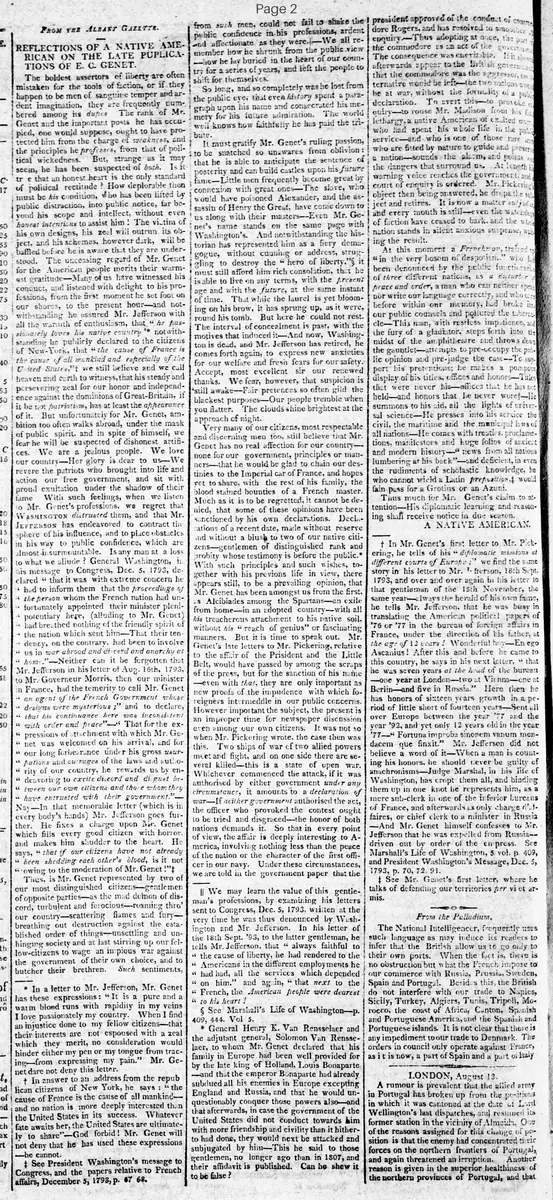
REFLECTIONS OF A NATIVE AMERICAN ON THE LATE PUBLICATIONS OF E. C. GENET.
The boldest assertors of liberty are often mistaken for the tools of faction, or if they happen to be men of sanguine temper and ardent imagination, they are frequently numbered among its dupes. The rank of Mr. Genet and the important posts he has occupied, one would suppose, ought to have protected him from the charge of weakness, and the principles he professes, from that of political wickedness. But, strange as it may seem, he has been suspected of both. Is it true that an honest heart is the only standard of political rectitude? How deplorable then must be his condition, who has been lifted by public distraction, into public notice, far beyond his scope and intellect, without even honest intentions to assist him! The victim of his own designs, his zeal will outrun its object, and his schemes, however dark, will be baffled before he is aware that they are understood. The unceasing regard of Mr. Genet for the American people merits their warmest gratitude--Many of us have witnessed his conduct, and listened with delight to his professions, from the first moment he set foot on our shores, to the present hour and notwithstanding he assured Mr. Jefferson with all the warmth of enthusiasm, that "he passionately loves his native country"--notwithstanding be publicly declared to the citizens of New-York, that "the cause of France is the cause of all mankind and especially of the United States," we still believe and we call heaven and earth to witness, that his steady and persevering zeal for our honor and independence against the dominions of Great-Britain, if it be not patriotism, has at least the appearance of it. But unfortunately for Mr. Genet, ambition too often walks abroad, under the mask of public spirit, and in spite of himself, we fear he will be suspected of dishonest artifices. We are a jealous people. We love our country-Her glory is dear to us-We revere the patriots who brought into life and action our free government, and sit with proud exultation under the shadow of their fame. With such feelings, when we listen to Mr. Genet's professions, we regret that Washington distrusted them, and that Mr. Jefferson has endeavored to contract the sphere of his influence, and to place obstacles in his way to public confidence, which are almost insurmountable. Is any man at a loss to what we allude? General Washington, in his message to Congress, Dec. 5, 1793, declared "that it was with extreme concern he had to inform them that the proceedings of the person whom the French nation had unfortunately appointed their minister plenipotentiary here, (alluding to Mr. Genet) had breathed nothing of the friendly spirit of the nation which sent him--That their tendency, on the contrary, had been to involve us in war abroad and discord and anarchy at home." Neither can it be forgotten that Mr. Jefferson in his letter of Aug. 16th, 1793, to Mr. Gouverneur Morris, then our minister in France, had the temerity to call Mr. Genet "an agent of the French Government whose designs were mysterious;" and to declare, that his continuance here was inconsistent "with order and peace"-"That for the expressions of attachment with which Mr. Genet was welcomed on his arrival, and for our long forbearance under his gross usurpations and outrages of the laws and authority of our country, he rewards us by endeavoring to excite discord and disgust between our own citizens and those whom they have entrusted with their government." Nay-In that memorable letter (which is in every body's hands) Mr. Jefferson goes further. He fixes a charge upon Mr. Genet which fills every good citizen with horror, and makes him shudder to the heart. He says, "that if our citizens have not already been shedding each other's blood, is it not owing to the moderation of Mr. Genet!" Thus, is Mr. Genet represented by two of our most distinguished citizens--gentlemen of opposite parties--as the mad demon of discord, turbulent and ferocious--roaming thro' our country--scattering flames and fury--breathing out destruction against the established order of things--unsettling and unhinging society and at last stirring up our fellow-citizens to wage an impious war against the government of their own choice, and to butcher their brethren. Such sentiments, from such men, could not fail to shake the public confidence in his professions, ardent and affectionate as they were.---We all remember how he shrunk from the public view--how he lay buried in the heart of our country for a series of years, and left the people to shift for themselves.
So long, and so completely was he lost from the public eye, that even history spent a paragraph upon his name and consecrated his memory for his future admiration. The world well knows how faithfully he has paid the tribute.
It must gratify Mr. Genet's ruling passion, to be snatched so unawares from oblivion: that he is able to anticipate the sentence of posterity and can build castles upon his future fame-Little men frequently become great by connexion with great ones--The slave, who would have poisoned Alexander, and the assassin of Henry the Great, have come down to us along with their masters--Even Mr. Genet's name stands on the same page with Washington's. And notwithstanding the historian has represented him as a fiery demagogue, without cunning or address, struggling to destroy the "hero of liberty,"s it must still afford him rich consolation, that he is able to live on any terms, with the present age and with the future, at the same instant of time. That while the laurel is yet blooming on his brow, it has sprung up, as it were, round his tomb. But here he could not rest. The interval of concealment is past, with the motives that induced it--And now, Washington is dead, and Mr. Jefferson has retired, he comes forth again, to express new anxieties for our welfare and fresh fears for our safety. Accept, most excellent sir our renewed thanks. We fear, however, that suspicion is still awake--Fair pretences so often gild the blackest purposes--Our people tremble when you flatter. The clouds shine brightest at the approach of night.
Very many of our citizens, most respectable and discerning men too, still believe that Mr. Genet has no real affection for our country-none for our government, principles or manners--that he would be glad to chain our destinies to the Imperial car of France, and hopes yet to share, with the rest of his family, the blood stained bounties of a French master. Much as it is to be regretted, it cannot be denied, that some of these opinions have been sanctioned by his own declarations. Declarations of a recent date, made without reserve and without a blush to two of our native citizens-gentlemen of distinguished rank and probity whose testimony is before the public.*
With such principles and such wishes, together with his previous life in view, there appears still, to be a prevailing opinion, that Mr. Genet has been amongst us from the first, as Alcibiades among the Spartans-an exile from home--in an adopted country--with all his treachercus attachment to his native soil, without his "reach of genius" or fascinating manners. But it is time to speak out. Mr. Genet's late letters to Mr. Pickering, relative to the affair of the President and the Little Belt, would have passed by among the scraps of the press, but for the sanction of his name-even with that, they are only important as new proofs of the impudence with which foreigners intermeddle in our public concerns. However important the subject, the present is an improper time for newspaper discussion even among our own citizens. It was not so when Mr. Pickering wrote, the case then was this. Two ships of war of two allied powers meet and fight, and on one side there are several killed this is a state of open war. Whichever commenced the attack, if it was authorised by either government under any circumstance, it amounts to a declaration of war--If neither government authorised the act, the officer who provoked the contest ought to be tried and disgraced--the honor of both nations demands it. So that in every point of view, the affair is deeply interesting to America, involving nothing less than the peace of the nation or the character of the first officer in our navy. Under these circumstances, we are told in the government paper that the president approved of the conduct of commodore Rogers, and has resolved to smother an enquiry.--Thus adopting at once, the part of the commodore as an act of the government. The consequence was creditable. if it should afterwards appear to the British government that the commodore was the aggressor, no alternative would be left--the two nations would be at war, without the formality of a public declaration. To avert this--to provoke an enquiry-to rouse Mr. Madison from his fat lethargy, a native American of exalted rank who had spent his whole life in the public service -and- who is one of those rare men who are fated by nature to guide and preserve a nation--sounds the alarm, and points out the dangers that surround us. At length his warning voice reaches the government, and a court of enquiry is ordered. Mr. Pickering object then being answered, he drops the subject and retires. It is now a matter sub judice and every mouth is still--even the watch dogs of faction have ceased to bark, and the whole nation stands in silent anxious suspense, waiting the result.
At this moment a Frenchman, trained "in the very bosom of despotism.." who had been denounced by the public functionaries of three different nations, as a disturber of peace and order, a man who can neither speak nor write our language correctly, and who ere before within our memory, had broke in upon our public counsels and polluted the Tabernacle--This man, with restless impatience, and the fury of a gladiator. steps forth into the midst of the amphitheatre and throws down the gauntlet-attempts to pre-occupy the public opinion and pre-judge the case--To support his pretensions; he makes a pompous display of his titles, offices and honors-Titles that were never his-offices that he has not held-and honors that he never wore--He summons to his aid, all the lights of universal science-He presses into his service the civil, the maritime and the municipal laws of all nations--He comes with treaties. proclamations, manifestoes and huge folios of ancient and modern history-"news from all nations lumbering at his back" -and deficient, in even the rudiments of scholastic knowledge, he who cannot wield a Latin preposition. would fain pass for a Grotius or an Vattel.
Thus much of Mr. Genet's claim to attention--His diplomatic learning and reasoning shall receive notice in due season.
A NATIVE AMERICAN.
In Mr. Genet's first letter to Mr. Pickering, he tells of his "diplomatic missions at different courts of Europe;" we find the same story in his letter to Mr. Jefferson, 18th Sept. 1793, and over and over again in his letter to that gentleman of the 15th November, the same year-always the herald of his own fame, he tells Mr. Jefferson, that he was busy in translating the American political papers of '76 or '77 in the bureau of foreign affairs in France, under the direction of his father, at the age of 12 years! Wonderful boy-En ego Ascanius! After this and before he came to this country, he says in his next letter, "that he was seven years at the head of the bureau--one year at London--two at Vienna--one at Berlin and five in Russia." Here then he has honors of sixteen years growth in a period of little short of fourteen years-Sent all over Europe between the year 77 and the year '92, and yet only 12 years old in the year '77-"Fortuna improba simonem vanum mendacem que finxit." Mr. Jefferson did not believe a word of it-When a man is counting his honors, he should never be guilty of anachronisms-Judge Marshall, in his life of Washington, has cropt them all, and binding them up in one knot he represents him, as a mere sub-clerk in one of the inferior bureaus of France, and afterwards as only charge d'affaires, or chief clerk to a minister in Russia--And Mr. Genet himself confesses to Mr. Jefferson that he was expelled from Russia--driven out by order of the empress. See Marshall's Life of Washington, 5 vol. p. 409, and President Washington's Message, Dec. 5, 1793, p. 70, 72. 91.
See Mr. Genet's first letter, where he talks of defending our territories er vi et armis.
The boldest assertors of liberty are often mistaken for the tools of faction, or if they happen to be men of sanguine temper and ardent imagination, they are frequently numbered among its dupes. The rank of Mr. Genet and the important posts he has occupied, one would suppose, ought to have protected him from the charge of weakness, and the principles he professes, from that of political wickedness. But, strange as it may seem, he has been suspected of both. Is it true that an honest heart is the only standard of political rectitude? How deplorable then must be his condition, who has been lifted by public distraction, into public notice, far beyond his scope and intellect, without even honest intentions to assist him! The victim of his own designs, his zeal will outrun its object, and his schemes, however dark, will be baffled before he is aware that they are understood. The unceasing regard of Mr. Genet for the American people merits their warmest gratitude--Many of us have witnessed his conduct, and listened with delight to his professions, from the first moment he set foot on our shores, to the present hour and notwithstanding he assured Mr. Jefferson with all the warmth of enthusiasm, that "he passionately loves his native country"--notwithstanding be publicly declared to the citizens of New-York, that "the cause of France is the cause of all mankind and especially of the United States," we still believe and we call heaven and earth to witness, that his steady and persevering zeal for our honor and independence against the dominions of Great-Britain, if it be not patriotism, has at least the appearance of it. But unfortunately for Mr. Genet, ambition too often walks abroad, under the mask of public spirit, and in spite of himself, we fear he will be suspected of dishonest artifices. We are a jealous people. We love our country-Her glory is dear to us-We revere the patriots who brought into life and action our free government, and sit with proud exultation under the shadow of their fame. With such feelings, when we listen to Mr. Genet's professions, we regret that Washington distrusted them, and that Mr. Jefferson has endeavored to contract the sphere of his influence, and to place obstacles in his way to public confidence, which are almost insurmountable. Is any man at a loss to what we allude? General Washington, in his message to Congress, Dec. 5, 1793, declared "that it was with extreme concern he had to inform them that the proceedings of the person whom the French nation had unfortunately appointed their minister plenipotentiary here, (alluding to Mr. Genet) had breathed nothing of the friendly spirit of the nation which sent him--That their tendency, on the contrary, had been to involve us in war abroad and discord and anarchy at home." Neither can it be forgotten that Mr. Jefferson in his letter of Aug. 16th, 1793, to Mr. Gouverneur Morris, then our minister in France, had the temerity to call Mr. Genet "an agent of the French Government whose designs were mysterious;" and to declare, that his continuance here was inconsistent "with order and peace"-"That for the expressions of attachment with which Mr. Genet was welcomed on his arrival, and for our long forbearance under his gross usurpations and outrages of the laws and authority of our country, he rewards us by endeavoring to excite discord and disgust between our own citizens and those whom they have entrusted with their government." Nay-In that memorable letter (which is in every body's hands) Mr. Jefferson goes further. He fixes a charge upon Mr. Genet which fills every good citizen with horror, and makes him shudder to the heart. He says, "that if our citizens have not already been shedding each other's blood, is it not owing to the moderation of Mr. Genet!" Thus, is Mr. Genet represented by two of our most distinguished citizens--gentlemen of opposite parties--as the mad demon of discord, turbulent and ferocious--roaming thro' our country--scattering flames and fury--breathing out destruction against the established order of things--unsettling and unhinging society and at last stirring up our fellow-citizens to wage an impious war against the government of their own choice, and to butcher their brethren. Such sentiments, from such men, could not fail to shake the public confidence in his professions, ardent and affectionate as they were.---We all remember how he shrunk from the public view--how he lay buried in the heart of our country for a series of years, and left the people to shift for themselves.
So long, and so completely was he lost from the public eye, that even history spent a paragraph upon his name and consecrated his memory for his future admiration. The world well knows how faithfully he has paid the tribute.
It must gratify Mr. Genet's ruling passion, to be snatched so unawares from oblivion: that he is able to anticipate the sentence of posterity and can build castles upon his future fame-Little men frequently become great by connexion with great ones--The slave, who would have poisoned Alexander, and the assassin of Henry the Great, have come down to us along with their masters--Even Mr. Genet's name stands on the same page with Washington's. And notwithstanding the historian has represented him as a fiery demagogue, without cunning or address, struggling to destroy the "hero of liberty,"s it must still afford him rich consolation, that he is able to live on any terms, with the present age and with the future, at the same instant of time. That while the laurel is yet blooming on his brow, it has sprung up, as it were, round his tomb. But here he could not rest. The interval of concealment is past, with the motives that induced it--And now, Washington is dead, and Mr. Jefferson has retired, he comes forth again, to express new anxieties for our welfare and fresh fears for our safety. Accept, most excellent sir our renewed thanks. We fear, however, that suspicion is still awake--Fair pretences so often gild the blackest purposes--Our people tremble when you flatter. The clouds shine brightest at the approach of night.
Very many of our citizens, most respectable and discerning men too, still believe that Mr. Genet has no real affection for our country-none for our government, principles or manners--that he would be glad to chain our destinies to the Imperial car of France, and hopes yet to share, with the rest of his family, the blood stained bounties of a French master. Much as it is to be regretted, it cannot be denied, that some of these opinions have been sanctioned by his own declarations. Declarations of a recent date, made without reserve and without a blush to two of our native citizens-gentlemen of distinguished rank and probity whose testimony is before the public.*
With such principles and such wishes, together with his previous life in view, there appears still, to be a prevailing opinion, that Mr. Genet has been amongst us from the first, as Alcibiades among the Spartans-an exile from home--in an adopted country--with all his treachercus attachment to his native soil, without his "reach of genius" or fascinating manners. But it is time to speak out. Mr. Genet's late letters to Mr. Pickering, relative to the affair of the President and the Little Belt, would have passed by among the scraps of the press, but for the sanction of his name-even with that, they are only important as new proofs of the impudence with which foreigners intermeddle in our public concerns. However important the subject, the present is an improper time for newspaper discussion even among our own citizens. It was not so when Mr. Pickering wrote, the case then was this. Two ships of war of two allied powers meet and fight, and on one side there are several killed this is a state of open war. Whichever commenced the attack, if it was authorised by either government under any circumstance, it amounts to a declaration of war--If neither government authorised the act, the officer who provoked the contest ought to be tried and disgraced--the honor of both nations demands it. So that in every point of view, the affair is deeply interesting to America, involving nothing less than the peace of the nation or the character of the first officer in our navy. Under these circumstances, we are told in the government paper that the president approved of the conduct of commodore Rogers, and has resolved to smother an enquiry.--Thus adopting at once, the part of the commodore as an act of the government. The consequence was creditable. if it should afterwards appear to the British government that the commodore was the aggressor, no alternative would be left--the two nations would be at war, without the formality of a public declaration. To avert this--to provoke an enquiry-to rouse Mr. Madison from his fat lethargy, a native American of exalted rank who had spent his whole life in the public service -and- who is one of those rare men who are fated by nature to guide and preserve a nation--sounds the alarm, and points out the dangers that surround us. At length his warning voice reaches the government, and a court of enquiry is ordered. Mr. Pickering object then being answered, he drops the subject and retires. It is now a matter sub judice and every mouth is still--even the watch dogs of faction have ceased to bark, and the whole nation stands in silent anxious suspense, waiting the result.
At this moment a Frenchman, trained "in the very bosom of despotism.." who had been denounced by the public functionaries of three different nations, as a disturber of peace and order, a man who can neither speak nor write our language correctly, and who ere before within our memory, had broke in upon our public counsels and polluted the Tabernacle--This man, with restless impatience, and the fury of a gladiator. steps forth into the midst of the amphitheatre and throws down the gauntlet-attempts to pre-occupy the public opinion and pre-judge the case--To support his pretensions; he makes a pompous display of his titles, offices and honors-Titles that were never his-offices that he has not held-and honors that he never wore--He summons to his aid, all the lights of universal science-He presses into his service the civil, the maritime and the municipal laws of all nations--He comes with treaties. proclamations, manifestoes and huge folios of ancient and modern history-"news from all nations lumbering at his back" -and deficient, in even the rudiments of scholastic knowledge, he who cannot wield a Latin preposition. would fain pass for a Grotius or an Vattel.
Thus much of Mr. Genet's claim to attention--His diplomatic learning and reasoning shall receive notice in due season.
A NATIVE AMERICAN.
In Mr. Genet's first letter to Mr. Pickering, he tells of his "diplomatic missions at different courts of Europe;" we find the same story in his letter to Mr. Jefferson, 18th Sept. 1793, and over and over again in his letter to that gentleman of the 15th November, the same year-always the herald of his own fame, he tells Mr. Jefferson, that he was busy in translating the American political papers of '76 or '77 in the bureau of foreign affairs in France, under the direction of his father, at the age of 12 years! Wonderful boy-En ego Ascanius! After this and before he came to this country, he says in his next letter, "that he was seven years at the head of the bureau--one year at London--two at Vienna--one at Berlin and five in Russia." Here then he has honors of sixteen years growth in a period of little short of fourteen years-Sent all over Europe between the year 77 and the year '92, and yet only 12 years old in the year '77-"Fortuna improba simonem vanum mendacem que finxit." Mr. Jefferson did not believe a word of it-When a man is counting his honors, he should never be guilty of anachronisms-Judge Marshall, in his life of Washington, has cropt them all, and binding them up in one knot he represents him, as a mere sub-clerk in one of the inferior bureaus of France, and afterwards as only charge d'affaires, or chief clerk to a minister in Russia--And Mr. Genet himself confesses to Mr. Jefferson that he was expelled from Russia--driven out by order of the empress. See Marshall's Life of Washington, 5 vol. p. 409, and President Washington's Message, Dec. 5, 1793, p. 70, 72. 91.
See Mr. Genet's first letter, where he talks of defending our territories er vi et armis.
What sub-type of article is it?
Foreign Affairs
War Or Peace
Partisan Politics
What keywords are associated?
Genet Critique
French Minister
Us Foreign Policy
Little Belt Incident
Washington Distrust
Jefferson Letter
American Neutrality
British Relations
Diplomatic Impudence
Partisan Suspicions
What entities or persons were involved?
Edmond Charles Genet
George Washington
Thomas Jefferson
Timothy Pickering
Commodore Rogers
Gouverneur Morris
Editorial Details
Primary Topic
Critique Of Edmond Charles Genet's Influence And Recent Publications
Stance / Tone
Strongly Critical Of Genet, Defensive Of Washington And Jefferson
Key Figures
Edmond Charles Genet
George Washington
Thomas Jefferson
Timothy Pickering
Commodore Rogers
Gouverneur Morris
Key Arguments
Genet's Bold Assertions Of Liberty Mask Factional Tools Or Dupes
Washington And Jefferson Rightly Distrusted Genet's Intentions To Involve Us In War And Discord
Genet's Professions Of Love For America And France Are Suspected As Ambition Under Public Spirit Mask
Genet's Past Declarations And Letters Reveal Disloyalty And Threats Against Us
Recent Letters On President And Little Belt Affair Show Impudence In Intermeddling
Genet's Diplomatic Claims Are Exaggerated And Historically Inaccurate
Us Government Appropriately Ordered Inquiry Into Little Belt Incident To Preserve Peace
Genet Denounced As Disturber Of Peace By Multiple Nations
Genet's Influence Should Be Limited To Avoid Subjugating Us To French Interests
Critique Of Genet's Attempt To Prejudge Public Opinion On Naval Affair