Thank you for visiting SNEWPapers!
Sign up free
Domestic News
March 20, 1819
Alexandria Gazette & Daily Advertiser
Alexandria, Virginia
What is this article about?
In New York, John Stuyvesant sued Jacob Barker for $15 deposited in his bank. Barker counterclaimed $53.12 from a prior overdraft discharged under state insolvent law. Jury ruled the law unconstitutional, awarding Barker $38.01 balance after applying the deposit.
Clipping
OCR Quality
95%
Excellent
Full Text
New-York, March 15.
INTERESTING LAW CASE.
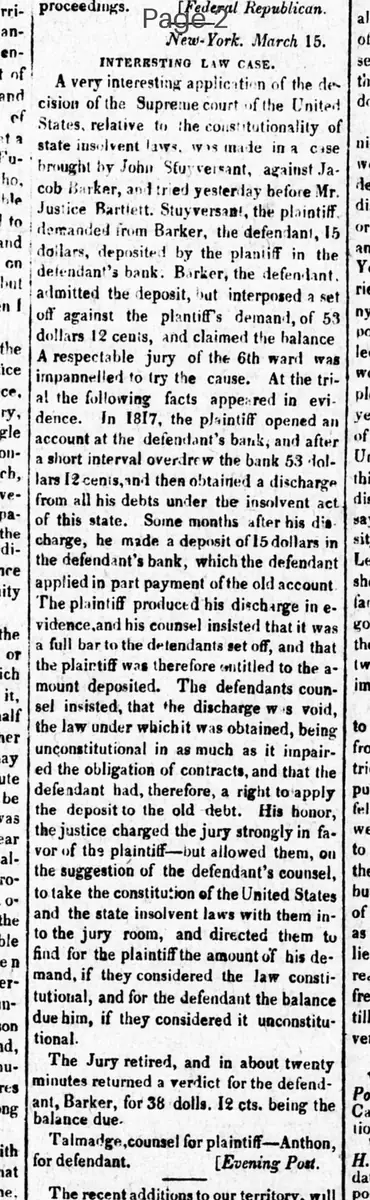
A very interesting application of the decision of the Supreme court of the United States, relative to the constitutionality of state insolvent laws, was made in a case brought by John Stuyvesant, against Jacob Barker, and tried yesterday before Mr. Justice Bartlett. Stuyvesant, the plaintiff, demanded from Barker, the defendant, 15 dollars, deposited by the plaintiff in the defendant's bank. Barker, the defendant, admitted the deposit, but interposed a set off against the plaintiff's demand, of 53 dollars 12 cents, and claimed the balance A respectable jury of the 6th ward was impanelled to try the cause. At the trial the following facts appeared in evidence. In 1817, the plaintiff opened an account at the defendant's bank; and after a short interval overdrew the bank 53 dollars 12 cents, and then obtained a discharge from all his debts under the insolvent act of this state. Some months after his discharge, he made a deposit of 15 dollars in the defendant's bank, which the defendant applied in part payment of the old account The plaintiff produced his discharge in evidence, and his counsel insisted that it was a full bar to the defendant's set off, and that the plaintiff was therefore entitled to the amount deposited. The defendant's counsel insisted, that the discharge was void, the law under which it was obtained, being unconstitutional in as much as it impaired the obligation of contracts, and that the defendant had, therefore, a right to apply the deposit to the old debt. His honor, the justice charged the jury strongly in favor of the plaintiff but allowed them, on the suggestion of the defendant's counsel, to take the constitution of the United States and the state insolvent laws with them into the jury room, and directed them to find for the plaintiff the amount of his demand, if they considered the law constitutional, and for the defendant the balance due him, if they considered it unconstitutional.
The Jury retired, and in about twenty minutes returned a verdict for the defendant, Barker, for 38 dolls. 1 cts. being the balance due.
Talmadge, counsel for plaintiff--Anthon, for defendant.
[Evening Post.]
INTERESTING LAW CASE.
A very interesting application of the decision of the Supreme court of the United States, relative to the constitutionality of state insolvent laws, was made in a case brought by John Stuyvesant, against Jacob Barker, and tried yesterday before Mr. Justice Bartlett. Stuyvesant, the plaintiff, demanded from Barker, the defendant, 15 dollars, deposited by the plaintiff in the defendant's bank. Barker, the defendant, admitted the deposit, but interposed a set off against the plaintiff's demand, of 53 dollars 12 cents, and claimed the balance A respectable jury of the 6th ward was impanelled to try the cause. At the trial the following facts appeared in evidence. In 1817, the plaintiff opened an account at the defendant's bank; and after a short interval overdrew the bank 53 dollars 12 cents, and then obtained a discharge from all his debts under the insolvent act of this state. Some months after his discharge, he made a deposit of 15 dollars in the defendant's bank, which the defendant applied in part payment of the old account The plaintiff produced his discharge in evidence, and his counsel insisted that it was a full bar to the defendant's set off, and that the plaintiff was therefore entitled to the amount deposited. The defendant's counsel insisted, that the discharge was void, the law under which it was obtained, being unconstitutional in as much as it impaired the obligation of contracts, and that the defendant had, therefore, a right to apply the deposit to the old debt. His honor, the justice charged the jury strongly in favor of the plaintiff but allowed them, on the suggestion of the defendant's counsel, to take the constitution of the United States and the state insolvent laws with them into the jury room, and directed them to find for the plaintiff the amount of his demand, if they considered the law constitutional, and for the defendant the balance due him, if they considered it unconstitutional.
The Jury retired, and in about twenty minutes returned a verdict for the defendant, Barker, for 38 dolls. 1 cts. being the balance due.
Talmadge, counsel for plaintiff--Anthon, for defendant.
[Evening Post.]
What sub-type of article is it?
Legal Or Court
What keywords are associated?
Law Case
Insolvent Act
Supreme Court Decision
New York Trial
Jury Verdict
What entities or persons were involved?
John Stuyvesant
Jacob Barker
Mr. Justice Bartlett
Talmadge
Anthon
Where did it happen?
New York
Domestic News Details
Primary Location
New York
Event Date
March 15
Key Persons
John Stuyvesant
Jacob Barker
Mr. Justice Bartlett
Talmadge
Anthon
Outcome
verdict for defendant barker for 38 dolls. 1 cts., the balance due after applying the deposit.
Event Details
John Stuyvesant sued Jacob Barker for $15 deposited in Barker's bank. Barker set off $53.12 from a 1817 overdraft discharged under state insolvent law. Jury found the law unconstitutional and awarded Barker the balance.