Thank you for visiting SNEWPapers!
Sign up free
Story
March 28, 1906
The Florida Agriculturist
Jacksonville, De Land, Duval County, Volusia County, Florida
What is this article about?
Practical advice from the Southern Planter on preventing horse shoulder sores by properly fitting and seasonally adjusting collars, with tips on soaking and personal oversight to ensure horse health during farm work.
Clipping
OCR Quality
98%
Excellent
Full Text
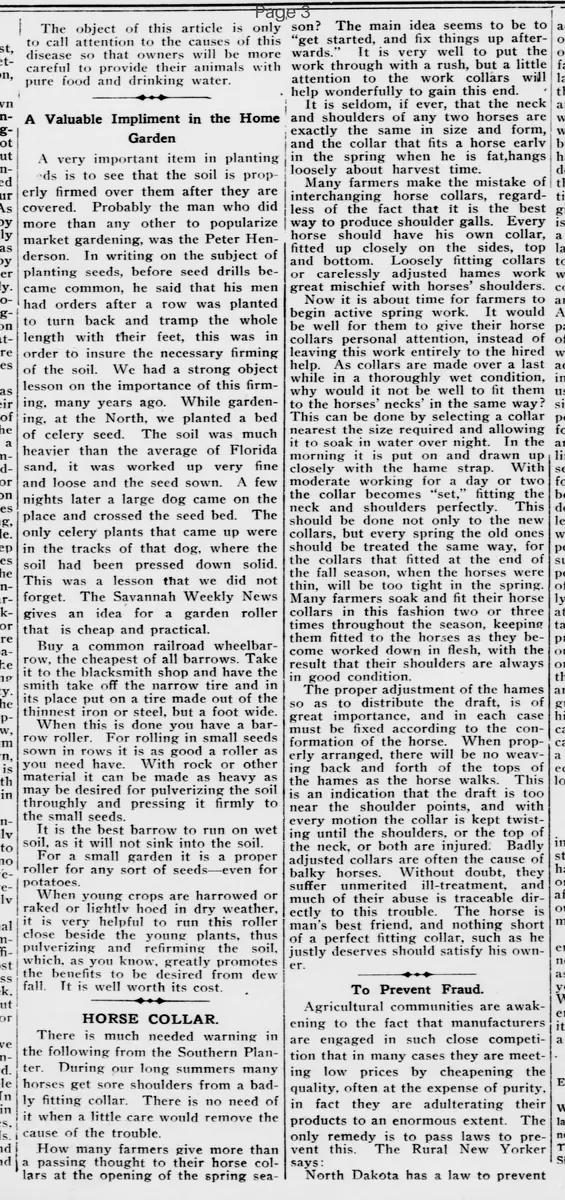
HORSE COLLAR.
There is much needed warning in the following from the Southern Planter.
During our long summers many horses get sore shoulders from a badly fitting collar. There is no need of it when a little care would remove the cause of the trouble. How many farmers give more than a passing thought to their horse collars at the opening of the spring season?
The main idea seems to be to "get started, and fix things up afterwards." It is very well to put the work through with a rush, but a little attention to the work collars will help wonderfully to gain this end. It is seldom, if ever, that the neck and shoulders of any two horses are exactly the same in size and form, and the collar that fits a horse early in the spring when he is fat, hangs loosely about harvest time. Many farmers make the mistake of interchanging horse collars, regardless of the fact that it is the best way to produce shoulder galls. Every horse should have his own collar, fitted up closely on the sides, top and bottom. Loosely fitting collars or carelessly adjusted hames work great mischief with horses' shoulders.
Now it is about time for farmers to begin active spring work. It would be well for them to give their horse collars personal attention, instead of leaving this work entirely to the hired help. As collars are made over a last while in a thoroughly wet condition, why would it not be well to fit them to the horses' necks in the same way? This can be done by selecting a collar nearest the size required and allowing it to soak in water over night. In the morning it is put on and drawn up closely with the hame strap. With moderate working for a day or two the collar becomes "set," fitting the neck and shoulders perfectly. This should be done not only to the new collars, but every spring the old ones should be treated the same way, for the collars that fitted at the end of the fall season, when the horses were thin, will be too tight in the spring. Many farmers soak and fit their horse collars in this fashion two or three times throughout the season, keeping them fitted to the horses as they become worked down in flesh, with the result that their shoulders are always in good condition.
The proper adjustment of the hames so as to distribute the draft, is of great importance, and in each case must be fixed according to the conformation of the horse. When properly arranged, there will be no weaving back and forth of the tops of the hames as the horse walks. This is an indication that the draft is too near the shoulder points, and with every motion the collar is kept twisting until the shoulders, or the top of the neck, or both are injured. Badly adjusted collars are often the cause of balky horses. Without doubt, they suffer unmerited ill-treatment, and much of their abuse is traceable directly to this trouble. The horse is man's best friend, and nothing short of a perfect fitting collar, such as he justly deserves should satisfy his owner.
There is much needed warning in the following from the Southern Planter.
During our long summers many horses get sore shoulders from a badly fitting collar. There is no need of it when a little care would remove the cause of the trouble. How many farmers give more than a passing thought to their horse collars at the opening of the spring season?
The main idea seems to be to "get started, and fix things up afterwards." It is very well to put the work through with a rush, but a little attention to the work collars will help wonderfully to gain this end. It is seldom, if ever, that the neck and shoulders of any two horses are exactly the same in size and form, and the collar that fits a horse early in the spring when he is fat, hangs loosely about harvest time. Many farmers make the mistake of interchanging horse collars, regardless of the fact that it is the best way to produce shoulder galls. Every horse should have his own collar, fitted up closely on the sides, top and bottom. Loosely fitting collars or carelessly adjusted hames work great mischief with horses' shoulders.
Now it is about time for farmers to begin active spring work. It would be well for them to give their horse collars personal attention, instead of leaving this work entirely to the hired help. As collars are made over a last while in a thoroughly wet condition, why would it not be well to fit them to the horses' necks in the same way? This can be done by selecting a collar nearest the size required and allowing it to soak in water over night. In the morning it is put on and drawn up closely with the hame strap. With moderate working for a day or two the collar becomes "set," fitting the neck and shoulders perfectly. This should be done not only to the new collars, but every spring the old ones should be treated the same way, for the collars that fitted at the end of the fall season, when the horses were thin, will be too tight in the spring. Many farmers soak and fit their horse collars in this fashion two or three times throughout the season, keeping them fitted to the horses as they become worked down in flesh, with the result that their shoulders are always in good condition.
The proper adjustment of the hames so as to distribute the draft, is of great importance, and in each case must be fixed according to the conformation of the horse. When properly arranged, there will be no weaving back and forth of the tops of the hames as the horse walks. This is an indication that the draft is too near the shoulder points, and with every motion the collar is kept twisting until the shoulders, or the top of the neck, or both are injured. Badly adjusted collars are often the cause of balky horses. Without doubt, they suffer unmerited ill-treatment, and much of their abuse is traceable directly to this trouble. The horse is man's best friend, and nothing short of a perfect fitting collar, such as he justly deserves should satisfy his owner.
What sub-type of article is it?
Agricultural Advice
Animal Care
What keywords are associated?
Horse Collars
Sore Shoulders
Collar Fitting
Hame Adjustment
Spring Work
Animal Welfare
Story Details
Story Details
Advises farmers to fit horse collars properly by soaking and adjusting them to prevent sore shoulders, emphasizing personal attention, seasonal refitting, and correct hame adjustment to ensure horse comfort and performance.