Thank you for visiting SNEWPapers!
Sign up free
Glasgow Weekly Times
Glasgow, Howard County, Missouri
What is this article about?
Editorial opposes legalizing bank suspensions and shinplasters in Missouri, citing constitutional requirements for specie payment and Democratic principles from Jackson era. Reports on legislature rejecting amendment to accept specie-paying bank notes for taxes, favoring suspended State Bank notes.
Merged-components note: Multi-part continuation of the same editorial excerpt from the St. Louis Leader on state credit, shinplasters, and railroads, with sequential reading order and coherent topic flow.
Clipping
OCR Quality
Full Text
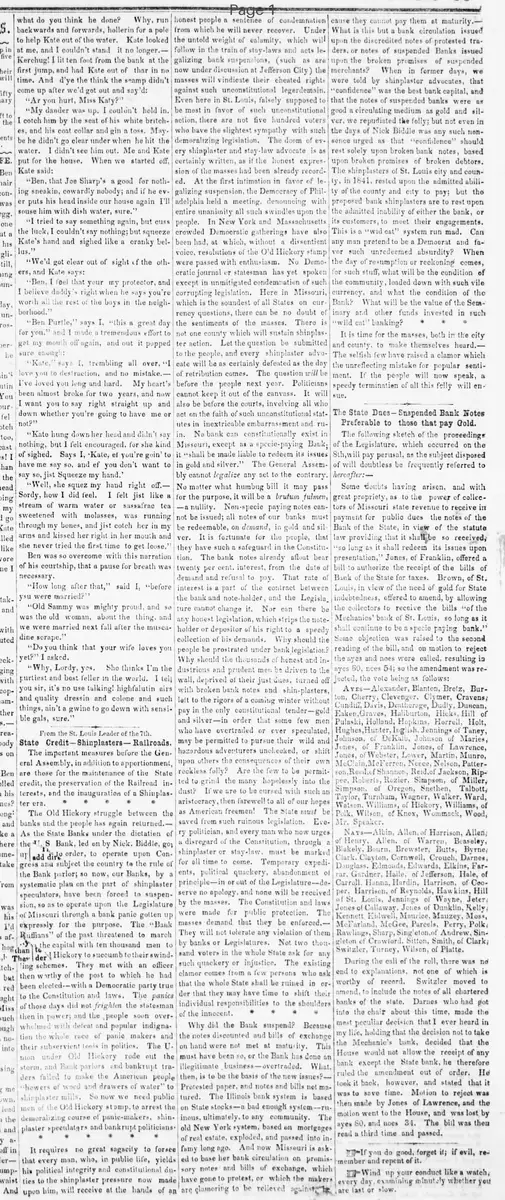
State Credit—Shinplasters— Railroads.
The important measures before the General
Assembly, in addition to apportionment,
are those for the maintenance of the State
credit, the preservation of the Railroad interests, and the inauguration of a Shinplaster
era.
The Old Hickory struggle between the
banks and the people has again returned.—
As the State Banks under the dictation of
the U. S Bank, led on by Nick. Biddle, go
into active order, to operate upon Congress
and subject the country to the rule of
the Bank parlor; so now, our Banks, by a
systematic plan on the part of shinplaster
speculators, have been forced to suspension, so as to operate upon the Legislature
of Missouri through a bank panic gotten up
expressly for the purpose. The "Bank
Ruffians" of the past threatened to march
upon the capital with ten thousand men to
force Old Hickory to succumb to their swindling
schemes. They met with an officer
then worthy of the post to which he had
been elected—with a Democratic party true
to the Constitution and laws. The panics
of those days did not frighten the statesman
then in power; and the people soon over-
whelmed with defeat and popular indignation the whole race of panic makers and
their subservient tools in politics. The Union under Old Hickory rode out the
storm, and Bank parlors and bankrupt traders failed to make the American people
"hewers of wood and drawers of water" to
shinplaster mills. So now we need public
men of the Old Hickory stamp, to arrest the
demoralizing course of panic-makers, shin-
plaster speculators and bankrupt politicians.
It requires no great sagacity to foresee
that every man, who, in public life, yields
his political integrity and constitutional authority to the shinplaster pressure now made
upon honest people a sentence of condemnation from which he will never recover. Under
the untold weight of calamity, which will
follow in the train of stay-laws and acts legalizing bank suspensions, (such as are
now under discussion at Jefferson City) the
masses will vindicate their cheated rights
against such unconstitutional legerdemain.
Even here in St. Louis, falsely supposed to
be most in favor of such unconstitutional
action, there are not five hundred voters
who have the slightest sympathy with such
demoralizing legislation. The doom of every
shinplaster and stay-law advocate is as
certainly written, as if the honest expression of the masses had been already recorded. At the first intimation in favor of legalizing suspension, the Democracy of Philadelphia held a meeting, denouncing with
entire unanimity all such swindles upon the
people. In New York and Massachusetts
crowded Democratic gatherings have also
been had, at which, without a dissentient
voice, resolutions of the Old Hickory stamp
were passed with enthusiasm. No Democratic journal or statesman has yet spoken
except in unmitigated condemnation of such
corrupting legislation. Here in Missouri,
which is the soundest of all States on currency questions, there can be no doubt of
the sentiments of the masses. There is
not one county which will sustain shinplaster action. Let the question be submitted
to the people, and every shinplaster advocate will be as certainly defeated as the day
of retribution comes. The question will be
before the people next year. Politicians
cannot keep it out of the canvass. It will
also be before the courts, involving all who
act on the faith of such unconstitutional statutes in inextricable embarrassment and ruin. No bank can constitutionally exist in
Missouri, except as a specie-paying Bank:
it "shall be made liable to redeem its issues
in gold and silver." The General Assembly cannot legalize any act to the contrary.
No matter what humbug bill it may pass
for the purpose, it will be a brutum fulmen,
—a nullity. Non-specie paying notes cannot
be issued; all notes of our banks must
be redeemable, on demand, in gold and silver. It is fortunate for the people, that
they have such a safeguard in the Constitution. The bank notes already afloat bear
twenty per cent. interest, from the date of
demand and refusal to pay. That rate of
interest is a part of the contract between
the bank and note-holder, and the Legislature cannot change it. Nor can there be
any honest legislation, which strips the note-
holder or depositor of his right to a speedy
collection of his demands. Why should the
people be prostrated under bank legislation?
Why should the thousands of honest and industrious and prudent men be driven to the
wall, deprived of their just dues, turned off
with broken bank notes and shin-plasters,
left to the rigors of a coming winter without
pay in the only constitutional tender—gold
and silver—in order that some few men
who have overtraded or over speculated,
may be permitted to pursue their wild and
hazardous adventures unchecked, or shift
upon others the consequences of their own
reckless folly? Are the few to be permitted to grind the many hopelessly into the
dust? If we are to be cursed with such an
aristocracy, then farewell to all of our hopes
as American freemen! The State must be
saved from such ruinous legislation. Every politician, and every man who now urges
a disregard of the Constitution, through a
shinplaster or stay-law, must be marked
for all time to come. Temporary expedients, political quackery, abandonment of
principle—in or out of the Legislature—deserve no apology, and none will be received
by the masses. The Constitution and laws
were made for public protection. The
masses demand that they be enforced.—
They will not tolerate any violation of them
by banks or Legislatures. Not two thousand voters in the whole State ask for any
such quackery or injustice. The existing
clamor comes from a few persons who ask
that the whole State shall be ruined in order that they may have time to shift their
individual responsibilities to the shoulders
of the innocent.
Why did the Bank suspend? Because
the notes discounted and bills of exchange
on hand were not met at maturity. This
must have been so, or the Bank has done an
illegitimate business—overtraded. What,
then, is to be the basis of the new issues?—
Protested paper, and notes and bills not matured. The Illinois bank system is based
on State stocks—a bad enough system—ruinous, ultimately, to any community. The
old New York system, based on mortgages
of real estate, exploded, and passed into infamy long ago. And now Missouri is asked to base her bank circulation on promises
have gone to protest, or which the makers
cannot pay them at maturity.—What is this but a bank circulation issued upon the discredited notes of protested traders, or notes of suspended Banks issued upon the broken promises of suspended merchants? When in former days, we were told by shinplaster advocates, that "confidence" was the best bank capital, and that the notes of suspended banks were as good a circulating medium as gold and silver, we repudiated the folly; but not even in
the days of Nick Biddle was any such nonsense urged as that "confidence" should
rest solely upon broken bank notes, based
upon broken promises of broken debtors.
The shinplasters of St. Louis city and county, in 1841, rested upon the admitted ability of the county and city to pay; but the
proposed bank shinplasters are to rest upon
the admitted inability of either the bank, or
its customers, to meet their engagements.
This is a "wild cat" system run mad. Can
any man pretend to be a Democrat and favor such unredeemed absurdity? When
the day of resumption or reckoning comes,
for such stuff, what will be the condition of
the community, loaded down with such vile
currency, and what the condition of the
Bank? What will be the value of the Seminary and other funds invested in such
"wild cat" banking?
It is time for the masses, both in the city
and county, to make themselves heard.—
The selfish few have raised a clamor which
the unreflecting mistake for popular sentiment. If the people will now speak, a
speedy termination of all this folly will ensue.
The State Dues—Suspended Bank Notes
Preferable to those that pay Gold.
The following sketch of the proceedings
of the Legislature, which occurred on the
8th, will pay perusal, as the subject disposed
of will doubtless be frequently referred to
hereafter:—
Some doubts having arisen, and with
great propriety, as to the power of collectors of Missouri state revenue to receive in
payment for public dues the notes of the
Bank of the State, in view of the statute
law providing that it shall be so received,
"so long as it shall redeem its issues upon
presentation," Jones, of Franklin, offered a
bill to authorize the receipt of the bills of
Bank of the State for taxes. Brown, of St.
Louis, in view of the need of gold for State
indebtedness, offered to amend, by allowing
the collectors to receive the bills "of the
Mechanics' bank of St. Louis, so long as it
shall continue to be a specie paying bank."
Some objection was raised to the second
reading of the bill, and on motion to reject
the ayes and noes were called, resulting in
ayes 60, nays 54; so the amendment was rejected, the vote being as follows:
Ayes—Alexander, Blanton, Bretz, Burton,
Cherry, Clevenger, Clymer, Cravens;
Cundiff, Davis, Deatherage, Dudley, Duncan,
Eakin, Graves, Haliburton, Hicks, Hill of
Pulaski, Holland, Hopkins, Horrell, Holt,
Hughes, Hunter, English, Jennings of Taney,
Johnson, of DeKalb, Johnson of Maries,
Jones, of Franklin, Jones, of Lawrence,
Jones, of Webster, Lower, Martin, Munro,
McClain, McFerren, Neece, Nelson, Patterson,
Reed. of Shannon, Reid, of Jackson, Rip-
pee, Roberts, Rozier, Simpson, of Miller,
Simpson, of Oregon, Snethen, Talbott,
Taylor, Turnham, Wagner, Walker, Ward,
Watson. Williams, of Hickory, Williams, of
Polk, Wilson, of Knox, Wommack, Wood,
Mr. Speaker.
Nays—Albin, Allen, of Harrison, Allen,
of Henry, Allen, of Warren, Beasley,
Blakely, Bourn, Brewster, Butts, Byrne,
Clark, Clayton, Cornwell, Crouch, Darnes,
Douglass. Edmonds, Edwards, Elkins, Farrar,
Gardner, Haile, of Jefferson, Hale, of
Carroll, Hanna, Hardin, Harrison, of Cooper,
Harrison, of Reynolds, Hawkins, Hill
of St. Louis, Jennings of Wayne, Jeter,
Jones of Callaway, Jones of Dunklin, Kelly,
Kennett Kidwell, Maurice, Mauzey, Moss,
McFarland, McGee, Parcels, Perry, Polk,
Rawlings, Sharp, Singleton, of Andrew, Singleton of Crawford. Sitton, Smith, of Clark
Switzler, Turney, Wilson, of Platte.
During the call of the roll, there was no
end to explanations, not one of which is
worthy of record. Switzler moved to
amend, to include the notes of all chartered
banks of the state. Darnes who had got
into the chair about this time, made the
most peculiar decision that I ever heard in
my life, holding that the decision not to take
the Mechanic's bank, decided that the
House would not allow the receipt of any
bank except the State bank, he therefore
ruled the amendment out of order. He
took it back, however, and stated that it
was to save time. Motion to reject was
then made by Jones of Lawrence, and the
motion went to the House, and was lost by
ayes 80, and noes 34. The bill was then
read a third time and passed.
What sub-type of article is it?
What keywords are associated?
What entities or persons were involved?
Editorial Details
Primary Topic
Opposition To Shinplasters And Bank Suspensions In Missouri
Stance / Tone
Strongly Against Legalizing Suspensions And Shinplasters, Invoking Old Hickory Democratic Principles
Key Figures
Key Arguments