Thank you for visiting SNEWPapers!
Sign up free
The Ottawa Free Trader
Ottawa, La Salle County County, Illinois
What is this article about?
Recent disclosures reveal a widespread criminal gang in northern Illinois involved in counterfeiting, robberies, murders, and arson plots. Key figures like Sears, West, Bridge, and others are turning on each other. Historical incidents include the 1841 murder of Regulator commander Campbell and attempted burning of Postmaster Haskell's properties. Operations centered in Nauvoo with rendezvous in Chicago area.
Clipping
OCR Quality
Full Text
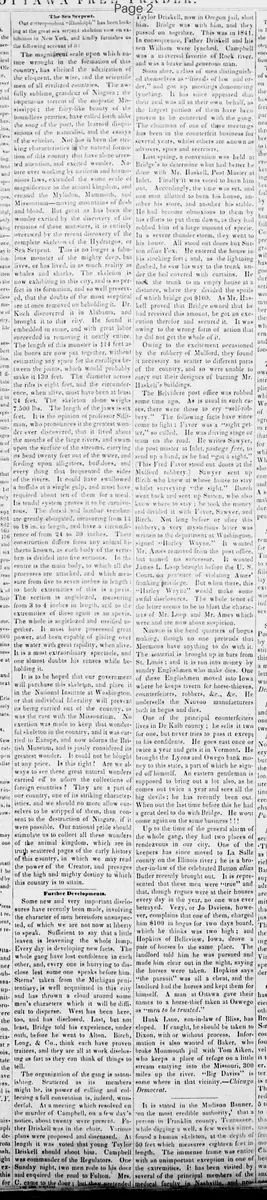
Some new and very important disclosures have recently been made, involving the character of men heretofore unsuspected, of which we are not now at liberty to speak. Sufficient to say that a little leaven is leavening the whole lump. Every day is developing new facts. The whole gang have lost confidence in each other, and, every one is hurrying to disclose lest some one speaks before him. Sears, taken from the Michigan penitentiary, is well acquainted in this city and has thrown a cloud around some men's characters which it will be difficult to disperse. West has been here, too, and has disclosed. Last, but not least, Bridge told his experience, under oath, before he went to Alton. Birch, Long, & Co., think each have proven traitors, and they are all at work disclosing as fast as they can think of things to tell.
The organization of the gang is astonishing. Scattered as its members might be, its power of calling and collecting a full convention is, indeed, wonderful. At a meeting which resolved on the murder of Campbell, on a few days' notice, about twenty were present. Father Driskell was in the chair. Various plans were proposed and discussed. At length it was voted that young Taylor Driskell should shoot him. Campbell was commander of the Regulators. One Sunday night, two men rode to his door and inquired the road to Fulton. Mrs. C. came to the door; but they pretended to mistake her for Taylor Driskell, now in Oregon jail, shot him. Bridge was with him, and they passed on together. This was in 1841. In consequence, Father Driskell and his son William were lynched. Campbell was a universal favorite of Rock river, and was a brave and generous man.
Soon after, a class of men distinguished themselves as "friends of law and order," and got up meetings denouncing lynching. It has since appeared that their zeal was all in their own behalf, as the largest portion of them have been proven to be connected with the gang. The chairman of one of these meetings has been in the counterfeit business for several years, whilst others are known as advisers, spies and secretaries.
Last spring, a convention was held at Bridge's to determine what had better be done with Mr. Haskell, Post Master at Inlet. Finally it was voted to burn him out. Accordingly, the time was set, and one man allotted to burn his house, another his store, and another his stable. He had become obnoxious to them by his efforts to root them down, as they had robbed him of a large amount of specie. In a severe thunder storm, they went to his house. All stood out doors but Sutton alias Fox. He entered the house in his stocking feet; and, as the lightning flashed, he saw his way to the trunk under the bed covered with curtains. He took the trunk to an empty house at a distance, where they divided the spoils of which Bridge got $100. As Mr. Haskell proved that Bridge owned that he had received this amount, he got an execution therefor and secured it. It was owing to the wrong form of action that he did not get the whole of it.
Owing to the excitement occasioned by the robbery of Mulford, they found it necessary to scatter to different parts of the country, and so were unable to carry out their designs of burning Mr. Haskell's buildings.
The Belvidere post office was robbed some time ago. As is usual in such cases, there were those to cry "self-robbery." The following facts have since come to light: Favor was a "sight getter," so called. He was driving stage or team on the road. He writes Sawyer, the post master at Inlet, postage free, to send up a hand, as he had "got a sight." (This Fred Favor stood out doors at the Mulford robbery.) Sawyer sent up Birch who knew at whose house to stay whilst surveying "the sight." Burch went back and sent up Sutton, who also knew where to stay: he took the money and divided it with Favor, Sawyer, and Birch. Not long before or after this robbery, a very mysterious letter was written to the department at Washington, signed "Harley Wayne." It wanted Mr. Ames removed from the post office, but named no successor. It wanted James L. Loop brought before the U. S. Court, on pretence of violating Ames' franking privilege. But when there, this "Harley Wayne" would make some awful disclosures. The whole tenor of the letter seems to be to blast the character of Mr. Loop and Mr. Ames which were and are now above suspicion.
Nauvoo is the head quarters of bogus making, though no one pretends that Mormons have anything to do with it. The material is brought up in bars from St. Louis; and it is run into money by sundry Englishmen who make dies. One of these Englishmen moved into Iowa where he keeps tavern for horse-thieves, counterfeiters, robbers, &c., &c. He undersells the Nauvoo manufacturers both in bogus and dies.
One of the principal counterfeiters lives in De Kalb county; he sells it two for one, but never tries to pass it except to his confidents. He goes east once or twice a year and gets it in Vermont. He brought the Lyons and Owego bank money to this state, a part of which he signed off himself. An eastern gentleman is supposed to bring out a lot also, as he comes out twice a year and sees all the big devils; he has recently been out. When out the last time before this he had a great deal to do with Bridge. He won't come again on the same business!!!
Up to the time of the general alarm of the whole gang, they had two places of rendezvous in our city. One of the keepers has since moved to La Salle county on the Illinois river; he is a brother-in-law of the celebrated Button alias Butler recently brought out. It is represented that these men were "true" and that, though rogues were at their houses every day in the year, no one was ever betrayed. Vex, or Jo Daviess, however, complains that one of them charged him $100 in bogus for two days board which he thinks was too high; and Hopkins of Belleview, Iowa, drove a pair of horses to the same place. The landlord told him he was pursued and made him clear out in the night, saying the horses were taken. Hopkins says "the pursuit" was all a cheat, and the landlord had the horses and kept them for himself. A man at Ottawa gave their names to a horse-thief taken at Oswego as "men to be trusted."
Hank Lane, son-in-law of Bliss, has eloped. If caught, he should be taken to Dixon, with or without process. Information is also wanted of Baker, who broke Monmouth jail with Tom Aiken, who keeps a place of refuge on a little stream emptying into the Missouri, 300 miles up the river. "Big Davis" is somewhere in that vicinity.—Chicago Democrat.
What sub-type of article is it?
What keywords are associated?
What entities or persons were involved?
Where did it happen?
Domestic News Details
Primary Location
Northern Illinois
Event Date
Recent Disclosures; 1841 Murder; Last Spring Convention
Key Persons
Outcome
gang members disclosing secrets and losing confidence; campbell murdered in 1841 leading to lynching of father driskell and son william; attempted robbery of haskell with partial recovery; post office robbery divided among conspirators; elopement of hank lane; scattering due to mulford robbery alarm
Event Details
Disclosures by former gang members reveal a organized criminal network involved in counterfeiting, post office and specie robberies, planned arsons, and the 1841 murder of Regulator commander Campbell. Gang conventions planned crimes including shooting Campbell and burning Postmaster Haskell's buildings. Counterfeiting operations in Nauvoo and De Kalb county; rendezvous in Chicago area. Recent alarm causes members to turn on each other.