Thank you for visiting SNEWPapers!
Sign up free
Editorial
March 3, 1939
The Butler County Press
Hamilton, Butler County, Ohio
What is this article about?
An editorial quotes George Washington's letter to John Habberton praising the U.S. Constitution's balanced structure, which provides necessary powers while distributing authority to prevent despotism, contingent on the people's virtue.
Clipping
OCR Quality
98%
Excellent
Full Text
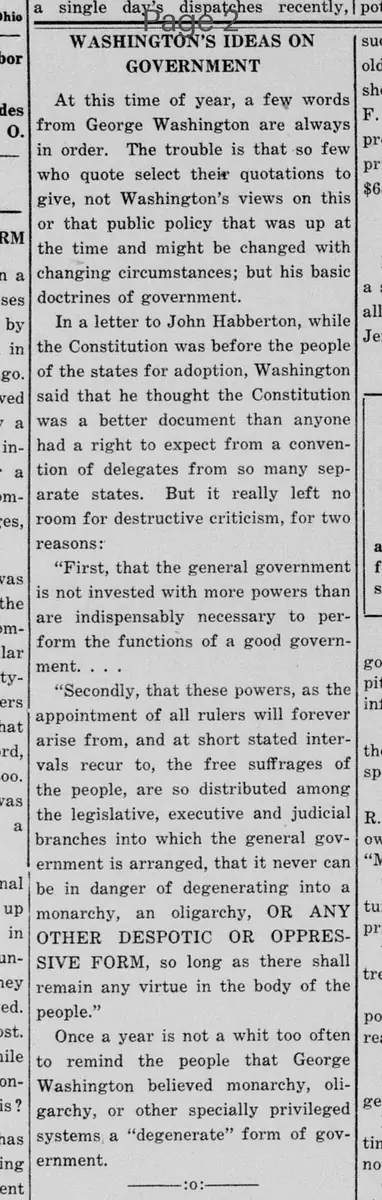
WASHINGTON'S IDEAS ON
GOVERNMENT
At this time of year, a few words from George Washington are always in order. The trouble is that so few who quote select their quotations to give, not Washington's views on this or that public policy that was up at the time and might be changed with changing circumstances; but his basic doctrines of government.
In a letter to John Habberton, while the Constitution was before the people of the states for adoption, Washington said that he thought the Constitution was a better document than anyone had a right to expect from a convention of delegates from so many separate states. But it really left no room for destructive criticism, for two reasons:
'First, that the general government is not invested with more powers than are indispensably necessary to perform the functions of a good government....
'Secondly, that these powers, as the appointment of all rulers will forever arise from, and at short stated intervals recur to, the free suffrages of the people, are so distributed among the legislative, executive and judicial branches into which the general government is arranged, that it never can be in danger of degenerating into a monarchy, an oligarchy, or any other despotic or oppressive form, so long as there shall remain any virtue in the body of the people.'
Once a year is not a whit too often to remind the people that George Washington believed monarchy, oligarchy, or other specially privileged systems a 'degenerate' form of government.
GOVERNMENT
At this time of year, a few words from George Washington are always in order. The trouble is that so few who quote select their quotations to give, not Washington's views on this or that public policy that was up at the time and might be changed with changing circumstances; but his basic doctrines of government.
In a letter to John Habberton, while the Constitution was before the people of the states for adoption, Washington said that he thought the Constitution was a better document than anyone had a right to expect from a convention of delegates from so many separate states. But it really left no room for destructive criticism, for two reasons:
'First, that the general government is not invested with more powers than are indispensably necessary to perform the functions of a good government....
'Secondly, that these powers, as the appointment of all rulers will forever arise from, and at short stated intervals recur to, the free suffrages of the people, are so distributed among the legislative, executive and judicial branches into which the general government is arranged, that it never can be in danger of degenerating into a monarchy, an oligarchy, or any other despotic or oppressive form, so long as there shall remain any virtue in the body of the people.'
Once a year is not a whit too often to remind the people that George Washington believed monarchy, oligarchy, or other specially privileged systems a 'degenerate' form of government.
What sub-type of article is it?
Constitutional
What keywords are associated?
Washington
Constitution
Government
Republicanism
Public Virtue
What entities or persons were involved?
George Washington
John Habberton
Editorial Details
Primary Topic
Washington's Endorsement Of The U.S. Constitution
Stance / Tone
Supportive Reminder Of Republican Principles
Key Figures
George Washington
John Habberton
Key Arguments
The Constitution Invests The General Government With Only Indispensably Necessary Powers For Good Government.
Powers Are Distributed Among Legislative, Executive, And Judicial Branches To Prevent Degeneration Into Monarchy, Oligarchy, Or Despotism.
Such Safeguards Hold As Long As Virtue Remains In The People.