Thank you for visiting SNEWPapers!
Sign up free
The Cordova Daily Times
Cordova, Alaska
What is this article about?
Bank examiner W. E. Wilcox describes his perilous winter overland trip from Cordova to Fairbanks, Alaska, enduring extreme cold, blizzards, and treacherous snow trails navigated by instinctual horses. Two U.S. soldiers recently died on the same trail due to untrained mounts.
Clipping
OCR Quality
Full Text
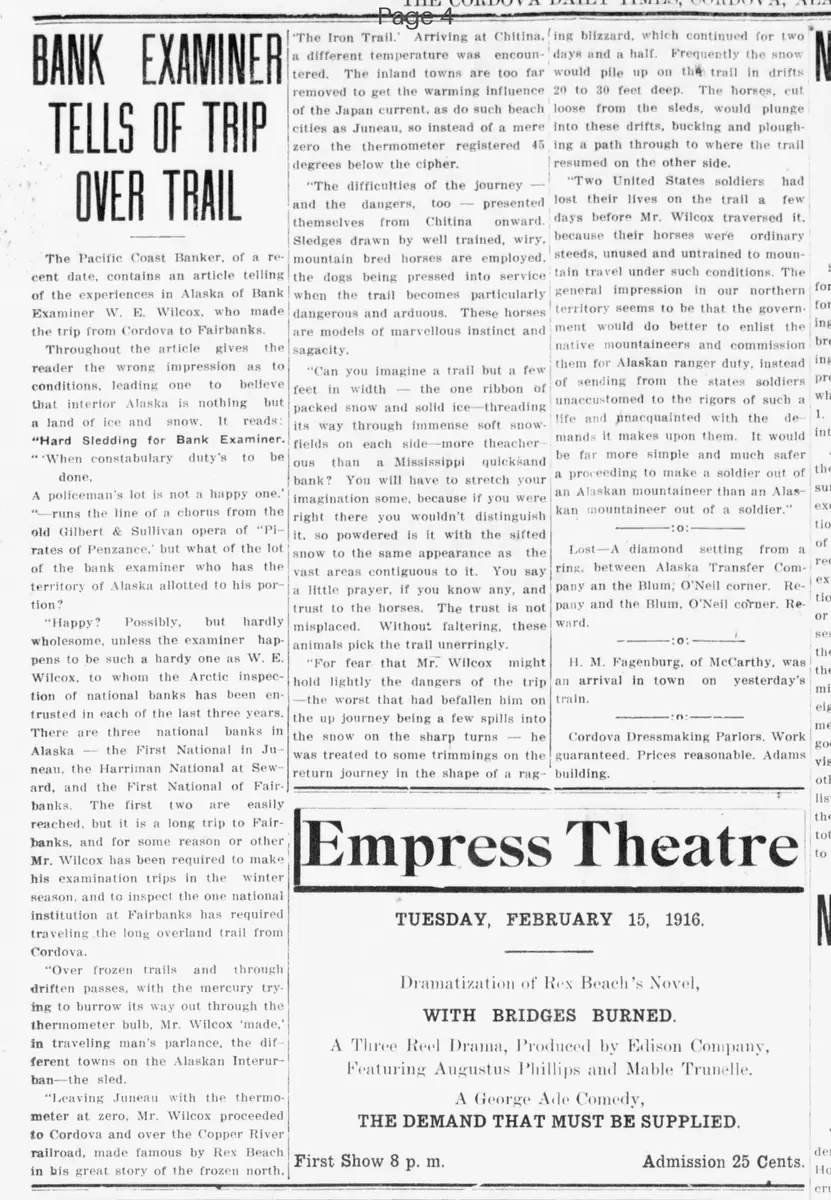
The Pacific Coast Banker of a recent date contains an article telling of the experiences in Alaska of Bank Examiner W. E. Wilcox, who made the trip from Cordova to Fairbanks. Throughout the article gives the reader the wrong impression as to conditions, leading one to believe that interior Alaska is nothing but a land of ice and snow. It reads:
"Hard Sledding for Bank Examiner.
"'When constabulary duty's to be done,
A policeman's lot is not a happy one.'
"runs the line of a chorus from the old Gilbert & Sullivan opera of 'Pirates of Penzance,' but what of the lot of the bank examiner who has the territory of Alaska allotted to his portion?
"Happy? Possibly, but hardly wholesome, unless the examiner happens to be such a hardy one as W. E. Wilcox, to whom the Arctic inspection of national banks has been entrusted in each of the last three years. There are three national banks in Alaska - the First National in Juneau, the Harriman National at Seward, and the First National of Fairbanks. The first two are easily reached, but it is a long trip to Fairbanks, and for some reason or other Mr. Wilcox has been required to make his examination trips in the winter season, and to inspect the one national institution at Fairbanks has required traveling the long overland trail from Cordova.
"Over frozen trails and through drifted passes, with the mercury trying to burrow its way out through the thermometer bulb, Mr. Wilcox 'made,' in traveling man's parlance, the different towns on the Alaskan Interurban-the sled.
"Leaving Juneau with the thermometer at zero, Mr. Wilcox proceeded to Cordova and over the Copper River railroad, made famous by Rex Beach in his great story of the frozen north, 'The Iron Trail.' Arriving at Chitina, a different temperature was encountered. The inland towns are too far removed to get the warming influence of the Japan current, as do such beach cities as Juneau, so instead of a mere zero the thermometer registered 45 degrees below the cipher.
"The difficulties of the journey - and the dangers, too - presented themselves from Chitina onward. Sledges drawn by well trained, wiry, mountain bred horses are employed, the dogs being pressed into service when the trail becomes particularly dangerous and arduous. These horses are models of marvellous instinct and sagacity.
"(Can you imagine a trail but a few feet in width, the one ribbon of packed snow and solid ice-threading its way through immense soft snow-fields on each side-more treacherous than a Mississippi quicksand bank? You will have to stretch your imagination some, because if you were right there you wouldn't distinguish it, so powdered is it with the sifted snow to the same appearance as the vast areas contiguous to it. You say a little prayer, if you know any, and trust to the horses. The trust is not misplaced. Without faltering, these animals pick the trail unerringly.
"For fear that Mr. Wilcox might hold lightly the dangers of the trip -the worst that had befallen him on the up journey being a few spills into the snow on the sharp turns - he was treated to some trimmings on the return journey in the shape of a raging blizzard, which continued for two days and a half. Frequently the snow would pile up on the trail in drifts 20 to 30 feet deep. The horses, cut loose from the sleds, would plunge into these drifts, bucking and ploughing a path through to where the trail resumed on the other side.
"Two United States soldiers had lost their lives on the trail a few days before Mr. Wilcox traversed it, because their horses were ordinary steeds, unused and untrained to mountain travel under such conditions. The general impression in our northern territory seems to be that the government would do better to enlist the native mountaineers and commission them for Alaskan ranger duty, instead of sending from the states soldiers unaccustomed to the rigors of such a life and unacquainted with the demands it makes upon them. It would be far more simple and much safer a proceeding to make a soldier out of an Alaskan mountaineer than an Alaskan mountaineer out of a soldier."
What sub-type of article is it?
What themes does it cover?
What keywords are associated?
What entities or persons were involved?
Where did it happen?
Story Details
Key Persons
Location
Overland Trail From Cordova To Fairbanks, Alaska
Event Date
Winter Season
Story Details
Bank examiner W. E. Wilcox travels the frozen overland trail from Cordova to Fairbanks in extreme winter conditions, using sleds pulled by trained horses that navigate treacherous icy paths and deep snow drifts during a blizzard; two U.S. soldiers perish on the same trail shortly before due to untrained horses.