Thank you for visiting SNEWPapers!
Sign up free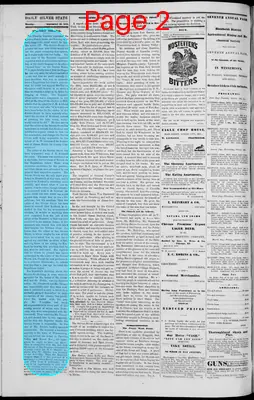
Editorial
September 29, 1879
The Silver State
Unionville, Winnemucca, Humboldt County, Nevada
What is this article about?
The SILVER STATE editorial defends against the Paradise Reporter's accusations of influencing 1878 Nevada election outcomes and Kinkead's nomination, denying claims and highlighting the Reporter editor's past Republican voting and employment.
Clipping

OCR Quality
95%
Excellent
Full Text
SOMEWHAT PERSONAL.
The Paradise Reporter expressed the opinion that if Grant and Kearney were both hanged the world would be none the worse off. The SILVER STATE expressed the hope that Grant would not see the paper containing that opinion as it might make him feel badly. The next issue of the Reporter expressed regret for what it said relative to Grant, but, in the classic language of its editor, "turned loose" on the SILVER STATE. This paper briefly stated that the Reporter was very sorry for what it said about Grant, and that we could scarcely believe its editor, who was so conscientious a Republican less than a year ago that he could not support Bradley for Governor, could become in so short a time so virulent a rebel as to favor the hanging of Grant. The Reporter, whose editor was a compositor in this office at the time of the election in 1878, admits that he voted for J. H. Kinkead for Governor, and asks "if it would not have been better for the editor of the SILVER STATE to have squarely advocated the election of Kinkead, instead of pursuing the luke warm, wishy-washy course he did." He then asserts that the editor of the SILVER STATE has been heard to remark that Kinkead was indebted to a great extent to him for his nomination, and charges the SILVER STATE with being responsible for the defeat of L. W. Greenwell for Senator and of James Richie for County Commissioner.
The editor of the SILVER STATE has been acquainted with J. H. Kinkead for years. His name was mentioned as a candidate for Governor of Nevada on the Republican ticket. There were numerous candidates for the position, and their claims were advocated by the press of their respective counties. The SILVER STATE was the only paper published in Humboldt at that time, and it referred to Kinkead's candidacy occasionally, and stated what it now re-asserts, that its editor, though intimately acquainted with J. H. Kinkead for years, could not with truth say aught against him, except that he was a Republican; but the assertion "that the editor of the SILVER STATE has been heard to remark that Kinkead is indebted to him for his nomination or election," is as false as anything that ever emanated from the pen of the editor of the Reporter, or that was ever conceived in the shallow brains of the soreheads who furnish him with what they imagine are brilliant ideas. He knows that the editor of the SILVER STATE, in whose employ he was at the time, never asked him to vote for or against any candidate on either ticket, and only knew of his voting for Kinkead by hearing him proclaim that he did, after he had voted. His right to vote for whom he pleased was never questioned by the editor of the SILVER STATE, yet, though he now professes to be so ardently Democratic, he admits that less than a year ago he voted the Republican ticket.
The Reporter's driveling about the SILVER STATE being in some sense responsible for the defeat of Mr. Greenwell and Mr. Richie, scarcely deserves notice. Mr. Greenwell and Mr. Thompson, immediately after they were nominated, published a card, in which they mutually pledged themselves to make no canvass of the county, but quietly leave the matter with the people. Mr. Thompson had many old acquaintances in every part of the county, several of whom were Democrats, who were unacquainted with Mr. Greenwell. They voted for Mr. Thompson and elected him by two majority, and for this the Reporter thinks the SILVER STATE is responsible. In the case of Mr. Ritchie, locality operated against him. He received a handsome majority in the town of Winnemucca, but run behind his ticket in Paradise Valley and Mount Rose, his home, where he ought to have run ahead. This, in connection with the fact that the people of Big Meadows, irrespective of party, voted for H. C. Marker, explains why Mr. Ritchie was defeated by one majority. Does the Reporter imagine that it is the province of a newspaper to abuse decent men because they differ from it politically. If it does, it has opportunity to give scope to its ravings, as this is a free country and there is no law to compel its editor so exercise common sense, in future declared him for an idiot.
The Paradise Reporter expressed the opinion that if Grant and Kearney were both hanged the world would be none the worse off. The SILVER STATE expressed the hope that Grant would not see the paper containing that opinion as it might make him feel badly. The next issue of the Reporter expressed regret for what it said relative to Grant, but, in the classic language of its editor, "turned loose" on the SILVER STATE. This paper briefly stated that the Reporter was very sorry for what it said about Grant, and that we could scarcely believe its editor, who was so conscientious a Republican less than a year ago that he could not support Bradley for Governor, could become in so short a time so virulent a rebel as to favor the hanging of Grant. The Reporter, whose editor was a compositor in this office at the time of the election in 1878, admits that he voted for J. H. Kinkead for Governor, and asks "if it would not have been better for the editor of the SILVER STATE to have squarely advocated the election of Kinkead, instead of pursuing the luke warm, wishy-washy course he did." He then asserts that the editor of the SILVER STATE has been heard to remark that Kinkead was indebted to a great extent to him for his nomination, and charges the SILVER STATE with being responsible for the defeat of L. W. Greenwell for Senator and of James Richie for County Commissioner.
The editor of the SILVER STATE has been acquainted with J. H. Kinkead for years. His name was mentioned as a candidate for Governor of Nevada on the Republican ticket. There were numerous candidates for the position, and their claims were advocated by the press of their respective counties. The SILVER STATE was the only paper published in Humboldt at that time, and it referred to Kinkead's candidacy occasionally, and stated what it now re-asserts, that its editor, though intimately acquainted with J. H. Kinkead for years, could not with truth say aught against him, except that he was a Republican; but the assertion "that the editor of the SILVER STATE has been heard to remark that Kinkead is indebted to him for his nomination or election," is as false as anything that ever emanated from the pen of the editor of the Reporter, or that was ever conceived in the shallow brains of the soreheads who furnish him with what they imagine are brilliant ideas. He knows that the editor of the SILVER STATE, in whose employ he was at the time, never asked him to vote for or against any candidate on either ticket, and only knew of his voting for Kinkead by hearing him proclaim that he did, after he had voted. His right to vote for whom he pleased was never questioned by the editor of the SILVER STATE, yet, though he now professes to be so ardently Democratic, he admits that less than a year ago he voted the Republican ticket.
The Reporter's driveling about the SILVER STATE being in some sense responsible for the defeat of Mr. Greenwell and Mr. Richie, scarcely deserves notice. Mr. Greenwell and Mr. Thompson, immediately after they were nominated, published a card, in which they mutually pledged themselves to make no canvass of the county, but quietly leave the matter with the people. Mr. Thompson had many old acquaintances in every part of the county, several of whom were Democrats, who were unacquainted with Mr. Greenwell. They voted for Mr. Thompson and elected him by two majority, and for this the Reporter thinks the SILVER STATE is responsible. In the case of Mr. Ritchie, locality operated against him. He received a handsome majority in the town of Winnemucca, but run behind his ticket in Paradise Valley and Mount Rose, his home, where he ought to have run ahead. This, in connection with the fact that the people of Big Meadows, irrespective of party, voted for H. C. Marker, explains why Mr. Ritchie was defeated by one majority. Does the Reporter imagine that it is the province of a newspaper to abuse decent men because they differ from it politically. If it does, it has opportunity to give scope to its ravings, as this is a free country and there is no law to compel its editor so exercise common sense, in future declared him for an idiot.
What sub-type of article is it?
Partisan Politics
What keywords are associated?
Newspaper Rivalry
1878 Nevada Election
Political Accusations
Republican Ticket
Candidate Defeats
What entities or persons were involved?
Paradise Reporter
Silver State
Grant
Kearney
J. H. Kinkead
L. W. Greenwell
James Richie
Mr. Thompson
H. C. Marker
Editorial Details
Primary Topic
Response To Rival Newspaper's Political Accusations
Stance / Tone
Defensive Rebuttal
Key Figures
Paradise Reporter
Silver State
Grant
Kearney
J. H. Kinkead
L. W. Greenwell
James Richie
Mr. Thompson
H. C. Marker
Key Arguments
Denial Of Claim That Silver State Editor Helped Nominate Kinkead
Rejection Of Responsibility For Defeats Of Greenwell And Richie
Accusation Of Reporter Editor's Political Inconsistency From Republican To Democrat
Explanation Of Election Outcomes Due To Local Factors And Candidates' Choices