Thank you for visiting SNEWPapers!
Sign up free
Literary
October 30, 1873
Yorkville Enquirer
York, York County, South Carolina
What is this article about?
In this chapter continuation, orphan Lizzie lives with her pious but hypocritical uncle Mr. Mason, who harbors secret love for her and has stolen her late father's savings. After confessing his feelings and revealing she's not his niece, he locks her in to plead. She rejects him, discovers incriminating papers proving his fraud, leading to his suicide. Lizzie reunites with lover Theodore, inherits the ill-gotten wealth, and exposes Mason's true nature as a 'whited sepulchre.'
Clipping
OCR Quality
98%
Excellent
Full Text
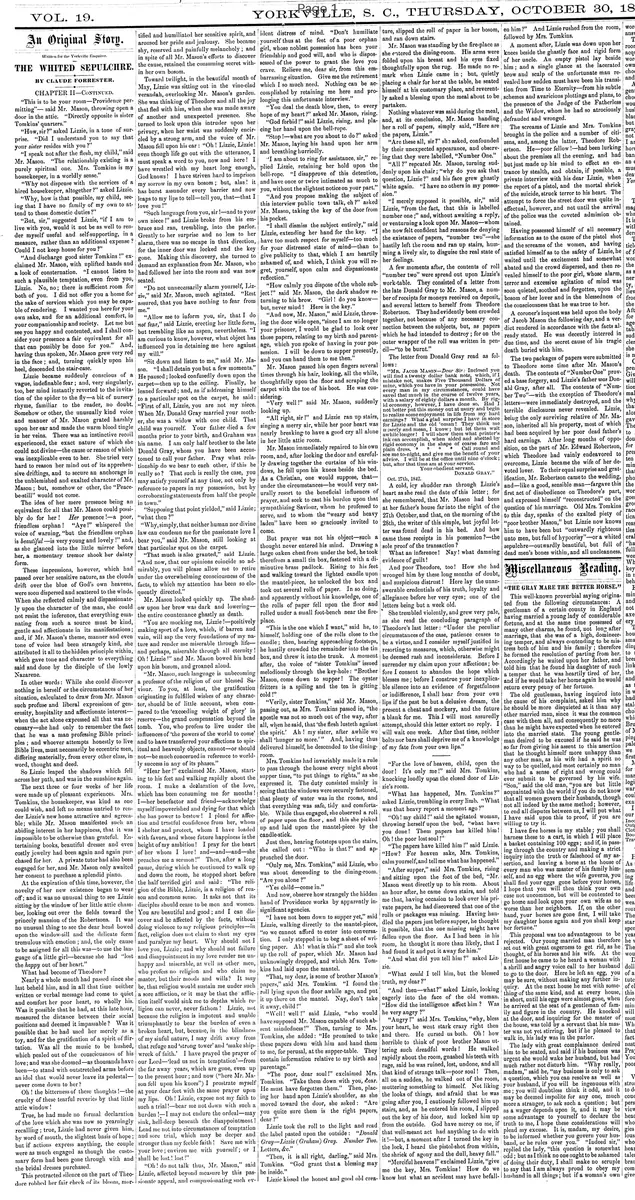
VOL. 19.
An Original Story.
Written for the Yorkville Enquirer.
THE WHITED SEPULCHRE.
BY CLAUDE FORRESTER.
CHAPTER II—CONTINUED.
"This is to be your room—Providence permitting," said Mr. Mason, throwing open a door in the attic. "Directly opposite is sister Tomkins' quarters."
"How, sir?" asked Lizzie, in a tone of surprise. "Did I understand you to say that your sister resides with you?"
"I speak not after the flesh, my child," said Mr. Mason. "The relationship existing is a purely spiritual one. Mrs. Tomkins is my housekeeper, in a worldly sense."
"Why not dispense with the services of a hired housekeeper, altogether?" asked Lizzie.
"Why, how is that possible, my child, seeing that I have no family of my own to attend to these domestic duties?"
"But, sir," suggested Lizzie, "if I am to live with you, would it not be as well to render myself useful and self-supporting, in a measure, rather than an additional expense? Could I not keep house for you?"
"And discharge good sister Tomkins!" exclaimed Mr. Mason, with uplifted hands and a look of consternation. "I cannot listen to such a plausible temptation, even from you, Lizzie. No, no; there is sufficient room for both of you. I did not offer you a home for the sake of services which you may be capable of rendering. I wanted you here for your own sake, and for an additional comfort, in your companionship and society. Let me but see you happy and contented, and I shall consider your presence a fair equivalent for all that can possibly be done for you." And, having thus spoken, Mr. Mason grew very red in the face; and, turning quickly upon his heel, descended the stair-case.
Lizzie became suddenly conscious of a vague, indefinable fear; and, very singularly too, her mind instantly reverted to the invitation of the spider to the fly—a bit of nursery rhyme, familiar to the reader, no doubt. Somehow or other, the unusually kind voice and manner of Mr. Mason grated harshly upon her ear and made the warm blood tingle in her veins. There was an instinctive recoil experienced, the exact nature of which she could not divine—the cause or reason of which was inexplicable even to her. She tried very hard to reason her mind out of its apprehensive driftings, and to secure an anchorage in the unblemished and exalted character of Mr. Mason; but, somehow or other, the "Peace be still" would not come.
The idea of her mere presence being an equivalent for all that Mr. Mason could possibly do for her! Her presence!—a poor friendless orphan! "Ave!" whispered the voice of warning, "but the friendless orphan is beautiful—is very young and lovely!" and, as she glanced into the little mirror before her, a momentary tremor shook her dainty form.
These impressions, however, which had passed over her sensitive nature, as the clouds drift over the blue of God's own heavens, were soon dispersed and scattered to the winds. When she reflected calmly and dispassionately upon the character of the man, she could not resist the inference, that everything emanating from such a source must be kind, gentle and affectionate in its manifestations; and, if Mr. Mason's theme, manner and even tone of voice had been strangely kind, she attributed it all to the hidden principle within, which gave tone and character to everything said and done by the disciple of the lowly Nazarene.
In other words: While she could discover nothing in herself or the circumstances of her situation, calculated to draw from Mr. Mason such profuse and liberal expressions of generosity, hospitality and affectionate interest—when the act alone expressed all that was necessary—she had only to remember the fact that he was a man professing Bible principles; and whoever attempts honestly to live Bible lives, must necessarily be eccentric men, differing materially, from every other class, in word, thought and deed.
So Lizzie leaped the shadows which fell across her path, and was in the sunshine again.
The next three or four weeks of her life were made up of pleasant experiences. Mrs. Tomkins, the housekeeper, was kind as one could wish, and left no means untried to render Lizzie's new home attractive and agreeable; while Mr. Mason manifested such an abiding interest in her happiness, that it was impossible to be otherwise than grateful. Entertaining books, beautiful dresses and even costly jewelry had been again and again purchased for her. A private tutor had also been engaged for her, and Mr. Mason only awaited her consent to purchase a splendid piano.
At the expiration of this time, however, the novelty of her new existence began to wear off; and it was no unusual thing to see Lizzie sitting by the window of her little attic chamber, looking out over the fields toward the princely mansion of the Robertsons. It was no unusual thing to see the dear head bowed upon the window-sill and the delicate form tremulous with emotion; and, the only cause to be assigned for all this was—to use the language of a little girl—because she had "lost the happy out of her heart."
What had become of Theodore?
Nearly a whole month had passed since she last beheld him, and in all that time neither written or verbal message had come to quiet and comfort her poor heart, so wholly his.
Was it possible that he had, at this late hour, measured the distance between their social positions and deemed it impassable? Was it possible that he had used her merely as a toy, and for the gratification of a spirit of flirtation. Was all the music to be hushed, which pealed out of the consciousness of his love; and was she doomed—as thousands have been—to stand with outstretched arms before an idol that would never leave its pedestal—never come down to her?
Oh! the bitterness of these thoughts!—the cruelty of these tearful reveries by that little attic window!
True, he had made no formal declaration of the love which she was now so yearningly recalling; true, Lizzie had never given him, by word of mouth, the slightest basis of hope; but if actions express anything, the couple were as much engaged as though the customary form had been gone through with and the bridal dresses purchased.
This protracted silence on the part of Theodore robbed her fair cheek of its bloom, mortified and humiliated her sensitive spirit, and aroused her pride and jealousy. She became shy, reserved and painfully melancholy; and in spite of all Mr. Mason's efforts to discover the cause, retained the consuming secret within her own bosom.
Toward twilight, in the beautiful month of May, Lizzie was sitting out in the vine-clad verandah, overlooking Mr. Mason's garden. She was thinking of Theodore and all the joy that fled with him, when she was made aware of another and unexpected presence. She turned to look upon this intruder upon her privacy, when her waist was suddenly encircled by a strong arm, and the voice of Mr. Mason fell upon her ear: "Oh! Lizzie. Lizzie! even though life go out with the utterance, I must speak a word to you, now and here! I have wrestled with my heart long enough, God knows! I have striven hard to imprison my sorrow in my own bosom; but, alas! it has burst asunder every barrier and now leaps to my lips to tell—tell you, that—that I love you!"
"Such language from you, sir!—and to your own niece!" and Lizzie broke from his embrace and ran, trembling, into the parlor.
Greatly to her surprise and no less to her alarm, there was no escape in that direction for the inner door was locked and the key gone. Making this discovery, she turned to demand an explanation from Mr. Mason, who had followed her into the room and was now seated.
"Do not unnecessarily alarm yourself, Lizzie," said Mr. Mason, much agitated. "Rest assured, that you have nothing to fear from me."
"Allow me to inform you, sir, that I do not fear," said Lizzie, erecting her little form, but trembling like an aspen, nevertheless. "I am curious to know, however, what object has influenced you in detaining me here against my will."
"Sit down and listen to me," said Mr. Mason. "I shall detain you but a few moments."
He paused; looked confusedly down upon the carpet—then up to the ceiling. Finally, he leaned forward; and, as if addressing himself to a particular spot on the carpet, he said:
"First of all, Lizzie, you are not my niece. When Mr. Donald Gray married your mother, she was a widow with one child. That child was yourself. Your father died a few months prior to your birth, and Graham was his name. I am only half brother to the late Donald Gray, whom you have been accustomed to call your father. Pray what relationship do we bear to each other, if this be really so? That such is really the case, you may satisfy yourself at any time, not only by reference to papers in my possession, but by corroborating statements from half the people in town."
"Supposing that point yielded," said Lizzie; "what then?"
"Why, simply, that neither human nor divine law can condemn me for the passionate love I bear you," said Mr. Mason, still looking at that particular spot on the carpet.
"That much is also granted," said Lizzie. "And now, that our opinions coincide so admirably, you will please allow me to retire under the overwhelming consciousness of the facts, to which my attention has been so eloquently directed."
Mr. Mason looked quickly up. The shadow upon her brow was dark and lowering—the entire countenance ghastly as death.
"You are mocking me, Lizzie! positively making sport of a love, which, if barren and vain, will sap the very foundations of my nature and render me miserable through life—and perhaps, miserable through all eternity! Oh! Lizzie!" and Mr. Mason bowed his head upon his bosom, and groaned aloud.
"Mr. Mason, such language is unbecoming a professor of the religion of our blessed Saviour. To you, at least, the gratification originating in fulfilled wishes of any character, should be of little account, when compared to the 'exceeding weight of glory' in reserve—the grand compensation beyond the tomb. You, who profess to live under the influences of 'the powers of the world to come' and to have transferred your affections to spiritual and heavenly objects, cannot—or should not—be much concerned in reference to worldly success in any of its phases."
"Hear her!" exclaimed Mr. Mason, starting to his feet and walking rapidly about the room. "I make a declaration of the love, which has been consuming me for months! I—her benefactor and friend—acknowledge myself impoverished and dying for that which she has power to bestow! I plead for affection and trustful confidence from her, whom I shelter and protect, whom I have loaded with favors, and whose future happiness is the height of my ambition! I pray for the heart of her whom I love! and—and—and—she preaches me a sermon!" Then, after a long pause, during which he continued to walk up and down the room, he stopped short before the half terrified girl and said: "The religion of the Bible, Lizzie, is a religion of reason and common sense. It asks not that its disciples should cease to be men and women. You are beautiful and good; and I can discover and be affected by the facts, without doing violence to my religious principles—in fact, religion does not claim to shut my eyes and paralyze my heart. Why should not I love you, Lizzie; and why should not failure and disappointment in my love render me unhappy and miserable, as well as other men, who profess no religion and who claim no master, but their moods and wills? It may be, that religion would sustain me under such a sore affliction, or it may be that the affliction itself would sink me to depths which religion can never, never fathom! Lizzie, not because the religion is impotent and unable triumphantly to bear the burden of even a broken heart, but, because, in the blindness of my sinful nature, I may drift away from that refuge and 'strong tower' and 'make shipwreck of faith.' I have prayed the prayer of our Lord—'lead us not in temptation'—from the far away years, which are gone, even up to the present hour; and now (here Mr. Mason fell upon his knees) I prostrate myself at your dear feet with the same prayer upon my lips. Oh! Lizzie, expose not my faith to such a trial!—bear me not down with such a burden!—I may not endure the ordeal—may sink, hell-deep beneath the disappointment! Lead me not into circumstances of temptation and sore trial, which may be deeper and stronger than my feeble faith! Save me with your love; environ me with yourself; or I shall be lost! lost!"
"Oh! do not talk thus, Mr. Mason," said Lizzie, affected beyond measure by this passionate appeal, and compassionating such evident distress of mind. "Don't humiliate yourself thus at the feet of a poor orphan girl, whose noblest possession has been your friendship and good will, and who is dispossessed of the power to grant the love you crave. Relieve me, dear sir, from this embarrassing situation. Give me the retirement which I so much need. Nothing can be accomplished by retaining me here and prolonging this unfortunate interview."
"You deal the death blow, then, to every hope of my heart?" asked Mr. Mason, rising.
"God forbid!" said Lizzie, rising, and placing her hand upon the bell-rope.
"Stop!—what are you about to do?" asked Mr. Mason, laying his hand upon her arm and breathing hurriedly.
"I am about to ring for assistance, sir," replied Lizzie, retaining her hold upon the bell-rope. "I disapprove of this detention, and have once or twice intimated as much to you, without the slightest notice on your part."
"And you propose making the subject of this interview public town talk, eh?" asked Mr. Mason, taking the key of the door from his pocket.
"I shall dismiss the subject entirely," said Lizzie, extending her hand for the key. "I have too much respect for myself—too much for your distressed state of mind—than to give publicity to that, which I am heartily ashamed of, and which, I think you will regret, yourself, upon calm and dispassionate reflection."
"How calmly you dispose of the whole subject!" said Mr. Mason, the dark shadow returning to his brow. "Girl! do you know—but, never mind! Here is the key."
"And now, Mr. Mason," said Lizzie, throwing the door wide open, "since I am no longer your prisoner, I would be glad to look over those papers, relating to my birth and parentage, which you spoke of having in your possession. I will be down to supper presently and you can hand them to me then."
Mr. Mason passed his open fingers several times through his hair, looking, all the while thoughtfully upon the floor and scraping the carpet with the toe of his boot. He was considering.
"Very well!" said Mr. Mason, suddenly looking up.
"All right, sir!" and Lizzie ran up stairs singing a merry air, while her poor heart was nearly breaking—to have a good cry all alone in her little attic room.
Mr. Mason immediately repaired to his own room, and, after locking the door and carefully drawing together the curtains of his windows, he fell upon his knees beside the bed.
As a Christian, one would suppose, that—under the circumstances—he would very naturally resort to the beneficial influences of prayer, and seek to cast his burden upon that sympathizing Saviour, whom he professed to serve, and to whom the "weary and heavy laden" have been so graciously invited to come.
But prayer was not his object—such a thought never entered his mind. Drawing a large oaken chest from under the bed, he took therefrom a small tin box, fastened with a diminutive brass padlock. Rising to his feet and walking toward the lighted candle upon the mantel-piece, he unlocked the box and took out several rolls of paper. In so doing, and apparently without his knowledge, one of the rolls of paper fell upon the floor and rolled under a small foot-bench near the fire place.
"This is the one which I want," said he, to himself, holding one of the rolls close to the candle; then, hearing approaching footsteps, he hastily crowded the remainder into the tin box, and threw it into the trunk. A moment after, the voice of "sister Tomkins" issued melodiously through the key-hole: "Brother Mason, come down to supper! The oyster fritters is a spiling and the tea is gitting cold!"
"Verily, sister Tomkins," said Mr. Mason passing out, as Mrs. Tomkins passed in, "the apostle was not so much out of the way, after all, when he said, that 'the flesh lusteth against the spirit.' Ah! my sister, after awhile we shall 'hunger no more.'" And, having thus delivered himself, he descended to the dining room.
Mrs. Tomkins had invariably made it a rule to pass through the house every night about supper time, "to put things to rights," as she expressed it. The duty consisted mainly in seeing that the windows were securely fastened, that plenty of water was in the rooms, and that everything was safe, tidy and comfortable. While thus engaged, she observed a roll of paper upon the floor, and this she picked up and laid upon the mantel-piece by the candle-stick.
Just then, hearing footsteps upon the stairs, she called out: "Who is that?" and approached the door.
"Only me, Mrs. Tomkins," said Lizzie, who was about descending to the dining-room.
"Are you alone?"
"Yes child—come in."
And now, observe how strangely the hidden hand of Providence works by apparently insignificant agencies.
"I have not been down to supper yet," said Lizzie, walking directly to the mantel-piece "so we cannot afford to enter into conversation. I only stepped in to beg a sheet of writing paper. Ah! what is this?" and she took up the roll of paper, which Mr. Mason had unknowingly dropped, and which Mrs. Tomkins had laid upon the mantel.
"That, my dear, is some of brother Mason's papers," said Mrs. Tomkins. "I found the roll lying upon the floor awhile ago, and put it up there on the mantel. Nay, don't take it away, child!"
"Well! well!" said Lizzie, "who would have supposed Mr. Mason capable of such absent mindedness!" Then, turning to Mrs. Tomkins, she added: "He promised to take these papers down with him and hand them to me, for perusal, at the supper-table. They contain information relative to my birth and parentage."
"The poor, dear soul!" exclaimed Mrs. Tomkins. "Take them down with you, dear. He must have forgotten them." Then, placing her hand upon Lizzie's shoulder, as she moved toward the door, she asked: "Are you quite sure them is the right papers, dear?"
Lizzie took the roll to the light and read the label pasted upon the outside: "Donald Gray—Lizzie (Graham) Gray. Number Two Letters, &c."
"Then, it is all right, darling," said Mrs. Tomkins. "God grant that a blessing may be inside."
Lizzie kissed the honest and good old creature, slipped the roll of paper in her bosom and ran down stairs.
Mr. Mason was standing by the fire-place as she entered the dining-room. His arms were folded upon his breast and his eyes fixed thoughtfully upon the rug. He made no remark when Lizzie came in; but, quietly placing a chair for her at the table, he seated himself at his customary place, and reverently asked a blessing upon the meal about to be partaken.
Nothing whatever was said during the meal and, at its conclusion, Mr. Mason handing her a roll of papers, simply said, "Here are the papers, Lizzie."
"Are these all, sir?" she asked, confounded by their unexpected appearance, and observing that they were labelled, "Number One."
"All?" repeated Mr. Mason, turning suddenly upon his chair; "why do you ask that question, Lizzie?" and his face grew ghastly white again. "I have no others in my possession."
"I merely supposed it possible, sir," said Lizzie, "from the fact, that this is labelled number one;" and, without awaiting a reply or venturing a look upon Mr. Mason—whom she now felt confident had reasons for denying the existence of papers, "number two"—she hastily left the room and ran up stairs, humming a lively air, to disguise the real state of her feelings.
A few moments after, the contents of roll "number two" were spread out upon Lizzie's work-table. They consisted of a letter from the late Donald Gray to Mr. Mason, a number of receipts for moneys received on deposit, and several letters to herself from Theodore Robertson. They had evidently been crowded together, not because of any necessary connection between the subjects, but, as papers which he had intended to destroy; for on the outer wrapper of the roll was written in pencil—"to be burnt."
The letter from Donald Gray read as follows:
"Mr. Jacob Mason—Dear Sir: Inclosed you will find a twenty dollar bank note, which, if I mistake not, makes Five Thousand Dollars of mine, which you have in your possession. Not every man in my circumstances, could have saved that much in the course of twelve years, with a salary of eighty dollars a month. By rigid economy, however, I have done so. Had I not better put this money out at usury and begin to realize some enjoyment in life from my hard earnings? What a glad surprise I have in store for Lizzie and the old 'oman! They think me miserly and mean, I know; but let them wait awhile longer! I will show them what printer's ink can accomplish, when aided and abetted by rigid economy in the shape of coarse fare and plain dress.
Call round and see me to-night, and give me the benefit of your advice. I will be at the office until nine o'clock; but, after that time I am at your service.
Your obedient servant,
DONALD GRAY."
Oct. 27th, 1842.
A cold, icy shudder ran through Lizzie's heart as she read the date of this letter: for she remembered, that Mr. Mason had been at her father's house far into the night of the 27th October, and that, on the morning of the 28th, the writer of this simple, but joyful letter was found dead in his bed. And how came these receipts in his possession?—the sole proof of the transaction?
What an inference! Nay! what damning evidence of guilt!
And poor Theodore, too! How she had wronged him by these long months of doubt and suspicious distrust! Here lay the unanswerable credentials of his truth, loyalty and allegiance before her very eyes; one of the letters being but a week old.
She trembled violently, and grew very pale as she read the concluding paragraph of Theodore's last letter: "Under the peculiar circumstances of the case, patience ceases to be a virtue, and I consider myself justified in resorting to measures, which, otherwise might be deemed rash and inconsiderate. Before I surrender my claim upon your affections; before I consent to abandon the hope which blesses me; before I construe your inexplicable silence into an evidence of forgetfulness or indifference, I shall hear from your own lips if the past be but a delusive dream, the present a cheat and mockery, and the future a blank for me. This I will most assuredly attempt, should this letter extort no reply. I will wait one week. After that time, neither bolts nor bars shall deprive me of a knowledge of my fate from your own lips."
"For the love of heaven, child, open the door! It's only me!" said Mrs. Tomkins knocking loudly upon the closed door of Lizzie's room.
"What has happened, Mrs. Tomkins?" asked Lizzie, trembling in every limb. "What was that heavy report a moment ago?"
"Oh! my child!" said the agitated woman throwing herself upon the bed, "what have you done! Them papers has killed him! Oh! the poor lost soul!"
"The papers have killed him!" said Lizzie. "How? For heaven sake, Mrs. Tomkins, calm yourself, and tell me what has happened."
"After supper," said Mrs. Tomkins, rising and sitting upon the foot of the bed, "Mr. Mason went directly up to his room. About an hour after, he came down stairs, and told me that, having occasion to look over his private papers, he had discovered that one of the rolls or packages was missing. Having handled the papers just before supper, he thought it possible, that the one missing might have fallen upon the floor. As I had been in his room, he thought it more than likely, that I had found it and put it away for him."
"And what did you tell him?" asked Lizzie.
"What could I tell him, but the blessed truth, my dear?"
"And then—what?" asked Lizzie, looking eagerly into the face of the old woman.
"How did the intelligence affect him? Was he very angry?"
"Angry!" said Mrs. Tomkins, "why, bless your heart, he went stark crazy right then and there. He cursed us both. Oh! how horrible to think of poor brother Mason uttering such dreadful words! He walked rapidly about the room, gnashed his teeth with rage, said he was ruined, lost, undone, and all that kind of strange talk—poor soul! Then all on a sudden, he walked out of the room, muttering something to himself. Not liking the looks of things, and afraid that he was going after you, I cautiously followed him up stairs, and, as he entered his room, I slipped out the key of his door, and locked him up from the outside. God have mercy on me, if that well-meant act had anything to do with it!—but, a moment after I turned the key in the lock, I heard the pistol-shot from within the shriek of agony and the dull, heavy fall."
"Merciful heavens!" exclaimed Lizzie, "give me the key, Mrs. Tomkins! How do we know but what an accident may have befallen him?" And Lizzie rushed from the room followed by Mrs. Tomkins.
A moment after, Lizzie was down upon her knees beside the ghastly face and rigid form of her uncle. An empty pistol lay beside him; and a single glance at the lacerated brow and scalp of the unfortunate man revealed how sudden must have been his transition from Time to Eternity—from his subtle schemes and avaricious plottings and plans, to the presence of the Judge of the Fatherless and the Widow, whom he had so atrociously defrauded and wronged.
The screams of Lizzie and Mrs. Tomkins brought in the police and a number of citizens, and, among the latter, Theodore Robertson. He—poor fellow!—had been lurking about the premises all the evening, and had but just made up his mind to effect an entrance by stealth, and obtain, if possible, a private interview with his dear Lizzie, when the report of a pistol, and the mortal shriek of the suicide, struck terror to his heart. The attempt to force the street door was quite ineffectual, however, and not until the arrival of the police was the coveted admission obtained.
Having possessed himself of all necessary information as to the cause of the pistol shot and the screams of the women, and having satisfied himself as to the safety of Lizzie, he waited until the excitement had somewhat abated and the crowd dispersed, and then revealed himself to the poor girl, whose alarm, terror and excessive agitation of mind was soon quieted, soothed and forgotten, upon the bosom of her lover and in the blessedness of the consciousness that he was true to her.
A coroner's inquest was held upon the body of Jacob Mason the following day, and a verdict rendered in accordance with the facts already stated. He was decently interred in due time, and the secret cause of his tragic death buried with him.
The two packages of papers were submitted to Theodore some time after Mr. Mason's death. The contents of "Number One" proved a base forgery, and Lizzie's father was Donald Gray, after all. The contents of "Number Two"—with the exception of Theodore's letters—were immediately destroyed, and the terrible disclosures never revealed. Lizzie being the only surviving relative of Mr. Mason, inherited all his property, most of which had been acquired by her poor dead father's hard earnings. After long months of opposition, on the part of Mr. Edward Robertson which Theodore had vainly endeavored to overcome, Lizzie became the wife of her devoted lover. To their equal surprise and gratification, Mr. Robertson came to the wedding, and—like a good, sensible man—forgave this first act of disobedience on Theodore's part, and expressed himself "reconstructed" on the question of his marriage. Old Mrs. Tomkins to this day, speaks of the exalted piety of "poor brother Mason," but Lizzie now knows him to have been but "outwardly righteous unto men, but full of hypocrisy"—or a whited sepulchre—outwardly beautiful, but full of dead men's bones within, and all uncleanness.
An Original Story.
Written for the Yorkville Enquirer.
THE WHITED SEPULCHRE.
BY CLAUDE FORRESTER.
CHAPTER II—CONTINUED.
"This is to be your room—Providence permitting," said Mr. Mason, throwing open a door in the attic. "Directly opposite is sister Tomkins' quarters."
"How, sir?" asked Lizzie, in a tone of surprise. "Did I understand you to say that your sister resides with you?"
"I speak not after the flesh, my child," said Mr. Mason. "The relationship existing is a purely spiritual one. Mrs. Tomkins is my housekeeper, in a worldly sense."
"Why not dispense with the services of a hired housekeeper, altogether?" asked Lizzie.
"Why, how is that possible, my child, seeing that I have no family of my own to attend to these domestic duties?"
"But, sir," suggested Lizzie, "if I am to live with you, would it not be as well to render myself useful and self-supporting, in a measure, rather than an additional expense? Could I not keep house for you?"
"And discharge good sister Tomkins!" exclaimed Mr. Mason, with uplifted hands and a look of consternation. "I cannot listen to such a plausible temptation, even from you, Lizzie. No, no; there is sufficient room for both of you. I did not offer you a home for the sake of services which you may be capable of rendering. I wanted you here for your own sake, and for an additional comfort, in your companionship and society. Let me but see you happy and contented, and I shall consider your presence a fair equivalent for all that can possibly be done for you." And, having thus spoken, Mr. Mason grew very red in the face; and, turning quickly upon his heel, descended the stair-case.
Lizzie became suddenly conscious of a vague, indefinable fear; and, very singularly too, her mind instantly reverted to the invitation of the spider to the fly—a bit of nursery rhyme, familiar to the reader, no doubt. Somehow or other, the unusually kind voice and manner of Mr. Mason grated harshly upon her ear and made the warm blood tingle in her veins. There was an instinctive recoil experienced, the exact nature of which she could not divine—the cause or reason of which was inexplicable even to her. She tried very hard to reason her mind out of its apprehensive driftings, and to secure an anchorage in the unblemished and exalted character of Mr. Mason; but, somehow or other, the "Peace be still" would not come.
The idea of her mere presence being an equivalent for all that Mr. Mason could possibly do for her! Her presence!—a poor friendless orphan! "Ave!" whispered the voice of warning, "but the friendless orphan is beautiful—is very young and lovely!" and, as she glanced into the little mirror before her, a momentary tremor shook her dainty form.
These impressions, however, which had passed over her sensitive nature, as the clouds drift over the blue of God's own heavens, were soon dispersed and scattered to the winds. When she reflected calmly and dispassionately upon the character of the man, she could not resist the inference, that everything emanating from such a source must be kind, gentle and affectionate in its manifestations; and, if Mr. Mason's theme, manner and even tone of voice had been strangely kind, she attributed it all to the hidden principle within, which gave tone and character to everything said and done by the disciple of the lowly Nazarene.
In other words: While she could discover nothing in herself or the circumstances of her situation, calculated to draw from Mr. Mason such profuse and liberal expressions of generosity, hospitality and affectionate interest—when the act alone expressed all that was necessary—she had only to remember the fact that he was a man professing Bible principles; and whoever attempts honestly to live Bible lives, must necessarily be eccentric men, differing materially, from every other class, in word, thought and deed.
So Lizzie leaped the shadows which fell across her path, and was in the sunshine again.
The next three or four weeks of her life were made up of pleasant experiences. Mrs. Tomkins, the housekeeper, was kind as one could wish, and left no means untried to render Lizzie's new home attractive and agreeable; while Mr. Mason manifested such an abiding interest in her happiness, that it was impossible to be otherwise than grateful. Entertaining books, beautiful dresses and even costly jewelry had been again and again purchased for her. A private tutor had also been engaged for her, and Mr. Mason only awaited her consent to purchase a splendid piano.
At the expiration of this time, however, the novelty of her new existence began to wear off; and it was no unusual thing to see Lizzie sitting by the window of her little attic chamber, looking out over the fields toward the princely mansion of the Robertsons. It was no unusual thing to see the dear head bowed upon the window-sill and the delicate form tremulous with emotion; and, the only cause to be assigned for all this was—to use the language of a little girl—because she had "lost the happy out of her heart."
What had become of Theodore?
Nearly a whole month had passed since she last beheld him, and in all that time neither written or verbal message had come to quiet and comfort her poor heart, so wholly his.
Was it possible that he had, at this late hour, measured the distance between their social positions and deemed it impassable? Was it possible that he had used her merely as a toy, and for the gratification of a spirit of flirtation. Was all the music to be hushed, which pealed out of the consciousness of his love; and was she doomed—as thousands have been—to stand with outstretched arms before an idol that would never leave its pedestal—never come down to her?
Oh! the bitterness of these thoughts!—the cruelty of these tearful reveries by that little attic window!
True, he had made no formal declaration of the love which she was now so yearningly recalling; true, Lizzie had never given him, by word of mouth, the slightest basis of hope; but if actions express anything, the couple were as much engaged as though the customary form had been gone through with and the bridal dresses purchased.
This protracted silence on the part of Theodore robbed her fair cheek of its bloom, mortified and humiliated her sensitive spirit, and aroused her pride and jealousy. She became shy, reserved and painfully melancholy; and in spite of all Mr. Mason's efforts to discover the cause, retained the consuming secret within her own bosom.
Toward twilight, in the beautiful month of May, Lizzie was sitting out in the vine-clad verandah, overlooking Mr. Mason's garden. She was thinking of Theodore and all the joy that fled with him, when she was made aware of another and unexpected presence. She turned to look upon this intruder upon her privacy, when her waist was suddenly encircled by a strong arm, and the voice of Mr. Mason fell upon her ear: "Oh! Lizzie. Lizzie! even though life go out with the utterance, I must speak a word to you, now and here! I have wrestled with my heart long enough, God knows! I have striven hard to imprison my sorrow in my own bosom; but, alas! it has burst asunder every barrier and now leaps to my lips to tell—tell you, that—that I love you!"
"Such language from you, sir!—and to your own niece!" and Lizzie broke from his embrace and ran, trembling, into the parlor.
Greatly to her surprise and no less to her alarm, there was no escape in that direction for the inner door was locked and the key gone. Making this discovery, she turned to demand an explanation from Mr. Mason, who had followed her into the room and was now seated.
"Do not unnecessarily alarm yourself, Lizzie," said Mr. Mason, much agitated. "Rest assured, that you have nothing to fear from me."
"Allow me to inform you, sir, that I do not fear," said Lizzie, erecting her little form, but trembling like an aspen, nevertheless. "I am curious to know, however, what object has influenced you in detaining me here against my will."
"Sit down and listen to me," said Mr. Mason. "I shall detain you but a few moments."
He paused; looked confusedly down upon the carpet—then up to the ceiling. Finally, he leaned forward; and, as if addressing himself to a particular spot on the carpet, he said:
"First of all, Lizzie, you are not my niece. When Mr. Donald Gray married your mother, she was a widow with one child. That child was yourself. Your father died a few months prior to your birth, and Graham was his name. I am only half brother to the late Donald Gray, whom you have been accustomed to call your father. Pray what relationship do we bear to each other, if this be really so? That such is really the case, you may satisfy yourself at any time, not only by reference to papers in my possession, but by corroborating statements from half the people in town."
"Supposing that point yielded," said Lizzie; "what then?"
"Why, simply, that neither human nor divine law can condemn me for the passionate love I bear you," said Mr. Mason, still looking at that particular spot on the carpet.
"That much is also granted," said Lizzie. "And now, that our opinions coincide so admirably, you will please allow me to retire under the overwhelming consciousness of the facts, to which my attention has been so eloquently directed."
Mr. Mason looked quickly up. The shadow upon her brow was dark and lowering—the entire countenance ghastly as death.
"You are mocking me, Lizzie! positively making sport of a love, which, if barren and vain, will sap the very foundations of my nature and render me miserable through life—and perhaps, miserable through all eternity! Oh! Lizzie!" and Mr. Mason bowed his head upon his bosom, and groaned aloud.
"Mr. Mason, such language is unbecoming a professor of the religion of our blessed Saviour. To you, at least, the gratification originating in fulfilled wishes of any character, should be of little account, when compared to the 'exceeding weight of glory' in reserve—the grand compensation beyond the tomb. You, who profess to live under the influences of 'the powers of the world to come' and to have transferred your affections to spiritual and heavenly objects, cannot—or should not—be much concerned in reference to worldly success in any of its phases."
"Hear her!" exclaimed Mr. Mason, starting to his feet and walking rapidly about the room. "I make a declaration of the love, which has been consuming me for months! I—her benefactor and friend—acknowledge myself impoverished and dying for that which she has power to bestow! I plead for affection and trustful confidence from her, whom I shelter and protect, whom I have loaded with favors, and whose future happiness is the height of my ambition! I pray for the heart of her whom I love! and—and—and—she preaches me a sermon!" Then, after a long pause, during which he continued to walk up and down the room, he stopped short before the half terrified girl and said: "The religion of the Bible, Lizzie, is a religion of reason and common sense. It asks not that its disciples should cease to be men and women. You are beautiful and good; and I can discover and be affected by the facts, without doing violence to my religious principles—in fact, religion does not claim to shut my eyes and paralyze my heart. Why should not I love you, Lizzie; and why should not failure and disappointment in my love render me unhappy and miserable, as well as other men, who profess no religion and who claim no master, but their moods and wills? It may be, that religion would sustain me under such a sore affliction, or it may be that the affliction itself would sink me to depths which religion can never, never fathom! Lizzie, not because the religion is impotent and unable triumphantly to bear the burden of even a broken heart, but, because, in the blindness of my sinful nature, I may drift away from that refuge and 'strong tower' and 'make shipwreck of faith.' I have prayed the prayer of our Lord—'lead us not in temptation'—from the far away years, which are gone, even up to the present hour; and now (here Mr. Mason fell upon his knees) I prostrate myself at your dear feet with the same prayer upon my lips. Oh! Lizzie, expose not my faith to such a trial!—bear me not down with such a burden!—I may not endure the ordeal—may sink, hell-deep beneath the disappointment! Lead me not into circumstances of temptation and sore trial, which may be deeper and stronger than my feeble faith! Save me with your love; environ me with yourself; or I shall be lost! lost!"
"Oh! do not talk thus, Mr. Mason," said Lizzie, affected beyond measure by this passionate appeal, and compassionating such evident distress of mind. "Don't humiliate yourself thus at the feet of a poor orphan girl, whose noblest possession has been your friendship and good will, and who is dispossessed of the power to grant the love you crave. Relieve me, dear sir, from this embarrassing situation. Give me the retirement which I so much need. Nothing can be accomplished by retaining me here and prolonging this unfortunate interview."
"You deal the death blow, then, to every hope of my heart?" asked Mr. Mason, rising.
"God forbid!" said Lizzie, rising, and placing her hand upon the bell-rope.
"Stop!—what are you about to do?" asked Mr. Mason, laying his hand upon her arm and breathing hurriedly.
"I am about to ring for assistance, sir," replied Lizzie, retaining her hold upon the bell-rope. "I disapprove of this detention, and have once or twice intimated as much to you, without the slightest notice on your part."
"And you propose making the subject of this interview public town talk, eh?" asked Mr. Mason, taking the key of the door from his pocket.
"I shall dismiss the subject entirely," said Lizzie, extending her hand for the key. "I have too much respect for myself—too much for your distressed state of mind—than to give publicity to that, which I am heartily ashamed of, and which, I think you will regret, yourself, upon calm and dispassionate reflection."
"How calmly you dispose of the whole subject!" said Mr. Mason, the dark shadow returning to his brow. "Girl! do you know—but, never mind! Here is the key."
"And now, Mr. Mason," said Lizzie, throwing the door wide open, "since I am no longer your prisoner, I would be glad to look over those papers, relating to my birth and parentage, which you spoke of having in your possession. I will be down to supper presently and you can hand them to me then."
Mr. Mason passed his open fingers several times through his hair, looking, all the while thoughtfully upon the floor and scraping the carpet with the toe of his boot. He was considering.
"Very well!" said Mr. Mason, suddenly looking up.
"All right, sir!" and Lizzie ran up stairs singing a merry air, while her poor heart was nearly breaking—to have a good cry all alone in her little attic room.
Mr. Mason immediately repaired to his own room, and, after locking the door and carefully drawing together the curtains of his windows, he fell upon his knees beside the bed.
As a Christian, one would suppose, that—under the circumstances—he would very naturally resort to the beneficial influences of prayer, and seek to cast his burden upon that sympathizing Saviour, whom he professed to serve, and to whom the "weary and heavy laden" have been so graciously invited to come.
But prayer was not his object—such a thought never entered his mind. Drawing a large oaken chest from under the bed, he took therefrom a small tin box, fastened with a diminutive brass padlock. Rising to his feet and walking toward the lighted candle upon the mantel-piece, he unlocked the box and took out several rolls of paper. In so doing, and apparently without his knowledge, one of the rolls of paper fell upon the floor and rolled under a small foot-bench near the fire place.
"This is the one which I want," said he, to himself, holding one of the rolls close to the candle; then, hearing approaching footsteps, he hastily crowded the remainder into the tin box, and threw it into the trunk. A moment after, the voice of "sister Tomkins" issued melodiously through the key-hole: "Brother Mason, come down to supper! The oyster fritters is a spiling and the tea is gitting cold!"
"Verily, sister Tomkins," said Mr. Mason passing out, as Mrs. Tomkins passed in, "the apostle was not so much out of the way, after all, when he said, that 'the flesh lusteth against the spirit.' Ah! my sister, after awhile we shall 'hunger no more.'" And, having thus delivered himself, he descended to the dining room.
Mrs. Tomkins had invariably made it a rule to pass through the house every night about supper time, "to put things to rights," as she expressed it. The duty consisted mainly in seeing that the windows were securely fastened, that plenty of water was in the rooms, and that everything was safe, tidy and comfortable. While thus engaged, she observed a roll of paper upon the floor, and this she picked up and laid upon the mantel-piece by the candle-stick.
Just then, hearing footsteps upon the stairs, she called out: "Who is that?" and approached the door.
"Only me, Mrs. Tomkins," said Lizzie, who was about descending to the dining-room.
"Are you alone?"
"Yes child—come in."
And now, observe how strangely the hidden hand of Providence works by apparently insignificant agencies.
"I have not been down to supper yet," said Lizzie, walking directly to the mantel-piece "so we cannot afford to enter into conversation. I only stepped in to beg a sheet of writing paper. Ah! what is this?" and she took up the roll of paper, which Mr. Mason had unknowingly dropped, and which Mrs. Tomkins had laid upon the mantel.
"That, my dear, is some of brother Mason's papers," said Mrs. Tomkins. "I found the roll lying upon the floor awhile ago, and put it up there on the mantel. Nay, don't take it away, child!"
"Well! well!" said Lizzie, "who would have supposed Mr. Mason capable of such absent mindedness!" Then, turning to Mrs. Tomkins, she added: "He promised to take these papers down with him and hand them to me, for perusal, at the supper-table. They contain information relative to my birth and parentage."
"The poor, dear soul!" exclaimed Mrs. Tomkins. "Take them down with you, dear. He must have forgotten them." Then, placing her hand upon Lizzie's shoulder, as she moved toward the door, she asked: "Are you quite sure them is the right papers, dear?"
Lizzie took the roll to the light and read the label pasted upon the outside: "Donald Gray—Lizzie (Graham) Gray. Number Two Letters, &c."
"Then, it is all right, darling," said Mrs. Tomkins. "God grant that a blessing may be inside."
Lizzie kissed the honest and good old creature, slipped the roll of paper in her bosom and ran down stairs.
Mr. Mason was standing by the fire-place as she entered the dining-room. His arms were folded upon his breast and his eyes fixed thoughtfully upon the rug. He made no remark when Lizzie came in; but, quietly placing a chair for her at the table, he seated himself at his customary place, and reverently asked a blessing upon the meal about to be partaken.
Nothing whatever was said during the meal and, at its conclusion, Mr. Mason handing her a roll of papers, simply said, "Here are the papers, Lizzie."
"Are these all, sir?" she asked, confounded by their unexpected appearance, and observing that they were labelled, "Number One."
"All?" repeated Mr. Mason, turning suddenly upon his chair; "why do you ask that question, Lizzie?" and his face grew ghastly white again. "I have no others in my possession."
"I merely supposed it possible, sir," said Lizzie, "from the fact, that this is labelled number one;" and, without awaiting a reply or venturing a look upon Mr. Mason—whom she now felt confident had reasons for denying the existence of papers, "number two"—she hastily left the room and ran up stairs, humming a lively air, to disguise the real state of her feelings.
A few moments after, the contents of roll "number two" were spread out upon Lizzie's work-table. They consisted of a letter from the late Donald Gray to Mr. Mason, a number of receipts for moneys received on deposit, and several letters to herself from Theodore Robertson. They had evidently been crowded together, not because of any necessary connection between the subjects, but, as papers which he had intended to destroy; for on the outer wrapper of the roll was written in pencil—"to be burnt."
The letter from Donald Gray read as follows:
"Mr. Jacob Mason—Dear Sir: Inclosed you will find a twenty dollar bank note, which, if I mistake not, makes Five Thousand Dollars of mine, which you have in your possession. Not every man in my circumstances, could have saved that much in the course of twelve years, with a salary of eighty dollars a month. By rigid economy, however, I have done so. Had I not better put this money out at usury and begin to realize some enjoyment in life from my hard earnings? What a glad surprise I have in store for Lizzie and the old 'oman! They think me miserly and mean, I know; but let them wait awhile longer! I will show them what printer's ink can accomplish, when aided and abetted by rigid economy in the shape of coarse fare and plain dress.
Call round and see me to-night, and give me the benefit of your advice. I will be at the office until nine o'clock; but, after that time I am at your service.
Your obedient servant,
DONALD GRAY."
Oct. 27th, 1842.
A cold, icy shudder ran through Lizzie's heart as she read the date of this letter: for she remembered, that Mr. Mason had been at her father's house far into the night of the 27th October, and that, on the morning of the 28th, the writer of this simple, but joyful letter was found dead in his bed. And how came these receipts in his possession?—the sole proof of the transaction?
What an inference! Nay! what damning evidence of guilt!
And poor Theodore, too! How she had wronged him by these long months of doubt and suspicious distrust! Here lay the unanswerable credentials of his truth, loyalty and allegiance before her very eyes; one of the letters being but a week old.
She trembled violently, and grew very pale as she read the concluding paragraph of Theodore's last letter: "Under the peculiar circumstances of the case, patience ceases to be a virtue, and I consider myself justified in resorting to measures, which, otherwise might be deemed rash and inconsiderate. Before I surrender my claim upon your affections; before I consent to abandon the hope which blesses me; before I construe your inexplicable silence into an evidence of forgetfulness or indifference, I shall hear from your own lips if the past be but a delusive dream, the present a cheat and mockery, and the future a blank for me. This I will most assuredly attempt, should this letter extort no reply. I will wait one week. After that time, neither bolts nor bars shall deprive me of a knowledge of my fate from your own lips."
"For the love of heaven, child, open the door! It's only me!" said Mrs. Tomkins knocking loudly upon the closed door of Lizzie's room.
"What has happened, Mrs. Tomkins?" asked Lizzie, trembling in every limb. "What was that heavy report a moment ago?"
"Oh! my child!" said the agitated woman throwing herself upon the bed, "what have you done! Them papers has killed him! Oh! the poor lost soul!"
"The papers have killed him!" said Lizzie. "How? For heaven sake, Mrs. Tomkins, calm yourself, and tell me what has happened."
"After supper," said Mrs. Tomkins, rising and sitting upon the foot of the bed, "Mr. Mason went directly up to his room. About an hour after, he came down stairs, and told me that, having occasion to look over his private papers, he had discovered that one of the rolls or packages was missing. Having handled the papers just before supper, he thought it possible, that the one missing might have fallen upon the floor. As I had been in his room, he thought it more than likely, that I had found it and put it away for him."
"And what did you tell him?" asked Lizzie.
"What could I tell him, but the blessed truth, my dear?"
"And then—what?" asked Lizzie, looking eagerly into the face of the old woman.
"How did the intelligence affect him? Was he very angry?"
"Angry!" said Mrs. Tomkins, "why, bless your heart, he went stark crazy right then and there. He cursed us both. Oh! how horrible to think of poor brother Mason uttering such dreadful words! He walked rapidly about the room, gnashed his teeth with rage, said he was ruined, lost, undone, and all that kind of strange talk—poor soul! Then all on a sudden, he walked out of the room, muttering something to himself. Not liking the looks of things, and afraid that he was going after you, I cautiously followed him up stairs, and, as he entered his room, I slipped out the key of his door, and locked him up from the outside. God have mercy on me, if that well-meant act had anything to do with it!—but, a moment after I turned the key in the lock, I heard the pistol-shot from within the shriek of agony and the dull, heavy fall."
"Merciful heavens!" exclaimed Lizzie, "give me the key, Mrs. Tomkins! How do we know but what an accident may have befallen him?" And Lizzie rushed from the room followed by Mrs. Tomkins.
A moment after, Lizzie was down upon her knees beside the ghastly face and rigid form of her uncle. An empty pistol lay beside him; and a single glance at the lacerated brow and scalp of the unfortunate man revealed how sudden must have been his transition from Time to Eternity—from his subtle schemes and avaricious plottings and plans, to the presence of the Judge of the Fatherless and the Widow, whom he had so atrociously defrauded and wronged.
The screams of Lizzie and Mrs. Tomkins brought in the police and a number of citizens, and, among the latter, Theodore Robertson. He—poor fellow!—had been lurking about the premises all the evening, and had but just made up his mind to effect an entrance by stealth, and obtain, if possible, a private interview with his dear Lizzie, when the report of a pistol, and the mortal shriek of the suicide, struck terror to his heart. The attempt to force the street door was quite ineffectual, however, and not until the arrival of the police was the coveted admission obtained.
Having possessed himself of all necessary information as to the cause of the pistol shot and the screams of the women, and having satisfied himself as to the safety of Lizzie, he waited until the excitement had somewhat abated and the crowd dispersed, and then revealed himself to the poor girl, whose alarm, terror and excessive agitation of mind was soon quieted, soothed and forgotten, upon the bosom of her lover and in the blessedness of the consciousness that he was true to her.
A coroner's inquest was held upon the body of Jacob Mason the following day, and a verdict rendered in accordance with the facts already stated. He was decently interred in due time, and the secret cause of his tragic death buried with him.
The two packages of papers were submitted to Theodore some time after Mr. Mason's death. The contents of "Number One" proved a base forgery, and Lizzie's father was Donald Gray, after all. The contents of "Number Two"—with the exception of Theodore's letters—were immediately destroyed, and the terrible disclosures never revealed. Lizzie being the only surviving relative of Mr. Mason, inherited all his property, most of which had been acquired by her poor dead father's hard earnings. After long months of opposition, on the part of Mr. Edward Robertson which Theodore had vainly endeavored to overcome, Lizzie became the wife of her devoted lover. To their equal surprise and gratification, Mr. Robertson came to the wedding, and—like a good, sensible man—forgave this first act of disobedience on Theodore's part, and expressed himself "reconstructed" on the question of his marriage. Old Mrs. Tomkins to this day, speaks of the exalted piety of "poor brother Mason," but Lizzie now knows him to have been but "outwardly righteous unto men, but full of hypocrisy"—or a whited sepulchre—outwardly beautiful, but full of dead men's bones within, and all uncleanness.
What sub-type of article is it?
Prose Fiction
What themes does it cover?
Moral Virtue
Love Romance
Religious
What keywords are associated?
Hypocrisy
Romance
Inheritance
Deception
Suicide
Fraud
Orphan
Confession
Religious Pretense
What entities or persons were involved?
By Claude Forrester.
Literary Details
Title
The Whited Sepulchre. Chapter Ii—Continued.
Author
By Claude Forrester.
Key Lines
"Oh! Lizzie. Lizzie! Even Though Life Go Out With The Utterance, I Must Speak A Word To You, Now And Here! I Have Wrestled With My Heart Long Enough, God Knows! I Have Striven Hard To Imprison My Sorrow In My Own Bosom; But, Alas! It Has Burst Asunder Every Barrier And Now Leaps To My Lips To Tell—Tell You, That—That I Love You!"
"First Of All, Lizzie, You Are Not My Niece. When Mr. Donald Gray Married Your Mother, She Was A Widow With One Child. That Child Was Yourself. Your Father Died A Few Months Prior To Your Birth, And Graham Was His Name."
The Letter From Donald Gray Read As Follows: "Mr. Jacob Mason—Dear Sir: Inclosed You Will Find A Twenty Dollar Bank Note, Which, If I Mistake Not, Makes Five Thousand Dollars Of Mine, Which You Have In Your Possession."
"Under The Peculiar Circumstances Of The Case, Patience Ceases To Be A Virtue, And I Consider Myself Justified In Resorting To Measures, Which, Otherwise Might Be Deemed Rash And Inconsiderate."
But Lizzie Now Knows Him To Have Been But "Outwardly Righteous Unto Men, But Full Of Hypocrisy"—Or A Whited Sepulchre—Outwardly Beautiful, But Full Of Dead Men's Bones Within, And All Uncleanness.