Thank you for visiting SNEWPapers!
Sign up free
Literary
May 4, 1795
Gazette Of The United States And Daily Evening Advertiser
Philadelphia, Philadelphia County, Pennsylvania
What is this article about?
Verse epilogue to 'The Wheel of Fortune' satirizing Fortune and Folly's roles in human affairs, illustrating how the unwise rise quickly via luck but fall through folly, with examples of characters like Pat O'Leary, Sir Martin Madcap, and Sir Giles Jumble, ending in a plea for audience applause.
Clipping
OCR Quality
98%
Excellent
Full Text
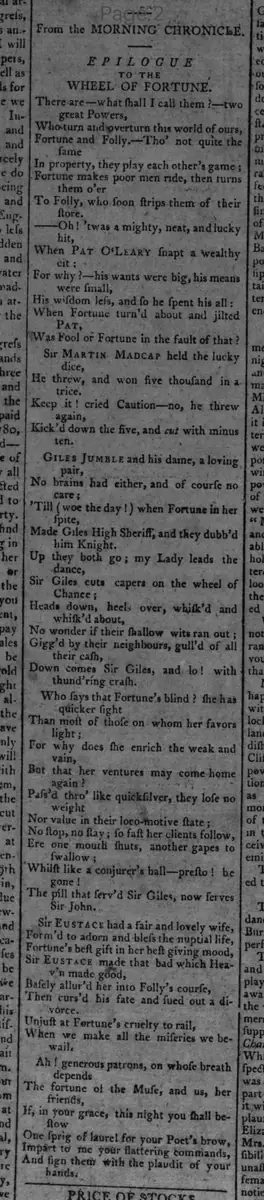
From the MORNING CHRONICLE.
EPILOGUE
TO THE
WHEEL OF FORTUNE.
There are—what shall I call them?—two great Powers,
Who turn and overturn this world of ours,
Fortune and Folly.—Tho' not quite the same
In property, they play each other's game;
Fortune makes poor men ride, then turns them o'er
To Folly, who soon trips them of their store.
Oh! 'twas a mighty, neat, and lucky hit,
When Pat O'Leary snapt a wealthy cit;
For why?—his wants were big, his means were small,
His wisdom less, and so he pent his all:
When Fortune turn'd about and jilted Pat,
Was Fool or Fortune in the fault of that?
Sir Martin Madcap held the lucky dice,
He threw, and won five thousand in a trice.
Keep it! cried Caution—no, he threw again,
Kick'd down the five, and cut with minus ten.
Giles Jumble and his dame, a loving pair,
No brains had either, and of course no care;
Till (woe the day!) when Fortune in her spite,
Made Giles High Sheriff, and they dubb'd him Knight.
Up they both go; my Lady leads the dance,
Sir Giles cuts capers on the wheel of Chance;
Heads down, heels over, whirk'd and whirk'd about,
No wonder if their shallow wits ran out;
Gigg'd by their neighbours, gull'd of all their cash,
Down comes Sir Giles, and lo! with thund'ring crash.
Who says that Fortune's blind? she has quicker sight
Than most of those on whom her favors light;
For why does she enrich the weak and vain,
But that her ventures may come home again?
Pass'd thro' like quicksilver, they lose no weight
Nor value in their loco-motive state;
No stop, no stay; so fast her clients follow,
Ere one mouth shuts, another gapes to swallow;
Whilst like a conjurer's ball—presto! be gone!
The pill that serv'd Sir Giles, now serves Sir John.
Sir Eustace had a fair and lovely wife,
Form'd to adorn and bless the nuptial life,
Fortune's best gift in her best giving mood,
Sir Eustace made that bad which Heav'n made good,
Basely allure'd her into Folly's course,
Then curs'd his fate and sued out a divorce.
Unjust at Fortune's cruelty to rail,
When we make all the miseries we bewail.
Ah! generous patrons, on whose breath depends
The fortune of the Muse, and us, her friends,
If, in your grace, this night you shall bestow
One sprig of laurel for your Poet's brow,
Impart to me your flattering commands,
And sign them with the plaudit of your hands:
EPILOGUE
TO THE
WHEEL OF FORTUNE.
There are—what shall I call them?—two great Powers,
Who turn and overturn this world of ours,
Fortune and Folly.—Tho' not quite the same
In property, they play each other's game;
Fortune makes poor men ride, then turns them o'er
To Folly, who soon trips them of their store.
Oh! 'twas a mighty, neat, and lucky hit,
When Pat O'Leary snapt a wealthy cit;
For why?—his wants were big, his means were small,
His wisdom less, and so he pent his all:
When Fortune turn'd about and jilted Pat,
Was Fool or Fortune in the fault of that?
Sir Martin Madcap held the lucky dice,
He threw, and won five thousand in a trice.
Keep it! cried Caution—no, he threw again,
Kick'd down the five, and cut with minus ten.
Giles Jumble and his dame, a loving pair,
No brains had either, and of course no care;
Till (woe the day!) when Fortune in her spite,
Made Giles High Sheriff, and they dubb'd him Knight.
Up they both go; my Lady leads the dance,
Sir Giles cuts capers on the wheel of Chance;
Heads down, heels over, whirk'd and whirk'd about,
No wonder if their shallow wits ran out;
Gigg'd by their neighbours, gull'd of all their cash,
Down comes Sir Giles, and lo! with thund'ring crash.
Who says that Fortune's blind? she has quicker sight
Than most of those on whom her favors light;
For why does she enrich the weak and vain,
But that her ventures may come home again?
Pass'd thro' like quicksilver, they lose no weight
Nor value in their loco-motive state;
No stop, no stay; so fast her clients follow,
Ere one mouth shuts, another gapes to swallow;
Whilst like a conjurer's ball—presto! be gone!
The pill that serv'd Sir Giles, now serves Sir John.
Sir Eustace had a fair and lovely wife,
Form'd to adorn and bless the nuptial life,
Fortune's best gift in her best giving mood,
Sir Eustace made that bad which Heav'n made good,
Basely allure'd her into Folly's course,
Then curs'd his fate and sued out a divorce.
Unjust at Fortune's cruelty to rail,
When we make all the miseries we bewail.
Ah! generous patrons, on whose breath depends
The fortune of the Muse, and us, her friends,
If, in your grace, this night you shall bestow
One sprig of laurel for your Poet's brow,
Impart to me your flattering commands,
And sign them with the plaudit of your hands:
What sub-type of article is it?
Poem
Satire
What themes does it cover?
Moral Virtue
Social Manners
What keywords are associated?
Epilogue
Fortune
Folly
Satire
Wheel Of Fortune
Moral Lesson
Social Rise Fall
Literary Details
Title
Epilogue To The Wheel Of Fortune
Form / Style
Rhyming Verse Epilogue
Key Lines
There Are—What Shall I Call Them?—Two Great Powers,
Who Turn And Overturn This World Of Ours,
Fortune And Folly.—Tho' Not Quite The Same
In Property, They Play Each Other's Game;
Who Says That Fortune's Blind? She Has Quicker Sight
Than Most Of Those On Whom Her Favors Light;
For Why Does She Enrich The Weak And Vain,
But That Her Ventures May Come Home Again?
Unjust At Fortune's Cruelty To Rail,
When We Make All The Miseries We Bewail.
Ah! Generous Patrons, On Whose Breath Depends
The Fortune Of The Muse, And Us, Her Friends,