Thank you for visiting SNEWPapers!
Sign up free
The Liberator
Boston, Suffolk County, Massachusetts
What is this article about?
Henry H. Garnet, a young Black man from Oneida Institute, delivers a passionate speech at the American Anti-Slavery Society anniversary, arguing for citizenship rights for people of color based on their historical contributions to America's wars, agriculture, religion, and founding, condemning national hypocrisy on slavery.
Merged-components note: Continuation of Henry H. Garnet's speech across pages 2 and 3, with sequential reading order and direct text flow.
Clippings
1 of 2
OCR Quality
Full Text
From the Emancipator.
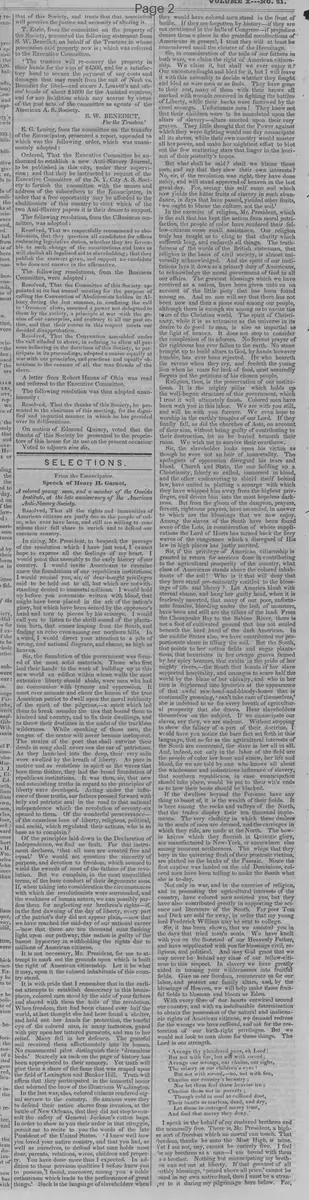
Speech of Henry H. Garnet,
A colored young man, and a member of the Oneida Institute, at the late anniversary of the American Anti-Slavery Society.
Resolved, That all the rights and immunities of American citizens are justly due to the people of color, who ever have been, and still are willing to contribute their full share to enrich and to defend our common country.
In rising, Mr. President, to bespeak the passage of the resolution which I have just read, I cannot hope to express all the feelings of my heart. I would point this assembly to the early history of our country. I would invite Americans to examine anew the foundations of our republican institutions. I would remind you, sir, of dear-bought privileges said to be held out to all, but which are notwithstanding denied to immortal millions. I would hold up before you covenants written with blood. that might have been placed in the ark of the nation's glory, but which have been seized by the oppressor's hand and torn to pieces by his scourge. I would call you to listen to the shrill sound of the plantation horn, that comes leaping from the South, and finding an echo even among our northern hills. In a word, I would direct your attention to a pile of wrong, and national disgrace, and shame, as high as heaven.
Sir, the foundation of this government was formed of the most solid materials. Those who first laid their hands to the work of building up in this new world an edifice within whose walls the most extensive liberty should abide, were men who had no communion with tyranny and oppression. It must ever animate and cheer the bosom of the true American patriot to dwell upon the moral sublimity of the spirit of the pilgrims,—a spirit which led them to break asunder the ties that bound them to kindred and country, and to fix their dwellings, and to throw their destinies in the midst of the trackless wilderness. While speaking of those men, the tongue of the orator will never become ineloquent. The strains of the poet that shall entwine their deeds in song shall never vex the ear of patriotism. As they launched into the deep, their very sails were swelled by the breath of liberty. As pure in motive and as resistless in spirit as the waves that bore them thither. they laid the broad foundation of republican institutions. It was then, sir, that new and astonishing truths in regard to the principles of liberty were developed. Acting under the influence of these truths. our fathers pressed forward with holy and patriotic zeal in the road to that national independence which the revolution of seventy-six opened to them. Of the wonderful perseverance of the ceaseless love of liberty, religious, political, and social, which regulated their actions, who is so base as to complain?
Of the principles laid down in the Declaration of Independence, we find no fault. For that instrument declares, 'that all men are created free and equal.' We would not question the sincerity of purpose, and devotion to freedom, which seemed to wield the swords of most of the fathers of the revolution. But we complain, in the most unqualified terms, of the base conduct of their degenerate sons. If, when taking into consideration the circumstances with which the revolutionists were surrounded, and the weakness of human nature, we can possibly pardon them for neglecting our brethren's rights—if, in the first dawning of the day of liberty, every part of the patriot's duty did not appear plain,—now that we have reached the mid-day of our national career —now that there are ten thousand suns flashing light upon our pathway, this nation is guilty of the basest hypocrisy in withholding the rights due to millions of American citizens.
It is not necessary. Mr. President. for me to attempt to mark out the grounds upon which is built the right of American citizenship. Let it be what it may, upon it the colored inhabitants of this country stand.
It is with pride that I remember that in the earliest attempts to establish democracy in this hemisphere, colored men stood by the side of your fathers and shared with them the toils of the revolution. When freedom, that had been chased over half the world, at last thought she had here found a shelter and held out her hands for protection, the tearful eye of the colored man, in many instances, gazed with pity upon her tattered garments, and ran to her relief. Many fell in her defence. The grateful soil received them affectionately into its bosom. No monumental piles distinguish their 'dreamless beds.' Scarcely an inch on the page of history has been appropriated to their memory. Yet truth will give them a share of the fame that was reaped upon the field of Lexington and Bunker Hill. Truth will affirm that they participated in the immortal honor that adorned the brow of the illustrious Washington.
In the last war, also, colored citizens rendered signal service to the country. So anxious were they to defend their native shores from invasion, at the battle of New Orleans, that they did not stop to consult the safety of General Jackson's cotton bags. In order to show to you their ardor in that struggle, permit me to recite to you the words of the late President of the United States. I knew well how you loved your native country, and that you had, as well as ourselves, to defend what man holds most dear. parents. relations. wives. children and property. You have done more than I expected. In addition to those previous qualities I before knew you to possess, I found, moreover, among you a noble enthusiasm which leads to the performance of great things.' Such is the language of slaveholders when they would have colored men stand in the front of battle. If they are forgotten by history—if they are not mentioned in the halls of Congress—if prejudice denies them a place in the grateful recollections of Americans in general, I trust they will at least be remembered amid the cloister of the Hermitage.
Sir, in consideration of the toils of our fathers in both wars, we claim the right of American citizenship. We claim it, but shall we ever enjoy it? Our ancestors fought and bled for it, but I will leave it with this assembly to decide whether they fought and bled as wise men or as fools. They have gone to their rest, many of them with their brows all marked with wounds received in fighting the battles of Liberty, while their backs were furrowed by the cruel scourge. Unfortunate men! They knew not that their children were to be immolated upon the altars of slavery—altars erected upon their very graves. They little thought that the Power against which they were fighting would one day emancipate all its slaves, while their own country would muster all her power, and make her mightiest effort to blot out the few scattering stars that linger in the horizon of their posterity's hopes.
But what shall be said? shall we blame these men, and say that they slew their own interests? No, sir, if the revolution was right, they have done nobly, and will stand approved of heaven in the last great day. For, seeing this self same soil which now yields the bitter fruits of slavery in such abundance, in days that have passed, yielded other fruits, we ought to blame the culture, not the soil.'
In the exercise of religion, Mr. President, which is the salt that has kept the nation from moral putrefaction. the people of color have rendered their fellow-citizens some small assistance. Our religion truly has taught us to cling to that charity which suffereth long, and endureth all things. The truthfulness of the words of the British statesman, that religion is the basis of civil society, is almost universally acknowledged. And the spirit of our institutions lays it down as a primary duty of Americans, to acknowledge the moral government of God in all our affairs. The greatest blessings which we have received as a nation, have been given unto us on account of the little piety that has been found among us. And no one will say that there has not been now and then a pious soul among our people, although there is enough sin among us to excite the tears of the Christian world. The spirit of Christianity, while it is as extensive as the universe in its desire to do good to man, is also as impartial as the light of heaven. It does not stop to consider the complexion of its adorers. No fervent prayer of the righteous has ever fallen to the earth. No stone brought up to build altars to God, by hands however humble, has ever been rejected.' He who heareth the ravens when they cry, and feedeth the young lion when he roars for lack of food, most assuredly forgets not the petitions of his chosen people.
Religion, then, is the preservation of our institutions. It is the mighty pillar which holds up the well-begun structure of this government, which I trust it will ultimately finish. Colored men have been with you in this labor. We are with you still, and will be with you forever. We even hope to worship in the earthly temples of our Lord. If they finally fall, as did the churches of Asia, on account of their sins, without being guilty of contributing to their destruction, let us be buried beneath their ruins. We wish not to survive their overthrow.
Sir, the slaveholder looks upon his victim as though he were not an heir of immortality. The apologists of oppression disregard his tears and blood. Church and State, the one holding up a Christianity, falsely so called, immersed in blood, and the other endeavoring to shield itself behind law, have united in platting a scourge with which they have whipped him away from the highest privileges, and driven him into the most hopeless darkness. But from the gloom of the dungeon, prayers, fervent, righteous prayers, have ascended, in answer to which are the blessings that we now enjoy. Among the slaves of the South have been found some of the Lots, in consideration of whose supplications the Lord of Hosts has turned back the fiery waves of the vengeance which a disregard of His law in high places has justly merited.
Sir, if the privilege of American citizenship is granted in return for services done in contributing to the agricultural prosperity of the country, what class of Americans stands above the colored inhabitants of the soil! Who is it that will deny that they here stand pre-eminently entitled to the blessings of life and liberty? Let America blush with eternal shame, and hang her guilty head, when it is fearlessly asserted, that many of our poor, unfortunate females, bleeding under the lash of monsters, have been and still are the tillers of the land. From the Chesapeake Bay to the Sabine River, there is not a foot of cultivated ground that has not smiled beneath the hard hand of the dark American. In the middle States also, we have contributed our proportionate share in tilling the soil. But the South, that points to her cotton fields and sugar plantations, that luxuriates in her orange groves fanned by her spicy breezes, that exults in the pride of her mighty rivers,——the South that boasts of her slave supported hospitality. and manages to scare half the world by the blaze of her chivalry, and who in her turn is frightened into hysterics at the appearance of that awful raw-head-and-bloody-bones that is continually groaning, 'can't take care of themselves,' she is indebted to us for every breath of agricultural prosperity that she draws. Hear slaveholders themselves on the subject. If we emancipate our slaves, say they, we are undone. Without stopping to show the fallacy of a part of their doctrine, I would have you notice the bare fact set forth in this language, that so far as the agricultural interests of the South are concerned. the slave is her all in all. And, indeed, not only in the labor of the field are the people of color her bone and sinew, her life and blood, for we are told by one who knows all about the wholesome and industrious influence of slavery, that southern republicans, in case emancipation should take place, would be put to their wit's ends as to how their boots should be blacked.
If the dwellers beyond the Potomac have any thing to boast of, it. is the wealth of their fields. It is here among the rocks and valleys of the North, that the trades display their ten thousand implements. The very clothing in which these dealers in the souls of men are dressed, and the carriages in which they ride. are made at the North. The bowie knives which they flourish in Quixotic glory. are manufactured in New-York, or somewhere else among innocent northerners. The whips that they bury in the quivering flesh of their prostrate victims, are platted on the banks of the Passaic. Since the first captive was landed on the old Dominions. colored men have been toiling to make the South what she is to-day.
Not only in war, and in the exercise of religion, and in promoting the agricultural interests of the country, have colored men assisted you, but they have also contributed greatly in supporting the science and literature of the South. For poor Tom and Dick are sold far away, in order that my young lord Frederick William may be sent to college
Sir. it has been shown, that we assisted you in the days that tried men's souls. We have knelt with you on the footstool of our Heavenly Father. and have supplicated with you for blessings civil, religious, and political. And may God grant that we may never be behind any class of our fellow-citizens in this respect. In slavery we have greatly aided in turning your wildernesses into fruitful fields. Give us our freedom, remunerate us for our labor, and protect our family altars, and, by the blessings of Heaven, we will help make those fruitful fields to blossom and bloom as Eden.
With every fibre of our hearts entwined around our country, and with an indefeasible determination to obtain the possession of the natural and inalienable rights of American citizens, we demand redress for the wrongs we have suffered, and ask for the restoration of our birth-right privileges. But we would not look to man alone for these things. The Lord is our strength.
Avenge thy plundered poor, oh Lord!
But not with fire, but not with sword;
Avenge our wrongs, our chains, our sighs,
The misery in our children's eyes!
But not with sword,——no, not with fire,
Chastise our country's locust ire;
Nor let them feel thine heavier ire;
Chastise them not in poverty;
Though cold in soul as coffined dust,
Their hearts as tearless, dead, and dry,
Let them in outraged mercy trust,
And find that mercy they deny.
I speak in the behalf of my enslaved brethren and the nominally free. There is, Mr. President, a higher sort of freedom which no mortal can touch. That freedom, thanks be unto the Most High, is mine. Yet I am not, nay, cannot be entirely free. I feel for my brethren as a man—I am bound with them as a brother. Nothing but emancipating my brethren can set me at liberty. If that greatest of all earthly blessings, 'prized above all price,' cannot be found in my own native land, then I must be a stranger to it during my pilgrimage here below. For.
although I were dwelling beneath the bright skies of Asia, or listening to the harp-like strains of the gentle winds that whisper of freedom among the groves of Africa—though my habitation were fixed in the freest part of Victoria's dominions, yet it were vain, and worse than vain for me to indulge the thought of being free, while three millions of my countrymen are wailing in the dark prison-house of oppression.
In submitting the resolution, sir, I would again call upon Americans to remember, that, but a few years ago their fathers crossed the ocean, in search of the freedom now denied to us. I would beseech them to remember that the great day of God's final reckoning is just before us, remember his eternal justice, and then remember the outcast bondman, and let him go forth free in the presence of God, in whose image he was created.
What sub-type of article is it?
What themes does it cover?
What keywords are associated?
What entities or persons were involved?
Where did it happen?
Story Details
Key Persons
Location
United States
Event Date
Late Anniversary Of The American Anti Slavery Society
Story Details
Henry H. Garnet urges the assembly to pass a resolution granting citizenship rights to people of color, highlighting their contributions to the American Revolution, War of 1812, agriculture, religion, and national prosperity, while condemning the hypocrisy of denying them liberty despite the Declaration of Independence.