Thank you for visiting SNEWPapers!
Sign up free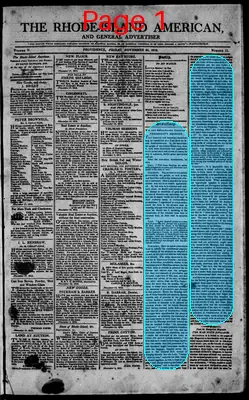
Editorial
November 20, 1812
The Rhode Island American, And General Advertiser
Providence, Providence County, Rhode Island
What is this article about?
Satirical commentary in the Rhode-Island American critiquing President Madison's message on the War of 1812, mocking military strategies in Michigan and Canada, General Hull's expedition, U.S. Indian policy, and contrasting it with British actions.
Clipping
OCR Quality
95%
Excellent
Full Text
miscellany
For the Rhode-Island American.
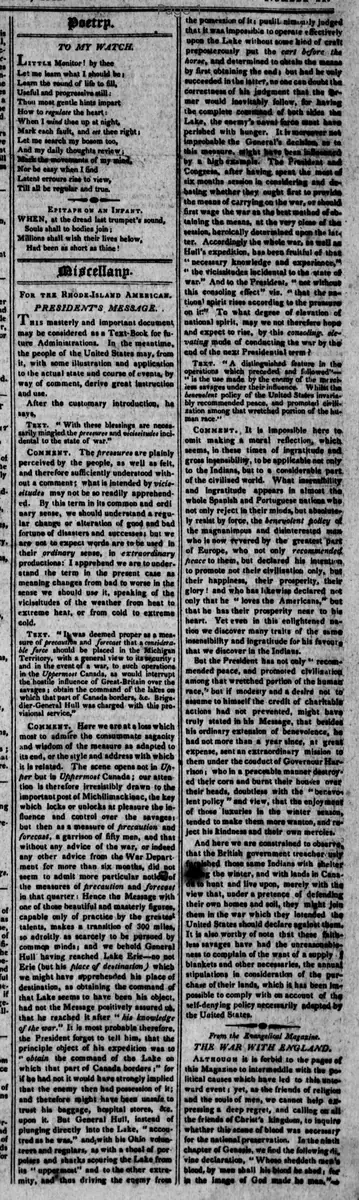
PRESIDENT'S MESSAGE.
This masterly and important document may be considered as a Text-Book for future Administrations. In the meantime, the people of the United States may, from it, with some illustration and application to the actual state and course of events, by way of comment, derive great instruction and use.
After the customary introduction, he says,
Text. "With these blessings are necessarily mingled the pressures and vicissitudes incidental to the state of war."
Comment. The pressures are plainly perceived by the people, as well as felt, and therefore sufficiently understood without a comment; what is intended by vicissitudes may not be so readily apprehended. By this term in its common and ordinary sense, we should understand a regular change or alteration of good and bad fortune of disasters and successes: but we are not to expect words are to be used in their ordinary sense, in extraordinary productions: I apprehend we are to understand the term in the present case as meaning changes from bad to worse in the sense we should use it, speaking of the vicissitudes of the weather from heat to extreme heat, or from cold to extreme cold.
Text. "It was deemed proper as a measure of precaution and forecast that a considerable force should be placed in the Michigan Territory, with a general view to its security; and in the event of a war, to such operations in the Uppermost Canada, as would interrupt the hostile influence of Great-Britain over the savages; obtain the command of the lakes on which that part of Canada borders, &c. Brigadier-General Hull was charged with this provisional service,"
Comment. Here we are at a loss which most to admire the consummate sagacity and wisdom of the measure as adapted to its end, or the style and address with which it is related. The scene opens not in Upper but in Uppermost Canada; our attention is therefore irresistibly drawn to the important post of Michilimackinac, the key which locks or unlocks at pleasure the influence and control over the savages; but then as a measure of precaution and forecast, a garrison of fifty men, and that without any advice of the war, or indeed any other advice from the War Department for more than six months, did not seem to admit "more particular notice" of the measures of precaution and forecast in that quarter: Hence the Message with one of those beautiful and masterly figures, Capable only of practice by the greatest talents, makes a transition of 300 miles so adroitly, as scarcely to be pursued by common minds; and we behold General Hull having reached Lake Erie -- do not Erie (but his place of destination) which we might have apprehended his place of destination, as obtaining the command of that Lake seems to have been his object, had not the Message positively assured us. that he reached it after "his knowledge of the war." It is most probable therefore. the President forgot to tell him, that the principal object of his expedition was to "obtain the command of the Lake on which that part of Canada borders:" for if he had not it would have strongly implied that the enemy then had possession of it; and therefore might have been unsafe to trust his baggage, hospital stores, &c. upon it. But General Hull, instead of plunging directly into the Lake, "accoun-tred as he was," and with his Ohio volun-teers and regulars, as with a shoal of por-poises and sharks scouring the Lake from its "uppermost" and to the other extre-mity, and thus driving the enemy from the possession of it; pusillanimously judged that it was impossible to operate effectively upon the Lake without some kind of craft preposterously put the cart before the horse, and determined to obtain the means by first obtaining the end; but had he only succeeded in the latter, no one can doubt the correctness of his judgment that the for-mer would inevitably follow, for having the complete Command of both sides the Lake, the enemy's naval force must have perished with hunger. It is moreover not improbable the General's decision as to this measure might have been influenced by a high example. The President and Congress, after having spent the most di-minutive months session in considering and de-bating whether they ought first to provide the means of carrying on the war, or should first wage the war as the best method of ob-taining the means, at the very close of the session, heroically determined upon the lat-ter. Accordingly the whole war, as well as Hull's expedition, has been fruitful of that "necessary knowledge and experience" "the vicissitudes incidental to the state of war." And to the President, "not without this consoling effect" viz. "that the na-tional spirit rises according to the pressure on it." To what degree of elevation of national spirit, may we therefore hope and expect to rise, by this consoling, ele-vating mode of conducting the war by the end of the next Presidential term?
Text. "A distinguished feature in the operations which preceded and followed is the use made by the enemy of the merci-less savages under their influence. Whilst the benevolent policy of the United States invaria-bly recommended peace, and promoted civili-zation among that wretched portion of the hu-man race."
Comment. It is impossible here to omit making a moral reflection, which seems, in these times of ingratitude and gross insensibility, to be applicable not only to the Indians, but to a considerable part. of the civilised world. What insensibility and ingratitude appears in almost the whole Spanish and Portuguese nations who not only reject in their minds, but absolutely resist by force, the benevolent policy of the magnanimous and disinterested man who is now revered by the greatest part of Europe, who not only recommended peace to them, but declared his intention, to promote not their civilization only, but their happiness, their prosperity, their glory! and who has likewise declared not only that he "loves the Americans," but that he has their prosperity near to his heart. Yet even in this enlightened na-tion we discover many traits of the same insensibility and ingratitude for his favour that we discover in the Indians.
But the President has not only "recom-mended peace, and promoted civilization among that wretched portion of the human race," but if modesty and a desire not to assume to himself the credit of charitable actions had not prevented, might have truly stated in his Message, that besides his ordinary extension of benevolence, he had not more than a year since, at great expense, sent an extraordinary mission to them under the conduct of Governor Har-rison; who in a peaceable manner destroyed their corn and burnt their houses over their heads, doubtless with the benevolent policy "and view, that the enjoyment of those luxuries in the winter season, tended to make them more wanton, and re-ject his kindness and their own mercies. And here we are constrained to observe that the British government treacherously furnished those same Indians with shelter during the winter, and with lands in Cana-da to hunt and live upon, merely with the view that, under a pretence of defending their own homes and soil, they might join them in the war which they intended the United States should declare against them. It is also worthy of note that these faith-less savages have had the unreasonableness to complain of the want of a supply of blankets and other necessaries, the annual stipulations in consideration of the pur-chase of their lands, which it has been im-possible to comply with on account of the self-denying policy necessarily adopted by the United States.
For the Rhode-Island American.
PRESIDENT'S MESSAGE.
This masterly and important document may be considered as a Text-Book for future Administrations. In the meantime, the people of the United States may, from it, with some illustration and application to the actual state and course of events, by way of comment, derive great instruction and use.
After the customary introduction, he says,
Text. "With these blessings are necessarily mingled the pressures and vicissitudes incidental to the state of war."
Comment. The pressures are plainly perceived by the people, as well as felt, and therefore sufficiently understood without a comment; what is intended by vicissitudes may not be so readily apprehended. By this term in its common and ordinary sense, we should understand a regular change or alteration of good and bad fortune of disasters and successes: but we are not to expect words are to be used in their ordinary sense, in extraordinary productions: I apprehend we are to understand the term in the present case as meaning changes from bad to worse in the sense we should use it, speaking of the vicissitudes of the weather from heat to extreme heat, or from cold to extreme cold.
Text. "It was deemed proper as a measure of precaution and forecast that a considerable force should be placed in the Michigan Territory, with a general view to its security; and in the event of a war, to such operations in the Uppermost Canada, as would interrupt the hostile influence of Great-Britain over the savages; obtain the command of the lakes on which that part of Canada borders, &c. Brigadier-General Hull was charged with this provisional service,"
Comment. Here we are at a loss which most to admire the consummate sagacity and wisdom of the measure as adapted to its end, or the style and address with which it is related. The scene opens not in Upper but in Uppermost Canada; our attention is therefore irresistibly drawn to the important post of Michilimackinac, the key which locks or unlocks at pleasure the influence and control over the savages; but then as a measure of precaution and forecast, a garrison of fifty men, and that without any advice of the war, or indeed any other advice from the War Department for more than six months, did not seem to admit "more particular notice" of the measures of precaution and forecast in that quarter: Hence the Message with one of those beautiful and masterly figures, Capable only of practice by the greatest talents, makes a transition of 300 miles so adroitly, as scarcely to be pursued by common minds; and we behold General Hull having reached Lake Erie -- do not Erie (but his place of destination) which we might have apprehended his place of destination, as obtaining the command of that Lake seems to have been his object, had not the Message positively assured us. that he reached it after "his knowledge of the war." It is most probable therefore. the President forgot to tell him, that the principal object of his expedition was to "obtain the command of the Lake on which that part of Canada borders:" for if he had not it would have strongly implied that the enemy then had possession of it; and therefore might have been unsafe to trust his baggage, hospital stores, &c. upon it. But General Hull, instead of plunging directly into the Lake, "accoun-tred as he was," and with his Ohio volun-teers and regulars, as with a shoal of por-poises and sharks scouring the Lake from its "uppermost" and to the other extre-mity, and thus driving the enemy from the possession of it; pusillanimously judged that it was impossible to operate effectively upon the Lake without some kind of craft preposterously put the cart before the horse, and determined to obtain the means by first obtaining the end; but had he only succeeded in the latter, no one can doubt the correctness of his judgment that the for-mer would inevitably follow, for having the complete Command of both sides the Lake, the enemy's naval force must have perished with hunger. It is moreover not improbable the General's decision as to this measure might have been influenced by a high example. The President and Congress, after having spent the most di-minutive months session in considering and de-bating whether they ought first to provide the means of carrying on the war, or should first wage the war as the best method of ob-taining the means, at the very close of the session, heroically determined upon the lat-ter. Accordingly the whole war, as well as Hull's expedition, has been fruitful of that "necessary knowledge and experience" "the vicissitudes incidental to the state of war." And to the President, "not without this consoling effect" viz. "that the na-tional spirit rises according to the pressure on it." To what degree of elevation of national spirit, may we therefore hope and expect to rise, by this consoling, ele-vating mode of conducting the war by the end of the next Presidential term?
Text. "A distinguished feature in the operations which preceded and followed is the use made by the enemy of the merci-less savages under their influence. Whilst the benevolent policy of the United States invaria-bly recommended peace, and promoted civili-zation among that wretched portion of the hu-man race."
Comment. It is impossible here to omit making a moral reflection, which seems, in these times of ingratitude and gross insensibility, to be applicable not only to the Indians, but to a considerable part. of the civilised world. What insensibility and ingratitude appears in almost the whole Spanish and Portuguese nations who not only reject in their minds, but absolutely resist by force, the benevolent policy of the magnanimous and disinterested man who is now revered by the greatest part of Europe, who not only recommended peace to them, but declared his intention, to promote not their civilization only, but their happiness, their prosperity, their glory! and who has likewise declared not only that he "loves the Americans," but that he has their prosperity near to his heart. Yet even in this enlightened na-tion we discover many traits of the same insensibility and ingratitude for his favour that we discover in the Indians.
But the President has not only "recom-mended peace, and promoted civilization among that wretched portion of the human race," but if modesty and a desire not to assume to himself the credit of charitable actions had not prevented, might have truly stated in his Message, that besides his ordinary extension of benevolence, he had not more than a year since, at great expense, sent an extraordinary mission to them under the conduct of Governor Har-rison; who in a peaceable manner destroyed their corn and burnt their houses over their heads, doubtless with the benevolent policy "and view, that the enjoyment of those luxuries in the winter season, tended to make them more wanton, and re-ject his kindness and their own mercies. And here we are constrained to observe that the British government treacherously furnished those same Indians with shelter during the winter, and with lands in Cana-da to hunt and live upon, merely with the view that, under a pretence of defending their own homes and soil, they might join them in the war which they intended the United States should declare against them. It is also worthy of note that these faith-less savages have had the unreasonableness to complain of the want of a supply of blankets and other necessaries, the annual stipulations in consideration of the pur-chase of their lands, which it has been im-possible to comply with on account of the self-denying policy necessarily adopted by the United States.
What sub-type of article is it?
War Or Peace
Military Affairs
Indian Affairs
What keywords are associated?
President's Message
War Of 1812
General Hull
Michigan Territory
Indian Policy
Lake Erie
British Influence
Vicissitudes Of War
What entities or persons were involved?
President
Brigadier General Hull
Great Britain
Savages
Governor Harrison
Editorial Details
Primary Topic
Satirical Critique Of President's Message On War Of 1812
Stance / Tone
Satirical Criticism Of Administration's War Strategy And Policies
Key Figures
President
Brigadier General Hull
Great Britain
Savages
Governor Harrison
Key Arguments
Pressures And Vicissitudes Of War Are Worsening Conditions
Inadequate Precautions In Michigan Territory And Michilimackinac
Hull's Expedition Failed To Secure Lake Erie Command Due To Lack Of Vessels
Administration's Delay In War Preparations Mirrors Hull's Errors
British Use Of Indians Contrasts With U.S. Benevolent Policy
U.S. Actions Like Harrison's Destruction Of Indian Villages Undermine Benevolence Claims
British Provided Shelter And Lands To Indians
Indians Complain Of Unfulfilled Treaty Stipulations