Thank you for visiting SNEWPapers!
Sign up free
Jackson Advocate
Jackson, Hinds County, Mississippi
What is this article about?
In Tanganyika, Julius Nyerere leads a unified multiracial elected bloc in the Legislative Council after 1958-59 elections, prompting an increase in elected ministers and raising questions for British colonial policy amid contrasts with Kenya and Central Africa.
Clipping
OCR Quality
Full Text
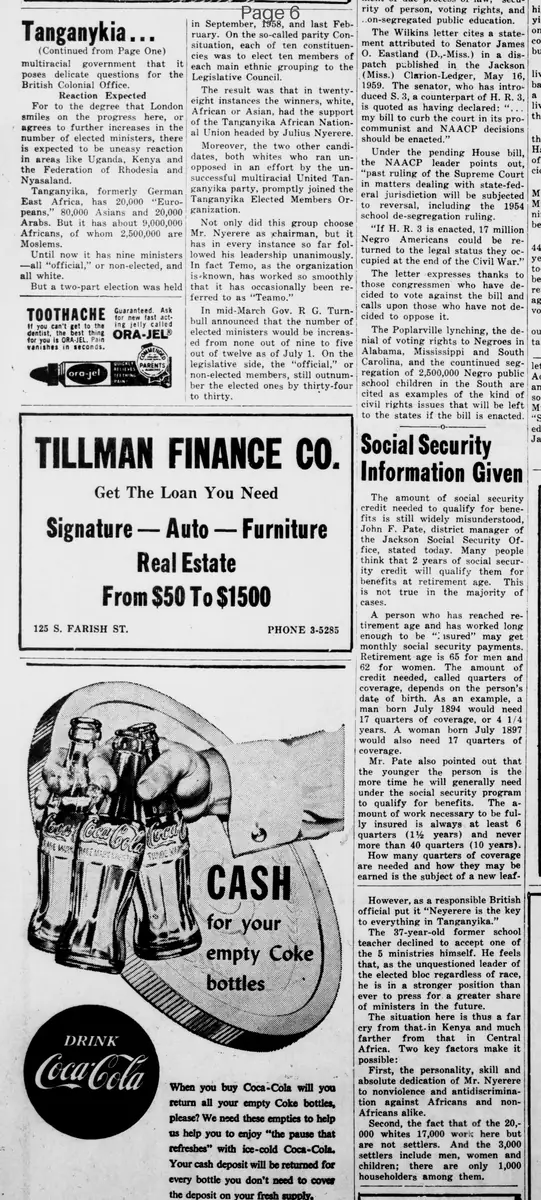
The 37-year-old former school teacher declined to accept one of the 5 ministries himself. He feels that, as the unquestioned leader of the elected bloc regardless of race, he is in a stronger position than ever to press for a greater share of ministers in the future.
The situation here is thus a far cry from that in Kenya and much farther from that in Central Africa. Two key factors make it possible:
First, the personality, skill and absolute dedication of Mr. Nyerere to nonviolence and antidiscrimination against Africans and non-Africans alike.
Second, the fact that of the 20,000 whites 17,000 work here but are not settlers. And the 3,000 settlers include men, women and children; there are only 1,000 householders among them.
Tanganyika (Continued from Page One)
multiracial government that it poses delicate questions for the British Colonial Office.
Reaction Expected
For to the degree that London smiles on the progress here, or agrees to further increases in the number of elected ministers, there is expected to be uneasy reaction in areas like Uganda, Kenya and the Federation of Rhodesia and Nyasaland.
Tanganyika, formerly German East Africa, has 20,000 "Europeans," 80,000 Asians and 20,000 Arabs. But it has about 9,000,000 Africans, of whom 2,500,000 are Moslems.
Until now it has nine ministers all "official," or non-elected, and all white.
But a two-part election was held in September, 1958, and last February. On the so-called parity constitution, each of ten constituencies was to elect ten members of each main ethnic grouping to the Legislative Council.
The result was that in twenty-eight instances the winners, white, African or Asian, had the support of the Tanganyika African National Union headed by Julius Nyerere.
Moreover, the two other candidates, both whites who ran unopposed in an effort by the unsuccessful multiracial United Tanganyika party, promptly joined the Tanganyika Elected Members Organization.
Not only did this group choose Mr. Nyerere as chairman, but it has in every instance so far followed his leadership unanimously.
In fact Temo, as the organization is known, has worked so smoothly that it has occasionally been referred to as "Teamo."
In mid-March Gov. R. G. Turnbull announced that the number of elected ministers would be increased from none out of nine to five out of twelve as of July 1. On the legislative side, the "official," or non-elected members, still outnumber the elected ones by thirty-four to thirty.
What sub-type of article is it?
What keywords are associated?
What entities or persons were involved?
Where did it happen?
Foreign News Details
Primary Location
Tanganyika
Event Date
September 1958 And Last February; Mid March
Key Persons
Outcome
number of elected ministers increased from none out of nine to five out of twelve as of july 1; official members outnumber elected by thirty-four to thirty
Event Details
Julius Nyerere, leader of the Tanganyika African National Union, heads the elected bloc in the Legislative Council following elections in September 1958 and February. The bloc, including whites, Africans, and Asians, forms a multiracial group under Nyerere's unanimous leadership. Governor Turnbull announced increase in elected ministers. Tanganyika has 20,000 Europeans, 80,000 Asians, 20,000 Arabs, and 9,000,000 Africans. Situation contrasts with Kenya and Central Africa due to Nyerere's dedication to nonviolence and the non-settler status of most whites.