Thank you for visiting SNEWPapers!
Sign up free
Gazette Of The United States
New York, New York County, New York
What is this article about?
The Observer No. XV argues that the federal government should assume state debts, reject state requisitions due to coercion problems, and implement a uniform direct taxation system on property for national finance, emphasizing federalism and efficiency.
Merged-components note: These two components are a direct continuation of the same editorial series 'THE OBSERVER. No. XV.' discussing the assumption of state debts, with sequential reading orders across pages.
Clippings
1 of 2
OCR Quality
Full Text
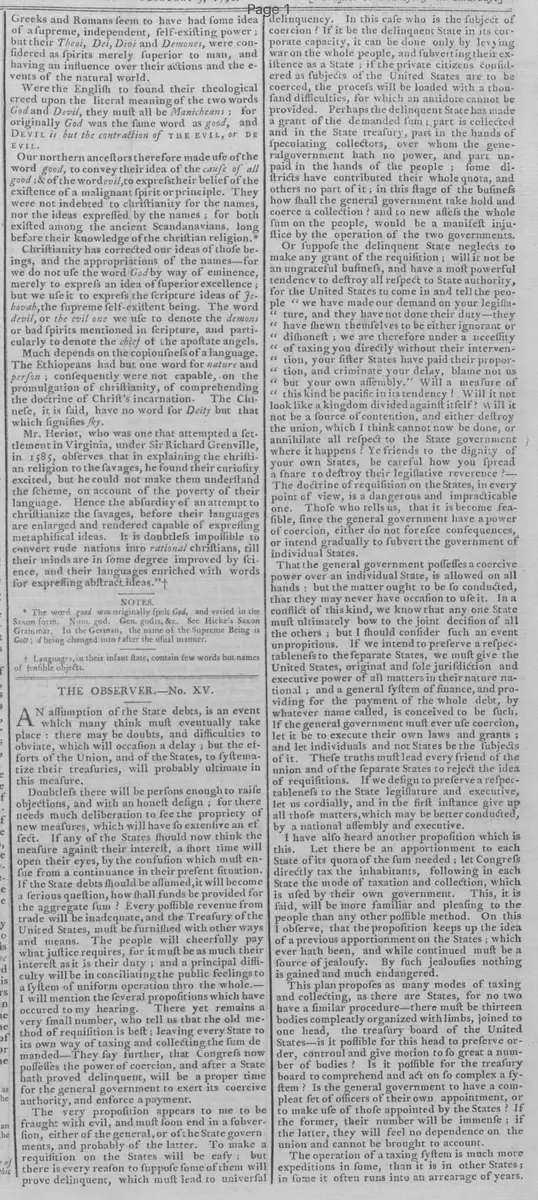
An assumption of the State debts, is an event which many think must eventually take place: there may be doubts, and difficulties to obviate, which will occasion a delay; but the efforts of the Union, and of the States, to systematize their treasuries, will probably ultimate in this measure.
Doubtless there will be persons enough to raise objections, and with an honest design; for there needs much deliberation to see the propriety of new measures, which will have so extensive an effect. If any of the States should now think the measure against their interest, a short time will open their eyes, by the confusion which must ensue from a continuance in their present situation.
If the State debts should be assumed, it will become a serious question, how shall funds be provided for the aggregate sum? Every possible revenue from trade will be inadequate, and the Treasury of the United States, must be furnished with other ways and means. The people will cheerfully pay what justice requires, for it must be as much their interest as it is their duty; and a principal difficulty will be in conciliating the public feelings to a system of uniform operation thro the whole.—
I will mention the several propositions which have occurred to my hearing. There yet remains a very small number, who tell us that the old method of requisition is best; leaving every State to its own way of taxing and collecting the sum demanded. They say further, that Congress now possesses the power of coercion, and after a State hath proved delinquent, will be a proper time for the general government to exert its coercive authority, and enforce a payment.
The very proposition appears to me to be fraught with evil, and must soon end in a subversion, either of the general, or of the State governments, and probably of the latter. To make a requisition on the States will be easy; but there is every reason to suppose some of them will prove delinquent, which must lead to universal delinquency. In this case who is the subject of coercion? if it be the delinquent State in its corporate capacity, it can be done only by levying war on the whole people, and subverting their existence as a State; if the private citizens considered as subjects of the United States are to be coerced, the process will be loaded with a thousand difficulties, for which an antidote cannot be provided. Perhaps the delinquent State has made a grant of the demanded sum; part is collected and in the State treasury, part in the hands of peculating collectors, over whom the general government hath no power, and part unpaid in the hands of the people; some districts have contributed their whole quota, and others no part of it; in this stage of the business how shall the general government take hold and coerce a collection? and to new assess the whole sum on the people, would be a manifest injustice by the operation of the two governments.
Or suppose the delinquent State neglects to make any grant of the requisition; will it not be an ungrateful business, and have a most powerful tendency to destroy all respect to State authority, for the United States to come in and tell the people "we have made our demand on your legislature, and they have not done their duty—they have shewn themselves to be either ignorant or dishonest; we are therefore under a necessity of taxing you directly without their intervention, your sister States have paid their proportion, and criminate your delay, blame not us but your own assembly." Will a measure of this kind be pacific in its tendency? Will it not look like a kingdom divided against itself? will it not be a source of contention, and either destroy the union, which I think cannot now be done, or annihilate all respect to the State government where it happens? Ye friends to the dignity of your own States, be careful how you spread a snare to destroy their legislative reverence?—
The doctrine of requisition on the States, in every point of view, is a dangerous and impracticable one. Those who tell us, that it is become feasible, since the general government have a power of coercion, either do not foresee consequences, or intend gradually to subvert the government of individual States.
That the general government possesses a coercive power over an individual State, is allowed on all hands; but the matter ought to be so conducted, that they may never have occasion to use it. In a conflict of this kind, we know that any one State must ultimately bow to the joint decision of all the others; but I should consider such an event unpropitious. If we intend to preserve a respectableness to the separate States, we must give the United States, original and sole jurisdiction and executive power of all matters in their nature national; and a general system of finance, and providing for the payment of the whole debt, by whatever name called, is conceived to be such.
If the general government must ever use coercion, let it be to execute their own laws and grants; and let individuals and not States be the subjects of it. These truths must lead every friend of the union and of the separate States to reject the idea of requisitions. If we design to preserve a respectableness to the State legislature and executive, let us cordially, and in the first instance give up all those matters, which may be better conducted, by a national assembly and executive.
I have also heard another proposition which is this. Let there be an apportionment to each State of its quota of the sum needed; let Congress directly tax the inhabitants, following in each State the mode of taxation and collection, which is used by their own government. This, it is said, will be more familiar and pleasing to the people than any other possible method. On this I observe, that the proposition keeps up the idea of a previous apportionment on the States; which ever hath been, and while continued must be a source of jealousy. By such jealousies nothing is gained and much endangered.
This plan proposes as many modes of taxing and collecting, as there are States, for no two have a similar procedure—there must be thirteen bodies compleatly organized with limbs, joined to one head, the treasury board of the United States——is it possible for this head to preserve order, controul and give motion to so great a number of bodies? Is it possible for the treasury board to comprehend and act on so complex a system? Is the general government to have a compleat set of officers of their own appointment, or to make use of those appointed by the States? If the former, their number will be immense; if the latter, they will feel no dependence on the union and cannot be brought to account.
The operation of a taxing system is much more expeditions in some, than it is in other States; in some it often runs into an arrearage of years.
Can a general system stand with any punctuality upon such uncertainties? Will it not be in the power of a single state, by altering its own laws, at any time to disconcert the general treasury arrangement? Will the treasury officers ever be able to give an exact account of the national revenue, in whose hands monies are, or whether in a safe situation? I will propose a question which to the people is still a more serious one. Those public officers intrusted with the revenue, and with the disposition of monies, ought to be placed in the most accountable situation; from the integrity of those now in office, we cannot infer the honor or honesty of their successors; and will not so complex a plan as we are now considering, give the greatest room for evasion and fraud, that can never be detected? Whoever considers these questions, in some of them, will find unanswerable objections, against apportioning to the States, and adopting in each one, its own method of taxing and collecting.
If neither of the above methods are feasible, the general government must adopt a system of its own, on plain principles, which may operate through the whole with equal expedition and justice. The greatest evil is to be expected from a plan which either gives discretionary power to subordinate officers of government, in dividing the taxes on the people; or is so complex in its principles and operation that they cannot understand it. No good man will murmur when he sees himself treated on principles of equality; but lawgivers ought to remember, that for the common citizens to see this, the mode of taxation must be very plain. It is but a few, who have a thorough knowledge of the principles and influence of the tax laws in their own States, and this they have acquired by living long under them. Should the general government adopt a complex system, by detaching the most eligible parts, from all the local customs within the union, it would still appear to the people a proper object of jealousy, and not seeing an equal operation on others, they would suppose themselves injured.
If there be any kind of property which is the basis of wealth throughout the union, and bears a near proportion to the ability of the people who must pay; if this kind of property cannot be secreted, and may be charged on principles of greater equality than any other; if the nature of the property be such that every man may previously calculate his taxes, and detect an overcharge; if it admits a more easy and cheap collection than any other; if its produce must forever be in demand, which will enable the person charged to pay his taxes; this property on some plain principles ought to be the subject of direct taxation.
What sub-type of article is it?
What keywords are associated?
What entities or persons were involved?
Editorial Details
Primary Topic
Assumption Of State Debts And Federal Taxation System
Stance / Tone
Advocacy For Federal Assumption Of Debts And Uniform Direct Taxation
Key Figures
Key Arguments