Thank you for visiting SNEWPapers!
Sign up free
The Patowmac Guardian, And Berkeley Advertiser
Martinsburg, Shepherdstown, Berkeley County, Jefferson County, West Virginia
What is this article about?
In response to a prior letter, FAIRPLAY defends Representative Rutherford's criticism of a petition opposing the treaty with Britain, citing fraudulent signatures and misleading promises by promoters. He links the flour price decline to the treaty's effects and warns of rising public debt undermining national prosperity.
Clipping
OCR Quality
Full Text
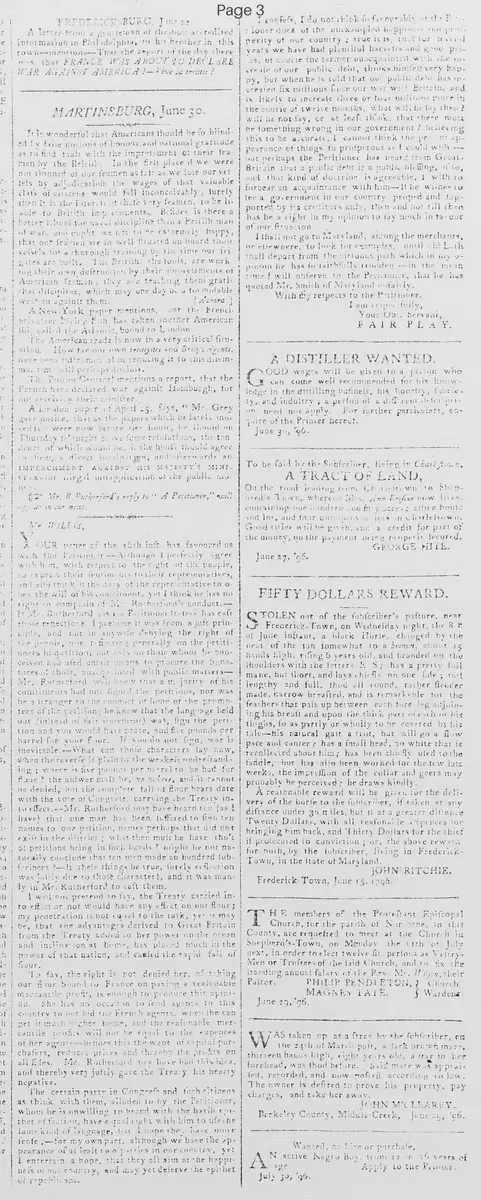
(Our reader of the 16th inst. has favoured us with the Petitioner's--Although I perfectly agree with him, with respect to the right of the people, to express their sentiments to their representatives. And also think it the duty of the representative to obey the will of his constituent. Yet I think he has no right in complaining of Mr. Rutherford's conduct.--
If Mr. Rutherford, as the Petitioner intimates, has cast those reflections. I presume it was from a just principle, and not in anyway denying the right of the people, nor reflecting generally on the petitioners in question, but only on those whom he conceived had used unfair manners to procure the signatures of those, so much hated with public matters---
Mr. Rutherford well knew that a majority of his constituents had not signed the petition, nor was he a stranger to the conduct of some of the promoters of the petition; he knew that the language held out instead of fair statement was, sign the petition and you would have peace. and five pounds per barrel for your flour. If you do not sign, war is inevitable.--What can those characters say now, when the reverse is plain to the weakest understanding. where is five pounds per barrel to be had for flour? the answer must be, no where, and it cannot be denied, but the complete fall at flour bears date with the vote of Congress. carrying the Treaty into effect,--Mr. Rutherford may have heard too (as I have) that one man has been suffered to sign ten names to one petition, names perhaps that did not exist in the district : what then must he have tho't of petitions being in such hands? might he not naturally conclude that ten men made an hundred subscribers --! If these things be true, surely reflection was justly due to those characters. and it was manly in Mr. Rutherford to cast them.
I will not pretend to say, the Treaty carried into effect or not would have any effect on our flour; my penetration is not equal to the task, yet I may be, that the advantages derived to Great Britain from the Treaty added to her power on the ocean and inclination at home, has placed much in the power of that nation, and caused the rapid fall of flour.
To say, the right is not denied her. of taking our flour bound to France on paying a reasonable mercantile profit, is enough to produce this opinion. she has no occasion to send agents to this country to out bid the French agents, when she can get it much nigher home, and the reasonable mercantile profits will not be equal to the expences of her agents--besides this the want of capital purchasers, reduces prices and thereby the profits on all sides, Mr. Rutherford may have had this idea. and thereby very justly gave the Treaty his hearty negative.
The certain party in Congress- and such citizens as think with them, alluded to by the Petitioner, whom he is unwilling to brand with the harsh epithet of faction, have equal right with him to use the same kind of language, but I hope they have more sense --for my own part, although we have the appearance of at least two parties in our country, yet I entertain a hope. that they all aim at the happiness of our country, and may yet deserve the epithet of republicans.
I confess. I do not think so favourably as he does of the uncommon happiness and prosperity of our country ; true it is, in the last several years we have had plentiful harvests and good prices, of course the farmer unacquainted with the increase of our public debt, thinks himself very happy, but when he is told that our public debt has increased six millions since our war with Britain. and is likely to increase three or four millions more in the course of twelve months, what will he say then? will he not say, or at least, think. that there must be something wrong in our government? believing this to be accurate, I cannot think the present appearance of things to properous as I could wish -- but perhaps the Petitioner has heard from Great. Britain that a public debt is a public blessing, if so, and that kind of doctrine is agreeable. I wish to forbear an acquaintance with him--if he wishes to see a government in our country propped and supported by its creditors only, then and not till then has he a right in my opinion to say much in favor of our constitution
I shall not go to Maryland, among the merchants. or elsewhere, to look for examples," until I first shall depart from the virtuous path which in my opinion he has so faithfully trodden --in the mean time I will observe to the Petitioner, that he has quoted Mr. Smith of Maryland unfairly.
With Sincere respects to the Petitioner.
I am respectfully,
Your Ob. Servant,
FAIRPLAY.
What sub-type of article is it?
What themes does it cover?
What keywords are associated?
What entities or persons were involved?
Letter to Editor Details
Author
Fairplay
Recipient
N. Willis
Main Argument
the writer defends mr. rutherford's conduct in criticizing the petition against the treaty, arguing that the petition involved unfair methods and fraudulent signatures, and that the fall in flour prices resulted from the treaty's implementation rather than its rejection. he expresses concern over the increasing public debt and questions the prosperity claimed by the petitioner.
Notable Details