Thank you for visiting SNEWPapers!
Sign up free
The Daily Alaska Empire
Juneau, Juneau County, Alaska
What is this article about?
Drew Pearson's column reveals Democratic plans for a special congressional session to counter Republican delays, Truman's firm opposition to returning tidelands oil to states, and Republican Senator Taft's advocacy for expanded federal welfare programs including housing, health, and education, amid internal GOP debates.
Merged-components note: Continuation of Drew Pearson's 'Washington Merry-Go-Round' editorial column across pages.
Clippings
1 of 2
OCR Quality
Full Text
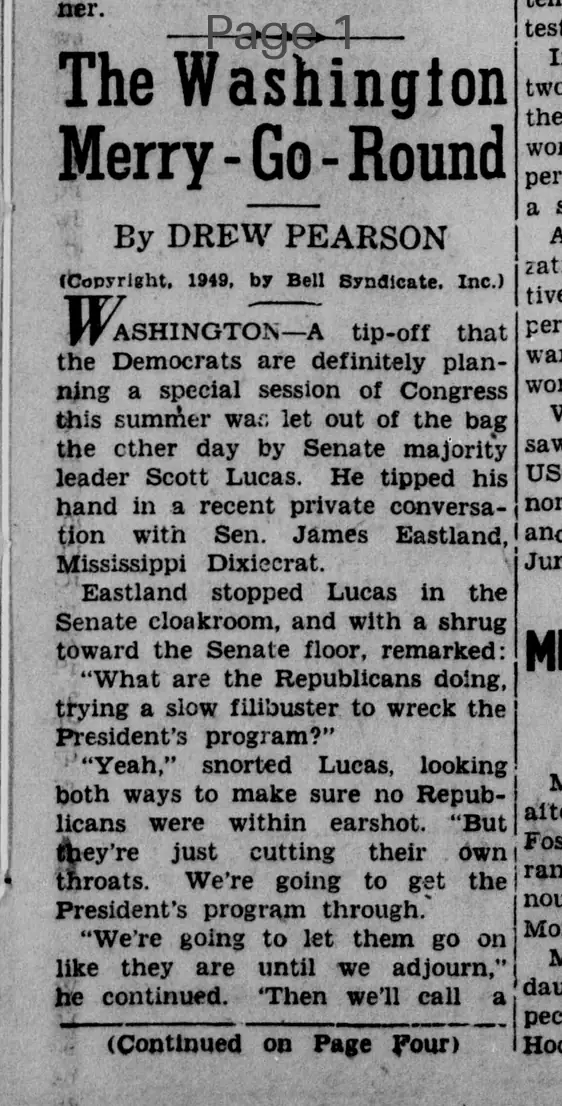
By DREW PEARSON
(Copyright, 1949, by Bell Syndicate, Inc.)
WASHINGTON-A tip-off that the Democrats are definitely planning a special session of Congress this summer was let out of the bag the other day by Senate majority leader Scott Lucas. He tipped his hand in a recent private conversation with Sen. James Eastland, Mississippi Dixiecrat.
Eastland stopped Lucas in the Senate cloakroom, and with a shrug toward the Senate floor, remarked: "What are the Republicans doing, trying a slow filibuster to wreck the President's program?"
"Yeah," snorted Lucas, looking both ways to make sure no Republicans were within earshot. "But they're just cutting their own throats.
We're going to get the President's program through.
We're going to let them go on like they are until we adjourn," he continued.
Then we'll call a
special session.
(Continued on Page Four)
The Washington
Merry-Go-Round
By DREW PEARSON
(Continued from Page 1)
special session
this
summer
and
come back and pass the President's
program.
After that, we'll go to
the people and tell them the reason
we had to call a special session was
because the Republicans caused a
sitdown strike in the United States
Senate.
There isn't a man on the Repub-
lican side who has any idea
of
politics," Lucas added.
"As long
as they have men
like
Wherry
(minority leader Kenneth Wherry
of Nebraska), they're not going
to
get anywhere."
TIDELANDS OIL
Salt Lake City's dignified, white-
haired postmaster, I. A. Smoot,
called on President Truman the
other day to plead for a strong
hand in crushing the oil lobby. The
lobby is now pushing another bill
through Congress to restore the rich
tidelands oil to the states.
There was no hedging in Tru-
man's reply.
"As long as I am President," he
declared, "I will never permit the
submerged oil lands to go back to
the states."
TAFT AND NEW DEAL
Probably more than anyone else,
Sen. Robert Taft of Ohio is the
personification of the Republican
Party. Therefore, when he called
for a broader social program in an
off-the-cuff speech the other day,
it had the effect of shifting the
GOP cornerstone a few points to
the left.
Taft's statement was delivered behind closed doors and was meant
only for the ears of Republican
Senators. Part of what he said
has already leaked to the press, but
for the first time here is the full
story of what happened.
The stage was set for Taft's remarks by his Ohio colleague, Sen.
John Bricker, who called for a
tightening of the economic belt and
a return to the standards of Re-
publican thrift.
Bricker's preaching was chiefly
aimed against public housing, and
in favor of his neat strategy to kill
public housing by tacking an anti-
segregation amendment on the bill
This would drag civil rights into
the housing fight and split the
Democratic Party right down the
Mason-Dixon line. Bricker suggested limiting debate on the anti-
segregation amendment by two-
thirds cloture and, for political reasons, divorcing the arguments from
the public-housing issue.
TAFT GETS TENSE
After more of this kind of talk
from Mundt of South Dakota and
Malone of Nevada, Taft jumped to
his feet and tensely took the arch-
conservatives to task. It was time,
he declared, to draw the line between the Democratic and Republican parties. The difference, he
said, was not in ideals, but in
methods.
"The Republicans stand for im-
proved standards of living,"
he
crackled. But we believe in welfare without regimentation."
He contended that federal aid for
housing, health and education does
not depart from the basic principles of the Constitution. Republicans are already supporting welfare
programs in the cities—including
slum clearance, free medical service and free education, he pointed out. Federal aid was just an
extension of this program, he said.
"Of course, Republicans must
support the free-enterprise system,"
Taft warned. "But we had better
take care of those in the lowest
income brackets or we will lose
the free-enterprise system."
He then invited Senators Bricker, Mundt and Malone to "come
down and take a look at our slum
condition."
"If we follow the Mundt-Malone
line," he warned, "there won't be
any Republican Party."
BRICKER'S BACKGROUND
Taft got a big hand from his
colleagues, after
which Bricker
broke in sharply.
"I don't want to be placed in
the category of someone who is
against people," he snapped. "All
my life I have given 10 to 15
per cent of my income to charity.
For several years I have served on
the Community Chest. I am as
deeply concerned about the common
man as anyone else."
Bricker didn't mention, of course,
the fact that he is a director of
the Buckeye State Building and
Loan League, and a part of the real
estate and anti-housing lobby. At
one time the League's bulletin gleefully boasted how Bricker had obligingly introduced four Senate bills
to help the lobby.
The man who got Bricker his
job with Buckeye is his staunch
political supporter, John Galbreath,
a power among Ohio real estate-
financial circles. Ohio politicians
sometimes say that Bricker does
not even shave in the morning
without consulting Galbreath.
Senate colleagues recall that William L. Kaiser, an ex-Capitol policeman, once fired two wild shots at
Bricker in the Senate subway.
Kaiser claimed he lost money in
the building and loan association
run by Galbreath and closed by
Bricker
when Attorney General
of Ohio.
Note—The business end of the
GOP meeting was devoted chiefly
to public housing. Taft outlined
his program, which included $500
grants to farmers for building out-
houses. At this Wisconsin's Senator Joe McCarthy jumped up.
"Would the Senator consider an
amendment," he asked innocently,
"to provide a $500 grant for similar facilities for lady members of the
Senate?"
McCarthy
referred
to the fact
that
Maine's
Margaret
Chase
Smith
has
been
pressuring
for a
ladies
room
near
the
Senate
chamber ever since she took office.
What sub-type of article is it?
What keywords are associated?
What entities or persons were involved?
Editorial Details
Primary Topic
Democratic Strategy For Special Session And Republican Debates On Social Programs
Stance / Tone
Critical Of Republican Obstruction And Conservatism, Supportive Of Democratic And Moderate Republican Positions
Key Figures
Key Arguments