Thank you for visiting SNEWPapers!
Sign up free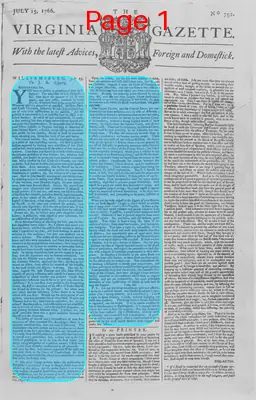
Letter to Editor
July 25, 1766
The Virginia Gazette
Richmond, Williamsburg, Richmond County, Virginia
What is this article about?
An anonymous letter to J. B. Esquire criticizes the Virginia General Court's unusual admission of Col. Chiswell to bail, arguing it subverts legal authority, ignores proper procedures, and undermines the relation between county and general courts, calling for judicial review of the judges' actions.
Clipping
OCR Quality
97%
Excellent
Full Text
WILLIAMSBURG,
July 25.
To J. B. Esquire.
Honourable Sir,
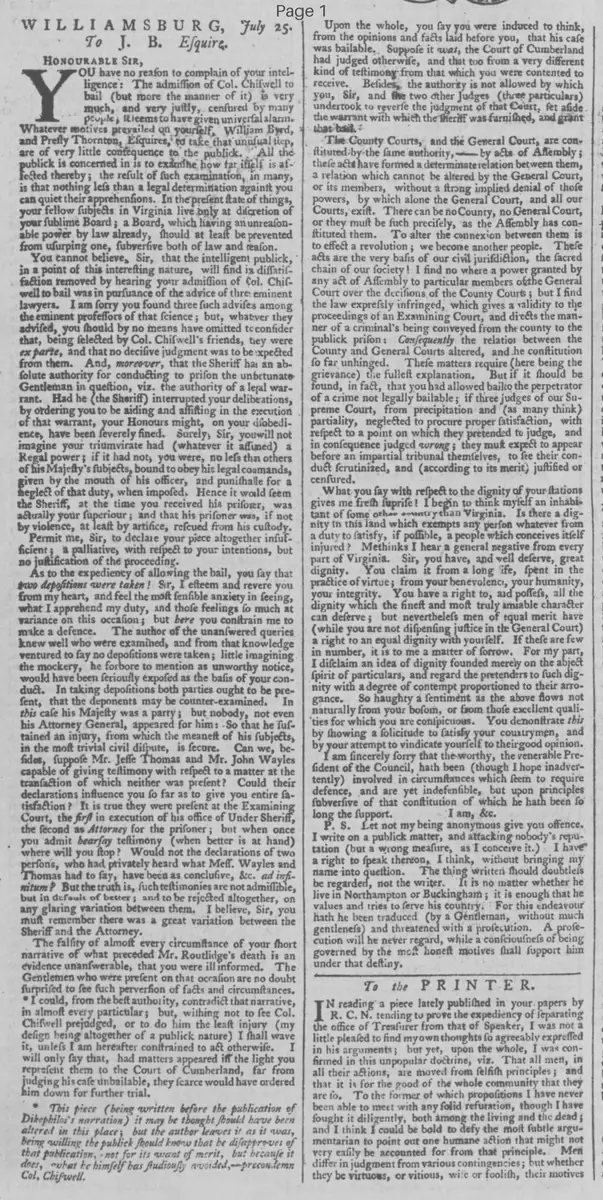
You have no reason to complain of your intelligence: The admission of Col. Chiswell to bail (but more the manner of it) is very much, and very justly, censured by many people; It seems to have given universal alarm. Whatever motives prevailed on yourself, William Byrd, and Presley Thornton, Esquires, to take that unusual step are of very little consequence to the publick. All the publick is concerned in is to examine how far itself is affected thereby; the result of such examination, in many, is that nothing less than a legal determination against you can quiet their apprehensions. In the present state of things, your fellow subjects in Virginia live only at discretion of your sublime Board; a Board, which having an unreasonable power by law already, should at least be prevented from usurping one, subversive both of law and reason.
You cannot believe, Sir, that the intelligent publick, in a point of this interesting nature, will find its dissatisfaction removed by hearing your admission of Col. Chiswell to bail was in pursuance of the advice of three eminent lawyers. I am sorry you found three such advisers among the eminent professors of that science; but, whatever they advised, you should by no means have omitted to consider that, being selected by Col. Chiswell's friends, they were ex parte, and that no decisive judgment was to be expected from them. And, moreover, that the Sheriff has an absolute authority for conducting to prison the unfortunate Gentleman in question, viz. the authority of a legal warrant. Had he (the Sheriff) interrupted your deliberations, by ordering you to be aiding and assisting in the execution of that warrant, your Honours might, on your disobedience, have been severely fined. Surely, Sir, you will not imagine your triumvirate had (whatever it assumed) a Regal power; if it had not, you were, no less than others of his Majesty's subjects, bound to obey his legal commands, given by the mouth of his officer, and punishable for a neglect of that duty, when imposed. Hence it would seem the Sheriff, at the time you received his prisoner, was actually your superior; and that his prisoner was, if not by violence, at least by artifice, rescued from his custody.
Permit me, Sir, to declare your piece altogether insufficient; a palliative, with respect to your intentions, but no justification of the proceeding.
As to the expediency of allowing the bail, you say two depositions were taken! Sir, I esteem and revere you from my heart, and feel the most sensible anxiety in seeing, what I apprehend my duty, and those feelings so much at variance on this occasion; but here you constrain me to make a defence. The author of the unanswered queries knew well who were examined, and from that knowledge ventured to say no depositions were taken; little imagining the mockery, he forbore to mention as unworthy notice, would have been seriously exposed as the basis of your conduct. In taking depositions both parties ought to be present, that the deponents may be counter-examined. In this case his Majesty was a party; but nobody, not even his Attorney General, appeared for him: -So that he sustained an injury, from which the meanest of his subjects, in the most trivial civil dispute, is secure. Can we, besides, suppose Mr. Jesse Thomas and Mr. John Wayles capable of giving testimony with respect to a matter at the transaction of which neither was present? Could their declarations influence you so far as to give you entire satisfaction? It is true they were present at the Examining Court, the first in execution of his office of Under Sheriff, the second as Attorney for the prisoner; but when once you admit hearsay testimony (when better is at hand) where will you stop? Would not the declarations of two persons, who had privately heard what Messrs. Wayles and Thomas had to say, have been as conclusive, &c. ad infinitum? But the truth is, such testimonies are not admissible, but in default of better; and to be rejected altogether, on any glaring variation between them. I believe, Sir, you must remember there was a great variation between the Sheriff and the Attorney.
The falsity of almost every circumstance of your short narrative of what preceded Mr. Routlidge's death is an evidence unanswerable, that you were ill informed. The Gentlemen who were present on that occasion are no doubt surprised to see such perversion of facts and circumstances. I could, from the best authority, contradict that narrative, in almost every particular; but, wishing not to see Col. Chiswell prejudged, or to do him the least injury (my design being altogether of a publick nature) I shall waive it, unless I am hereafter constrained to act otherwise. I will only say that, had matters appeared in the light you represent them to the Court of Cumberland, far from judging his case un-bailable, they scarce would have ordered him down for further trial.
This piece (being written before the publication of Dikephilos's narration) it may be thought should have been altered in this place; but the author leaves it as it was, being willing the publick should know that he disapproves of that publication, -not for its want of merit, but because it does, -what he himself has studiously avoided,-precondemn Col. Chiswell.
Upon the whole, you say you were induced to think, from the opinions and facts laid before you, that his case was bailable. Suppose it was, the Court of Cumberland had judged otherwise, and that too from a very different kind of testimony from that which you were contented to receive. Besides, the authority is not allowed by which you, Sir, and the two other Judges (three particulars) undertook to reverse the judgment of that Court, aid the warrant with which the Sheriff was furnished, and grant that bail.
Three County Courts, and the General Court, are constituted by the same authority, by Acts of Assembly; these acts have formed a determinate relation between them, a relation which cannot be altered by the General Court, or its members, without a strong implied denial of those powers, by which alone the General Court, and all our Courts, exist. There can be no County, no General Court, or they must be such precisely, as the Assembly has constituted them. To alter the connexion between them is to effect a revolution; we become another people. These acts are the very basis of our civil jurisdiction, the sacred chain of our society! I find no where a power granted by any act of Assembly to particular members of the General Court over the decisions of the County Courts; but I find the law expressly infringed, which gives a validity to the proceedings of an Examining Court, and directs the manner of a criminal's being conveyed from the county to the publick prison: Consequently the relation between the County and General Courts altered, and the constitution so far unhinged. These matters require (there being the grievance) the fullest explanation. But if it should be found, in fact, that you had allowed bail to the perpetrator of a crime not legally bailable; if three judges of our Supreme Court, from precipitation and (as many think) partiality, neglected to procure proper satisfaction, with respect to a point on which they pretended to judge, and in consequence judged wrong; they must expect to appear before an impartial tribunal themselves, to see their conduct scrutinized, and (according to its merit) justified or censured.
What you say with respect to the dignity of your stations gives me fresh surprise! I begin to think myself an inhabitant of some other country than Virginia. Is there a dignity in this land which exempts any person whatever from a duty to satisfy, if possible, a people which conceives itself injured? Methinks I hear a general negative from every part of Virginia. Sir, you have, and well deserve, great dignity. You claim it from a long life, spent in the practice of virtue; from your benevolence, your humanity, your integrity. You have a right to, and possess, all the dignity which the finest and most truly amiable character can deserve; but nevertheless men of equal merit have (while you are not dispensing justice in the General Court) a right to an equal dignity with yourself. If these are few in number, it is to me a matter of sorrow. For my part, I disclaim an idea of dignity founded merely on the abject spirit of particulars, and regard the pretenders to such dignity with a degree of contempt proportioned to their arrogance. So haughty a sentiment as the above flows not naturally from your bosom, or from those excellent qualities for which you are conspicuous. You demonstrate this by showing a solicitude to satisfy your countrymen, and by your attempt to vindicate yourself to their good opinion.
I am sincerely sorry that the worthy, the venerable President of the Council, hath been (though I hope inadvertently) involved in circumstances which seem to require defence, and are yet indefensible, but upon principles subversive of that constitution of which he hath been so long the support.
I am, &c.
P. S. Let not my being anonymous give you offence. I write on a publick matter, and attacking nobody's reputation (but a wrong measure, as I conceive it.) I have a right to speak thereon, I think, without bringing my name into question. The thing written should doubtless be regarded, not the writer. It is no matter whether he live in Northampton or Buckingham; it is enough that he values and tries to serve his country. For this endeavour hath he been traduced (by a Gentleman, without much gentleness) and threatened with a prosecution. A prosecution will he never regard, while a consciousness of being governed by the most honest motives shall support him under that destiny.
July 25.
To J. B. Esquire.
Honourable Sir,
You have no reason to complain of your intelligence: The admission of Col. Chiswell to bail (but more the manner of it) is very much, and very justly, censured by many people; It seems to have given universal alarm. Whatever motives prevailed on yourself, William Byrd, and Presley Thornton, Esquires, to take that unusual step are of very little consequence to the publick. All the publick is concerned in is to examine how far itself is affected thereby; the result of such examination, in many, is that nothing less than a legal determination against you can quiet their apprehensions. In the present state of things, your fellow subjects in Virginia live only at discretion of your sublime Board; a Board, which having an unreasonable power by law already, should at least be prevented from usurping one, subversive both of law and reason.
You cannot believe, Sir, that the intelligent publick, in a point of this interesting nature, will find its dissatisfaction removed by hearing your admission of Col. Chiswell to bail was in pursuance of the advice of three eminent lawyers. I am sorry you found three such advisers among the eminent professors of that science; but, whatever they advised, you should by no means have omitted to consider that, being selected by Col. Chiswell's friends, they were ex parte, and that no decisive judgment was to be expected from them. And, moreover, that the Sheriff has an absolute authority for conducting to prison the unfortunate Gentleman in question, viz. the authority of a legal warrant. Had he (the Sheriff) interrupted your deliberations, by ordering you to be aiding and assisting in the execution of that warrant, your Honours might, on your disobedience, have been severely fined. Surely, Sir, you will not imagine your triumvirate had (whatever it assumed) a Regal power; if it had not, you were, no less than others of his Majesty's subjects, bound to obey his legal commands, given by the mouth of his officer, and punishable for a neglect of that duty, when imposed. Hence it would seem the Sheriff, at the time you received his prisoner, was actually your superior; and that his prisoner was, if not by violence, at least by artifice, rescued from his custody.
Permit me, Sir, to declare your piece altogether insufficient; a palliative, with respect to your intentions, but no justification of the proceeding.
As to the expediency of allowing the bail, you say two depositions were taken! Sir, I esteem and revere you from my heart, and feel the most sensible anxiety in seeing, what I apprehend my duty, and those feelings so much at variance on this occasion; but here you constrain me to make a defence. The author of the unanswered queries knew well who were examined, and from that knowledge ventured to say no depositions were taken; little imagining the mockery, he forbore to mention as unworthy notice, would have been seriously exposed as the basis of your conduct. In taking depositions both parties ought to be present, that the deponents may be counter-examined. In this case his Majesty was a party; but nobody, not even his Attorney General, appeared for him: -So that he sustained an injury, from which the meanest of his subjects, in the most trivial civil dispute, is secure. Can we, besides, suppose Mr. Jesse Thomas and Mr. John Wayles capable of giving testimony with respect to a matter at the transaction of which neither was present? Could their declarations influence you so far as to give you entire satisfaction? It is true they were present at the Examining Court, the first in execution of his office of Under Sheriff, the second as Attorney for the prisoner; but when once you admit hearsay testimony (when better is at hand) where will you stop? Would not the declarations of two persons, who had privately heard what Messrs. Wayles and Thomas had to say, have been as conclusive, &c. ad infinitum? But the truth is, such testimonies are not admissible, but in default of better; and to be rejected altogether, on any glaring variation between them. I believe, Sir, you must remember there was a great variation between the Sheriff and the Attorney.
The falsity of almost every circumstance of your short narrative of what preceded Mr. Routlidge's death is an evidence unanswerable, that you were ill informed. The Gentlemen who were present on that occasion are no doubt surprised to see such perversion of facts and circumstances. I could, from the best authority, contradict that narrative, in almost every particular; but, wishing not to see Col. Chiswell prejudged, or to do him the least injury (my design being altogether of a publick nature) I shall waive it, unless I am hereafter constrained to act otherwise. I will only say that, had matters appeared in the light you represent them to the Court of Cumberland, far from judging his case un-bailable, they scarce would have ordered him down for further trial.
This piece (being written before the publication of Dikephilos's narration) it may be thought should have been altered in this place; but the author leaves it as it was, being willing the publick should know that he disapproves of that publication, -not for its want of merit, but because it does, -what he himself has studiously avoided,-precondemn Col. Chiswell.
Upon the whole, you say you were induced to think, from the opinions and facts laid before you, that his case was bailable. Suppose it was, the Court of Cumberland had judged otherwise, and that too from a very different kind of testimony from that which you were contented to receive. Besides, the authority is not allowed by which you, Sir, and the two other Judges (three particulars) undertook to reverse the judgment of that Court, aid the warrant with which the Sheriff was furnished, and grant that bail.
Three County Courts, and the General Court, are constituted by the same authority, by Acts of Assembly; these acts have formed a determinate relation between them, a relation which cannot be altered by the General Court, or its members, without a strong implied denial of those powers, by which alone the General Court, and all our Courts, exist. There can be no County, no General Court, or they must be such precisely, as the Assembly has constituted them. To alter the connexion between them is to effect a revolution; we become another people. These acts are the very basis of our civil jurisdiction, the sacred chain of our society! I find no where a power granted by any act of Assembly to particular members of the General Court over the decisions of the County Courts; but I find the law expressly infringed, which gives a validity to the proceedings of an Examining Court, and directs the manner of a criminal's being conveyed from the county to the publick prison: Consequently the relation between the County and General Courts altered, and the constitution so far unhinged. These matters require (there being the grievance) the fullest explanation. But if it should be found, in fact, that you had allowed bail to the perpetrator of a crime not legally bailable; if three judges of our Supreme Court, from precipitation and (as many think) partiality, neglected to procure proper satisfaction, with respect to a point on which they pretended to judge, and in consequence judged wrong; they must expect to appear before an impartial tribunal themselves, to see their conduct scrutinized, and (according to its merit) justified or censured.
What you say with respect to the dignity of your stations gives me fresh surprise! I begin to think myself an inhabitant of some other country than Virginia. Is there a dignity in this land which exempts any person whatever from a duty to satisfy, if possible, a people which conceives itself injured? Methinks I hear a general negative from every part of Virginia. Sir, you have, and well deserve, great dignity. You claim it from a long life, spent in the practice of virtue; from your benevolence, your humanity, your integrity. You have a right to, and possess, all the dignity which the finest and most truly amiable character can deserve; but nevertheless men of equal merit have (while you are not dispensing justice in the General Court) a right to an equal dignity with yourself. If these are few in number, it is to me a matter of sorrow. For my part, I disclaim an idea of dignity founded merely on the abject spirit of particulars, and regard the pretenders to such dignity with a degree of contempt proportioned to their arrogance. So haughty a sentiment as the above flows not naturally from your bosom, or from those excellent qualities for which you are conspicuous. You demonstrate this by showing a solicitude to satisfy your countrymen, and by your attempt to vindicate yourself to their good opinion.
I am sincerely sorry that the worthy, the venerable President of the Council, hath been (though I hope inadvertently) involved in circumstances which seem to require defence, and are yet indefensible, but upon principles subversive of that constitution of which he hath been so long the support.
I am, &c.
P. S. Let not my being anonymous give you offence. I write on a publick matter, and attacking nobody's reputation (but a wrong measure, as I conceive it.) I have a right to speak thereon, I think, without bringing my name into question. The thing written should doubtless be regarded, not the writer. It is no matter whether he live in Northampton or Buckingham; it is enough that he values and tries to serve his country. For this endeavour hath he been traduced (by a Gentleman, without much gentleness) and threatened with a prosecution. A prosecution will he never regard, while a consciousness of being governed by the most honest motives shall support him under that destiny.
What sub-type of article is it?
Persuasive
Political
Investigative
What themes does it cover?
Politics
Constitutional Rights
Crime Punishment
What keywords are associated?
Col Chiswell Bail
General Court Authority
Sheriff Warrant
County Court Judgment
Legal Depositions
Virginia Constitution
Judicial Partiality
What entities or persons were involved?
Anonymous
J. B. Esquire
Letter to Editor Details
Author
Anonymous
Recipient
J. B. Esquire
Main Argument
the general court's admission of col. chiswell to bail unlawfully usurps authority from the county court and sheriff, subverting legal procedures and the constitution; the judges must face legal scrutiny to address public apprehensions.
Notable Details
Criticizes Advice From Ex Parte Lawyers
Questions Validity Of Hearsay Depositions By Jesse Thomas And John Wayles
References Variation Between Sheriff And Attorney Testimonies
Disapproves Of Dikephilos's Narration For Prejudging Chiswell
Argues Against Reversing County Court Judgment Without Authority