Thank you for visiting SNEWPapers!
Sign up free
The Black Hills Union
Rapid City, Pennington County, South Dakota
What is this article about?
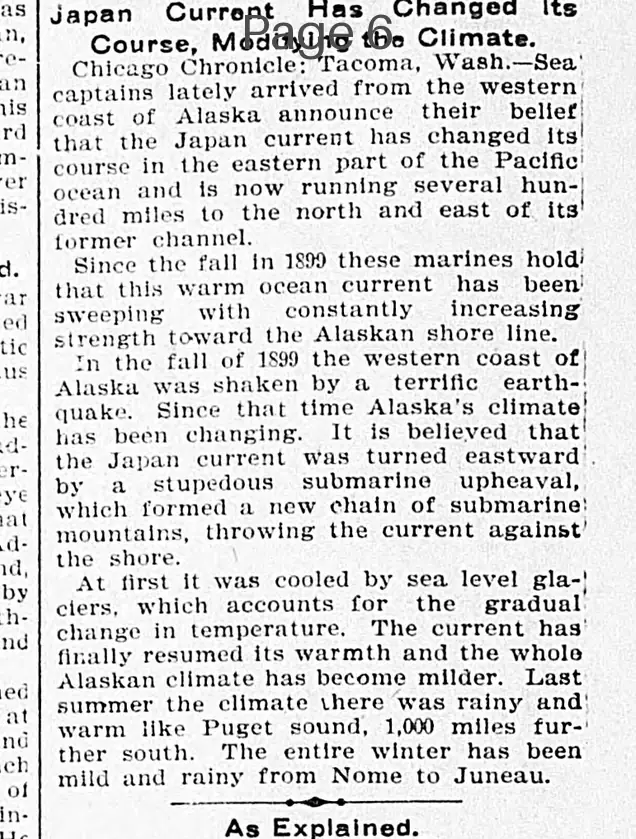
Sea captains arriving from Alaska's western coast report that the Japan current has shifted northward and eastward since a 1899 earthquake, causing a milder, rainier climate across Alaska from Nome to Juneau.
Clipping
OCR Quality
Full Text
Since the fall in 1899 these mariners hold that this warm ocean current has been sweeping with constantly increasing strength toward the Alaskan shore line.
In the fall of 1899 the western coast of Alaska was shaken by a terrific earthquake. Since that time Alaska's climate has been changing It is believed that the Japan current was turned eastward by a stupendous submarine upheaval, which formed a new chain of submarine mountains, throwing the current against the shore.
At first it was cooled by sea level glaciers, which accounts for the gradual change in temperature, The current has finally resumed its warmth and the whole Alaskan climate has become milder. Last summer the climate there was rainy and warm like Puget sound, 1,000 miles further south. The entire winter has been mild and rainy from Nome to Juneau.
What sub-type of article is it?
What keywords are associated?
Where did it happen?
Domestic News Details
Primary Location
Alaska
Event Date
Since The Fall In 1899
Outcome
alaska's climate has become milder, rainy, and warm like puget sound, from nome to juneau
Event Details
Sea captains lately arrived from the western coast of Alaska announce their belief that the Japan current has changed its course in the eastern part of the Pacific ocean and is now running several hundred miles to the north and east of its former channel. Since the fall in 1899 these mariners hold that this warm ocean current has been sweeping with constantly increasing strength toward the Alaskan shore line. In the fall of 1899 the western coast of Alaska was shaken by a terrific earthquake. Since that time Alaska's climate has been changing. It is believed that the Japan current was turned eastward by a stupendous submarine upheaval, which formed a new chain of submarine mountains, throwing the current against the shore. At first it was cooled by sea level glaciers, which accounts for the gradual change in temperature. The current has finally resumed its warmth and the whole Alaskan climate has become milder. Last summer the climate there was rainy and warm like Puget sound, 1,000 miles further south. The entire winter has been mild and rainy from Nome to Juneau.