Thank you for visiting SNEWPapers!
Sign up free
Semi Weekly Interior Journal
Stanford, Lincoln County, Kentucky
What is this article about?
Report from St. Petersburg on Russian preparations for potential war with England over disputed Afghan territory near Herat, detailing army strength, soldier types including Cossacks, cavalry, and infrastructure developments like telegraphs and railways.
Merged-components note: Merged split article 'FROM ST. PETERSBURG' on Russian war preparations with its illustrations; images integrated based on sequential reading order and contextual relevance.
Clipping
OCR Quality
Full Text
FROM ST. PETERSBURG.
PREPARATIONS FOR WAR IN THE DOMINION OF THE WHITE CZAR.
Illustrations of Different Types of Muscovite Soldiers—Russian Available Fighting Force—Cossacks—Maps of the Disputed Territory.
[Special Correspondence.]
ST. PETERSBURG, April 20.—It looks more and more as if a trial of strength was to be between England and Russia. In this despotic country government conclusions are not known to the whole populace an hour after they are made, but from what your correspondent has been able to gather, no thought of backing out of the contest with Great Britain has once entered the mind of the White Czar or any of his subjects. In the face of a foreign foe, no people will be more united than the Russians. The most rabid Nihilist is Russian before all. He will fight for his country to the death, though he would blow the Czar limb from limb with dynamite before breakfast on the day of battle. He loves Russia and hates despotism. It would amaze you to know how Nihilism has permeated the ranks of even the Czar's regular army. It is estimated that nearly every fourth man among the officers is a revolutionist, with no small percent of the private soldiers. There is no telling how true this is, however. In fact, there is no telling, with absolute certainty, anything that a Russian wishes to conceal. The preparations for war are carried on in silence, while Russia has been giving smooth answers to the British government. In diplomacy British bluntness is no match for Russian slyness.
When it comes to a square fight, we shall see. But the feeling throughout Russia is undoubtedly
"ON TO HERAT."
It is no secret that the whole army is being made ready for fight. The fleet is to be equipped. Russia is negotiating to purchase steamships in the United States. The splendid Eighth corps are now making ready to move south, with a view to active service,
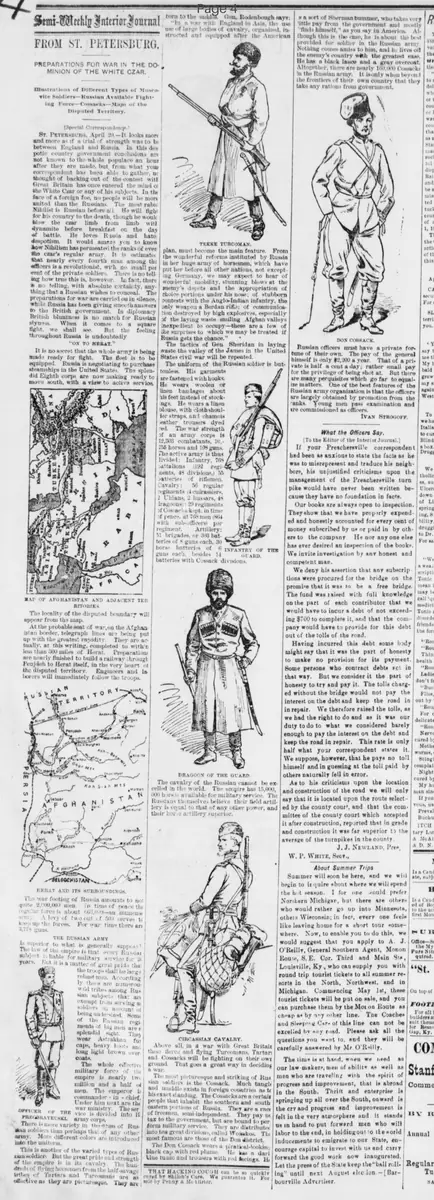
The locality of the disputed boundary will appear from the map.
At the probable seat of war, on the Afghanistan border, telegraph lines are being put up with the greatest rapidity. They are actually, at this writing, completed to within less than 500 miles of Herat. Preparations are nearly finished to build a railway through Penjdeh to Herat itself, in the very heart of the disputed territory. Engineers and laborers will immediately follow the troops.
The war footing of Russia amounts to not quite 2,000,000 men. In time of peace the regular force is about 800,000—an immense army. A levy of two out of 500 serves to keep up the forces. For war time there are 2,778 guns.
THE RUSSIAN ARMY
Is superior to what is generally supposed. The law of the empire is that every Russian subject is liable for military service for 25 years, but it is a matter of great pride that the troops shall be large, robust men. Accordingly there are numerous wild tribes among Russian subjects that are exempt from serving as soldiers on account of being unfitted-sized. Some of the Russian regiments of big men are a splendid sight. They wear Astrakhan fur caps, heavy boots and long light brown overcoats.
The whole effective military force of the empire is nearly two million and a half of men. The Emperor is commander-in-chief. Under him next are the war ministry. The service is divided into 18 army corps.
There is more variety in the dress of Russian soldiers than perhaps that of any other army. More different colors are introduced into the uniform.
This is another of the varied types of Russian soldier. But the great pride and strength of the empire is in its cavalry. The hundreds of flying horsemen from the half-savage tribes of Tartars and Turcomans are as effective as they are picturesque. They are born to the saddle. Gen. Rodenbough says:
"In a war with England in Asia, the use of large bodies of cavalry, organized, instructed and equipped after the American plan, must become the main feature. From the wonderful reforms instituted by Russia in her huge army of horsemen, which have put her before all other nations, not excepting Germany, we may expect to hear of wonderful mobility, stunning blows at the enemy's depots and the appropriation of choice portions under his nose; of stubborn contests with the Anglo-Indian infantry, the only weapon a Berdan rifle; of communication destroyed by high explosives, especially of the laying waste smiling Afghan valleys inexpedient to occupy—these are a few of the surprises to which we may be treated if Russia gets the chance."
The tactics of Gen. Sheridan in laying waste the valley of the James in the United States civil war will be repeated.
The uniform of the Russian soldier is buttonless. His garments are fastened with hooks. He wears woolen or linen bandages about his feet instead of stockings. He wears a linen blouse, with cloth shoulder straps, and chamois leather trousers dyed red. The war strength of an army corps is 12,303 combatants, 10,755 horses and 108 guns.
The active army is thus divided: Infantry, 768 battalions (192 regiments, 4 divisions.) 55 batteries of riflemen.
Cavalry: 56 regular regiments (cuirassiers, 12 Uhlans, 2 hussars, 48 dragoons): 29 regiments of Cossacks kept in time of peace at 768 men (864 with sub-officers per regiment.
Artillery: 51 brigades, or 303 batteries of 8 guns each. 30 horse batteries of 6 guns each, besides 14 batteries with Cossack divisions.
The cavalry of the Russians cannot be excelled in the world. The empire has 15,000,000 horses available for military service. The Russians themselves believe their field artillery is equal to that of any other power, and their horse artillery superior.
Circassian cavalry.
Above all, in a war with Great Britain these fierce and flying Turcomans, Tartars and Cossacks will be fighting on their own ground. That goes a great way in deciding a war.
The most picturesque and striking of Russian soldiers is the Cossack. Much tangle and muddle exists in foreign countries as to his exact standing. The Cossacks are a certain people that inhabit the southern and southeastern portions of Russia. They are a race of freemen, semi-independent. They pay no tax to the government, but are bound to perform military service. They are distributed into ten great divisions, called Woiskos. The most famous are those of the Don district.
The Don Cossack wears a piratical-looking black cap with red plume. He has a dark blue tunic and trousers with red facings. He is a sort of Sherman bummer, who takes very little pay from the government and mostly 'finds himself,' as you say in America. Although this is the case, he is about the best provided for soldier in the Russian army. Nothing comes amiss to him, and he lives off the enemy's country with the greatest ease. He has a black lance and a gray overcoat. Altogether, there are nearly 160,000 Cossacks in the Russian army. It is only when beyond the frontiers of their own country that they take any rations from government.
Russian officers must have a private fortune of their own. The pay of the general himself is only $2,200 a year. That of a private is half a cent a day: rather small pay for the privilege of being shot at. But there are many perquisites which go far to equalize matters. One of the best features of the Russian army organization is that the officers are largely obtained by promotion from the ranks. Young men pass examination and are commissioned as officers.
IVAN STROGOFF.
What sub-type of article is it?
What keywords are associated?
What entities or persons were involved?
Where did it happen?
Foreign News Details
Primary Location
Russia
Event Date
April 20
Key Persons
Outcome
war footing of nearly 2,000,000 men; preparations include equipping fleet, purchasing steamships, moving eighth corps south, building telegraphs and railway to herat.
Event Details
Russia prepares for potential war with England over disputed territory near Herat on Afghanistan border. Army mobilization, infrastructure development, and descriptions of Russian soldiers, cavalry, Cossacks, and military organization.