Thank you for visiting SNEWPapers!
Sign up free
Portland Gazette, And Maine Advertiser
Portland, Cumberland County, Maine
What is this article about?
Editorial critiques the National Intelligencer's views on U.S. treaties with France and England, defends Britain's impressment claims, and mocks Republicans John Randolph and Mr. Stanford for opposing a 6,000-man army amid the embargo, noting high desertion rates making it a 'running army.'
Merged-components note: These two sequential components form a single continuous opinion piece criticizing the National Intelligencer on foreign policy and impressment, reprinted from Ev. Post; merged and relabeled as editorial due to partisan tone.
Clipping
OCR Quality
Full Text
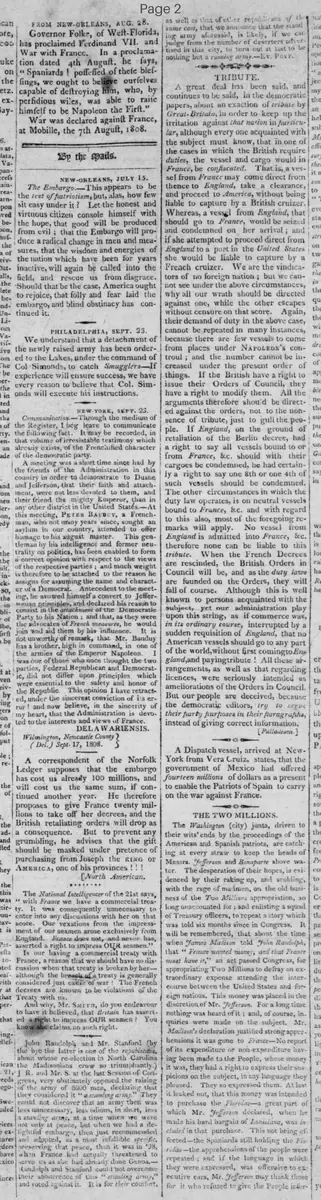
The National Intelligencer of the 21st says, "with France we have a commercial treaty. It was consequently unnecessary to enter into any discussions with her on that score. Our vexations from the impressment of our seamen arose exclusively from England. France does not, and never has, asserted a right to impress OUR seamen."
Is our having a commercial treaty with France, a reason that we should have no discussion when that treaty is broken by her—although the breach of a treaty is generally considered just cause of war? The French decrees are known to be violations of the Treaty with us.
And why, Mr. Smith, do you endeavour to have it believed that Britain has asserted a right to impress OUR seamen? You know she claims no such right.
John Randolph and Mr. Stanford (by the bye the latter is one of the republicans, about whose re-election in North Carolina the Madisonians crow so triumphantly.) J. R. and Mr. S. at the last Session of Congress, very obstinately opposed the raising of the army of 6000 men, declaring that they considered it "a standing army." They could not discover that an army then was less unnecessary, less odious, in short, less a standing army, at a time when we were not only at peace, but when we had a delightful embargo, then just recommended and adopted, as a most infallible specific, preserving that peace, than it was in '08. when France had actually threatened to serve us as she had already done Genoa.— Randolph and Stanford could not overcome their abhorrence of thus "standing army," and voted against it. It is for their comfort as well as that of other republicans of the same cast, that we announce that the standing army aforesaid, is likely, if we can judge from the number of deserters advertised in this city, to turn out at last to be nothing but a running army.—Ev. Pos t.
What sub-type of article is it?
What keywords are associated?
What entities or persons were involved?
Editorial Details
Primary Topic
Critique Of Republican Foreign Policy Views And Army Opposition
Stance / Tone
Sarcastic And Critical Of Republicans
Key Figures
Key Arguments