Thank you for visiting SNEWPapers!
Sign up free
Constitutional Whig
Richmond, Virginia
What is this article about?
An eyewitness account of the schooner Michigan, purchased for exhibition, being towed to Niagara Falls and sent over the cataract on September 8th, breaking apart upon descent. Animals aboard mostly perished or escaped; thousands of spectators gathered, causing shortages.
Merged-components note: Relabeled from shipping to story as this is a narrative account of the schooner Michigan experiment at Niagara Falls. The page 2 component continues the text seamlessly from page 1, indicating a cross-page story.
Clippings
1 of 2
OCR Quality
Full Text
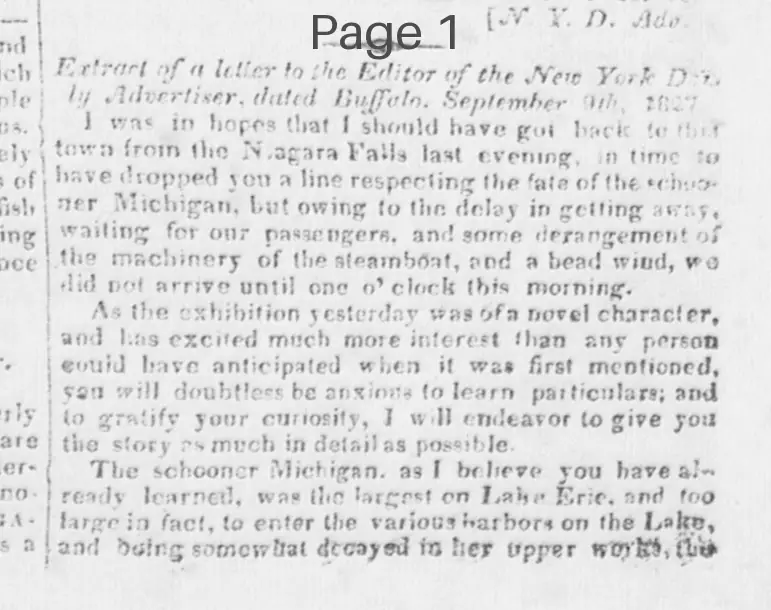
I was in hopes that I should have got back to this town from the Niagara Falls last evening, in time to have dropped you a line respecting the fate of the schooner Michigan. But owing to the delay in getting away, waiting for our passengers, and some derangement of the machinery of the steamboat, and a head wind, we did not arrive until one o'clock this morning.
As the exhibition yesterday was of a novel character, and has excited much more interest than any person could have anticipated when it was first mentioned, you will doubtless be anxious to learn particulars; and to gratify your curiosity, I will endeavor to give you the story as much in detail as possible.
The schooner Michigan, as I believe you have already learned, was the largest on Lake Erie, and too large in fact, to enter the various harbors on the Lake, and being somewhat decayed in her upper works, and
It thought struck her owner, Major Frazer, formerly of New-York, that she would answer the purpose of testing the fate of a vessel that by accident might approach too near the stupendous cataract of Niagara, and also of the fate of animals that might be caught in the rapids of those swift rolling waters, and carried over the Falls.
The proprietors of the large public houses at the Falls on both sides of the river, and of stages and steamboats, made up a purse to purchase the schooner, aware that they would be repaid by the company, which the exhibition would attract; and in this calculation they were not deceived.
For several days previous to the 8th, the stages came crowded as well as the canal boats, so much so that it was difficult to find a conveyance to the Falls; and such was the interest, that the descent was the only topic of conversation among all classes. On Friday night the 7th, waggons filled with country people rattled through this town all night; and on Saturday morning, Buffalo itself seemed to be moving in mass towards the grand point of attraction. To accommodate those who could not find a passage in carriages, five steamboats had advertised to leave here on Saturday morning, and great numbers chose this conveyance;
They were the Henry Clay, William Penn, Pioneer, Niagara, and Chippewa; being all the steam boats on Lake Erie, except the Superior. The Chippewa was appointed to tow down the pirate schooner, (as she was termed,) the Michigan; which service she performed.
I took my passage on board this boat, and we got under way before the others, passed through the basin at Black Rock, and about a mile below the Rock took in tow the vessel destined to make the dreadful plunge.
As soon as we got underway, the scene became interesting. The sun shone in full splendour, the waters of Erie were placid, there being scarcely a ruffle upon its surface, and a few miles astern of us four steamers crowded with passengers, and with bands of music on board, were ploughing their way down the rapids of Niagara. Our little boat towed the Michigan as far as Yale's landing on the British shore, within three miles of the Falls, where she anchored; and at this place the Chippewa landed her passengers, as well as the William Penn, and they were conveyed from thence to the Falls in vehicles of all descriptions. The three other steamboats landed their passengers on the American side.
Three o'clock was the hour appointed to weigh anchor on board the Michigan. The task of towing her from Yale's landing to the rapids, and a most hazardous one it was, was entrusted to Capt. Rough, the oldest Captain on the lake. With a yawl boat and five oarsmen, of stout hearts and strong arms, the old Captain got the schooner underway, and towed her to within one quarter of a mile of the first rapids, and within a half a mile of the tremendous precipice, as near as they dare approach, and cutting her adrift she passed majestically on, while the oarsmen of the yawl had to pull for their lives to effect their own safety. Indeed such were the fears of the lands, as I have understood, that on approaching near the rapids they cut the tow-line before they had received orders from their commander.
And now we approach the interesting moments of the exhibition. The high grounds on both sides of the American and British shores were lined with people, having a full view of the rapids and of the approach of the vessel, and now it was that a thousand fears and expectations were indulged, as the Michigan, unguided by human agency, approached, head on, the first rapid or descent, and apparently keeping the very course that the most skilful navigator would have pursued. Having an American ensign flying from her bowsprit and the British jack displayed at her stern.
She passed the first rapid unhurt, still head on, making a plunge, shipping a sea and rising from it in beautiful style, and in her descent over the second her masts went by the board, at the same moment affording those who have never seen a shipwreck, a specimen of the sudden destruction of the spars of a ship at sea in case of a wreck. Expectation for her fate was now at the highest; she swung round and presented her broadside to the foaming waters, and remaining stationary a moment or two, was by its force, swung round, stern foremost, and having passed to the third rapid, she bilged, but carried her hull apparently whole, between Goat Island and the British shore to the Horse Shoe, over which she was carried stern foremost, and launched into the abyss below. In her fall, she was dashed into ten thousand pieces. I went below the Falls immediately after the descent, and the river exhibited a singular appearance from the thousands of floating fragments, there being scarcely to be seen any two boards nailed together, and many of her timbers were broken into twenty pieces. Such was the eagerness of the multitude present to procure a piece of her, that before sunset a great part of her was carried away.
I believe I have already informed you of the animals on board. They consisted of a buffalo from the Rocky mountains, two bears from Green Bay and Grand River, two foxes, a raccoon, a dog, a cat, and four geese—the fate of these you will probably wish to learn. When the vessel was left to her fate, they were let loose on deck, except the buffalo, who was enclosed in a temporary pen. The two bears left the vessel shortly after she began to descend the rapids, and swam ashore, notwithstanding the rapidity of the current. On reaching the British shore they were taken. The buffalo was seen to pass over the Falls; but was not visible afterwards. What became of the other animals is not known. Those who had glasses could see one of the bears climbing the mast as the vessel approached the rapids: the foxes, &c. were running up and down, but nothing was seen of them after the vessel passed over. The only live animals of the crew that passed over the falls were two geese; they were taken up unhurt. Major Fraser obtained one; and an English gentleman purchased the other for two dollars.
The calculations are various as to the number of persons on both shores. Some estimate them as low as fifteen, and others at thirty thousand. The greatest body of people were on the American side. Goat Island for a considerable distance exhibited a dense column of persons, and the bridge erected from Goat Island, which is built upwards of a hundred feet over the rapids, was also crowded, and temporary booths, made with the boughs of trees, skirted both shores. As we passed down the Niagara, we had a full view the whole distance from Buffalo of the hundreds of vehicles of all descriptions passing towards the falls, and as the weather has been uncommonly hot and dry for a long time the roads presented uninterrupted columns of dust as far as the eye could extend. In fact, so much larger was the assemblage of persons than was anticipated, that notwithstanding the proprietors of the public houses had laid in an unusual supply of refreshments, they had not provided sufficient for one half the people, and thousands were unable to obtain a mouthful or any thing. You may judge of the situation of matters, when I assure you that I stopped at Forsyth's about 7 o'clock P. M. after climbing up his everlasting steps from the bottom of the falls, and was unable to obtain even a cracker or a glass of water, and this was the case at Brown's also. On the American side I learn, that every thing eatable and drinkable was consumed before one half the visitors had obtained any thing.
So well pleased are the people with this grand and novel aquatic exhibition, that already they are talking about getting up something more splendid next year. In this the tavern keepers and stage proprietors will heartily join, as the present frolic has afforded them a fine harvest for some time.
The emigration west through this town is constant. This morning I observed a body of Swiss emigrants encamped near the Canal, cooking their victuals, and making their meals in the open air, others busy in fixing up their waggons and arranging their affairs for travelling on further west.
What sub-type of article is it?
What themes does it cover?
What keywords are associated?
What entities or persons were involved?
Where did it happen?
Story Details
Key Persons
Location
Niagara Falls
Event Date
September 8th
Story Details
The schooner Michigan was purchased and towed to Niagara Falls for a public exhibition, released into the rapids, and carried over the falls stern foremost, disintegrating upon impact. Animals aboard included a buffalo, bears, foxes, raccoon, dog, cat, and geese; bears swam to shore, buffalo went over unseen after, two geese survived.