Thank you for visiting SNEWPapers!
Sign up free
Letter to Editor
January 2, 1864
Washington Standard
Olympia, Thurston County, Washington
What is this article about?
In a response to 'Sophia,' 'Hibernian' defends his previous coarse remarks on theater, references Roman history of drama and circuses, and argues that the stage corrupts morals, especially leading talented women to vice and away from virtue and faith. Dated Olympia, Dec. 23, 1863.
Clipping
OCR Quality
98%
Excellent
Full Text
Hibernian.
OLYMPIA, Dec. 23d, 1863.
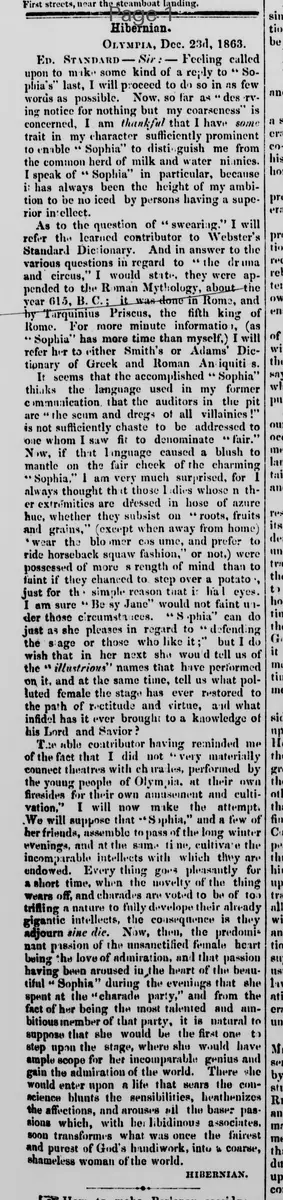
Ed. Standard-- Sir :-- Feeling called upon to make some kind of a reply to "Sophia's" last, I will proceed to do so in as few words as possible. Now, so far as "deserving notice for nothing but my coarseness" is concerned, I am thankful that I have some trait in my character sufficiently prominent to enable "Sophia" to distinguish me from the common herd of milk and water ninnies. I speak of "Sophia" in particular, because it has always been the height of my ambition to be noticed by persons having a superior intellect. As to the question of "swearing." I will refer the learned contributor to Webster's Standard Dictionary. And in answer to the various questions in regard to "the drama and circus," I would state, they were appended to the Roman mythology, about the year 615, B. C.; it was done in Rome, and by Tarquinius Priscus, the fifth king of Rome. For more minute information, (as "Sophia" has more time than myself,) I will refer her to either Smith's or Adams' Dictionary of Greek and Roman Antiquities. It seems that the accomplished "Sophia" thinks the language used in my former communication, that the auditors in the pit are "the scum and dregs of all villainies!" is not sufficiently chaste to be addressed to one whom I saw fit to denominate "fair." Now, if that language caused a blush to mantle on the fair cheek of the charming Sophia, I am very much surprised, for I always thought that those fair birds whose nether extremities are dressed in hose of azure hue, whether they subsist on "roots, fruits and grains," (except when away from home) "wear the bloomer costume, and prefer to ride horseback squaw fashion," or not,) were possessed of more strength of mind than to faint if they chanced to step over a potato, just for the simple reason that it had eyes. I am sure "Betsy Jane" would not faint under those circumstances. "Sophia" can do just as she pleases in regard to "defending the stage or those who like it;" but I do wish that in her next she would tell us of the "illustrious" names that have performed on it, and at the same time, tell us what polluted female the stage has ever restored to the path of rectitude and virtue, and what infidel has it ever brought to a knowledge of his Lord and Savior? The able contributor having reminded me of the fact that I did not "very materially connect theatres with charades, performed by the young people of Olympia, at their own firesides for their own amusement and cultivation." I will now make the attempt. We will suppose that "Sophia," and a few of her friends, assemble to pass off the long winter evenings, and at the same time, cultivate the incomparable intellects with which they are endowed. Every thing goes pleasantly for a short time, when the novelty of the thing wears off, and charades are voted to be of too trifling a nature to fully develop their already gigantic intellects, the consequence is they adjourn sine die. Now, then, the predominant passion of the unsanctified female heart being the love of admiration, and that passion having been aroused in the heart of the beautiful "Sophia" during the evenings that she spent at the "charade party," and from the fact of her being the most talented and ambitious member of that party, it is natural to suppose that she would be the first one to step upon the stage, where she would have ample scope for her incomparable genius and gain the admiration of the world. There she would enter upon a life that sears the conscience, blunts the sensibilities, heathenizes the affections, and arouses all the base passions which, with her libidinous associates, soon transforms what was once the fairest and purest of God's handiwork, into a coarse, shameless woman of the world.
HIBERNIAN.
OLYMPIA, Dec. 23d, 1863.
Ed. Standard-- Sir :-- Feeling called upon to make some kind of a reply to "Sophia's" last, I will proceed to do so in as few words as possible. Now, so far as "deserving notice for nothing but my coarseness" is concerned, I am thankful that I have some trait in my character sufficiently prominent to enable "Sophia" to distinguish me from the common herd of milk and water ninnies. I speak of "Sophia" in particular, because it has always been the height of my ambition to be noticed by persons having a superior intellect. As to the question of "swearing." I will refer the learned contributor to Webster's Standard Dictionary. And in answer to the various questions in regard to "the drama and circus," I would state, they were appended to the Roman mythology, about the year 615, B. C.; it was done in Rome, and by Tarquinius Priscus, the fifth king of Rome. For more minute information, (as "Sophia" has more time than myself,) I will refer her to either Smith's or Adams' Dictionary of Greek and Roman Antiquities. It seems that the accomplished "Sophia" thinks the language used in my former communication, that the auditors in the pit are "the scum and dregs of all villainies!" is not sufficiently chaste to be addressed to one whom I saw fit to denominate "fair." Now, if that language caused a blush to mantle on the fair cheek of the charming Sophia, I am very much surprised, for I always thought that those fair birds whose nether extremities are dressed in hose of azure hue, whether they subsist on "roots, fruits and grains," (except when away from home) "wear the bloomer costume, and prefer to ride horseback squaw fashion," or not,) were possessed of more strength of mind than to faint if they chanced to step over a potato, just for the simple reason that it had eyes. I am sure "Betsy Jane" would not faint under those circumstances. "Sophia" can do just as she pleases in regard to "defending the stage or those who like it;" but I do wish that in her next she would tell us of the "illustrious" names that have performed on it, and at the same time, tell us what polluted female the stage has ever restored to the path of rectitude and virtue, and what infidel has it ever brought to a knowledge of his Lord and Savior? The able contributor having reminded me of the fact that I did not "very materially connect theatres with charades, performed by the young people of Olympia, at their own firesides for their own amusement and cultivation." I will now make the attempt. We will suppose that "Sophia," and a few of her friends, assemble to pass off the long winter evenings, and at the same time, cultivate the incomparable intellects with which they are endowed. Every thing goes pleasantly for a short time, when the novelty of the thing wears off, and charades are voted to be of too trifling a nature to fully develop their already gigantic intellects, the consequence is they adjourn sine die. Now, then, the predominant passion of the unsanctified female heart being the love of admiration, and that passion having been aroused in the heart of the beautiful "Sophia" during the evenings that she spent at the "charade party," and from the fact of her being the most talented and ambitious member of that party, it is natural to suppose that she would be the first one to step upon the stage, where she would have ample scope for her incomparable genius and gain the admiration of the world. There she would enter upon a life that sears the conscience, blunts the sensibilities, heathenizes the affections, and arouses all the base passions which, with her libidinous associates, soon transforms what was once the fairest and purest of God's handiwork, into a coarse, shameless woman of the world.
HIBERNIAN.
What sub-type of article is it?
Persuasive
Ethical Moral
Provocative
What themes does it cover?
Morality
Religion
Social Issues
What keywords are associated?
Theater Criticism
Moral Corruption
Sophia Debate
Roman Drama Origins
Women Virtue
Religious Redemption
What entities or persons were involved?
Hibernian.
Ed. Standard Sir
Letter to Editor Details
Author
Hibernian.
Recipient
Ed. Standard Sir
Main Argument
'hibernian' argues against theater and drama, claiming they originate from pagan roman practices and lead to moral corruption, particularly transforming virtuous women into shameless figures, while challenging 'sophia' to provide examples of the stage's redemptive effects.
Notable Details
References Tarquinius Priscus And Roman Mythology Circa 615 B.C.
Cites Webster's Dictionary On Swearing.
Recommends Smith's Or Adams' Dictionary Of Greek And Roman Antiquities.
Personal Jabs At 'Sophia' Including Bloomer Costume And 'Betsy Jane' Reference.
Connects Home Charades To Progression Toward Professional Stage Corruption.