Thank you for visiting SNEWPapers!
Sign up free
Editorial
November 26, 1772
The Massachusetts Spy, Or, Thomas's Boston Journal
Boston, Suffolk County, Massachusetts
What is this article about?
A critical letter from the Political Register denounces Earl Hillsborough's administration as Secretary for the Colonies, highlighting unconstitutional orders, reliance on biased informants, failed policies on taxation and assemblies, and increased colonial tensions and costs to Britain.
Merged-components note: Merged image with editorial due to spatial overlap in bounding boxes and sequential reading order; the image appears to be an illustrative element within the editorial content.
Clipping
OCR Quality
65%
Fair
Full Text
VOL. II.
From the Political Register.
To the EARL of HILLSBOROUGH.
My Lord,
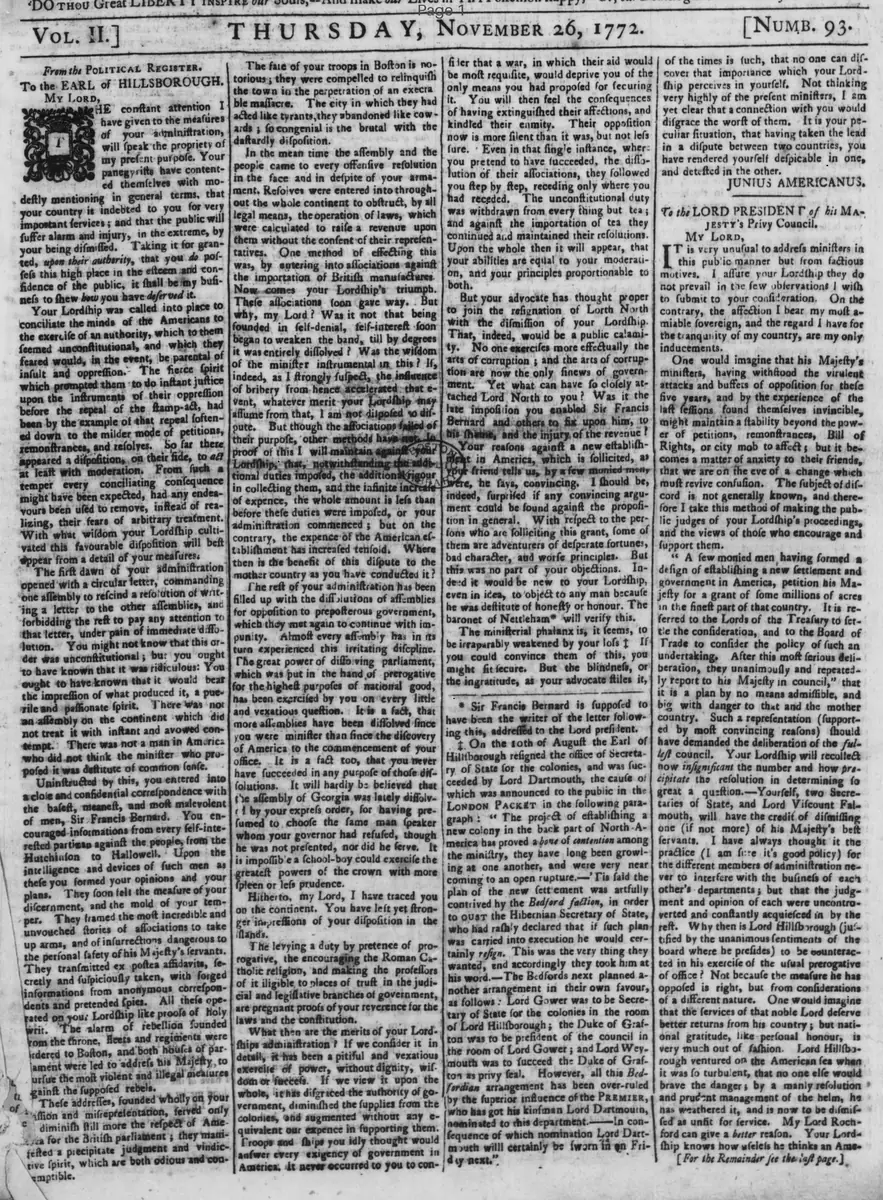
The constant attention I have given to the measures of your administration, will speak the propriety of my present purpose. Your panegyrists have contented themselves with modestly mentioning in general terms, that your country is indebted to you for very important services; and that the public will miss your being dismissed. Taking it for granted, upon their authority, that you do possess this high place in the esteem and confidence of the public, it shall be my business to show how you have deserved it.
Your Lordship was called into place to conciliate the minds of the Americans to the exercise of an authority, which to them seemed unconstitutional, and which they feared would, in the event, be parental of insult and oppression. The fierce spirit which prompted them to do instant justice before the repeal of the stamp-act, had been by the example of that repeal often toned down to the milder mode of petitions, remonstrances, and resolves. So far there appeared a disposition, on their side, to act at least with moderation. From such a temper every conciliating consequence might have been expected, had any endeavours been used to remove, instead of realizing, their fears of arbitrary treatment.
With what wisdom your Lordship cultivated this favourable disposition will best appear from a detail of your measures. The first dawn of your administration opened with a circular letter, commanding one assembly to rescind a resolution of rights, and forbidding the rest to pay any attention to that letter, under pain of immediate dissolution. You might not know that this order was unconstitutional; but you ought to have known that it was ridiculous: You ought to have known that it would bear the impression of what produced it, a puerile and passionate spirit. There was not an assembly on the continent which did not treat it with instant and avowed contempt. There was not a man in America who did not think the minister who proposed it was destitute of common sense.
Uninstructed by this, you entered into a close and confidential correspondence with the basest, meanest, and most malevolent interested partisans against the people, from Sir Francis Bernard to Hallowell. Upon the intelligence and devices of such men as these you formed your opinions and your plans. They soon felt the measure of your discernment, and the mould of your temper. They framed the most incredible and unvouched stories of associations to take up arms, and of insurrections dangerous to the personal safety of his Majesty's servants. They transmitted ex post facto affidavits, secret and suspicious informations from anonymous correspondents and pretended spies. All these operated on your Lordship like proofs of holy writ. The alarm of rebellion sounded from the throne, fleets and regiments were ordered to Boston, and both houses of parliament were led to address his Majesty, against the supposed rebels.
These addresses, founded wholly on your suggestion and misrepresentation, served only to diminish still more the respect of America for the British parliament: they manifested a precipitate judgment and vindictive spirit, which are both odious and contemptible.
The fate of your troops in Boston is notorious; they were compelled to relinquish the town in the perpetration of an execrable massacre. The city in which they had acted like tyrants, they abandoned like cowards; so congenial is the brutal with the dastardly disposition.
In the mean time the assembly and the people came to every offensive resolution in the face and in despite of your armament. Resolves were entered into throughout the whole continent to obstruct, by all legal means, the operation of laws, which were calculated to raise a revenue upon them without the consent of their representatives. One method of effecting this was, by entering into associations against the importation of British manufactures.
Now comes your Lordship's triumph. These associations soon gave way. But why, my Lord? Was it not that being founded in self-denial, self-interest soon began to weaken the band, till by degrees it was entirely dissolved? Was the wisdom of the minister instrumental in this? I indeed, as I strongly suspect, the influence of bribery from hence accelerated that event, whatever merit your Lordship may assume from that, I am not disposed to dispute. But though the associations failed of their purpose, other methods have not. In proof of this I will maintain against your Lordship, that, notwithstanding the additional duties imposed, the additional rigour in collecting them, and the infinite increase of expense, the whole amount is less than before these duties were imposed, or your administration commenced; but on the contrary, the expense of the American establishment has increased tenfold. Where then is the benefit of this dispute to the mother country as you have conducted it?
The rest of your administration has been filled up with the dissolutions of assemblies for opposition to preposterous government, which they soon met again to continue with impunity. Almost every assembly has in its turn experienced this irritating discipline. The great power of dissolving parliament, which was put in the hand of prerogative for the highest purposes of national good, has been exercised by you on every little and vexatious question. It is a fact, that more assemblies have been dissolved since you were minister than since the discovery of America to the commencement of your office. It is a fact too, that you never have succeeded in any purpose of those dissolutions. It will hardly be believed that the assembly of Georgia was lately dissolved by your express order, for having presumed to choose the same man speaker whom your governor had refused, though he was not present, nor did he serve. It is impossible a school-boy could exercise the greatest powers of the crown with more spleen or less prudence.
Hitherto, my Lord, I have traced you on the continent. You have left yet stronger impressions of your disposition in the Islands. The levying a duty by pretence of prerogative, the encouraging the Roman Catholic religion, and making the professors of it eligible to places of trust in the judicial and legislative branches of government, are pregnant proofs of your reverence for the laws and the constitution.
What then are the merits of your Lordship's administration? If we consider it in detail, it has been a pitiful and vexatious exercise of power, without dignity, wisdom or success. If we view it upon the whole, it has disgraced the authority of government, diminished the supplies from the colonies, and augmented without any equivalent our expense in supporting them. Troops and ships you idly thought would answer every exigency of government in America. It never occurred to you to consider that a war, in which their aid would be most requisite, would deprive you of the only means you had proposed for securing it. You will then feel the consequences of having extinguished their affections, and kindled their enmity. Their opposition now is more silent than it was, but not less sure. Even in that single instance, where you pretend to have succeeded, the dissolution of their associations, they followed you step by step, receding only where you had receded. The unconstitutional duty was withdrawn from every thing but tea; and against the importation of tea they continued and maintained their resolutions.
Upon the whole then it will appear, that your abilities are equal to your moderation, and your principles proportionable to both.
But your advocate has thought proper to join the resignation of Lord North with the dismission of your Lordship. That, indeed, would be a public calamity. No one exercises more effectually the arts of corruption: and the arts of corruption are now the only sinews of government. Yet what can have so closely attached Lord North to you? Was it the late imposition you enabled Sir Francis Bernard and others to fix upon him, to his shame, and the injury of the revenue?
Your reasons against a new establishment in America, which is solicited, as your friend tells us, by a few monied men were, he says, convincing. I should be, indeed, surprised if any convincing argument could be found against the proposition in general. With respect to the persons who are soliciting this grant, some of them are adventurers of desperate fortunes, bad character, and worse principles. But this was no part of your objections. Indeed it would be new to your Lordship, even in idea, to object to any man because he was destitute of honesty or honour. The baronet of Nettleham* will verify this.
The ministerial phalanx is, it seems, to be irreparably weakened by your loss. If you could convince them of this, you might retire secure. But the blindness, or the ingratitude, as your advocate styles it,
* Sir Francis Bernard is supposed to have been the writer of the letter following this, addressed to the Lord president.
I. On the 10th of August the Earl of Hillsborough resigned the office of Secretary of State for the colonies, and was succeeded by Lord Dartmouth, the cause of which was announced to the public in the London Packet in the following paragraph: "The project of establishing a new colony in the back part of North-America has proved a bone of contention among the ministry, they have long been growling at one another, and were very near coming to an open rupture. 'Tis said the plan of the new settlement was artfully contrived by the Bedford faction, in order to oust the Hibernian Secretary of State, who had rashly declared that if such plan was carried into execution he would certainly resign. This was the very thing they wanted, and accordingly they took him at his word. The Bedfords next planned another arrangement in their own favour, as follows: Lord Gower was to be Secretary of State for the colonies in the room of Lord Hillsborough; the Duke of Grafton was to be president of the council in the room of Lord Gower; and Lord Weymouth was to succeed the Duke of Grafton as privy seal. However, all this Bedfordian arrangement has been over-ruled by the Superior influence of the PREMIER, who has got his kinsman Lord Dartmouth, nominated to this department. In consequence of which nomination Lord Dartmouth will certainly be sworn in on Friday next."
From the Political Register.
To the EARL of HILLSBOROUGH.
My Lord,
The constant attention I have given to the measures of your administration, will speak the propriety of my present purpose. Your panegyrists have contented themselves with modestly mentioning in general terms, that your country is indebted to you for very important services; and that the public will miss your being dismissed. Taking it for granted, upon their authority, that you do possess this high place in the esteem and confidence of the public, it shall be my business to show how you have deserved it.
Your Lordship was called into place to conciliate the minds of the Americans to the exercise of an authority, which to them seemed unconstitutional, and which they feared would, in the event, be parental of insult and oppression. The fierce spirit which prompted them to do instant justice before the repeal of the stamp-act, had been by the example of that repeal often toned down to the milder mode of petitions, remonstrances, and resolves. So far there appeared a disposition, on their side, to act at least with moderation. From such a temper every conciliating consequence might have been expected, had any endeavours been used to remove, instead of realizing, their fears of arbitrary treatment.
With what wisdom your Lordship cultivated this favourable disposition will best appear from a detail of your measures. The first dawn of your administration opened with a circular letter, commanding one assembly to rescind a resolution of rights, and forbidding the rest to pay any attention to that letter, under pain of immediate dissolution. You might not know that this order was unconstitutional; but you ought to have known that it was ridiculous: You ought to have known that it would bear the impression of what produced it, a puerile and passionate spirit. There was not an assembly on the continent which did not treat it with instant and avowed contempt. There was not a man in America who did not think the minister who proposed it was destitute of common sense.
Uninstructed by this, you entered into a close and confidential correspondence with the basest, meanest, and most malevolent interested partisans against the people, from Sir Francis Bernard to Hallowell. Upon the intelligence and devices of such men as these you formed your opinions and your plans. They soon felt the measure of your discernment, and the mould of your temper. They framed the most incredible and unvouched stories of associations to take up arms, and of insurrections dangerous to the personal safety of his Majesty's servants. They transmitted ex post facto affidavits, secret and suspicious informations from anonymous correspondents and pretended spies. All these operated on your Lordship like proofs of holy writ. The alarm of rebellion sounded from the throne, fleets and regiments were ordered to Boston, and both houses of parliament were led to address his Majesty, against the supposed rebels.
These addresses, founded wholly on your suggestion and misrepresentation, served only to diminish still more the respect of America for the British parliament: they manifested a precipitate judgment and vindictive spirit, which are both odious and contemptible.
The fate of your troops in Boston is notorious; they were compelled to relinquish the town in the perpetration of an execrable massacre. The city in which they had acted like tyrants, they abandoned like cowards; so congenial is the brutal with the dastardly disposition.
In the mean time the assembly and the people came to every offensive resolution in the face and in despite of your armament. Resolves were entered into throughout the whole continent to obstruct, by all legal means, the operation of laws, which were calculated to raise a revenue upon them without the consent of their representatives. One method of effecting this was, by entering into associations against the importation of British manufactures.
Now comes your Lordship's triumph. These associations soon gave way. But why, my Lord? Was it not that being founded in self-denial, self-interest soon began to weaken the band, till by degrees it was entirely dissolved? Was the wisdom of the minister instrumental in this? I indeed, as I strongly suspect, the influence of bribery from hence accelerated that event, whatever merit your Lordship may assume from that, I am not disposed to dispute. But though the associations failed of their purpose, other methods have not. In proof of this I will maintain against your Lordship, that, notwithstanding the additional duties imposed, the additional rigour in collecting them, and the infinite increase of expense, the whole amount is less than before these duties were imposed, or your administration commenced; but on the contrary, the expense of the American establishment has increased tenfold. Where then is the benefit of this dispute to the mother country as you have conducted it?
The rest of your administration has been filled up with the dissolutions of assemblies for opposition to preposterous government, which they soon met again to continue with impunity. Almost every assembly has in its turn experienced this irritating discipline. The great power of dissolving parliament, which was put in the hand of prerogative for the highest purposes of national good, has been exercised by you on every little and vexatious question. It is a fact, that more assemblies have been dissolved since you were minister than since the discovery of America to the commencement of your office. It is a fact too, that you never have succeeded in any purpose of those dissolutions. It will hardly be believed that the assembly of Georgia was lately dissolved by your express order, for having presumed to choose the same man speaker whom your governor had refused, though he was not present, nor did he serve. It is impossible a school-boy could exercise the greatest powers of the crown with more spleen or less prudence.
Hitherto, my Lord, I have traced you on the continent. You have left yet stronger impressions of your disposition in the Islands. The levying a duty by pretence of prerogative, the encouraging the Roman Catholic religion, and making the professors of it eligible to places of trust in the judicial and legislative branches of government, are pregnant proofs of your reverence for the laws and the constitution.
What then are the merits of your Lordship's administration? If we consider it in detail, it has been a pitiful and vexatious exercise of power, without dignity, wisdom or success. If we view it upon the whole, it has disgraced the authority of government, diminished the supplies from the colonies, and augmented without any equivalent our expense in supporting them. Troops and ships you idly thought would answer every exigency of government in America. It never occurred to you to consider that a war, in which their aid would be most requisite, would deprive you of the only means you had proposed for securing it. You will then feel the consequences of having extinguished their affections, and kindled their enmity. Their opposition now is more silent than it was, but not less sure. Even in that single instance, where you pretend to have succeeded, the dissolution of their associations, they followed you step by step, receding only where you had receded. The unconstitutional duty was withdrawn from every thing but tea; and against the importation of tea they continued and maintained their resolutions.
Upon the whole then it will appear, that your abilities are equal to your moderation, and your principles proportionable to both.
But your advocate has thought proper to join the resignation of Lord North with the dismission of your Lordship. That, indeed, would be a public calamity. No one exercises more effectually the arts of corruption: and the arts of corruption are now the only sinews of government. Yet what can have so closely attached Lord North to you? Was it the late imposition you enabled Sir Francis Bernard and others to fix upon him, to his shame, and the injury of the revenue?
Your reasons against a new establishment in America, which is solicited, as your friend tells us, by a few monied men were, he says, convincing. I should be, indeed, surprised if any convincing argument could be found against the proposition in general. With respect to the persons who are soliciting this grant, some of them are adventurers of desperate fortunes, bad character, and worse principles. But this was no part of your objections. Indeed it would be new to your Lordship, even in idea, to object to any man because he was destitute of honesty or honour. The baronet of Nettleham* will verify this.
The ministerial phalanx is, it seems, to be irreparably weakened by your loss. If you could convince them of this, you might retire secure. But the blindness, or the ingratitude, as your advocate styles it,
* Sir Francis Bernard is supposed to have been the writer of the letter following this, addressed to the Lord president.
I. On the 10th of August the Earl of Hillsborough resigned the office of Secretary of State for the colonies, and was succeeded by Lord Dartmouth, the cause of which was announced to the public in the London Packet in the following paragraph: "The project of establishing a new colony in the back part of North-America has proved a bone of contention among the ministry, they have long been growling at one another, and were very near coming to an open rupture. 'Tis said the plan of the new settlement was artfully contrived by the Bedford faction, in order to oust the Hibernian Secretary of State, who had rashly declared that if such plan was carried into execution he would certainly resign. This was the very thing they wanted, and accordingly they took him at his word. The Bedfords next planned another arrangement in their own favour, as follows: Lord Gower was to be Secretary of State for the colonies in the room of Lord Hillsborough; the Duke of Grafton was to be president of the council in the room of Lord Gower; and Lord Weymouth was to succeed the Duke of Grafton as privy seal. However, all this Bedfordian arrangement has been over-ruled by the Superior influence of the PREMIER, who has got his kinsman Lord Dartmouth, nominated to this department. In consequence of which nomination Lord Dartmouth will certainly be sworn in on Friday next."
What sub-type of article is it?
Constitutional
Economic Policy
Partisan Politics
What keywords are associated?
Colonial Administration
Hillsborough Critique
American Resistance
Unconstitutional Measures
Taxation Duties
Assembly Dissolutions
Ministerial Intrigue
What entities or persons were involved?
Earl Of Hillsborough
Sir Francis Bernard
Lord North
Americans
British Parliament
Lord Dartmouth
Bedford Faction
Editorial Details
Primary Topic
Critique Of Earl Hillsborough's Colonial Administration
Stance / Tone
Strongly Critical And Sarcastic
Key Figures
Earl Of Hillsborough
Sir Francis Bernard
Lord North
Americans
British Parliament
Lord Dartmouth
Bedford Faction
Key Arguments
Hillsborough's Circular Letter Was Unconstitutional And Ridiculed By Assemblies
Relied On Biased Informants Leading To False Alarms Of Rebellion
Troops In Boston Committed Massacre And Retreated Cowardly
Associations Against Imports Failed But Revenue Decreased While Costs Increased
Frequent Dissolutions Of Assemblies Achieved No Success
Policies In Islands Violated Laws And Constitution
Overall Administration Lacked Wisdom, Increased Enmity With Colonies