Thank you for visiting SNEWPapers!
Sign up free
Keowee Courier
Walhalla, Pickens, Oconee County, Pickens County, South Carolina
What is this article about?
In a May 8, 1850, speech in the U.S. House, South Carolina's James L. Orr warns of pervasive Northern abolitionist sentiment threatening Southern slavery rights, citing societies, elections, laws, church divisions, and California's anti-slavery admission push, predicting disunion if unaddressed. Editorial praises the speech.
Merged-components note: Merging the published speech with its editorial introduction as a single logical component.
Clippings
1 of 2
OCR Quality
Full Text
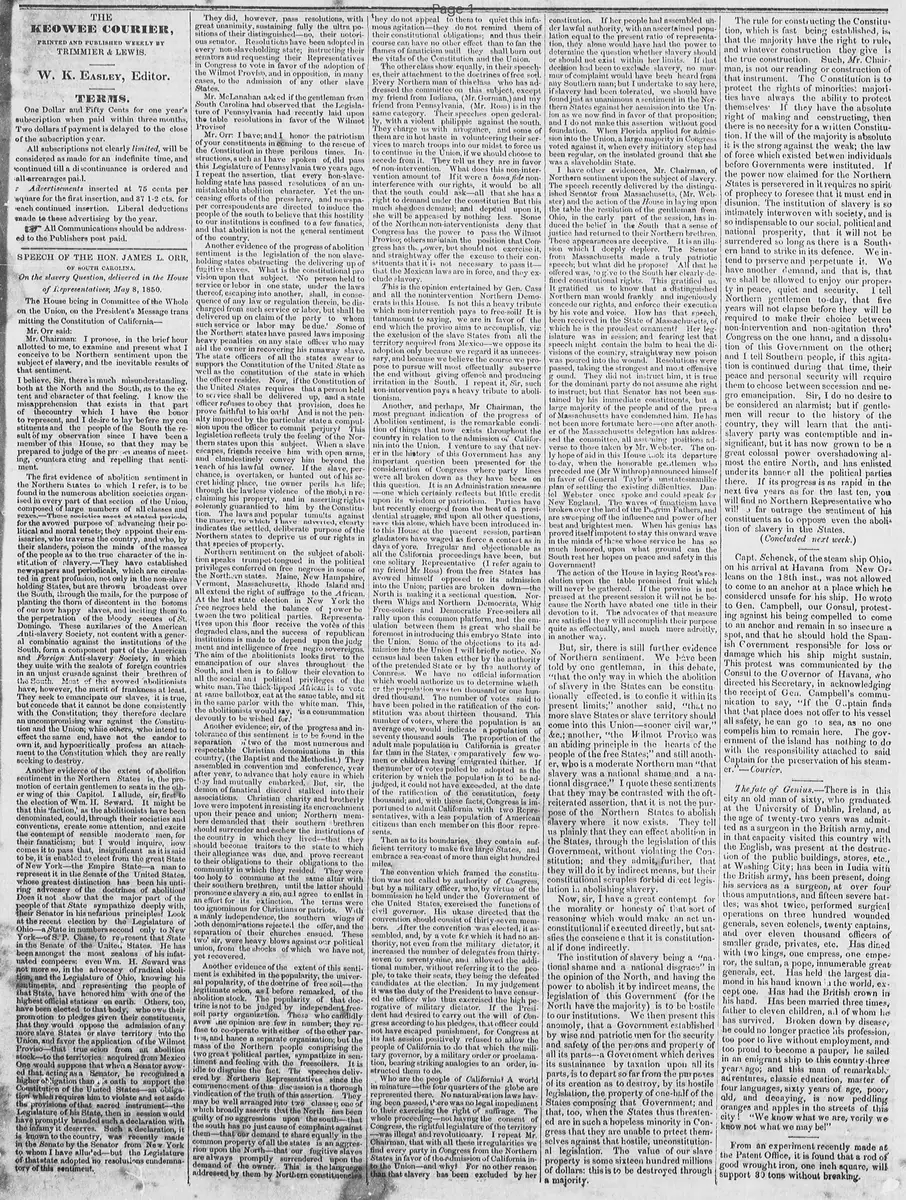
OF SOUTH CAROLINA.
On the slavery Question, delivered in the House
of
Representatives; May 8, 1850.
The House being in Committee of the Whole
on the Union, on the President's Message trans-
mitting the Constitution of California-
Mr. Orr said:
Mr. Chairman: I propose, in the brief hour
allotted to me, to examine and present what I
conceive to be Northern sentiment upon the
subject of slavery, and the inevitable results of
that sentiment.
I believe, Sir, there is much misunderstanding,
both at the North and the South, as to the ex-
tent and character of that feeling. I know the
misapprehension that exists in that part
of the country which I have the honor
to represent, and I desire to lay before my con-
stituents and the people of the South the re-
sult of my observation since I have been a
member of this House, so that they may be
prepared to judge of the proper means of meet-
ing, counteracting and repelling that senti-
ment.
The first evidence of abolition sentiment in
the Northern States to which I refer, is to be
found in the numerous abolition societies organ-
ised in every part of that section of the Union.
composed of large numbers of all classes and
sexes. These societies meet at stated periods,
for the avowed purpose of advancing their po-
litical and moral tenets; they appoint their em-
issaries, who traverse the country, and who, by
their slanders, poison the minds of the masses
of the people as to the true character of the in-
stitution of slavery. They have established
newspapers and periodicals, which are circula-
ted in great profusion, not only in the non-slave
holding States, but are thrown broadcast over
the South, through the mails, for the purpose of
planting the thorn of discontent in the bosoms
of our now happy slaves, and inciting them to
the perpetration of the bloody scenes of St.
Domingo. These auxiliaries of the American
Anti-slavery Society, not content with a gener-
al combination against the institutions of the
South, form a component part of the American
and Foreign Anti-slavery Society, in which
they unite with the zealots of foreign countries
in an unjust crusade against their brethren of
the South. Most of the avowed abolitionists
have, however, the merit of frankness at least.
They seek to emancipate our slaves, it is true,
but concede that it cannot be done consistently
with the Constitution; they therefore declare
an uncompromising war against the Constitu-
tion and the Union; while others, who intend to
effect the same end, have not the candor to
own it, and hypocritically profess an attach-
ment to the Constitution which they are really
seeking to destroy.
Another evidence of the extent of abolition
sentiment in the Northern States is, the pro-
motion of certain gentlemen to seats in the oth-
er wing of this Capitol. I allude, sir, first to
the election of Wm. H. Seward. It might be
that this 'faction,' as the abolitionists have been
denominated, could, through their societies and
conventions, create some attention, and excite
the contempt of sensible moderate men, for
their fanaticism; but I would inquire, how
comes it to pass that, insignificant as it is said
to be, it is enabled to elect from the great State
of New York—the Empire State—a man to
represent it in the Senate of the United States.
whose greatest distinction has been his unti-
ring advocacy of the doctrines of abolition?
Does it not show that the major part of the
people of that State sympathize deeply with,
their Senator in his nefarious principles? Look
at the recent election by the Legislature of
Ohio—a State in numbers second only to New
York—of S. P. Chase, to represent that State
in the Senate of the United States. He has
been amongst the most zealous of his infat-
uated compeers: even Wm. H. Seward was
not more so, in the advocacy of radical aboli-
tion, and the Legislature of Ohio, knowing his
sentiments, and representing the people of
that State, have honored him with one of the
highest official stations on earth. Others, too,
have been elected to that body, who owe their
promotion to pledges given their constituents,
that they would oppose the admission of any
more slave States or slave territory into the
Union, and favor the application of the Wilmot
Proviso—that true scion from an abolition
stock—to the territories acquired from Mexico.
One would suppose that when a Senator avow-
ed that, acting as a Senator, he recognized a
higher obligation than his oath to support the
Constitution of the United States—an obliga-
tion which requires him to violate and set aside
the provisions of that sacred instrument—the
Legislature of his State, then in session would
have promptly branded such a declaration with
the infamy it deserves. Such a declaration, it
is known to the country, was recently made
in the Senate by the Senator from New York
to whom I have alluded—but the Legislature
of that State adopted no resolutions condemna-
tory of this sentiment.
They did, however, pass resolutions, with
great unanimity, sustaining fully the ultra po-
sitions of their distinguished—no, their notori-
ous senator. Resolutions have been adopted in
every non-slaveholding state; instructing their
senators and requesting their Representatives
in Congress to vote in favor of the adoption of
the Wilmot Proviso, and in opposition, in many
cases, to the admission of any other slave
States.
Mr. McLanahan asked if the gentleman from
South Carolina had observed that the Legisla-
ture of Pennsylvania had recently laid upon
the table resolutions in favor of the Wilmot
Proviso?
Mr. Orr: I have; and I honor the patriotism
of your constituents in coming to the rescue of
the Constitution in these perilous times. In-
structions, such as I have spoken of, did pass
this Legislature of Pennsylvania two years ago.
I repeat the assertion, that every non-slave-
holding state has passed resolutions of an un-
mistakeable abolition character. Yet the un-
ceasing efforts of the press here, and newspa-
per correspondents are directed to induce the
people of the South to believe that this hostility
to our institutions is confined to a few fanatics,
and that abolition is not the general sentiment
of the country.
Another evidence of the progress of abolition
sentiment is the legislation of the non slave-
holding states obstructing the delivering up of
fugitive slaves. What is the constitutional pro-
vision upon that subject. 'No person held to
service or labor in one state, under the laws
thereof, escaping into another, shall, in conse-
quence of any law or regulation therein, be dis-
charged from such service or labor, but shall be
delivered up on claim of the party to whom
such service or labor may be due.' Some of
the Northern states have passed laws imposing
heavy penalties on any state officer who may
aid the owner in recovering his runaway slave.
The state officers of all the states swear to
support the Constitution of the United States as
well as the constitution of the state in which
the officer resides. Now, if the Constitution of
the United States requires that a person held
to service shall be delivered up, and a state
officer refuses to obey that provision, does he
prove faithful to his oath? And is not the pen-
alty imposed by the particular state a compul-
sion upon the officer to commit perjury? This
legislation reflects truly the feeling of the Nor-
thern states upon this subject. When a slave
escapes, friends receive him with open arms,
and clandestinely convey him beyond the
reach of his lawful owner. If the slave, per-
chance, is overtaken, or hunted out of his se-
cret hiding place, the owner perils his life;
through the lawless violence of the mob, in re-
claiming his property, and in asserting rights
solemnly guaranteed to him by the Constitu-
tion. The laws and popular tumults against
the master, to which I have adverted, clearly
indicates the settled, deliberate purpose of the
Northern states to deprive us of our rights in
that species of property.
Northern sentiment on the subject of aboli-
tion speaks trumpet-tongued in the political
privileges conferred on free negroes in some of
the Northern states. Maine, New Hampshire,
Vermont, Massachusetts, Rhode Island and
all extend the right of suffrage to the African.
At the last state election in New York the
free negroes held the balance of power be-
tween the two political parties. Representa-
tives upon this floor receive the votes of this
degraded class, and the success of republican
institutions is made to depend upon the judg-
ment and intelligence of free negro sovereigns.
The aim of the abolitionists looks first to the
emancipation of our slaves throughout the
South, and then is to follow their elevation to
all the social and political privileges of the
white man. The thick-lipped African is to vote
at the same ballot box, eat at the same table, and sit
in the same parlor with the white man. This,
the abolitionists would say, 'is a consummation
devoutly to be wished for.'
Another evidence, sir, of the progress and in-
tolerance of this sentiment is to be found in the
separation into two of the most numerous and
respectable Christian denominations in this
country, (the Baptist and the Methodist.) They
assembled in convention and conference, year
after year, to advance that holy cause in which
they had mutually embarked. But, sir, the
demon of fanatical discord stalked into their
associations. Christian charity and brotherly
love were impotent in resisting its encroachment
upon their peace and union; Northern mem-
bers demanded that their southern brethren
should surrender and eschew the institutions of
the country in which they lived—that they
should become traitors to the state to which
their allegiance was due, and prove recreant
to their obligations to the
community in which they resided. They were
too holy to commune at the same altar with
their southern brethren, until the latter should
pronounce slavery a sin, and agree to enlist in
an effort for its extinction. The terms were
too ignominious for Christians or patriots. With
a manly independence, the southern wings of
both denominations rejected the offer, and the
separation of their churches ensued. These
two, sir, were heavy blows against our political
union, from the shocks of which we have not
yet recovered.
Another evidence of the extent of this senti-
ment is exhibited in the popularity, the univer-
sal popularity, of the doctrine of free soil—the
legitimate scion, as I before remarked, of the
abolition stock. The popularity of that doc-
trine is not to be judged by independent free-
soil party organization. Those who candidly
avow the opinion are few in number; they re-
fuse to co-operate with either of the other par-
ties, and hence a separate organization; but the
mass of the Northern people comprising the
two great political parties, sympathize in sen-
timent and feeling with the freesoilers. It is
idle to disguise the fact. The speeches deliv-
ered by Northern Representatives since the
commencement of this discussion is a thorough
vindication of the truth of this assertion. They
may be well arranged into two classes; one of
which broadly asserts that the North has been
guilty of no aggressions upon the south—that
the south has no just cause of complaint against
them—that our demand to share equally in the
common property of all the states is an aggres-
sion upon the North; that our fugitive slaves
are always promptly surrendered upon the
demand of the owner. This is the language
addressed by them to Northern constituencies.
They do not appeal to them to quiet this infa-
mous agitation—they do not remind them of
their constitutional obligations; and thus their
course can have no other effect than to fan the
flames of fanaticism until they shall burn out
the vitals of the Constitution and the Union.
The other class show equally, in their speech-
es, their attachment to the doctrines of free soil.
Every Northern man of this class who has ad-
dressed the committee on this subject, except
my friend from Indiana, (Mr. Gorman,) and my
friend from Pennsylvania, (Mr. Ross) is in the
same category. Their speeches open gener-
ally, with a violent philippic against the south.
They charge us with arrogance, and some of
them are in hot haste in volunteering their ser-
vices to march troops into our midst to force us
to continue in the Union, if we should choose to
secede from it. They tell us they are in favor
of non-intervention. What does this non-inter-
vention amount to? If it were a bona fide non-
interference with our rights, it would be all
that the south could ask—all that she has a
right to demand under the constitution. But this
much she does demand; and depend upon it,
she will be appeased by nothing less. Some
of the Northern non-interventionists deny that
Congress has the power to pass the Wilmot
Proviso; others maintain the position that Con-
gress has the power, but should not exercise it;
and straightway offer the excuse to their con-
stituents that it is not necessary to pass it—
that the Mexican laws are in force, and they ex-
clude slavery.
This is the opinion entertained by Gen. Cass
and all the non-intervention Northern Demo-
crats in this House. Is not this a heavy tribute
which non-intervention pays to free-soil? It is
tantamount to saying, we are in favor of the
end which the proviso aims to accomplish, viz:
the exclusion of the slave States from all the
territory acquired from Mexico—we oppose its
adoption only because we regard it as unneces-
sary, and because we believe the course we pro-
pose to pursue will most effectually subserve
the end without giving offence and producing
irritation in the South. I repeat it, Sir, such
non-intervention pays a heavy tribute to aboli-
tionism.
Another, and perhaps, Mr. Chairman, the
most pregnant indication of the progress of
Abolition sentiment, is the remarkable condi-
tion of things that now exists throughout the
country in relation to the admission of Califor-
nia into the Union. I venture to say that nev-
er in the history of this Government has any
important question been presented for the
consideration of Congress where party lines
were all broken down as they have been on
this question. It is an Administration measure
—one which certainly reflects but little credit
upon its wisdom or patriotism. Parties have
but recently emerged from the heat of a presi-
dential struggle, and upon all other questions
save this alone, which have been introduced in-
to this House at the present session, partisan
gladiators have waged as fierce a contest as in
days of yore. Irregular and objectionable as
all the California proceedings have been, but
one solitary Representative (I refer again to
my friend Mr. Ross) from the free States has
avowed himself opposed to its admission
into the Union; parties are broken down—the
North is making it a sectional question. Nor-
thern Whigs and Northern Democrats, Whig
Free-soilers and Democratic Free-soilers all
rally upon this common platform, and the em-
ulation between them is great who shall be
foremost in introducing this embryo State into
the Union. Some of the objections to its ad-
mission into the Union I will briefly notice. No
census had been taken either by the authority
of the pretended State or by the authority of
Congress. We have no official information
which would authorize us to determine wheth-
er the population was ten thousand or one hun-
dred thousand. The number of votes said to
have been polled in the ratification of the con-
stitution was about thirteen thousand. This
number of voters, where the population is an
average one, would indicate a population of
seventy thousand souls. The proportion of the
adult male population in California is greater
far than in the States, comparatively few wo-
men or children having emigrated thither. If
the number of votes polled be adopted as the
criterion by which the population is to be ad-
judged, it could not have exceeded, at the date
of the ratification of the constitution, forty
thousand; and, with these facts, Congress is im-
portuned to admit California with two Repre-
sentatives, with a less population of American
citizens than each member on this floor repre-
sents.
Then as to its boundaries, they contain suf-
ficient territory to make five large States, and
embrace a sea-coast of more than eight hundred
miles.
The convention which framed the constitu-
tion was not called by authority of Congress,
but by a military officer, who, by virtue of the
commission he held under the Government of
the United States, exercised the functions of
civil governor. His ukase directed that the
convention should consist of thirty-seven mem-
bers. After the convention was elected, it as-
sembled, and, by a vote for which it had no au-
thority, not even from the military dictator, it
increased the number of delegates from thirty-
seven to seventy-nine, and allowed the addi-
tional number, without referring it to the peo-
ple, to take their seats, they being the defeated
candidates at the election. In my judgement
it was the duty of the President to have censur-
ed the officer who thus exercised the high pre-
rogative of military dictator. If the Presi-
dent had desired to carry out the will of Con-
gress according to his pledges, that officer could
not have escaped punishment, for Congress at
its last session positively refused to allow the
people of California to do that which the mili-
tary governor, by a military order or proclama-
tion, bearing striking analogies to an order, in-
structed them to do.
Who are the people of California? A world
in miniature—the four quarters of the globe are
represented there. No naturalization laws hav-
ing been passed, there was no legal impediment
to their exercising the right of suffrage. The
whole proceeding—not having the consent of
Congress, the rightful legislature of the territory
—was illegal and revolutionary. I repeat Mr.
Chairman, that with all these irregularities we
find every party in Congress from the Northern
States in favor of the admission of California in-
to the Union—and why? For no other reason
than that slavery has been excluded by her
constitution. If her people had assembled un-
der lawful authority, with an ascertained popu-
lation equal to the present ratio of representa-
tion, they alone would have had the power to
determine the question whether slavery should
or should not exist within her limits. If that
decision had been to exclude slavery, no mur-
mur of complaint would have been heard from
any Southern man; but I undertake to say here,
if slavery had been tolerated, we should have
found just as unanimous a sentiment in the Nor-
thern States against her admission into the Un-
ion as we now find in favor of that proposition;
and I do not make this assertion without good
foundation. When Florida applied for admis-
sion into the Union, a large majority in Congress
voted against it, when every initiatory step had
been regular, on the isolated ground that she
was a slaveholding State.
I have other evidences, Mr. Chairman, of
Northern sentiment upon the subject of slavery.
The speech recently delivered by the distingu-
ished Senator from Massachusetts, (Mr. Web-
ster) and the action of the House in laying upon
the table the resolution of the gentleman from
Ohio, in the early part of the session, has in-
duced the belief in the South that a sense of
justice had returned to their Northern brethren.
These appearances are deceptive. It is an illu-
sion which I deeply deplore. The Senator
from Massachusetts made a truly patriotic
speech: but what did he propose? All that he
offered was, to give to the South her clearly-de-
fined constitutional rights. This gratifies us.
It gratified us to know that a distinguished
Northern man would frankly and ingeniously
concede our rights, and enforce their execution
by his vote and voice. How has that speech,
been received in the State of Massachusetts, of
which he is the proudest ornament? Her leg-
islature was in session: and fearing lest that
speech might contain the balm to heal the di-
visions of the country, straightway new poison
was poured into the wound. Resolutions were
passed, taking the strongest and most offensive
ground. They did not instruct him, it is true,
for the dominant party do not assume the right
to instruct; but that Senator has not been sus-
tained by his immediate constituents, but a
large majority of the people and of the press
of Massachusetts have condemned him. He has
not been more fortunate here—one after anoth-
er of the Massachusetts delegation has addres-
sed the committee, all assuming positions ad-
verse to those taken by Mr. Webster. The on-
ly hope of aid in this House took its departure
to-day, when the honorable gentleman who
preceded me (Mr. Winthrop) announced himself
in favor of General Taylor's unstatesmanlike
plan of settling the existing difficulties. Dan-
iel Webster once spoke and could speak for
New England. The waves of fanaticism have
broken over the land of the Pilgrim Fathers, and
are sweeping off the influence and power of her
best and brightest men. When his genius has
proved itself impotent to stay this onward wave
in the minds of these whose service he has so
much honored, upon what ground can the
South rest her hopes on peace and safety in this
Government?
The action of the House in laying Root's res-
olution upon the table promised fruit which
will never be gathered. If the proviso is not
pressed at the present session it will not be be-
cause the North have abated one tittle in their
devotion to it. The advocates of that measure
are satisfied they will accomplish their purpose
quite as effectually, and much more adroitly
in another way.
But, sir, there is still further evidence
of Northern sentiment. We have been
told by one gentleman, in this debate,
'that the only way in which the abolition
of slavery in the States can be constitu-
tionally effected, is to confine it within its
present limits;' another said, 'that no
more slave States or slave territory should
come into this Union—sooner civil war,'
&c.; another, 'the Wilmot Proviso was
an abiding principle in the hearts of the
people of the free States;' and still anoth-
er, who is a moderate Northern man 'that
slavery was a national shame and a na-
tional disgrace.' I quote these sentiments
that they may be contrasted with the oft-
reiterated assertion, that it is not the pur-
pose of the Northern States to abolish
slavery where it now exists. They tell
us plainly that they can effect abolition in
the States, through the legislation of this
Government, without violating the Con-
stitution; and they admit, further, that
they will do it by indirect means, but their
constitutional scruples forbid direct legis-
lation in abolishing slavery.
Now, sir, I have a great contempt for
the morality or honesty of that sort of
reasoning which would make an act un-
constitutional if executed directly, but sat-
isfies the conscience that it is constitution-
al if done indirectly.
The institution of slavery being a 'na-
tional shame and a national disgrace' in
the opinion of the North, and having the
power to abolish it by indirect means, the
legislation of this Government (for the
North have the majority) is to be hostile
to our institutions. We then present this
anomaly, that a Government established
by wise and patriotic men for the security
and safety of the persons and property of
all its parts—a Government which derives
its sustenance by taxation upon all its
parts, is to depart so far from the purposes
of its creation as to destroy, by its hostile
legislation, the property of one-half of the
States composing that Government; and
that, too, when the States thus threaten-
ed are in such a hopeless minority in Con-
gress that they are unable to protect them-
selves against that hostile, unconstitution-
al legislation. The value of our slave
property is some sixteen hundred millions
of dollars: this is to be destroyed through
a majority.
The rule for constructing the Constitu-
tion, which is fast being established, is
that the majority have the right to rule,
and whatever construction they give is
the true construction. Such, Mr. Chair-
man, is not our reading or construction of
that instrument. The Constitution is to
protect the rights of minorities: majori-
ties have always the ability to protect
themselves: if they have the absolute
right of making and constructing, then
there is no necessity for a written Constitu-
tion. If the will of the majority is absolute
it is the strong against the weak; the law
of force which existed between individuals
before Governments were instituted. If
the power now claimed for the Northern
States is persevered in it requires no spirit
of prophecy to foresee that it must end in
disunion. The institution of slavery is so
intimately interwoven with society, and is
so indispensable to our social, political and
national prosperity, that it will not be
surrendered so long as there is a South-
ern hand to strike in its defence. We in-
tend to preserve and perpetuate it. We
have another demand, and that is, that
we shall be allowed to enjoy our prop-
erty in peace, quiet and security. I tell
Northern gentlemen to-day, that five
years will not elapse before they will be
required to make their choice between
non-intervention and non-agitation thro'
Congress on the one hand, and a dissolu-
tion of this Government on the other;
and I tell Southern people, if this agita-
tion is continued during that time, their
peace and personal security will require
them to choose between secession and ne-
gro emancipation. Sir, I do not desire to
be considered an alarmist; but if gentle-
men will recur to the history of the
country, they will learn that the anti-
slavery party was contemptible and in-
significant, but it has now grown to be a
great colossal power overshadowing al-
most the entire North, and has enlisted
under its banner all the political parties
there. If its progress is as rapid in the
next five years as for the last ten, you
will find no Northern Representative who
will so far outrage the sentiment of his
constituents as to oppose even the aboli-
tion of slavery in the States.
(Concluded next week.)
HON. JAMES L. ORR.
We commence this week the publication of this gentleman's able and eloquent speech.
Mr. Orr's speech does great credit to him as a young politician, and will we doubt not give much satisfaction to his constituents and the South generally.
This Honorable gentleman takes a comprehensive view of the differences existing between the two great divisions of the country, and in the course of his remarks the aggressions, usurpations and injustice of the North are clearly pointed out, and the duties and obligations of the South, to herself under the circumstances, forcibly enjoined.
What sub-type of article is it?
What themes does it cover?
What keywords are associated?
What entities or persons were involved?
Where did it happen?
Story Details
Key Persons
Location
House Of Representatives, Washington, D.C.
Event Date
May 8, 1850
Story Details
James L. Orr delivers a speech decrying widespread Northern abolitionist sentiment, evidenced by societies, elections of anti-slavery senators, obstructive fugitive slave laws, church schisms, free soil doctrine popularity, and unified Northern support for California's slave-free admission, warning of inevitable disunion and calling for non-intervention to preserve Southern rights.