Thank you for visiting SNEWPapers!
Sign up free
Editorial
June 5, 1752
The Virginia Gazette
Richmond, Williamsburg, Richmond County, Virginia
What is this article about?
Continuation of satirical remarks critiquing the 'Virginia Pindar''s religious poetry for portraying God in amorous, feminine terms akin to courting a mistress, with extensive quotes and ironic commentary on the author's style and devotion.
Merged-components note: This is a multi-page continuation of an editorial critique on the 'Virginia Pindar' poetry, with seamless text flow across components.
Clippings
1 of 3
OCR Quality
75%
Good
Full Text
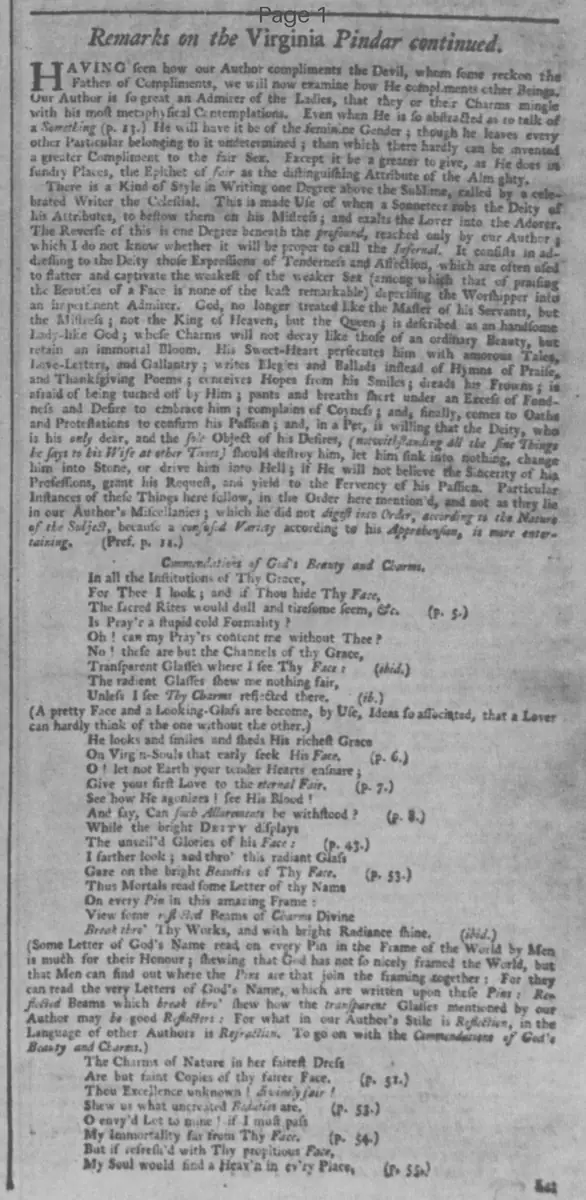
Remarks on the Virginia Pindar continued.
Having seen how our Author compliments the Devil, whom some reckon the Father of Compliments, we will now examine how He compliments other Beings.
Our Author is so great an Admirer of the Ladies, that they or their Charms mingle with his most metaphysical Contemplations. Even when He is so abstracted as to talk of a Something (p. 13.) He will have it be of the feminine Gender: though he leaves every other Particular belonging to it undetermined; than which there hardly can be invented a greater Compliment to the fair Sex. Except it be a greater to give, as He does in sundry Places, the Epithet of fair as the distinguishing Attribute of the Almighty.
There is a Kind of Style in Writing one Degree above the Sublime, called by celebrated Writers the Celestial. This is made Use of when a Sonneteer robs the Deity of his Attributes, to bestow them on his Mistress; and exalts the Lover into the Adorer. The Reverse of this is one Degree beneath the preposterous, reached only by our Author; which I do not know whether it will be proper to call the Infernal. It consists in addressing to the Deity those Expressions of Tenderness and Affection, which are often used to flatter and captivate the weakest of the weaker Sex (among which that of praising the Beauties of a Face is none of the least remarkable) depriving the Worshipper into an impertinent Admirer. God, no longer treated like the Master of his Servants, but the Mistress; not the King of Heaven, but the Queen; is described as an handsome lady-like God; whose Charms will not decay like those of an ordinary Beauty, but retain an immortal Bloom. His Sacred-Heart importunes him with amorous Tales, Love-Letters, and Gallantry; writes Elegies and Ballads instead of Hymns of Praise, and Thanksgiving Poems; conceives Hopes from his Smiles; dreads his Frowns; is afraid of being put off by Him; pants and breathes short under an Excess of Fondness and Desire to embrace him; complains of Coyness; and, finally, comes to Oaths and Protestations to confirm his Passion; and, in a Pet, is willing that the Deity, who is his only dear, and the one Object of his Desires, (notwithstanding all the fine Things he says to his Wife at other Times) should destroy him, let him sink into nothing, change him into Stone, or drive him into Hell; if He will not believe the Sincerity of his Professions, grant his Request, and yield to the Fervency of his Passion. Particular Instances of these Things here follow, in the Order here mentioned, and not as they lie in our Author's Miscellanies; which he did not digest into Order, according to the Nature of the Subject, because a confused Variety according to his Apprehension, is more entertaining. (Pref. p. 11.)
Complimentations of God's Beauty and Charms.
In all the Institutions of Thy Grace,
For Thee I look ; and if Thou hide Thy Face,
The sacred Rites would dull and tiresome Seem, &c. (p. 8.)
Is Pray'r a stupid cold Formality?
Ob ! can my Pray'rs content me without Thee?
No ! they are but the Channels of thy Grace,
Transparent Glasses where I see Thy Face : (ibid.)
The radiant Glasses Shew me nothing fair,
Unless I see Thy Charms reflected there. (ib.)
(A pretty Face and a Looking-Glass are become, by Use, Ideas so associated, that a Lover can hardly think of the one without the other.)
He looks and smiles and sheds His richest Grace
On Virgin-Souls that early seek His Face. (p. 6.)
O let not Earth your tender Hearts ensnare
Give your first Love to the eternal Fair. (p.7.)
See how He agonizes ! see His Blood
And say, Can such Allurements be withstood ? (p.8.)
While the bright Dairy displays
The unveiled Glories of his Face : (p.43.)
I farther look : and thro' this radiant Glass
Gaze on the bright Beauties of Thy Face. (p. 53.)
Thus Mortals read some Letter of thy Name
On every Pin in this amazing Frame :
View some hid Streams of Charms Divine
Break thro' Thy Works, and with bright Radiance shine. (ibid.)
(Some Letter of God's Name read on every Pin in the Frame of the World by Men much of their Honour; shewing that God has not so nicely framed the World, but that Men can find out where the Pins are that join the framing together: For they can read the very Letters of God's Name, which are written upon these Pins: Reflected Beams which break thro' shew how the transparent Glasses mentioned by our Author may be good Reflecters: For what in our Author's Style is Reflection, in the Language of other Authors is Refraction, To go on with the Complimenting of God's Beauty and Charms.)
The Charms of Nature in her fairest Dress
Are but faint Copies of thy fairer Face. (p. 51.)
Thou Excellence unknown unfathomable!
Shew us what uncreated Rarities are. (p. 53.)
O envy'd Lot to muse if I must part
My Immortality far from Thy Face. (p. 54.)
But if refresh'd with Thy propitious Face,
My Soul would find a Heav'n in ev'ry Place, (p. 55)
Let human Nature claim their proper Share,
But Oh! supremely love the Everlasting Fair!
(p.58.)
From all created Charms my Heart recall,
To the All-perfect Fair, th' Eternal All.
(p. 62.)
All-gracious God! I be thou my resting Place;
Heav'n flows exuberant from Thy smiling Face.
(p. 80.)
The Saviour all, with heav'nly Charms,
Stands calling Sinners to his Arms.
(p. 90.)
I love Thine Image in a Glass,
But Oh! to see Thy naked Face!
(p. 92.)
The Glories of Thy Face display,
Tho' Life should for the Vision pay.
(p. 93.)
Eternal Separation from Thy Face.
(p. 114.)
Oh! wilt Thou doom me to a long
Exile from thy propitious Face,
my Only Bliss!
(p. 185.)
(As the Roman Catholics are said to put up ten Ave-Maries for one Pater-noster so our Author celebrates the Beauty of God's Face ten Times for once that He mentions any other of the Divine Perfections. And by thus perpetually dwelling on the Beauty of God He must depress him, full as much as Mr. Addison exalts Marcia, by making Beauty her least Perfection.)
"Tis not a Set of Features or Complexion,
The Tincture of a Skin, that I admire.
Beauty soon grows familiar to the Lover,
Fades in his Eye, and palls upon the Sense.
The Virtuous Marcia tow'rs above her Sex:
True She is fair, (O! how divinely fair!)
But still the lovely Maid improves her Charms
With inward Greatness, unaffected Wisdom,
And Sanctity of Manners. Cato's Soul
Shines out in every Thing she acts or speaks,
While winning Mildness, and attractive Smiles,
Dwell in her Looks, and with becoming Grace
Softens the Rigour of her Father's Virtues,
Addison's Cato.
Amorous Talks, &c.
Since first Thy Beauties charm'd my Sight,
Created Charms yield us Delight.
(Our Author has quite forgot his poor Wife.)
: Let Heav'n, Earth, Men, and Angels, cease to be,
I've Bliss enough, I've all I wish in Thee )", (p. 120.)
In Thee, my God, I'm bless'd, I'm happy still
Nor should the Loss of these vain Trifes set,
But at the General Devastation smiles, , ' (p, 127.)
(Here our Author's Love of God has quite extinguished the Love of his Brethren, He being able to love God whom he hath not seen, without loving his Brother whom he hath seen. For we must not think that he hath really seen God ; though he talks of his Face, of gazing on the Beauties of his Face, of seeing his Face in a Glass, in as strong Terms as if he had really Seen God : which of speaking is nothing but the Privilege allowed to Poetical Writers of Christian and Divine Poetry.)
Nay, if thy Glory might but rise
Cheerful my Brains I'd resign
And fall a willing Sacrifice
To gain a Purpose so divine.
So much more worthy than this Life of mine.
(p, 3:)
(Here our Author's Love of God, has quite extinguished the love of himself. Quære,
Whether any one ever arriv'd to this Pitch of Love before? Whether even our Author can do it now in plain Prose? I cannot quit this last Figure without confirming it as in observable Instance of our Author's Logic. To contribute to the Glory of God is, he Says, a divine Purpose, to gain which he ought to give up his Life, that is, his Existence for a Moment in the Body; and therefore, to gain this divine Purpose, he would cheerfully resign his Brains, that is, give up his rational Existence,)
To Thee so ardent all my Passions more,
That if I love Thee not, I know not what I love, : . (p, 3-)
, not aught, otherwise expressed by Tinsel, or what d'ye call it.)
Whence this immense Ambition in my Mind, ,
That Scorns all Joys but those of heav'nly Kind..
(ibid.)
Why should a Worm, an animated Clod,
Disdain all Bliss beneath a heav'nly God? : (ibid.).
Why indeed when this Worm, this animated God is married, and possessed of a Wife
Coo, whom he loves, and has Reason to love to an immeasurable Degree of Fondness.)
I spring from Earth, and Heav'n is my Abode,
When I can say thee charming Words, say God!
My God! infinite Joys lie in the Sound:
Be Thou but mine; and all the Sun go round
Without reluctant Murm'ring I resign;
I have enough, if I can call Thee MINE.
(P.4
(Our Author has found here' as quick and easy a Way of getting to Heaven, as it would be to get thither by saying lord! Lord!. since he can get thither any Time, by only saying My God! My God! But then it must be own'd this Heaven, such infinite Joys of his lie in a very Small Compass, , Since they lie within that of a single Word. When addressing himself to God, he says, be Thou but mine, &c. he hardly translates a Passage of Waller' s upon his Mistress's Girdle,
"Give me but what this Ribband bound,
Take all the rest, the Sun goes round."
Waller.)
Let others "Let their Passions rove
Round all the Earth's from Shore to Shore; "
Since Jesus is my Friend my Love,
My utmost Wish can grasp no more,.
(p. 94.)
His Glories have allay'd my Eye,
And into Love transfw'd my Heart :
To Him my tendr'est Passions fly ;
: . Itswl!-nor Shall they 'e'er depart, ", (ibid,)
Our Author has been already favoured with the Sight of the Glories of Jesus Christ, the Help, I suppose, of his Christian Muse.)
Thy Presence would at once Past terrors bruise
And cause the Realms of Dissolution smile. : (p. 55.)
As French and Bartramley like Objects
Ladies, injudged by Smiles and Frowns.
Can Riches, Pleasures, Honours, Empires, Crowns,
Or Friends, tempt me, when I feel Thy Frowns ?. : (p. 4.)
O ! then, where'er Thou fix my last Abode,
Be it in Reach of Thy sweet Smiles my God! (p. 55.)
Yet, if depriv'd of thy supporters Smile,
I still be cur'd, abandon'd, wretched still." (p. 5+)
Prostrate before Thee, See we lie I
Frown us not from Thee, lest we die, " (p: 90.)
:-.-Look out to Thee, .
My only Hope?"with without Eyes, ,
'And find my Heav'n in Thy propitious Smile.
(o.
Thank Thou Should'st Blast me with a Frown,
Thy sovereign Justice' I must own, , : (p. 126.)
He is afraid of being turned off
Say, my great God, and ease my Heart,
O wilt 'Thou frown, and say, Depart!
Depart!a..-Ah: where, Lord! shall I go?
I have no other Bliss but Thee, , . (p. 109.
Thou wilt not, let me seek thy Face in vain
dizi ntie Puke,'dnste the:Wmb: Sintlyin
Say, Great Omniscient! (for Thou know'st my Heart)
Can Nature case my Soul,
40
J g mi aa.tr Iofi f Fomd:sb,
hn sn kis Apo,
Oh : if I love Thee not, at least forget
Whence this Strange Turmoil, this uneasy Pain,
"Til thy sweet'r Smiles re-compass my Soul again ?
Whence these wild Pantings of immense Desire ?
(p. 3.)
(Our Author is ingeniously afraid that he loves not God ; and assured, that he does love him at the Same Time/)
The borrow'd Beauties of Thy Works but raise
The restless Pant to view Thy brighter Face j
But O! 'tis Thou alone canst fill
The boundless Wish, and bid the Pant be still.
Without Thee, every Charm insipid grows,
And the aspiring Soul finds no Repose.
In Quest of Thee She flies ; in Quest of Thee
Roves thro' the Mazes of Immensity,
Restless, bewilder'd. O my only Joy!
Reveal Thy Self ; these Cravings Satisfy: &c.
(P- 53, 54-)
No; I resign me to His Hand,
2
And to His soft Embraces move.
(p. gr.)
Let not a Motion of my Heart,
From Thee once venture to depart ;
(I6.)
He would not cruelly deride
My Soul with Bliss to be deny'd ;
Nor kindle Love to pang in vain,
And rack me with augmented Pain.
(p. 118.)
Thus I long,I Pant to see;
(p. g2.)
He complains of Absence.
Where is that Fear, incarnate God,
That once on Earth made His Abode
That Jesus, who upon the Tree
Languish'd, and bled, and died for me?
Ah I will my Saviour now be by!
Repulse me not; for whither shall I fice?
The Words of Life are found all one with Thee.
He is just about.
Then Peace my restless and suspicious Heart,
And ye dire boding Fears depart.
He avows Oaths ; and makes Protestations to confirm his Passion
No,! never, never, can this Heart
From Thee her God, her all, depart;
Indulge my Boldness ;I protest,
In Thee alone I must be bless'd;
I'm fix'd, resolutely fix'd in this,
Thyself or nought shall be my Bliss.
I swear by the Eternal Three,
I will accept no Bliss but Thee.
Be Witness Heaven; I here protest
My Mind Shall never, never rest
Til I thy Presence gain.
I'll pray away my vital Breath,
Begging thy gracious Smiles in Death;
Nor cease til I obtain. (p. 125.)
(Permit me to add here a modest Offer of our Author's, that if God hadmit him into Heaven He will suffer God to keep his Throne.)
O ! raise me to the blissful Realms on high,
Not to be glorify'd, but glorify;
Not to be honour'd, but to honour Thee,
Much there to reign, but more to adoring Knee.
Expostulates with God, and puts him in Mind of his past Engagements.
Repel- me not ; 'tis in my Saviour's Name,
Not in my own, Thy Grace I humbly claim;
And when in that prevailing Name I pray,
I know art oblig'd, Thou canst not say me nay.
Hast thou not bound Thyself with thy own Mouth,
In the Engagements of eternal Truth. (p. 121.)
With Damnation, Annihilation, or Damnation to him; if His Passion can be said. or shall hereafter charge 3 or if it be not sincere d.
O if I love Thee not, I'm self-condemn'd.
(p. 122.)
My God ! the Wretch that does not love Thy Name
To Life and Being forfeits all his Claim,
And may he sink to nothing, whence he came.
Or let the Yrun of the dire Mouth of Hell,
Receive him with his Fellow-Fiends to dwell.
Oh ! if my Heart does not to Thee aspire,
I ought with equal Fervour I desire,
I'm Self-condemn'd, and doom'd to Fire.
If Sin be any more my Joy,
Me, with my own Consent, destroy.
(p. 107.)
(A bold Word, and a fair Offer, to come from one who aye.)
That I'm the vilest Sinner, Lord ! I own
In penitent Prostration at Thy Throne ;
Worthy an endless Monument to be
To thousand Words not to revolt from Thee.)
(P. 220. )
Far better had I flourish'd for a Day
A fading Flower, &c.
.(p. 54.)
Thy Words become me! Jesus say!
O here I faint and die away.
It fills me, Lord ; but to suppose
That I should ever treat Thee thus!
No, rather let my guilty Breath !
To treat Thee thus is worse than Death
If I such Love as this forget
Then let my Heart forget to beat :
If e'er I slight thine Agony,
In that curs'd Moment let me die;
Or, if I cease to love Thy Name,
Reduce to nothing whence I came :
Oh if I must for ever dwell
A' ent from Thee, why did not Hell
Destroy me, e're I felt this Flame?
Thus ardent Passion to thy Name.
(p. 128.)
Here lay me, at thy Feet, if die I must.
(p. 121.)
No! Claim my tend'rest Passions for Thy own;
Or tear them from my Heart, and change me into Stone.
(p. 62.)
Was it our Author's Passion here, or the Consonance of final Syllables made him wish to be turned into Stone.)
Our Author's Stile, under this last Head, is Literally the same with that of Beaus to their Mistresses. For they cry out, Stop my Vitals, Let me die, Damnation fire or with Othello, Perdition catch my Soul but I do love thee. Indeed our Author's whole Treatment of God is such, that setting aside the Pre-conception of his Piety or of his talking to God, you may, without any Force upon his Words, easily imagine him a modern Poet addressing himself to his Mistress; or more literally an ancient Bard making Love to his admired Youth, or Male-Mistress. Which Shews, that it is very wicked in the Said Beaus, Poets, and Bards, to use a Language to their Mistresses; which properly,belongs to God.
(Let me add here, that, as Homer is said to have drawn his Gods like Men, that his Men might appear like Gods : So our Author has made his God like Man in two Points which have been heretofore thought peculiar to Man; but whether for a Reason like that of Homer, I cannot say. I have often heard, and easily believed, that Man is so corrupt as to have lost all innate Goodness, and to be utterly incapable of performing any good Actions, without being moved thereto and fed A Grace. But I think our Author delivers a new Doctrine : When He would have God himself to be moved by Grace to the Exercise of Goodness. Yet it is no Wonder that God Should need Grace, in our Author's Account ; since It seems God has fallen too as well as Man,
He, touch'd with Pity, and impell'd by Grace,
Sent his own Son to Save a guilty Race.
(P. 7.)
See, press'd beneath the dismal Load;
He sinks. He falls, altho' a God!
This familiar Way of treating the Supreme Being, which has been exemplified. Is
equally decent and respectful; and so much better, than the vulgar Method of praying,
that I wonder not to see our Author despising the dull Formality of Prayer (p. 49.) and
preferring his own Aspirations. Happy they! who have the Opportunity of hearing those
Aspirations: And by that Means of knowing fully what is meant by them; which our
ordinary Dictionaries are too deficient to explain. For surely so well Sounding a Word
must mean something more than breathing. or pronouncing a Greek H; which is Bailey's
Simple Account of the Matter. Happy, thrice happy they! who have such a Teacher
to instruct them in the Courtship of their Maker; and how to make Love to the So-
vereign of the Universe, with such moving Gaiety, and in such parodish Language; as
might even well become the Followers of Mahomet, who expect to find, in their Heaven,
vigorous friskish Girls, with pretty black rolling Eyes.
[The Conclusion in our next.]
Having seen how our Author compliments the Devil, whom some reckon the Father of Compliments, we will now examine how He compliments other Beings.
Our Author is so great an Admirer of the Ladies, that they or their Charms mingle with his most metaphysical Contemplations. Even when He is so abstracted as to talk of a Something (p. 13.) He will have it be of the feminine Gender: though he leaves every other Particular belonging to it undetermined; than which there hardly can be invented a greater Compliment to the fair Sex. Except it be a greater to give, as He does in sundry Places, the Epithet of fair as the distinguishing Attribute of the Almighty.
There is a Kind of Style in Writing one Degree above the Sublime, called by celebrated Writers the Celestial. This is made Use of when a Sonneteer robs the Deity of his Attributes, to bestow them on his Mistress; and exalts the Lover into the Adorer. The Reverse of this is one Degree beneath the preposterous, reached only by our Author; which I do not know whether it will be proper to call the Infernal. It consists in addressing to the Deity those Expressions of Tenderness and Affection, which are often used to flatter and captivate the weakest of the weaker Sex (among which that of praising the Beauties of a Face is none of the least remarkable) depriving the Worshipper into an impertinent Admirer. God, no longer treated like the Master of his Servants, but the Mistress; not the King of Heaven, but the Queen; is described as an handsome lady-like God; whose Charms will not decay like those of an ordinary Beauty, but retain an immortal Bloom. His Sacred-Heart importunes him with amorous Tales, Love-Letters, and Gallantry; writes Elegies and Ballads instead of Hymns of Praise, and Thanksgiving Poems; conceives Hopes from his Smiles; dreads his Frowns; is afraid of being put off by Him; pants and breathes short under an Excess of Fondness and Desire to embrace him; complains of Coyness; and, finally, comes to Oaths and Protestations to confirm his Passion; and, in a Pet, is willing that the Deity, who is his only dear, and the one Object of his Desires, (notwithstanding all the fine Things he says to his Wife at other Times) should destroy him, let him sink into nothing, change him into Stone, or drive him into Hell; if He will not believe the Sincerity of his Professions, grant his Request, and yield to the Fervency of his Passion. Particular Instances of these Things here follow, in the Order here mentioned, and not as they lie in our Author's Miscellanies; which he did not digest into Order, according to the Nature of the Subject, because a confused Variety according to his Apprehension, is more entertaining. (Pref. p. 11.)
Complimentations of God's Beauty and Charms.
In all the Institutions of Thy Grace,
For Thee I look ; and if Thou hide Thy Face,
The sacred Rites would dull and tiresome Seem, &c. (p. 8.)
Is Pray'r a stupid cold Formality?
Ob ! can my Pray'rs content me without Thee?
No ! they are but the Channels of thy Grace,
Transparent Glasses where I see Thy Face : (ibid.)
The radiant Glasses Shew me nothing fair,
Unless I see Thy Charms reflected there. (ib.)
(A pretty Face and a Looking-Glass are become, by Use, Ideas so associated, that a Lover can hardly think of the one without the other.)
He looks and smiles and sheds His richest Grace
On Virgin-Souls that early seek His Face. (p. 6.)
O let not Earth your tender Hearts ensnare
Give your first Love to the eternal Fair. (p.7.)
See how He agonizes ! see His Blood
And say, Can such Allurements be withstood ? (p.8.)
While the bright Dairy displays
The unveiled Glories of his Face : (p.43.)
I farther look : and thro' this radiant Glass
Gaze on the bright Beauties of Thy Face. (p. 53.)
Thus Mortals read some Letter of thy Name
On every Pin in this amazing Frame :
View some hid Streams of Charms Divine
Break thro' Thy Works, and with bright Radiance shine. (ibid.)
(Some Letter of God's Name read on every Pin in the Frame of the World by Men much of their Honour; shewing that God has not so nicely framed the World, but that Men can find out where the Pins are that join the framing together: For they can read the very Letters of God's Name, which are written upon these Pins: Reflected Beams which break thro' shew how the transparent Glasses mentioned by our Author may be good Reflecters: For what in our Author's Style is Reflection, in the Language of other Authors is Refraction, To go on with the Complimenting of God's Beauty and Charms.)
The Charms of Nature in her fairest Dress
Are but faint Copies of thy fairer Face. (p. 51.)
Thou Excellence unknown unfathomable!
Shew us what uncreated Rarities are. (p. 53.)
O envy'd Lot to muse if I must part
My Immortality far from Thy Face. (p. 54.)
But if refresh'd with Thy propitious Face,
My Soul would find a Heav'n in ev'ry Place, (p. 55)
Let human Nature claim their proper Share,
But Oh! supremely love the Everlasting Fair!
(p.58.)
From all created Charms my Heart recall,
To the All-perfect Fair, th' Eternal All.
(p. 62.)
All-gracious God! I be thou my resting Place;
Heav'n flows exuberant from Thy smiling Face.
(p. 80.)
The Saviour all, with heav'nly Charms,
Stands calling Sinners to his Arms.
(p. 90.)
I love Thine Image in a Glass,
But Oh! to see Thy naked Face!
(p. 92.)
The Glories of Thy Face display,
Tho' Life should for the Vision pay.
(p. 93.)
Eternal Separation from Thy Face.
(p. 114.)
Oh! wilt Thou doom me to a long
Exile from thy propitious Face,
my Only Bliss!
(p. 185.)
(As the Roman Catholics are said to put up ten Ave-Maries for one Pater-noster so our Author celebrates the Beauty of God's Face ten Times for once that He mentions any other of the Divine Perfections. And by thus perpetually dwelling on the Beauty of God He must depress him, full as much as Mr. Addison exalts Marcia, by making Beauty her least Perfection.)
"Tis not a Set of Features or Complexion,
The Tincture of a Skin, that I admire.
Beauty soon grows familiar to the Lover,
Fades in his Eye, and palls upon the Sense.
The Virtuous Marcia tow'rs above her Sex:
True She is fair, (O! how divinely fair!)
But still the lovely Maid improves her Charms
With inward Greatness, unaffected Wisdom,
And Sanctity of Manners. Cato's Soul
Shines out in every Thing she acts or speaks,
While winning Mildness, and attractive Smiles,
Dwell in her Looks, and with becoming Grace
Softens the Rigour of her Father's Virtues,
Addison's Cato.
Amorous Talks, &c.
Since first Thy Beauties charm'd my Sight,
Created Charms yield us Delight.
(Our Author has quite forgot his poor Wife.)
: Let Heav'n, Earth, Men, and Angels, cease to be,
I've Bliss enough, I've all I wish in Thee )", (p. 120.)
In Thee, my God, I'm bless'd, I'm happy still
Nor should the Loss of these vain Trifes set,
But at the General Devastation smiles, , ' (p, 127.)
(Here our Author's Love of God has quite extinguished the Love of his Brethren, He being able to love God whom he hath not seen, without loving his Brother whom he hath seen. For we must not think that he hath really seen God ; though he talks of his Face, of gazing on the Beauties of his Face, of seeing his Face in a Glass, in as strong Terms as if he had really Seen God : which of speaking is nothing but the Privilege allowed to Poetical Writers of Christian and Divine Poetry.)
Nay, if thy Glory might but rise
Cheerful my Brains I'd resign
And fall a willing Sacrifice
To gain a Purpose so divine.
So much more worthy than this Life of mine.
(p, 3:)
(Here our Author's Love of God, has quite extinguished the love of himself. Quære,
Whether any one ever arriv'd to this Pitch of Love before? Whether even our Author can do it now in plain Prose? I cannot quit this last Figure without confirming it as in observable Instance of our Author's Logic. To contribute to the Glory of God is, he Says, a divine Purpose, to gain which he ought to give up his Life, that is, his Existence for a Moment in the Body; and therefore, to gain this divine Purpose, he would cheerfully resign his Brains, that is, give up his rational Existence,)
To Thee so ardent all my Passions more,
That if I love Thee not, I know not what I love, : . (p, 3-)
, not aught, otherwise expressed by Tinsel, or what d'ye call it.)
Whence this immense Ambition in my Mind, ,
That Scorns all Joys but those of heav'nly Kind..
(ibid.)
Why should a Worm, an animated Clod,
Disdain all Bliss beneath a heav'nly God? : (ibid.).
Why indeed when this Worm, this animated God is married, and possessed of a Wife
Coo, whom he loves, and has Reason to love to an immeasurable Degree of Fondness.)
I spring from Earth, and Heav'n is my Abode,
When I can say thee charming Words, say God!
My God! infinite Joys lie in the Sound:
Be Thou but mine; and all the Sun go round
Without reluctant Murm'ring I resign;
I have enough, if I can call Thee MINE.
(P.4
(Our Author has found here' as quick and easy a Way of getting to Heaven, as it would be to get thither by saying lord! Lord!. since he can get thither any Time, by only saying My God! My God! But then it must be own'd this Heaven, such infinite Joys of his lie in a very Small Compass, , Since they lie within that of a single Word. When addressing himself to God, he says, be Thou but mine, &c. he hardly translates a Passage of Waller' s upon his Mistress's Girdle,
"Give me but what this Ribband bound,
Take all the rest, the Sun goes round."
Waller.)
Let others "Let their Passions rove
Round all the Earth's from Shore to Shore; "
Since Jesus is my Friend my Love,
My utmost Wish can grasp no more,.
(p. 94.)
His Glories have allay'd my Eye,
And into Love transfw'd my Heart :
To Him my tendr'est Passions fly ;
: . Itswl!-nor Shall they 'e'er depart, ", (ibid,)
Our Author has been already favoured with the Sight of the Glories of Jesus Christ, the Help, I suppose, of his Christian Muse.)
Thy Presence would at once Past terrors bruise
And cause the Realms of Dissolution smile. : (p. 55.)
As French and Bartramley like Objects
Ladies, injudged by Smiles and Frowns.
Can Riches, Pleasures, Honours, Empires, Crowns,
Or Friends, tempt me, when I feel Thy Frowns ?. : (p. 4.)
O ! then, where'er Thou fix my last Abode,
Be it in Reach of Thy sweet Smiles my God! (p. 55.)
Yet, if depriv'd of thy supporters Smile,
I still be cur'd, abandon'd, wretched still." (p. 5+)
Prostrate before Thee, See we lie I
Frown us not from Thee, lest we die, " (p: 90.)
:-.-Look out to Thee, .
My only Hope?"with without Eyes, ,
'And find my Heav'n in Thy propitious Smile.
(o.
Thank Thou Should'st Blast me with a Frown,
Thy sovereign Justice' I must own, , : (p. 126.)
He is afraid of being turned off
Say, my great God, and ease my Heart,
O wilt 'Thou frown, and say, Depart!
Depart!a..-Ah: where, Lord! shall I go?
I have no other Bliss but Thee, , . (p. 109.
Thou wilt not, let me seek thy Face in vain
dizi ntie Puke,'dnste the:Wmb: Sintlyin
Say, Great Omniscient! (for Thou know'st my Heart)
Can Nature case my Soul,
40
J g mi aa.tr Iofi f Fomd:sb,
hn sn kis Apo,
Oh : if I love Thee not, at least forget
Whence this Strange Turmoil, this uneasy Pain,
"Til thy sweet'r Smiles re-compass my Soul again ?
Whence these wild Pantings of immense Desire ?
(p. 3.)
(Our Author is ingeniously afraid that he loves not God ; and assured, that he does love him at the Same Time/)
The borrow'd Beauties of Thy Works but raise
The restless Pant to view Thy brighter Face j
But O! 'tis Thou alone canst fill
The boundless Wish, and bid the Pant be still.
Without Thee, every Charm insipid grows,
And the aspiring Soul finds no Repose.
In Quest of Thee She flies ; in Quest of Thee
Roves thro' the Mazes of Immensity,
Restless, bewilder'd. O my only Joy!
Reveal Thy Self ; these Cravings Satisfy: &c.
(P- 53, 54-)
No; I resign me to His Hand,
2
And to His soft Embraces move.
(p. gr.)
Let not a Motion of my Heart,
From Thee once venture to depart ;
(I6.)
He would not cruelly deride
My Soul with Bliss to be deny'd ;
Nor kindle Love to pang in vain,
And rack me with augmented Pain.
(p. 118.)
Thus I long,I Pant to see;
(p. g2.)
He complains of Absence.
Where is that Fear, incarnate God,
That once on Earth made His Abode
That Jesus, who upon the Tree
Languish'd, and bled, and died for me?
Ah I will my Saviour now be by!
Repulse me not; for whither shall I fice?
The Words of Life are found all one with Thee.
He is just about.
Then Peace my restless and suspicious Heart,
And ye dire boding Fears depart.
He avows Oaths ; and makes Protestations to confirm his Passion
No,! never, never, can this Heart
From Thee her God, her all, depart;
Indulge my Boldness ;I protest,
In Thee alone I must be bless'd;
I'm fix'd, resolutely fix'd in this,
Thyself or nought shall be my Bliss.
I swear by the Eternal Three,
I will accept no Bliss but Thee.
Be Witness Heaven; I here protest
My Mind Shall never, never rest
Til I thy Presence gain.
I'll pray away my vital Breath,
Begging thy gracious Smiles in Death;
Nor cease til I obtain. (p. 125.)
(Permit me to add here a modest Offer of our Author's, that if God hadmit him into Heaven He will suffer God to keep his Throne.)
O ! raise me to the blissful Realms on high,
Not to be glorify'd, but glorify;
Not to be honour'd, but to honour Thee,
Much there to reign, but more to adoring Knee.
Expostulates with God, and puts him in Mind of his past Engagements.
Repel- me not ; 'tis in my Saviour's Name,
Not in my own, Thy Grace I humbly claim;
And when in that prevailing Name I pray,
I know art oblig'd, Thou canst not say me nay.
Hast thou not bound Thyself with thy own Mouth,
In the Engagements of eternal Truth. (p. 121.)
With Damnation, Annihilation, or Damnation to him; if His Passion can be said. or shall hereafter charge 3 or if it be not sincere d.
O if I love Thee not, I'm self-condemn'd.
(p. 122.)
My God ! the Wretch that does not love Thy Name
To Life and Being forfeits all his Claim,
And may he sink to nothing, whence he came.
Or let the Yrun of the dire Mouth of Hell,
Receive him with his Fellow-Fiends to dwell.
Oh ! if my Heart does not to Thee aspire,
I ought with equal Fervour I desire,
I'm Self-condemn'd, and doom'd to Fire.
If Sin be any more my Joy,
Me, with my own Consent, destroy.
(p. 107.)
(A bold Word, and a fair Offer, to come from one who aye.)
That I'm the vilest Sinner, Lord ! I own
In penitent Prostration at Thy Throne ;
Worthy an endless Monument to be
To thousand Words not to revolt from Thee.)
(P. 220. )
Far better had I flourish'd for a Day
A fading Flower, &c.
.(p. 54.)
Thy Words become me! Jesus say!
O here I faint and die away.
It fills me, Lord ; but to suppose
That I should ever treat Thee thus!
No, rather let my guilty Breath !
To treat Thee thus is worse than Death
If I such Love as this forget
Then let my Heart forget to beat :
If e'er I slight thine Agony,
In that curs'd Moment let me die;
Or, if I cease to love Thy Name,
Reduce to nothing whence I came :
Oh if I must for ever dwell
A' ent from Thee, why did not Hell
Destroy me, e're I felt this Flame?
Thus ardent Passion to thy Name.
(p. 128.)
Here lay me, at thy Feet, if die I must.
(p. 121.)
No! Claim my tend'rest Passions for Thy own;
Or tear them from my Heart, and change me into Stone.
(p. 62.)
Was it our Author's Passion here, or the Consonance of final Syllables made him wish to be turned into Stone.)
Our Author's Stile, under this last Head, is Literally the same with that of Beaus to their Mistresses. For they cry out, Stop my Vitals, Let me die, Damnation fire or with Othello, Perdition catch my Soul but I do love thee. Indeed our Author's whole Treatment of God is such, that setting aside the Pre-conception of his Piety or of his talking to God, you may, without any Force upon his Words, easily imagine him a modern Poet addressing himself to his Mistress; or more literally an ancient Bard making Love to his admired Youth, or Male-Mistress. Which Shews, that it is very wicked in the Said Beaus, Poets, and Bards, to use a Language to their Mistresses; which properly,belongs to God.
(Let me add here, that, as Homer is said to have drawn his Gods like Men, that his Men might appear like Gods : So our Author has made his God like Man in two Points which have been heretofore thought peculiar to Man; but whether for a Reason like that of Homer, I cannot say. I have often heard, and easily believed, that Man is so corrupt as to have lost all innate Goodness, and to be utterly incapable of performing any good Actions, without being moved thereto and fed A Grace. But I think our Author delivers a new Doctrine : When He would have God himself to be moved by Grace to the Exercise of Goodness. Yet it is no Wonder that God Should need Grace, in our Author's Account ; since It seems God has fallen too as well as Man,
He, touch'd with Pity, and impell'd by Grace,
Sent his own Son to Save a guilty Race.
(P. 7.)
See, press'd beneath the dismal Load;
He sinks. He falls, altho' a God!
This familiar Way of treating the Supreme Being, which has been exemplified. Is
equally decent and respectful; and so much better, than the vulgar Method of praying,
that I wonder not to see our Author despising the dull Formality of Prayer (p. 49.) and
preferring his own Aspirations. Happy they! who have the Opportunity of hearing those
Aspirations: And by that Means of knowing fully what is meant by them; which our
ordinary Dictionaries are too deficient to explain. For surely so well Sounding a Word
must mean something more than breathing. or pronouncing a Greek H; which is Bailey's
Simple Account of the Matter. Happy, thrice happy they! who have such a Teacher
to instruct them in the Courtship of their Maker; and how to make Love to the So-
vereign of the Universe, with such moving Gaiety, and in such parodish Language; as
might even well become the Followers of Mahomet, who expect to find, in their Heaven,
vigorous friskish Girls, with pretty black rolling Eyes.
[The Conclusion in our next.]
What sub-type of article is it?
Satire
Moral Or Religious
What keywords are associated?
Satire
Religious Poetry
Virginia Pindar
Divine Charms
Amorous Devotion
Gods Face
Poetic Critique
What entities or persons were involved?
Virginia Pindar
Our Author
God
Addison
Waller
Homer
Editorial Details
Primary Topic
Satirical Critique Of The Virginia Pindar's Amorous Religious Poetry
Stance / Tone
Satirical Mockery Of Overly Feminine And Romantic Devotion To God
Key Figures
Virginia Pindar
Our Author
God
Addison
Waller
Homer
Key Arguments
The Author Compliments God With Feminine Attributes And Amorous Language More Suited To A Mistress.
Religious Poetry Treats Divine Worship As Courtship, Inverting Proper Reverence.
Examples From The Poetry Show Obsession With God's 'Face' And 'Charms' Over Other Perfections.
This Style Confuses Piety With Romantic Passion, Even Forgetting Familial Duties.
The Critique Compares It To Classical And Literary Precedents To Highlight Absurdity.