Thank you for visiting SNEWPapers!
Sign up free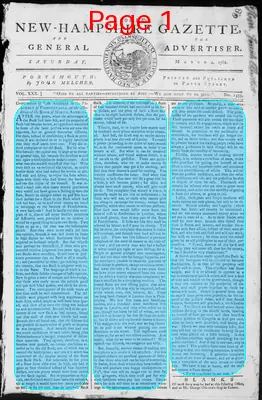
Editorial
March 4, 1786
Fowle's New Hampshire Gazette And General Advertiser
Portsmouth, Rockingham County, New Hampshire
What is this article about?
Continuation of an address to Pennsylvania's Assembly defending the Bank of North America against abolition. Critiques historical oppositions, proposes ways to alleviate money scarcity through industry and fiscal measures, and dismisses fears of foreign stockholders.
Clipping
OCR Quality
95%
Excellent
Full Text
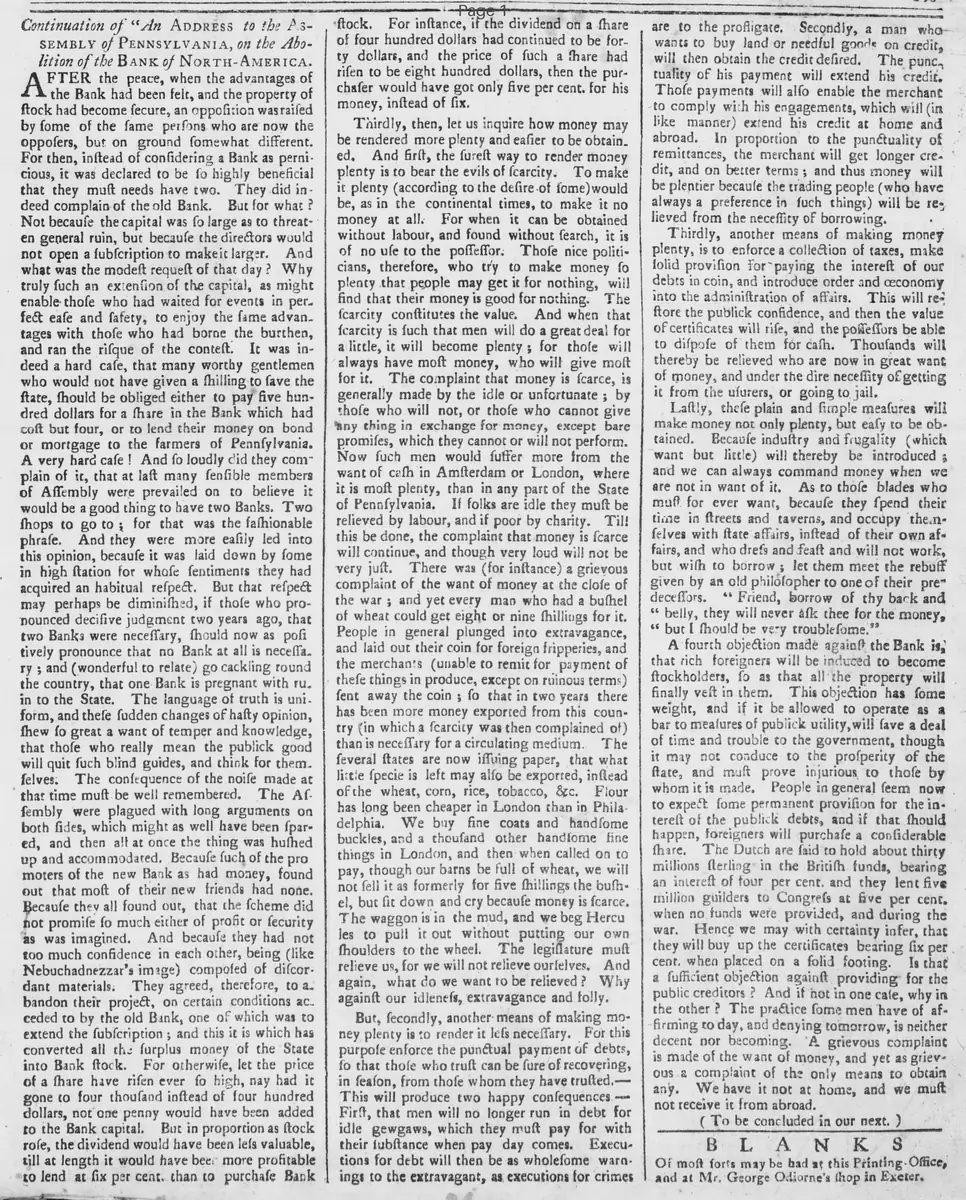
Continuation of "An Address to the Assembly of Pennsylvania, on the Abolition of the Bank of North-America."
After the peace, when the advantages of the Bank had been felt, and the property of stock had become secure, an opposition was raised by some of the same persons who are now the opposers, but on grounds somewhat different.
For then, instead of considering a Bank as pernicious, it was declared to be so highly beneficial that they must needs have two. They did indeed complain of the old Bank. But for what? Not because the capital was so large as to threaten general ruin, but because the directors would not open a subscription to make it larger. And what was the modest request of that day? Why truly such an extension of the capital, as might enable those who had waited for events in perfect ease and safety, to enjoy the same advantages with those who had borne the burthen, and ran the risque of the contest. It was indeed a hard case, that many worthy gentlemen who would not have given a shilling to save the state, should be obliged either to pay five hundred dollars for a share in the Bank which had cost but four, or to lend their money on bond or mortgage to the farmers of Pennsylvania. A very hard case! And so loudly did they complain of it, that at last many sensible members of Assembly were prevailed on to believe it would be a good thing to have two Banks. Two shops to go to; for that was the fashionable phrase. And they were more easily led into this opinion, because it was laid down by some in high station for whose sentiments they had acquired an habitual respect. But that respect may perhaps be diminished, if those who pronounced decisive judgment two years ago, that two Banks were necessary, should now as positively pronounce that no Bank at all is necessary; and (wonderful to relate) go cackling round the country, that one Bank is pregnant with ruin to the State. The language of truth is uniform, and these sudden changes of hasty opinion, shew so great a want of temper and knowledge, that those who really mean the publick good will quit such blind guides, and think for themselves. The consequence of the noise made at that time must be well remembered. The Assembly were plagued with long arguments on both sides, which might as well have been pared, and then all at once the thing was hushed up and accommodated. Because such of the promoters of the new Bank as had money, found out that most of their new friends had none. Because they all found out, that the scheme did not promise so much either of profit or security as was imagined. And because they had not too much confidence in each other, being (like Nebuchadnezzar's image) composed of discordant materials. They agreed, therefore, to abandon their project, on certain conditions acceded to by the old Bank, one of which was to extend the subscription; and this it is which has converted all the surplus money of the State into Bank stock. For otherwise, let the price of a share have risen ever so high, nay had it gone to four thousand instead of four hundred dollars, not one penny would have been added to the Bank capital. But in proportion as stock rose, the dividend would have been less valuable, till at length it would have been more profitable to lend at six per cent. than to purchase Bank stock. For instance, if the dividend on a share of four hundred dollars had continued to be forty dollars, and the price of such a share had risen to be eight hundred dollars, then the purchaser would have got only five per cent. for his money, instead of six.
Thirdly, then, let us inquire how money may be rendered more plenty and easier to be obtained. And first, the surest way to render money plenty is to bear the evils of scarcity. To make it plenty (according to the desire of some) would be, as in the continental times, to make it no money at all. For when it can be obtained without labour, and found without search, it is of no use to the possessor. Those nice politicians, therefore, who try to make money so plenty that people may get it for nothing, will find that their money is good for nothing. The scarcity constitutes the value. And when that scarcity is such that men will do a great deal for a little, it will become plenty; for those will always have most money, who will give most for it. The complaint that money is scarce, is generally made by the idle or unfortunate; by those who will not, or those who cannot give any thing in exchange for money, except bare promises, which they cannot or will not perform. Now such men would suffer more from the want of cash in Amsterdam or London, where it is most plenty, than in any part of the State of Pennsylvania. If folks are idle they must be relieved by labour, and if poor by charity. Till this be done, the complaint that money is scarce will continue, and though very loud will not be very just. There was (for instance) a grievous complaint of the want of money at the close of the war; and yet every man who had a bushel of wheat could get eight or nine shillings for it. People in general plunged into extravagance, and laid out their coin for foreign fripperies, and the merchants (unable to remit for payment of these things in produce, except on ruinous terms) sent away the coin; so that in two years there has been more money exported from this country (in which a scarcity was then complained of) than is necessary for a circulating medium. The several states are now issuing paper, that what little specie is left may also be exported, instead of the wheat, corn, rice, tobacco, &c. Flour has long been cheaper in London than in Philadelphia. We buy fine coats and handsome buckles, and a thousand other handsome fine things in London, and then when called on to pay, though our barns be full of wheat, we will not sell it as formerly for five shillings the bushel, but sit down and cry because money is scarce. The waggon is in the mud, and we beg Hercules to pull it out without putting our own shoulders to the wheel. The legislature must relieve us, for we will not relieve ourselves. And again, what do we want to be relieved? Why against our idleness, extravagance and folly.
But, secondly, another means of making money plenty is to render it less necessary. For this purpose enforce the punctual payment of debts, so that those who trust can be sure of recovering, in season, from those whom they have trusted. This will produce two happy consequences. First, that men will no longer run in debt for idle gewgaws, which they must pay for with their substance when pay day comes. Executions for debt will then be as wholesome warnings to the extravagant, as executions for crimes are to the profligate. Secondly, a man who wants to buy land or needful goods on credit, will then obtain the credit desired. The punctuality of his payment will extend his credit. Those payments will also enable the merchant to comply with his engagements, which will (in like manner) extend his credit at home and abroad. In proportion to the punctuality of remittances, the merchant will get longer credit, and on better terms; and thus money will be plentier because the trading people (who have always a preference in such things) will be relieved from the necessity of borrowing.
Thirdly, another means of making money plenty, is to enforce a collection of taxes, make solid provision for paying the interest of our debts in coin, and introduce order and oeconomy into the administration of affairs. This will restore the publick confidence, and then the value of certificates will rise, and the possessors be able to dispose of them for cash. Thousands will thereby be relieved who are now in great want of money, and under the dire necessity of getting it from the usurers, or going to jail.
Lastly, these plain and simple measures will make money not only plenty, but easy to be obtained. Because industry and frugality (which want but little) will thereby be introduced; and we can always command money when we are not in want of it. As to those blades who must for ever want, because they spend their time in streets and taverns, and occupy themselves with state affairs, instead of their own affairs, and who dress and feast and will not work, but wish to borrow; let them meet the rebuff given by an old philosopher to one of their predecessors. "Friend, borrow of thy back and belly, they will never ask thee for the money." but I should be very troublesome.
A fourth objection made against the Bank is, that rich foreigners will be induced to become stockholders, so as that all the property will finally vest in them. This objection has some weight, and if it be allowed to operate as a bar to measures of publick utility, will save a deal of time and trouble to the government, though it may not conduce to the prosperity of the state, and must prove injurious to those by whom it is made. People in general seem now to expect some permanent provision for the interest of the publick debts, and if that should happen, foreigners will purchase a considerable share. The Dutch are said to hold about thirty millions sterling in the British funds, bearing an interest of four per cent. and they lent five million guilders to Congress at five per cent. when no funds were provided, and during the war. Hence we may with certainty infer, that they will buy up the certificates bearing six per cent. when placed on a solid footing. Is that sufficient objection against providing for the public creditors? And if not in one case, why in the other? The practice some men have of affirming to day, and denying tomorrow, is neither decent nor becoming. A grievous complaint is made of the want of money, and yet as grievous a complaint of the only means to obtain any. We have it not at home, and we must not receive it from abroad.
(To be concluded in our next.)
After the peace, when the advantages of the Bank had been felt, and the property of stock had become secure, an opposition was raised by some of the same persons who are now the opposers, but on grounds somewhat different.
For then, instead of considering a Bank as pernicious, it was declared to be so highly beneficial that they must needs have two. They did indeed complain of the old Bank. But for what? Not because the capital was so large as to threaten general ruin, but because the directors would not open a subscription to make it larger. And what was the modest request of that day? Why truly such an extension of the capital, as might enable those who had waited for events in perfect ease and safety, to enjoy the same advantages with those who had borne the burthen, and ran the risque of the contest. It was indeed a hard case, that many worthy gentlemen who would not have given a shilling to save the state, should be obliged either to pay five hundred dollars for a share in the Bank which had cost but four, or to lend their money on bond or mortgage to the farmers of Pennsylvania. A very hard case! And so loudly did they complain of it, that at last many sensible members of Assembly were prevailed on to believe it would be a good thing to have two Banks. Two shops to go to; for that was the fashionable phrase. And they were more easily led into this opinion, because it was laid down by some in high station for whose sentiments they had acquired an habitual respect. But that respect may perhaps be diminished, if those who pronounced decisive judgment two years ago, that two Banks were necessary, should now as positively pronounce that no Bank at all is necessary; and (wonderful to relate) go cackling round the country, that one Bank is pregnant with ruin to the State. The language of truth is uniform, and these sudden changes of hasty opinion, shew so great a want of temper and knowledge, that those who really mean the publick good will quit such blind guides, and think for themselves. The consequence of the noise made at that time must be well remembered. The Assembly were plagued with long arguments on both sides, which might as well have been pared, and then all at once the thing was hushed up and accommodated. Because such of the promoters of the new Bank as had money, found out that most of their new friends had none. Because they all found out, that the scheme did not promise so much either of profit or security as was imagined. And because they had not too much confidence in each other, being (like Nebuchadnezzar's image) composed of discordant materials. They agreed, therefore, to abandon their project, on certain conditions acceded to by the old Bank, one of which was to extend the subscription; and this it is which has converted all the surplus money of the State into Bank stock. For otherwise, let the price of a share have risen ever so high, nay had it gone to four thousand instead of four hundred dollars, not one penny would have been added to the Bank capital. But in proportion as stock rose, the dividend would have been less valuable, till at length it would have been more profitable to lend at six per cent. than to purchase Bank stock. For instance, if the dividend on a share of four hundred dollars had continued to be forty dollars, and the price of such a share had risen to be eight hundred dollars, then the purchaser would have got only five per cent. for his money, instead of six.
Thirdly, then, let us inquire how money may be rendered more plenty and easier to be obtained. And first, the surest way to render money plenty is to bear the evils of scarcity. To make it plenty (according to the desire of some) would be, as in the continental times, to make it no money at all. For when it can be obtained without labour, and found without search, it is of no use to the possessor. Those nice politicians, therefore, who try to make money so plenty that people may get it for nothing, will find that their money is good for nothing. The scarcity constitutes the value. And when that scarcity is such that men will do a great deal for a little, it will become plenty; for those will always have most money, who will give most for it. The complaint that money is scarce, is generally made by the idle or unfortunate; by those who will not, or those who cannot give any thing in exchange for money, except bare promises, which they cannot or will not perform. Now such men would suffer more from the want of cash in Amsterdam or London, where it is most plenty, than in any part of the State of Pennsylvania. If folks are idle they must be relieved by labour, and if poor by charity. Till this be done, the complaint that money is scarce will continue, and though very loud will not be very just. There was (for instance) a grievous complaint of the want of money at the close of the war; and yet every man who had a bushel of wheat could get eight or nine shillings for it. People in general plunged into extravagance, and laid out their coin for foreign fripperies, and the merchants (unable to remit for payment of these things in produce, except on ruinous terms) sent away the coin; so that in two years there has been more money exported from this country (in which a scarcity was then complained of) than is necessary for a circulating medium. The several states are now issuing paper, that what little specie is left may also be exported, instead of the wheat, corn, rice, tobacco, &c. Flour has long been cheaper in London than in Philadelphia. We buy fine coats and handsome buckles, and a thousand other handsome fine things in London, and then when called on to pay, though our barns be full of wheat, we will not sell it as formerly for five shillings the bushel, but sit down and cry because money is scarce. The waggon is in the mud, and we beg Hercules to pull it out without putting our own shoulders to the wheel. The legislature must relieve us, for we will not relieve ourselves. And again, what do we want to be relieved? Why against our idleness, extravagance and folly.
But, secondly, another means of making money plenty is to render it less necessary. For this purpose enforce the punctual payment of debts, so that those who trust can be sure of recovering, in season, from those whom they have trusted. This will produce two happy consequences. First, that men will no longer run in debt for idle gewgaws, which they must pay for with their substance when pay day comes. Executions for debt will then be as wholesome warnings to the extravagant, as executions for crimes are to the profligate. Secondly, a man who wants to buy land or needful goods on credit, will then obtain the credit desired. The punctuality of his payment will extend his credit. Those payments will also enable the merchant to comply with his engagements, which will (in like manner) extend his credit at home and abroad. In proportion to the punctuality of remittances, the merchant will get longer credit, and on better terms; and thus money will be plentier because the trading people (who have always a preference in such things) will be relieved from the necessity of borrowing.
Thirdly, another means of making money plenty, is to enforce a collection of taxes, make solid provision for paying the interest of our debts in coin, and introduce order and oeconomy into the administration of affairs. This will restore the publick confidence, and then the value of certificates will rise, and the possessors be able to dispose of them for cash. Thousands will thereby be relieved who are now in great want of money, and under the dire necessity of getting it from the usurers, or going to jail.
Lastly, these plain and simple measures will make money not only plenty, but easy to be obtained. Because industry and frugality (which want but little) will thereby be introduced; and we can always command money when we are not in want of it. As to those blades who must for ever want, because they spend their time in streets and taverns, and occupy themselves with state affairs, instead of their own affairs, and who dress and feast and will not work, but wish to borrow; let them meet the rebuff given by an old philosopher to one of their predecessors. "Friend, borrow of thy back and belly, they will never ask thee for the money." but I should be very troublesome.
A fourth objection made against the Bank is, that rich foreigners will be induced to become stockholders, so as that all the property will finally vest in them. This objection has some weight, and if it be allowed to operate as a bar to measures of publick utility, will save a deal of time and trouble to the government, though it may not conduce to the prosperity of the state, and must prove injurious to those by whom it is made. People in general seem now to expect some permanent provision for the interest of the publick debts, and if that should happen, foreigners will purchase a considerable share. The Dutch are said to hold about thirty millions sterling in the British funds, bearing an interest of four per cent. and they lent five million guilders to Congress at five per cent. when no funds were provided, and during the war. Hence we may with certainty infer, that they will buy up the certificates bearing six per cent. when placed on a solid footing. Is that sufficient objection against providing for the public creditors? And if not in one case, why in the other? The practice some men have of affirming to day, and denying tomorrow, is neither decent nor becoming. A grievous complaint is made of the want of money, and yet as grievous a complaint of the only means to obtain any. We have it not at home, and we must not receive it from abroad.
(To be concluded in our next.)
What sub-type of article is it?
Economic Policy
What keywords are associated?
Bank Of North America
Abolition Opposition
Money Scarcity
Public Debt
Foreign Investment
Pennsylvania Assembly
Economic Reform
What entities or persons were involved?
Bank Of North America
Assembly Of Pennsylvania
Opposers
Dutch Foreigners
Congress
Editorial Details
Primary Topic
Defense Of The Bank Of North America Against Abolition
Stance / Tone
Supportive Of The Bank, Critical Of Opposers And Money Scarcity Complainers
Key Figures
Bank Of North America
Assembly Of Pennsylvania
Opposers
Dutch Foreigners
Congress
Key Arguments
Historical Opposition Shifted From Wanting Two Banks To Abolishing One, Showing Inconsistency.
Money Scarcity Stems From Idleness And Extravagance, Not Lack Of Banks; Promote Industry And Frugality.
Enforce Debt Payments To Reduce Need For Cash And Extend Credit.
Collect Taxes And Fund Public Debts To Restore Confidence And Increase Money Availability.
Foreign Investment In Bank Stock Is Beneficial, Similar To Funding Public Debts; Rejecting It Hinders Prosperity.