Thank you for visiting SNEWPapers!
Sign up free
Palladium Of Virginia And The Pacific Monitor
Lewisburg, Greenbrier County, West Virginia
What is this article about?
Members of the Dandy Hall association rebut Hymenaeus's critical essay in the Palladium, defending their reputation, sincerity, and views on love and marriage. They advocate for circumspect, age-appropriate marriages based on compatible dispositions, citing Greek philosophers and moral principles, while criticizing Hymenaeus's indecent and ignorant arguments.
Clipping
OCR Quality
Full Text
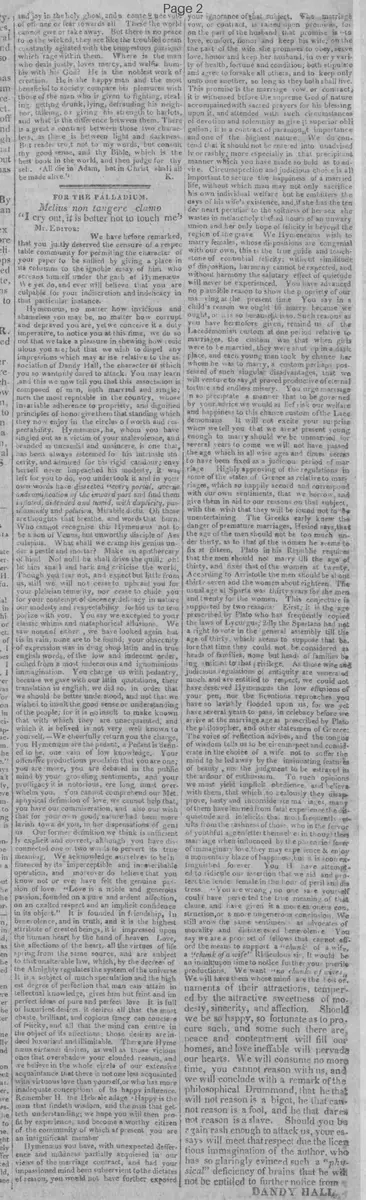
Melius non tangere clamo
"I cry out, it is better not to touch me"
Mr. EDITOR:
We have before remarked, that you justly deserved the censure of a respectable community for permitting the character of your paper to be sullied by giving a place in its columns to the ignoble essay of him who screams himself under the garb of Hymenaeus. We yet do, and ever will believe that you are culpable for your indiscretion and indecency in that particular instance.
Hymenaeus, no matter how invidious and shameless you may be, no matter how corrupt and depraved you are, yet we conceive it a duty imperative, to notice you at this time, we do so not that we take a pleasure in shewing how ridiculous you are; but that we wish to dispel any impressions which may arise relative to the association of Dandy Hall, the character of which you so wantonly dared to attack. You may learn, and this we now tell you that this association is composed of men, both married and single; men the most reputable in the country, whose invariable adherence to propriety, and dignified principles of honor give them that standing which they now enjoy in the circles of worth and respectability. Hymenaus, he, whom you have singled out as a victim of your malevolence, and branded as uncandid and insincere, is one that, has been always esteemed for his intrinsic sincerity, and admired for his rigid candour; envy herself never impeached his modesty, it was left for you to do, you undertook it and in your own words have dissected "every portal, avenue and ramifications of the inward part and find them inflated, distended and tumid, with duplicity, pusillanimity and pollution, Mirabile dictu. Oh those are thoughts that breathe, and words that burn."
Who cannot recognise this Hymenaeus not to be a son of Venus, but unworthy disciple of Aesculapius. What shall we cramp his genius under a pestle and mortar? Make an apothecary of him! No! no!!! he shall drive the quill; oh! let him snarl and bark and criticise the world. Though you tear not, and expect but little from us, still we will not cease to upbraid you for your plebeian temerity, nor cease to chide you for your contempt of decency delicacy in nature our modesty and respectability forbid us to temporize with you. You say we excepted to your classic whims and metaphorical allusions. We saw none of either, we have looked again but tis in vain, none are to be found; your obscenity of expression was in drug shop latin and in true english words, of the low and indecent order, culled from a most indecorous and ignominious imagination. You charge us with pedantry, because we gave with our latin quotations, their translation in english. we did so, in order that we should be better understood, and not that we wished to insult the good sense or understanding of the people; for it is no insult to make known that with which they are unacquainted, and which it is believed is not very well known to yourself.--We cheerfully return you the charge, you Hymenaus are the pedant, a Pedant is defined to be, one vain of low knowledge. Your offensive productions proclaim that you are one; you are more, you are debased in the public mind by your groveling sentiments, and your profligacy it is notorious, ere long must overwhelm you. You cannot comprehend our Metaphysical definition of love, we cannot help that, you have our commiseration, and also our wish that for your own good, nature had been more lavish towards you, in her dispensations of genius. Our former definition we think is sufficiently explicit and correct, although you have disconnected one or two words to pervert its true meaning. We acknowledge ourselves to be influenced by its imperceptible and ineffable operation, and moreover do believe that you know not or ever have felt the genuine passion of love. "Love is a noble and generous passion, founded on a pure and ardent affection, on an exalted respect and an implicit confidence in its object." It is founded in friendship, in benevolence, and in truth, and it is the highest attribute of created beings, it is impressed upon the human heart by the hand of heaven. Love, the affections of the heart, all the virtues of life spring from the same source, and are subject to that unalterable law, which, by the decrees of the Almighty regulates the system of the universe. It is a subject of much speculation and the highest degree of perfection that man can attain in intellectual knowledge, gives him but faint and imperfect ideas of pure and perfect love. It is full of luxuriant desires, it desires all that the most chaste, brilliant, and copious fancy can conceive of felicity, and all that the mind can centre in this object of its affections: those desires are indeed luxuriant and illimitable. There are Hymenaeus virtuous desires, as well as those vicious ones that overshadow your clouded reason, and we believe in the whole circle of our extensive acquaintance that there is not one less acquainted with virtuous love than yourself, or who has more inadequate conception of its happy influence.
Remember H. the Hebraic adage Happy is the man that findeth wisdom, and the man that getteth understanding; we hope you will then profit by experience, and become a worthy citizen of the community of which at present you are an insignificant member.
Hymenaus you have, with unexpected deference and mildness partially acquiesced in our views of the marriage contract, and had your impassioned mind been subservient to the dictates of reason, you would not have further exposed your ignorance of that subject. The marriage vow, or contract, is raised upon promises, for on the part of the husband that promise is "to love, comfort, honor and keep his wife; on the part of the wife she promises to obey, serve, love, honor and keep her husband, in every variety of health, fortune and condition; both stipulate and agree to forsake all others, and to keep only unto one another, so long as they both shall live."
This promise is the marriage vow, or contract, it is witnessed before the supreme God of nature accompanied with sacred prayers for his blessing upon it, and attended with such circumstances of devotion and solemnity as give it superior obligation, it is a contract of paramount importance and one of the highest nature. We do contend that it should not be entered into unadvisedly or rashly; more especially in that precipitate manner which you have made so bold as to advise. Circumspection and judicious choice is all important to secure the happiness of a married life, without which man may not only sacrifice his own individual welfare but he embitters the days of his wife's existence, and, if she has the tender heart peculiar to the softness of her sex she wastes in melancholy the sad hours of an unwary union and her only hope of felicity is beyond the region of the grave. We Hymenaus wish to marry females, whose dispositions are congenial with our own, this is the true guide and touchstone of connubial felicity; without similitude of disposition, harmony cannot be expected, and without harmony the salutary effect of quietude will never be experienced. You have advanced no plausible reason to show the propriety of our marrying at the present time. You say in a child's reason we ought to marry because we ought, or it is so because it is so. Such reasons as you have heretofore given, remind us of the Lacedemonian custom at one period relative to marriages, the custom was that when girls were to be married, they were shut up in a dark place, and each young man took by chance her whom he was to marry, a custom perhaps possessed of such singular disadvantages, that we will venture to say it proved productive of eternal torture and endless misery. You urge marriage in so precipitate a manner that to be governed by your advice we would as lief risk our welfare and happiness to this chance custom of the Lacedemonians. It will not excite your surprise when we tell you that we are at present young enough to marry should we be unmarried for several years to come we will not have passed the age which in all wise ages and times seems to have been fixed as a judicious period of marriage. Highly approving of the regulations in some of the states of Greece as relative to marriages, which so happily accord and correspond with our own sentiments, that we borrow, and give them in aid to our reasons on that subject, with the wish that they will be found not to be unentertaining. The Greeks early knew the danger of premature marriages, Hesiod says, that the age of the men should not be too much under thirty, as to that of the women he seems to fix at fifteen. Plato in his Republic requires that the men should not marry till the age of thirty, and fixes that of the women at twenty. According to Aristotle the men should be about thirty-seven and the women about eighteen. The usual age at Sparta was thirty years for the men and twenty for the women. This conjecture is supported by two reasons: First; it is the age prescribed by Plato who has frequently copied the laws of Lycurgus; 2dly the Spartans had not a right to vote in the general assembly till the age of thirty, which seems to suppose that before that time they could not be considered as heads of families, none but heads of families being entitled to that privilege. As those wise and judicious regulations of antiquity are venerated much, and are entitled to respect, we could not have deserved Hymenaus the low effusions of your pen, nor the licentious reproaches you have so lavishly flooded upon us, for we yet have several years to pass, in celibacy before we arrive at the marriage age as prescribed by Plato the philosopher, and other statesmen of Greece:
The voice of reflection advises, and the tongue of wisdom tells us to be circumspect and considerate in the choice of a wife not to suffer the mind to be led away by the insinuating features of beauty, nor the judgment to be estranged in the ardour of enthusiasm. To such opinions we must yield implicit obedience, and believe with them, that which so zealously they disapprove, hasty and inconsiderate marriages, many of them have learned from fatal experience the disquietude and infelicity that most frequently results from the rashness of those, who in the fervor of youthful age enter themselves in thoughtless marriage when influenced by the phrenzied fever of imaginary love they may experience & enjoy a momentary blaze of happiness, but it is soon extinguished forever. You Hymenaus have attempted to ridicule our assertion that we aid and protect the tender female in the hour of peril and distress. "You are wrong, no one save your self could have perverted the true meaning of that clause, and have given it a more carnal construction, or a more ungenerous conclusion. We still avow the same sentiment as advocates of morality and disinterested benevolence. You say we are a poor set of fellows that cannot afford the means to support a "chunk" of a wife a "chunk of a wife" Ridiculous sir, It would be an insult upon time to notice further your puerile productions. We want no chunks of wives. We will have them whose minds are the best ornaments of their attractions, tempered by the attractive sweetness of modesty, sincerity, and affection. Should we be so happy, so fortunate as to procure such, and some such there are, peace and contentment will fill our homes, and love ineffable will pervade our hearts. We will consume no more time, you cannot reason with us, and we will conclude with a remark of the philosophical Drummond, that he that will not reason is a bigot, he that cannot reason is a fool, and he that dares not reason is a slave. Should you be again rash enough to attack us, your essays will meet that respect due the licentious imagination of the author, who has so glaringly evinced such a "physical" deficiency of brains that he will not be entitled to further notice from us.
What sub-type of article is it?
What themes does it cover?
What keywords are associated?
What entities or persons were involved?
Letter to Editor Details
Author
Dandy Hall Association
Recipient
Mr. Editor
Main Argument
the dandy hall association defends its reputable members against hymenaeus's malicious attacks, emphasizing their sincerity and honor, while arguing that true love and marriage require circumspection, compatible dispositions, and appropriate age, not hasty unions as hymenaeus advises.
Notable Details