Thank you for visiting SNEWPapers!
Sign up free
Jackson Advocate
Jackson, Hinds County, Mississippi
What is this article about?
On Dec. 16 in Leopoldville, Belgian Congo, Africans and Belgians participated in the colony's first municipal council elections, a controlled 'consultation' signaling a shift from autocratic rule toward future representative government. About 70% African turnout expected, using innovative voting for illiterates.
Merged-components note: Merged initial article on page 1 with continuation blocks on page 5 about Congo elections.
Clippings
1 of 2
OCR Quality
Full Text
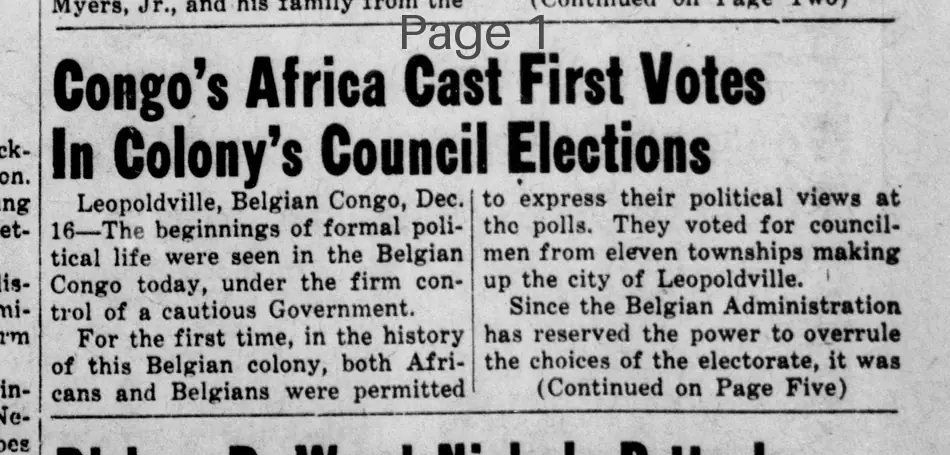
Leopoldville, Belgian Congo, Dec. 16 - The beginnings of formal political life were seen in the Belgian Congo today, under the firm control of a cautious Government.
For the first time, in the history of this Belgian colony, both Africans and Belgians were permitted to express their political views at the polls. They voted for councilmen from eleven townships making up the city of Leopoldville.
Since the Belgian Administration has reserved the power to overrule the choices of the electorate, it was (Continued on Page Five)
called a "consultation," rather than an election, and the councilmen will have limited powers. However, the event marks a fundamental change from the policy under which the Belgian Congo has been governed as a paternal autocracy. It is indicated that today's municipal consultation will lead in time to true national elections and to some form of representative government. But there is no stated timetable.
Voters Ignore Plan
In intermittent light rain, knots of a hundred or so Africans stood quietly in line outside the polling places here. By contrast there were only a handful of Belgians at the principal polling places for whites. It was expected that about 70 per cent of the Africans eligible would vote and probably a markedly smaller percentage of Belgians. For illiterates, a novel system was employed. Outside each African polling place was a board bearing a photograph of each candidate with a colored ballot beside him. Choosing the appropriate color in secret, the voter was able to make a direct choice. In case of any last-minute confusion, all candidates in each constituency were seated at long tables just outside the voting booths. They had to sit through the entire voting period, from 7:30 A. M. to noon.
The process went slowly in the African areas but the crowds were good-natured and orderly. This was the kind of an election that would end with more winners than losers. From a field of 765 candidates, the Africans were choosing 170 councilmen and 340 alternates, a total of 510, and the Belgians were choosing twenty-nine councilmen and fifty-eight alternates from a field of ninety-three. The councilmen of each of the eight African and three white townships will nominate mayors from their number, who will serve with the approval of the provincial governor. The mayors and an as yet unspecified number of councilmen will serve on a city-wide council under an appointed first mayor. The city wide council also will include an unspecified number of members to be named by the governor.
What sub-type of article is it?
What keywords are associated?
Where did it happen?
Foreign News Details
Primary Location
Leopoldville, Belgian Congo
Event Date
Dec. 16
Outcome
first municipal consultations held with africans choosing 170 councilmen and 340 alternates from 765 candidates, belgians choosing 29 councilmen and 58 alternates from 93; marks shift from paternal autocracy towards representative government, no timetable for national elections.
Event Details
For the first time, Africans and Belgians voted in council elections for eleven townships in Leopoldville under Belgian Government control, termed a 'consultation' with limited powers and override authority. Voters, mostly Africans in light rain, used a photo and color ballot system for illiterates; candidates sat outside booths. Process orderly; councilmen to nominate mayors approved by governor, forming city-wide council with appointed first mayor and governor appointees.