Thank you for visiting SNEWPapers!
Sign up free
The Republican
Oakland, Garrett County, Maryland
What is this article about?
Maryland educators clashed during a legislative hearing on converting Frostburg State Teachers College into a University of Maryland branch, with opposition from state education leaders citing inferiority concerns and support from university president and local proponents for economic benefits. (198 characters)
Merged-components note: Continuation of 'Educators Clash On College Plan' story across pages; relabeled from 'story' to 'domestic_news' to match primary content.
Clippings
1 of 2
OCR Quality
Full Text
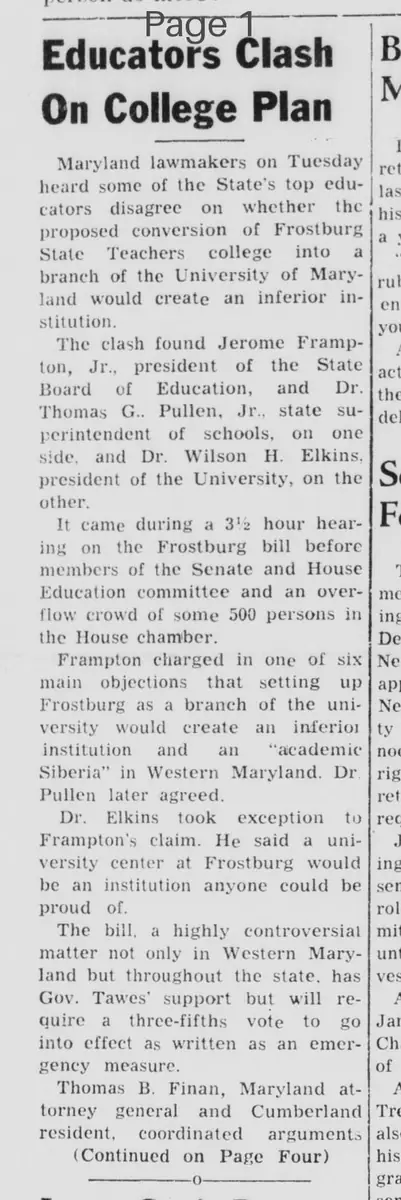
Maryland lawmakers on Tuesday heard some of the State's top educators disagree on whether the proposed conversion of Frostburg State Teachers college into a branch of the University of Maryland would create an inferior institution.
The clash found Jerome Frampton, Jr., president of the State Board of Education, and Dr. Thomas G. Pullen, Jr., state superintendent of schools, on one side, and Dr. Wilson H. Elkins, president of the University, on the other.
It came during a 3½ hour hearing on the Frostburg bill before members of the Senate and House Education committee and an overflow crowd of some 500 persons in the House chamber.
Frampton charged in one of six main objections that setting up Frostburg as a branch of the university would create an inferior institution and an "academic Siberia" in Western Maryland. Dr. Pullen later agreed.
Dr. Elkins took exception to Frampton's claim. He said a university center at Frostburg would be an institution anyone could be proud of.
The bill, a highly controversial matter not only in Western Maryland but throughout the state, has Gov. Tawes' support but will require a three-fifths vote to go into effect as written as an emergency measure.
Thomas B. Finan, Maryland attorney general and Cumberland resident, coordinated arguments (Continued on Page Four).
Educators Clash
(Continued from Page One)
of the proponents. He said the bill was "born not of politics but of desperation" to improve higher education in Western Maryland.
He introduced speakers representing a Western Maryland committee which sponsored the move after a broader recommendation for converting Frostburg, Salisbury and Towson Teacher colleges was deferred for further study. He said the committee represented every segment of the population and taxpayers who pay more than 60 percent of the Allegany and Garrett County tax bill.
Albert M. Jacobs, Allegany Ballistics corporation, and others representing industry, labor, governing bodies of the two counties, cited the low percentage of high school graduates from Western Maryland who attend college. Jacobs said the State Board of Education's plan for expanding the teacher college curriculum to arts and sciences was unsatisfactory and inferior.
Speakers said the proposed university center would be a big factor in attracting new industries and holding old ones in the area.
Finan claimed the only people in Western Maryland opposing were the faculty and students of the college and a "few pseudo intellectuals."
The state board charged Albert M. Jacobs had shown himself to be "irresponsible to the educational needs of the community."
Rev. Shelby Walthall, rector of St. Matthew's Episcopal Church, Oakland, testified the university plan had wide support in Garrett county and that the people were interested in raising the economic social and cultural level. F. T. Bell, of Kelly Springfield, representing Western Maryland industries, said they were not satisfied with the higher educational facilities in the area. "We need something different. We need something better."
Speaking in opposition were J. Wilmer Cronin, member of State Board of Education; Miss Mary Risteau, Dr. Pullen and Mr. Frampton. R. Bowen Hardesty, FSTC president, was unable to speak due to time limitations but answered questions on number of students in programs. Mrs. Eileen Steele, Frostburg, chairman of Maryland Citizens committee for better education and government, presented letters opposing university plan and a petition signed by some 3,000 residents of Western Maryland.
There was argument over the qualification of teachers at FSTC and what they were teaching. Dr. Louis Kaplan, dean of Baltimore Hebrew college, said most of teachers there "have degrees in education, not subject matter," and that the education given in most teacher colleges was "shallow and superficial as the faculty itself had only shallow and superficial training in subject matter."
What sub-type of article is it?
What keywords are associated?
What entities or persons were involved?
Where did it happen?
Domestic News Details
Primary Location
Western Maryland
Event Date
Tuesday
Key Persons
Outcome
hearing featured disagreements on the bill; requires three-fifths vote to pass as emergency measure; supported by gov. tawes.
Event Details
Maryland lawmakers held a 3½-hour hearing on a bill to convert Frostburg State Teachers College into a University of Maryland branch. State Board of Education president Jerome Frampton, Jr., and state superintendent Dr. Thomas G. Pullen, Jr., opposed it, arguing it would create an inferior institution. University president Dr. Wilson H. Elkins supported it. Proponents, coordinated by Attorney General Thomas B. Finan, included industry, labor, and local representatives emphasizing need for better higher education to attract industries. Opponents included education board members and a petition with 3,000 signatures.